The Columbia MBA deadlines for the 2027 entering class or the Class of 2029, fall across two separate schedules.
The August 2027 entry runs three rounds, closing September 9, 2026, January 5, 2027, and March 29, 2027.
The January 2027 entry, called J-Term, runs two rounds, closing June 17, 2026 and August 13, 2026. Both paths consist of four terms and merge in the fall of the second year, ensuring identical academic rigor, student resources, and admissions competitiveness.
However, there are key structural differences and timelines.
TL;DR
- August Entry Round 1 closes September 9, 2026 at noon ET. Decisions December 14
- August Entry Round 2 closes January 5, 2027 at noon ET. Decisions March 24
- August Entry Round 3 closes March 29, 2027 at noon ET. Decisions May 12
- J-Term Round 1 closes June 17, 2026 (rolling review). Decisions by July 31
- J-Term Round 2 closes August 13, 2026 (rolling review). Decisions by October 1
- Application fee: $250, deadlines at noon ET, not 11:59 PM
- R1 and R2 carry priority fellowship consideration
Open Upcoming Closed
R1 Open Sept 9, 2026 12:00 PM ET Decision: Dec 14, 2026
R2 UpcomingJan 5, 2027 12:00 PM ET Decision: Mar 24, 2027
R3 Upcoming Mar 29, 2027 12:00 PM ET Decision: May 12, 2027
Contents
- Columbia MBA Deadlines at a Glance
- August 2027 Entry Deadlines
- Priority Application Deadline Window
- January 2027 Entry (J-Term) Deadlines
- August vs. January (J-Term) Entry
- Rolling Admissions at Columbia: What It Means
- Round Strategy: When to Apply
- Interview Invitation Timeline
- Application Components and What is Due by the Deadline
- Decision Day, Waitlist, and Deposits
- Reapplicants: Eligibility and Process
- Deferred Enrollment Program (DEP) Deadlines
- Generative AI Policy for Applications
- Frequently Asked Questions
Columbia MBA Deadlines at a Glance
All deadlines close by 12:00 PM Eastern Time (noon, not 11:59 PM)[1][2].
For an application to count as complete, the applicant must submit their recommendation letters and pay the $250 application fee, and both must arrive before the application deadline.
| Entry | Round | Application Deadline (12:00 PM ET) | Final Decision Released |
|---|---|---|---|
| August | Round 1 | September 9, 2026 | December 14, 2026 |
| August | Round 2 | January 5, 2027 | March 24, 2027 |
| August | Round 3 | March 29, 2027 | May 12, 2027 |
| January (J-Term) | Round 1 | June 17, 2026 | No later than July 31, 2026 |
| January (J-Term) | Round 2 | August 13, 2026 | No later than October 1, 2026 |
August 2027 Entry Deadlines
The August entry is the traditional two-year MBA with a summer internship between the first and second years. About 70 percent of Columbia's full-time MBA class enters in August.
Columbia runs its MBA admissions in three rounds. You submit your essays and completed application by the round's deadline. The admissions committee then sends interview invitations, and announces final decisions on a set date. The schedule below gives the exact dates for each round.
Round 1: Applications are due on September 9, 2026, at 12:00 PM ET. The admissions committee releases interview invitations by November 2. Final decisions follow on December 14.
Round 2: Applications are due on January 5, 2027, at 12:00 PM ET. The committee releases interview invitations by February 17. Final decisions follow on March 24.
Round 3: Application due March 29, 2027, at 12:00 PM ET. Interview decisions released by April 30, 2027. Final decisions released on May 12, 2027.
Priority Application Deadline Window
The priority application deadline window could be seen through 2 contexts:
Priority Funding
For the August 2027 entry, applicants qualify for priority consideration for institutional fellowships on submitting applications by Round 1 or Round 2 deadline.
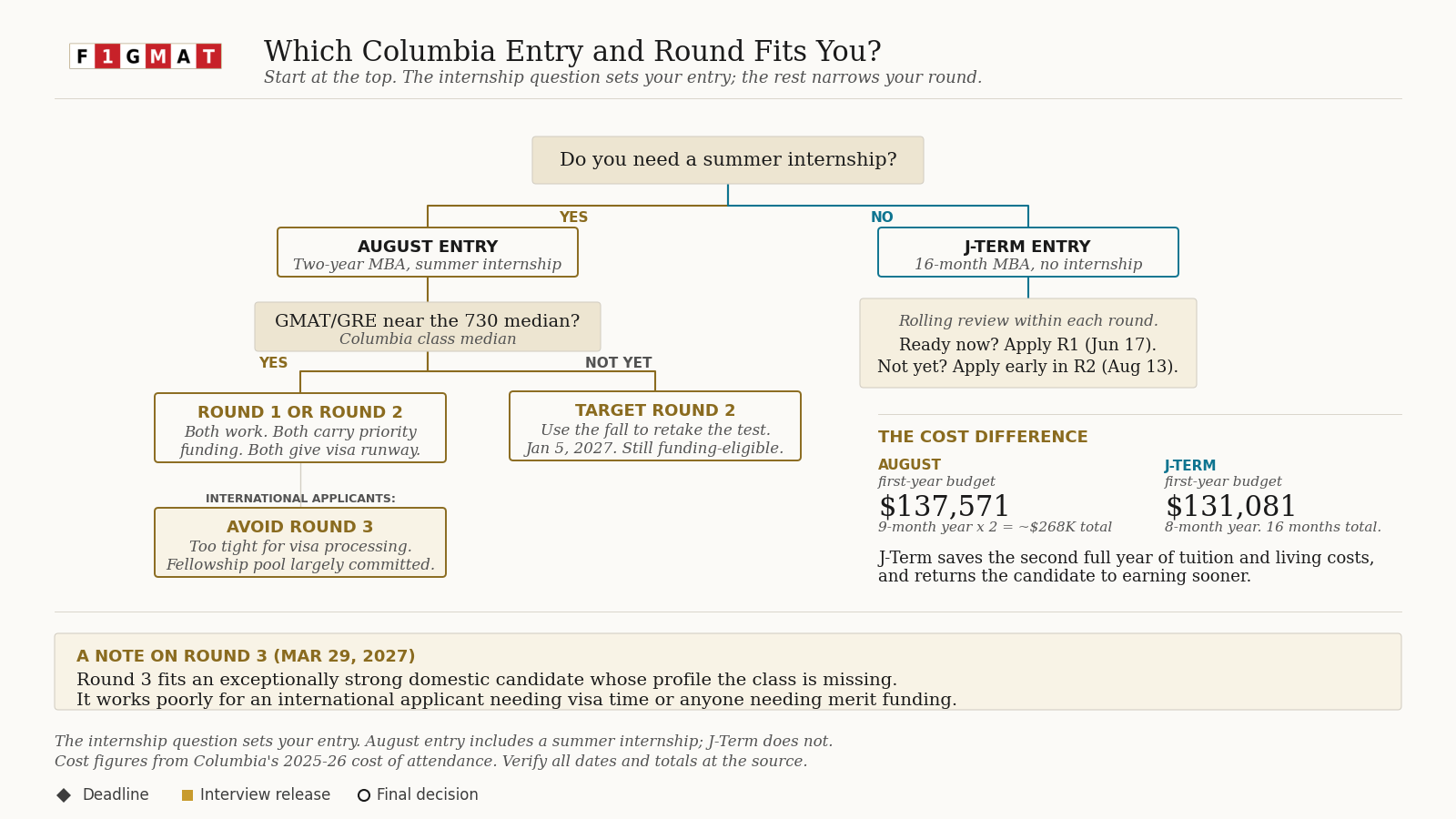
These awards offset a first-year cost of attendance that reached $137,571 in 2025-26. A Round 3 applicant is still considered for admission on the same terms but by the time that round opens, the school would have already awarded most of its fellowship money to applicants admitted in the first two rounds.
Applications are not reviewed until after each deadline (the August entry does not use rolling admissions within rounds). If an application is not complete by the round deadline, it rolls into the next available round in the same cycle.
Priority Decision
For couples applying on the same cycle, target the same round so that both candidates know the outcome before either has to accept or decline.
January 2027 Entry (J-Term) Deadlines
The January-entry MBA, often called J-Term, is a 16-month accelerated program for candidates who do not need a summer internship. About 30 percent of Columbia's full-time MBA class enters in January.
Round 1: Applications for Round 1 are due on June 17, 2026, at 12:00 PM ET. The admissions committee releases final decisions by July 31.
Round 2: By August 13, 2026, at 12:00 PM ET, Round 2 applicants must submit their materials. The committee notifies candidates of its decision by no later than October 1.
J-Term uses rolling admissions within each round.Applications submitted earlier within a round are reviewed earlier and may receive a decision before the round's deadline. The latest possible decision date is the round notification deadline, but many decisions go out before that.
J-Term is built for students remaining in the same industry post-MBA, sponsored candidates, family-business successors, or entrepreneurs working on a venture. Career switchers who need a summer internship should apply for the August entry instead.
August vs. January (J-Term) Entry
There is no compromise on quality between the two entries. They are taught by the same faculty with full access to electives for both terms.
The primary difference is in the entry timing and the January Term's lack of internship.
| Dimension | August Entry | January (J-Term) Entry |
|---|---|---|
| Program length | 24 months | 16 months |
| Share of class | 70% | 30% |
| Summer internship | Yes, between years | No formal internship |
| Number of rounds | 3 (R1, R2, R3) | 2 (R1, R2) |
| Review style | Reviewed after round deadline | Rolling within each round |
| Best fit for | Career switchers, US visa applicants needing recruiting cycles | Industry-stayers, sponsored candidates, entrepreneurs, family business |
| Curriculum | Same core, same electives | Same core, same electives |
| Merit fellowships | Eligible | Limited fellowship availability |
If you are unsure which entry to target, the deciding question is whether to choose between year one and year two. If you need a recruiting cycle and an internship, apply August. If you do not, J-Term lets you return to the workforce faster.
Rolling Admissions at Columbia: What It Means
The August entry has a round-based deadline, which means if you submit your application after the Round 1 deadline, you will be considered for the next round (Round 2), and after the Round 2 deadline, for Round 3.
August entry: round-based, not rolling
Even from a timeline point of view, if you submit much earlier than the Round 1 deadline, there is no guarantee that your application will be reviewed sooner than, let's say, someone who submitted their application a day before the deadline. Regardless of whether you are applying a week or 2 days before the deadline, avoid submissions hours from the deadline.
Applications submitted before the August round deadline are not reviewed until after the deadline. Submitting on day one of the round does not get your file looked at sooner. What it does is reduce your risk of last-minute technical issues blocking submission.
January entry: rolling inside each round
The randomness of the review process is not present in the January Entry. For the J-Term applications, a complete file submitted in week one of R1 will be reviewed before a complete file submitted on the R1 deadline day. The round notification deadline is the latest a decision can come; many go out earlier.
For both entries, the application is not complete until your recommendation letter has been submitted by your recommender. The clock starts when the last component lands, not when you click submit.
Round Strategy: When to Apply
What works in CBS MBA Application
- Round 1 and Round 2 for International Applicants
- R1 and R2 for merit and need-based funding
- R3 with unique profile even if academic scores below class median scores
What doesn't work in CBS MBA Application
- Writing AI-assisted essays
- Applying to J-term because there is less competition
- Re-applying with just 1 improvement in profile (GMAT/GRE or career progression or uniqueness of the project or better recommendation letter)
Round 1 (August entry, deadline September 9, 2026)
Round 1 suits two kinds of applicants. The first is anyone who has finished polishing their essays by Labor Day weekend and is ready to submit. The second is international applicants, who need the longest possible lead time to complete visa processing. Round 1 also carries priority fellowship consideration, the awards that offset a first-year cost of attendance that reached $137,571 in 2025-26.
Avoid if:Applicants whose test score is not in the competitive scale for a top MBA - GMAT range should postpone to Round 1. The first entry barrier is your GMAT or GRE scores. There is no compromise here, especially for a compeitive schools like Columbia MBA.
Round 2 (August entry, deadline January 5, 2027)
This round suits candidates if their current GMAT score undersells them. Round 2 deadline gives them the fall months to prepare and retake the test for a stronger score. For some, the gap offers the timeline to reach certain professional milestones that could act as a key stand-out quality for round 2 deadlines.
Note:R2 remains eligible for priority funding consideration alongside R1.
Round 3 (August entry, deadline March 29, 2027)
Best for: Applicants who has exceptionally strong academic record with a unique profile, who have been historically under-represented in a CBS MBA class. R3 is the most competitive round at any top program because most seats are already filled. The applicant's job profile must be such that they must be open to managing the waitlist cycle. Ideally, they should not be waiting for R3 decisions to choose between Columbia and another school.
Avoid if:If you are an international applicant who needs a long visa timeline, Round 3 could not be feasible, as the time between Round 3 decisions and the joining class timeline could overlap for an international student.
If you need funding in any form, merit or need - round 3 is not a good option.
J-Term R1 vs. R2
Because J-Term reviews inside each round are rolling, applying in R1 with a complete file generally beats applying on the R2 deadline. If you are between rounds and ready, submit. If you are not ready, wait and apply early in R2.
Interview Invitation Timeline
The Admissions Office at Columbia Business School invites candidates for an interview. You cannot request an interview.
When invitations go out
For the August entry, the school publishes an "interview decision released by" date.
For round R1 of the 2027 entering class, it is November 2, 2026.
For round R2 of the 2027 entering class, it is February 17, 2027.
For round R3 of the 2027 entering class, it is by April 30, 2027.
Please note that the date of interview invites, unlike the interview invites seen in Harvard, doesn't arrive on the interview invitation dates published in the schedule. You will get the interview invite anytime between the submission and the interview invite date.
Format
Most interviews are conducted by alumni. They are conducted in-person wherever it is possible or by video for international applicants. The style of the interview is conversational with a resume as the only reference. The questions cover career trajectory, post-MBA goal, why Columbia, and a fit or behavioral question.
After the interview
The alumni interviewer writes a structured report sent back to the Admissions Committee. Final decisions are released on the round's decision date.
Application Components and What is Due by the Deadline
Columbia is explicit: a file is not complete until the recommendation letter and application fee are submitted. The deadline applies to the full file, not just the applicant-controlled portion.
| Component | Deadline Behavior |
|---|---|
| Online application form | Must be submitted by 12:00 PM ET on the round deadline. |
| Application fee ($250) | Must be paid by the deadline. Fee waivers must be approved before the deadline. |
| Letter of recommendation | Required: one for first-time applicants, one new letter for reapplicants. Must be received by the deadline for the file to be complete. |
| Resume | One page ideal, one to two pages accepted. Uploaded with application. |
| Transcripts | Scanned PDF of each undergrad and graduate institution at application. Encrypted official copies required if admitted. |
| GMAT, EA, or GRE score | Self-reported score required at submission. Scores valid for five years. Highest score considered, no super-scoring across exams. Official scores required if admitted (GMAT/EA code QF8-N6-52, GRE code 6442). |
| Essays and short answers | Submitted inside the application. Three essays plus two short answers, all due at submission. |
| Interview | By invitation only after file review. Not a deadline item. |
All component requirements verified against Columbia Business School Admissions, [2].
Decision Day, Waitlist, and Deposits
Decision release
Decisions are released through the applicant portal on the round's final decision date. The school does not call to admit by phone or release decisions before the published date.
Waitlist
The waitlist management at Columbia is different from, let's say, Harvard. The latter releases waitlisted candidates each round. Columbia keeps the candidates on a waitlist throughout the later rounds and well into the summer. Since the school does not have a waitlist size, engage with the admissions team through a waitlist communication process to demonstrate intent to join the program.
Deposits
Admits secure their seat with two nonrefundable deposits, except August R3, which uses a single deposit. Deposits apply directly to first-semester tuition.
| Admit Round | Deposit 1 | Deposit 2 |
|---|---|---|
| January R1 and R2 | US$2,000 | US$1,000 |
| August R1 | US$6,000 | US$1,000 |
| August R2 | US$2,000 | US$1,000 |
| August R3 | N/A (single deposit) | US$3,000 |
Deposit amounts are highest for August R1 because admits have the longest time to weigh competing offers. R3 admits have a single, smaller deposit because the cycle is short.
Reapplicants: Eligibility and Process
A reapplicant is a candidate reapplying within 12 months of an earlier intended entry term. After 12 months, you submit a new application from scratch.
Who counts as a reapplicant (eligibility)
Per Columbia, you are a reapplicant if you submitted any of the following applications and received a final decision: 2025 or 2026 Full-Time MBA (January or August), 2025 or 2026 Executive MBA-New York, 2025 or 2026 Dual MBA / Executive MS in Engineering, or 2025 or 2026 Three-Year J.D./MBA.
Reapplicant requirements
- US$250 reapplication fee.
- You will need a new recommendation letter as a reapplicant, ideally from someone currently supervising your work. The letter must be written for this round too even if the same supervisor has written the letter before.
- Updated Application, Personal, Family, Employment, Education, and Extracurricular Activities sections.
- Updated answer to the financing question.
- Transcripts for any additional coursework taken since the previous application.
- Valid GMAT, GRE, or EA scores (5-year validity rule still applies).
- Reapplicant Essay (500 words). The other essays are not required for reapplicants
- Reapplicants use the same round deadlines as new applicants. There is no separate reapplicant deadline.
Application Fee and Fee Waivers
Every applicant pays a nonrefundable US$250 application fee, and the amount is the same for first-time applicants and reapplicants. You pay by Visa or MasterCard inside the application portal.
Who qualifies for a fee waiver
• Full-time students.
• Active duty US military personnel.
• Eligible displaced persons (per Columbia's published criteria).
• Peace Corps members currently in service.
• Teach For All network partner members currently in service.
How to request a waiver
You request a fee waiver from inside the application portal. After you log in, open the Welcome page and find the Fee Waiver Request form there. The form asks you to upload proof of current military service. The portal can take up to a week to update your request status. File the waiver well before the deadline of the round you are targeting.
Note: the application fee is automatically waived for the Deferred Enrollment Program.
Deferred Enrollment Program (DEP) Deadlines
The Deferred Enrollment Program is for current college seniors and final-year graduate students who want a guaranteed seat at Columbia after 2 to 5 years of work experience.
The DEP final deadline for the 2026 cycle was April 15, 2026 (now passed). The next DEP cycle deadline will be announced by Columbia in late 2026.
Who is eligible for DEP
• Students graduating during the current academic year from a bachelor's degree program.
• Students completing a graduate degree program, provided they started it directly after their bachelor's.
Students in PhD programs, law school, or medical school are not eligible for DEP. The application fee is waived for DEP applicants.
Generative AI Policy for Applications
Columbia allows applicants to use generative AI tools to brainstorm ideas and to edit their own writing. An applicant who uses these tools to produce a complete response breaks the Honor Code. The admissions committee verifies application content. It rescinds an offer when it finds a misrepresentation or an omission. An essay written by AI and submitted as the applicant's own work counts as that kind of misrepresentation.
The same standard covers recommendation letters.
The applicant must not draft any part of their own recommendation.
Recommenders submit references from an institutional or professional email address. When a reference arrives from a personal account, such as Gmail, Yahoo, qq.com, or 163.com, the committee examines it more closely, and it can rescind an admission if it finds a discrepancy.
Frequently Asked Questions
When is the Columbia MBA Round 1 for the 2026-2027 cycle?
August 2027 entry Round 1 is due September 9, 2026, at 12:00 PM Eastern Time. January 2027 entry Round 1 was due June 17, 2026.
When is the Columbia MBA Round 2?
August 2027 entry Round 2 is due January 5, 2027, at 12:00 PM ET. January 2027 entry Round 2 is due August 13, 2026, at 12:00 PM ET.
When is the Columbia MBA Round 3 deadline?
August 2027 entry Round 3 is due March 29, 2027, at 12:00 PM ET. This is the final round for the 2026-2027 cycle. There is no R3 for J-Term.
When does Columbia release MBA decisions?
August entry: December 14, 2026 (R1), March 24, 2027 (R2), May 12, 2027 (R3). January entry: by July 31, 2026 (R1), by October 1, 2026 (R2), with many decisions arriving earlier due to rolling review.
Is the Columbia deadline 11:59 PM or noon?
Noon. The deadline is 12:00 PM Eastern Time, not 11:59 PM. Plan for the morning of the deadline date, not the evening.
Does Columbia have rolling admissions?
Only for the January entry. J-Term applications are reviewed in the order they arrive inside each round. August-entry applications are reviewed after the round closes.
Should I apply to Round 1 or Round 2 at Columbia?
For the August 2027 entry, Round 1 fits a few different applicants. International applicants benefit most. An early decision gives them the lead time to clear visa processing before the program starts. The round also suits an applicant whose GMAT already falls near Columbia's median of 730, inside the 700 to 760 range that covers the middle 80% of the class. Round 1 also carries priority consideration for institutional fellowships, the awards that offset a first-year cost of attendance of $137,571.
Is Round 3 worth applying to at Columbia?
R3 is the most competitive round at any top MBA. It works for exceptionally strong domestic candidates with a profile that the class is missing. It is a poor choice for international candidates needing visa lead time or for candidates requiring merit funding to attend.
When does the Columbia application open?
The August 2027 application will open in early summer 2026. The January 2027 application is already open as of May 2026.
What is the Columbia MBA application fee?
US$250, nonrefundable, paid by Visa or MasterCard inside the application portal.
Who qualifies for a Columbia fee waiver?
Full-time students, active duty US military, eligible displaced persons, Peace Corps members in service, and Teach For All partner members in service. Proof of current service is required.
Does Columbia have an Early Decision round?
No. Columbia uses three rounds for the August entry (R1, R2, R3) and two for the January entry. None of them is binding. The September 9 R1 deadline is the earliest round, but it is not Early Decision and does not require a commitment to enroll.
Do my test scores need to arrive at Columbia by the deadline?
A self-reported score is required at submission. Official scores are required only if you are admitted (GMAT/EA code QF8-N6-52, GRE code 6442). All scores must be valid (within five years of the test date) at the time of application submission.
When do letters of recommendation need to be submitted?
By the round deadline. Your application is not complete (and will not be reviewed) until the recommendation has been received. Give your recommender at least four to six weeks of lead time.
When does Columbia send interview invitations?
Columbia releases interview invitations on a rolling basis within each round, so an applicant who submits early in a round can hear back well before the round's ceiling date. Each round sets a date by which all interview decisions are released: November 2, 2026 for Round 1, February 17, 2027 for Round 2, and April 30, 2027 for Round 3.
What is the Columbia MBA deposit amount?
Columbia requires a nonrefundable deposit to secure your place, and the amount depends on your entry term and round. The total amount ranges from $3,000 in most rounds to $7,000 for August Round 1. All deposits for securing admission apply toward your first-semester tuition.
What happens if I miss a Columbia deadline?
A submitted but incomplete file (missing recommendation, missing fee) rolls into the next available round in the same cycle. A file not submitted at all simply waits for the next round.
Is the reapplicant deadline different?
No. Reapplicants use the same round deadlines as new applicants. They submit a $250 fee, one new recommendation, updated application sections, and the reapplicant essay (500 words). Other essays are not required for reapplicants.
Are the J-Term and August deadlines different?
The J-Term track lets you finish the MBA in 16 months without taking a summer internship. You apply for January 2027 entry in one of two rounds. The first round closes at noon ET on June 17, 2026. The second round closes on August 13, 2026.
Columbia reviews J-Term applications as they arrive and releases decisions on a rolling basis. If you submit early in a round, you can hear back well before the round's final-decision date. The final decision dates for each rounds are July 31, 2026 for Round 1 and October 1, 2026 for Round 2.
Can I apply to both J-Term and August in the same cycle?
No. Each application is tied to one entry term.
You submit to either J-Term or August entry within a cycle. The two tracks differ in how they handle the summer.
J-Term students start in January and work straight through without a summer internship, which suits a candidate who plans to return to a current employer or industry in twelve months.
August-entry students start in the fall and spend the summer between their first and second year in an internship, the standard route for someone using the MBA to change careers.
Key Takeaways
- Columbia holds waitlisted candidates differently from peer schools. Instead of clearing the waitlist each round, the school carries candidates through later rounds and into the summer, so a waitlisted applicant should keep demonstrating intent through the waitlist communication process.
- The deposit is highest for August Round 1 at $7,000 total, collected as $6,000 plus $1,000, because those admits have the longest time to weigh competing offers. August Round 3 admits pay a single $3,000 deposit, and every deposit applies toward first-semester tuition.
- A reapplicant is anyone returning within 12 months of their last Columbia decision. The reapplication needs the $250 fee, one new recommendation letter, refreshed application sections, and a single 500-word reapplicant essay instead of the full essay set.
- The interviewer never sees your full application. Columbia interviews are conducted by alumni, in person where possible and by video for international applicants, and they work only from your resume, covering your career trajectory, post-MBA goal, why Columbia, and one fit or behavioral question.
- Columbia allows generative AI only for brainstorming ideas and for editing your drafts. An applicant who uses AI to write a complete essay breaks the Honor Code. If the admissions committee verifies and find that you have used AI-generated work as original work, your offer can be rescinded.