F1GMAT · https://www.f1gmat.com/mba-salary-placement-analysis/harvard-mba/2025/industry ·
 Add F1GMAT as a preferred source on Google, opens Google in a new tab
 See more of F1GMAT's MBA admissions research in Google's Top Stories by making us a preferred source on Google.
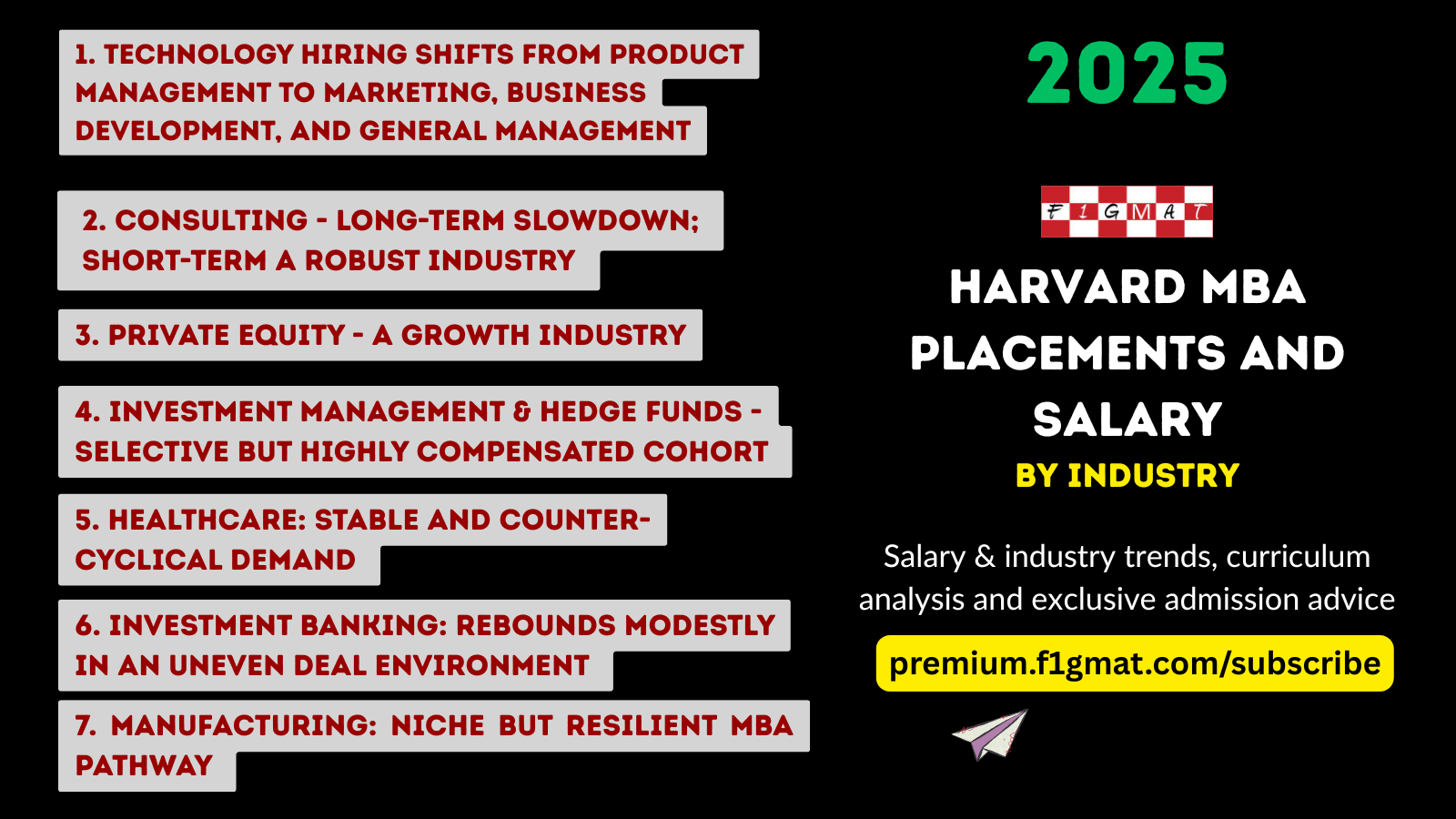
Harvard Business School reported the employment outcomes for the Class of 2025. We at F1GMAT analyzed and found 7 interesting industry placement and salary trends.
2. Consulting - Long-term slowdown; Short-term A robust industry
3. Private Equity - A Growth industry
4. Investment Management & Hedge Funds - Selective but highly compensated cohort
5. Healthcare: Stable and counter-cyclical demand
6. Investment Banking: Rebounds modestly in an uneven deal environment
7. Manufacturing: Niche but resilient MBA pathway
Trend 1: Technology Hiring Shifts from Product Management to Marketing, Business Development, and General Management
Technology remains the largest destination for the Harvard MBA Class of 2025, accounting for 22% of hires with a median base salary of $178,000 and total compensation reaching $208,000. This marks a continuation of tech’s strong presence in HBS hiring, even after the volatility seen in the broader tech sector across 2023–24.
The trend is notable when viewed against Harvard’s 2021–2024 records, where tech hovered in the mid-teens to high-teens; the Class of 2025 represents a modest but meaningful strengthening of tech demand for MBAs.
What stands out most is not just the volume of hiring, but the shift in role mix, as 36% of these graduates entered marketing, 20% moved into business development, and 16% took general management roles. This pattern aligns precisely with market behaviour across Q3 2024 through Q2 2025, when major Technology firms moved from AI experimentation to AI deployment. That transition required leaders who could translate technical capabilities into commercial outcomes rather than expand engineering headcount.
The headcount decline during late 2024, combined with an intensified focus on product monetisation and enterprise AI adoption in early 2025, made MBAs particularly valuable in non-technical leadership tracks.
The regional split, 46% in the West and 42% in the Northeast, also reflects how cloud and AI-infrastructure spending remained concentrated in those hubs.
Overall, the employment report captures a sector that, despite structural reshuffling, continued to rely on Harvard MBAs to scale its AI-led business strategies.
See how Harvard MBA Curriculum helps in this contrarian placement trend
 Essay Editing - Consult with Atul Jose (Essay Specialist, F1GMAT)
The skills that a writer/editor brings to the table are different from what a former admissions officer or a consultant who has limited writing skills brings
Review Skills # Writing Skills
Movie Critics # Movie Directors
For any questions about the service, email me, Atul Jose, at [email protected]
As F1GMAT’s Lead Consultant and Essay Specialist, I will help you structure the essay by:
1) Incorporating your Personal Brand
I will help you find unique life experiences that would differentiate you from the highly competitive Harvard MBA application pool.
2) Including Storytelling elements
I have developed a keen sense of storytelling from over a decade and a half of editing essays and writing essay examples for F1GMAT’s Essay Guides.
The skills that a writer/editor brings to the table are different from what a former admissions officer or a consultant who has limited writing skills brings
Review Skills # Writing Skills
Movie Critics # Movie Directors
It is easy to comment, but it is tough to structure the essay from the perspective of the applicant and turn the essay into a winning application essay.
3) Aligning with the Culture of the School
A big part of editing and guiding applicants is in educating them about the culture of the school
Some schools have very ‘specific’ traits that they are looking for in an applicant.
If you don’t highlight them and lean towards general leadership or cultural narratives, the essay won’t work.
I will guide you through the writing process.
I will also iteratively edit the essays without losing your original voice.
Trend 2: Consulting - Long-term slowdown; Short-term A robust industry
Consulting represents 21% of the Class of 2025, with a strong $190,000 median base salary and total compensation around $220,000. This trend maintains Consulting as one of the two dominant industries at Harvard, yet it also confirms a longer trend visible in HBS’s 2021–2024 employment data, which is that Consulting’s relative share has been gradually decreasing. The Class of 2025 continues that directional drift. The reasons lie not in declining prestige but in shifting client demand.
Across Q3 2024 to Q2 2025, Consulting firms significantly rebalanced their talent models as client priorities moved from strategy road-mapping to AI implementation, systems integration, cost-transformation, and digital operations. This altered recruiting towards candidates with hybrid business and technical fluency. Generalist hiring remained strong but more selective, and firms increasingly allocated headcount to specialised or experienced hires rather than first-year MBA consultants.
The employment report shows a high Northeast concentration (44%), historically the home of major Consulting hubs. The trend suggests that hiring remained anchored around firms investing in end-to-end transformation practices located in Boston and New York. Thus, while Consulting still constitutes a major pathway, its shrinking proportion relative to earlier classes reflects structural changes in the industry rather than diminished student interest.
 Download F1GMAT's Harvard MBA Essay Guide
• Business-Minded Essay: Please reflect on how your choices have influenced your career path and aspirations. (up to 300 words)
• Growth-Oriented Essay: Curiosity can be seen in many ways. Please share an example of how you have demonstrated curiosity and how that has influenced your growth. (up to 250 words)
• Leadership-Focused Essay: What experiences have shaped how you invest in others and how you lead? (up to 250 words)
Trend 3: Private Equity - A Growth industry
Private Equity continues to be a defining feature of Harvard’s employment landscape, with 14% of students entering the sector and achieving a median base salary of $187,500, with total compensation at $217,500. This reinforces a multi-year trend, visible in Harvard’s 2021–2024 data, of PE steadily rising to become one of the largest destinations for the school’s graduates.
From Q3 2024 to Q2 2025, Private Equity operated in an environment defined by slow exits but active dealmaking, especially in add-ons, software, Healthcare services, and industrial consolidation. As firms increasingly leaned into portfolio operations, commercial diligence, and AI-supported value-creation initiatives, demand shifted toward MBAs who could combine financial acumen with operating judgement.
The Class of 2025’s placement geography, 49% in the Northeast, with meaningful representation in the West and internationally, mirrors the concentration of large buyout and growth-equity platforms that continued hiring even during fundraising pressure. The stability of PE hiring at Harvard, despite turbulence in the private-capital markets, underscores the sector’s structural preference for candidates with analytical discipline, maturity, and operating experience, traits that align closely with the HBS profile.
Trend 4: Investment Management & Hedge Funds - Selective but highly compensated cohort
Investment Management and Hedge Funds together absorb 7% of the class, offering a median base salary of $182,500 and a striking median total compensation of $232,500, the highest among major industry clusters. The 2021–2024 data show that Harvard’s placements in this sector tend to fluctuate, but always remain selective.
The Class of 2025 reflects precisely that pattern: a small but high-impact group of hires. Through late 2024 and early 2025, asset-management firms and hedge funds operated in a market shaped by persistent volatility, early signs of rate normalisation, and the rapid expansion of AI-enabled quantitative processes. Many firms reduced broad MBA hiring but increased targeted recruitment for roles requiring sophisticated analytical reasoning and the ability to integrate alternative data or machine-learning insights into investment theses.
The regional outcomes, 53% in the Northeast, 25% in the West, mirror these hubs, with the employment data showing a sector that hires few but pays exceptionally well. The hiring profile shifted towards candidates who operate at the intersection of Finance, Data, and Technology.
Trend 5: Healthcare: Stable and counter-cyclical demand
Healthcare accounts for 6% of the Class of 2025, with a median base salary of $160,000 and total compensation near $190,000. When compared to Harvard’s employment records from 2021–2024, Healthcare has remained a stable and counter-cyclical industry, neither expanding nor contracting sharply, but consistently absorbing MBAs into strategy, operations, and growth-oriented roles.
Healthcare remained one of the most active sectors for private-equity roll-ups, provider consolidation, payer-tech integration, and digital-health restructuring, even as other industries experienced volatility. This created demand for general managers and strategy leads capable of navigating regulatory constraints and operational turnaround.
The 52% Northeast concentration aligns with the clustering of major Healthcare systems, payers, and life-science organisations in that region. Harvard’s Healthcare placements, therefore, reflect the industry’s resilience and its appetite for leaders who can manage complexity during a period of financial and technological transition.
Trend 6 - Investment Banking: Rebounds modestly in an uneven deal environment
Investment Banking draws 6% of the Class of 2025, offering a median base salary of $175,000 and total compensation around $225,000, with an overwhelming 83% placed in the Northeast. Compared with the 2021–2024 patterns, banking saw a decline during the dealmaking slowdown but began to re-engage in 2024 as certain M&A lanes reopened.
The period from Q3 2024 to Q2 2025 was marked by uneven recovery: while IPO markets moved slowly, strategic M&A and selected large transactions regained momentum, particularly in Technology and Healthcare.
Banks began staffing up selectively, prioritising strong analytical talent and candidates with cross-border or sector-specific experience. Harvard’s numbers show this recalibrated demand, not a full resurgence, but a cautious, targeted return to hiring that positioned MBAs in advisory roles tied to sectors showing renewed transaction activity.
Trend 7 - Manufacturing: Niche but resilient MBA pathway
Manufacturing and industrials represent 5% of the class, with a median base salary of $162,000 and total compensation of $177,000, a pattern consistent with the 2021–2024 hiring share for this sector.
What distinguishes the Class of 2025 data is the qualitative nature of these roles. From Q3 2024 to Q2 2025, global Manufacturing underwent significant supply-chain redesign, nearshoring initiatives, and automation upgrades. These market forces raised demand for MBAs capable of leading operations transformation, digital supply-chain management, and cost-restructuring efforts.
The 40% placement in the West likely reflects opportunities in advanced Manufacturing, clean-tech production, and industrial automation clusters located in that region. Harvard’s outcomes show a sector that does not hire in high volume but plays an increasingly strategic role for students drawn to operations and transformation work.
Industry | % Hired | Median Base Salary | Median Sign On Bonus | Total Salary |
| Technology | 22% | $178,000 | $30,000 | $208,000 |
| Consulting | 21% | $190,000 | $30,000 | $220,000 |
| Private Equity | 14% | $187,500 | $30,000 | $217,500 |
| Investment Management / Hedge Fund | 7% | $182,500 | $50,000 | $232,500 |
| Healthcare | 6% | $160,000 | $30,000 | $190,000 |
| Investment Banking | 6% | $175,000 | $50,000 | $225,000 |
| Manufacturing | 5% | $162,000 | $15,000 | $177,000 |
| Nonprofit / Government | 4% | $130,000 | NA | NA |
| Venture Capital | 4% | $200,000 | $30,000 | $230,000 |
| Consumer Products | 2% | $146,250 | $32,500 | $178,750 |
| Entertainment/Media | 3% | $180,000 | NA | NA |
Related Download
Reference