F1GMAT · https://www.f1gmat.com/columbia-mba-application-tips-using-placement-data ·
 Add F1GMAT as a preferred source on Google, opens Google in a new tab
 See more of F1GMAT's MBA admissions research in Google's Top Stories by making us a preferred source on Google.
In this Columbia MBA Application Tips Guide, I explore the Class of 2025 placement data for Consulting, Investment Banking, Investment Management, Private Equity, Technology, and Marketing for creating essay ideas that the admissions team values.
Financial Services led by the industry at 35.4 percent of total hires[1], and Consulting accounted for 40.1 percent of hires by job function[2]. Even within these numbers, the expectations were dramatically different for the Consulting Giants.
The Columbia MBA essay examples that you choose should validate your fit in a post-AI world.
Examples of Systems thinking – the foundational skills for AI governance should be the first skill that is evident in the inclusive leadership and goals essays.
TL;DR (At a Glance)
- Financial Services led at 35.4 percent of total hires and $245,000 median total compensation. Applicants must show cross-segment fluency, as ECM convertible recently had a direct impact on PE exit timing and IM allocation.
- Consulting absorbed 33.2 percent by industry and 40.1 percent by function, with BCG and McKinsey each hiring 62 graduates. Position around AI orchestration and a practical governance ideas
- Investment Banking took 17.1 percent at $225,000 in the strongest Q1 hiring environment in four years ($1.6 trillion in M&A). Name a megadeal advisor group for your essay as an example or a similar complex or sized deal over a generic "M&A advisory" goal.
- Private Equity paid $312,108 total compensation, the highest at Columbia, with $137,108 guaranteed. Prioritize emerging skills - AI Infrastructure Diligence or Continuation Vehicles, and tie it to the Heilbrunn Center.
- Investment Management at $250,000 total salary prioritizes hires for judgment. Show how you prioritized one dataset over another or integrated alternative data into a fundamental view.
- Technology stayed at 10.2 percent because hyperscaler capex doubled to $660-725 billion while hiring concentrated in AI strategy, infrastructure economics, AI governance, and AI commercial fluency. Frame Essay 1 around an enterprise AI deployment experience or an infrastructure-economics role.
- Marketing and Brand hit 16.2 percent combined, but campaign automation reached 92 percent (the 8 percent Human-in-the-Loop rate is the lowest of any function). Reposition Essay 1 around customer-economics judgment and segmentation
- The United States absorbed 82 percent of placements; Africa and the Middle East paid $211,000, the only international region above the U.S. median. Center Essay 3 around CBS's New York-specific assets (Heilbrunn, Paul Milstein, Sanford C. Bernstein, Lang); Gulf applicants should anchor Essay 1 on Sovereign Fund Eligibility skills.
- The top 5 employers (BCG, McKinsey, Bain, PwC, Deloitte) absorbed a larger share of hires than in any recent class. Career switchers must answer why a firm should bet on them over a returning analyst
Contents
- Trend 1: Financial Services Becomes Columbia's Largest Industry at 35.4 percent
- Application Tips for Columbia MBA Finance Applicants
- Trend 2: Consulting at 33.2 percent Shifts to AI Implementation and Governance
- Application Tips for Columbia MBA Consulting Applicants
- Trend 3: Investment Banking Absorbs 17.1 percent at $225,000 with a Bespoke Capital Stack
- Application Tips for Columbia MBA Investment Banking Applicants
- Trend 4: Private Equity Pays $312,108, the Highest at Columbia, on AI Diligence Premium
- Application Tips for Columbia MBA Private Equity Applicants
- Trend 5: Investment Management at $250,000 Hires for Judgment
- Application Tips for Columbia MBA Investment Management Applicants
- Trend 6: Technology Stays at 10.2 percent as Hiring Shifts to Strategy and Infrastructure
- Application Tips for Columbia MBA Technology Applicants
- Trend 7: Marketing and Brand at 16.2 percent After 92 percent of Campaign Work Was Automated
- Application Tips for Columbia MBA Marketing and Brand Applicants
- Trend 8: U.S. Concentration at 82 percent Signals Hyper-Optimization to New York
- Application Tips for U.S.-Bound Columbia MBA Applicants
- Trend 9: International Hiring Strongest in Africa and the Middle East with $211,000 Pay
- Application Tips for International Columbia MBA Applicants
- Trend 10: Top 5 Employer Concentration
- Application Tips Around Repeat-Recruiter Concentration
- Key Takeaways
- References
MBA Application Tips Based on 10 Columbia MBA Placement Trends
Trend 1: Financial Services Becomes Columbia's Largest Industry at 35.4 percent
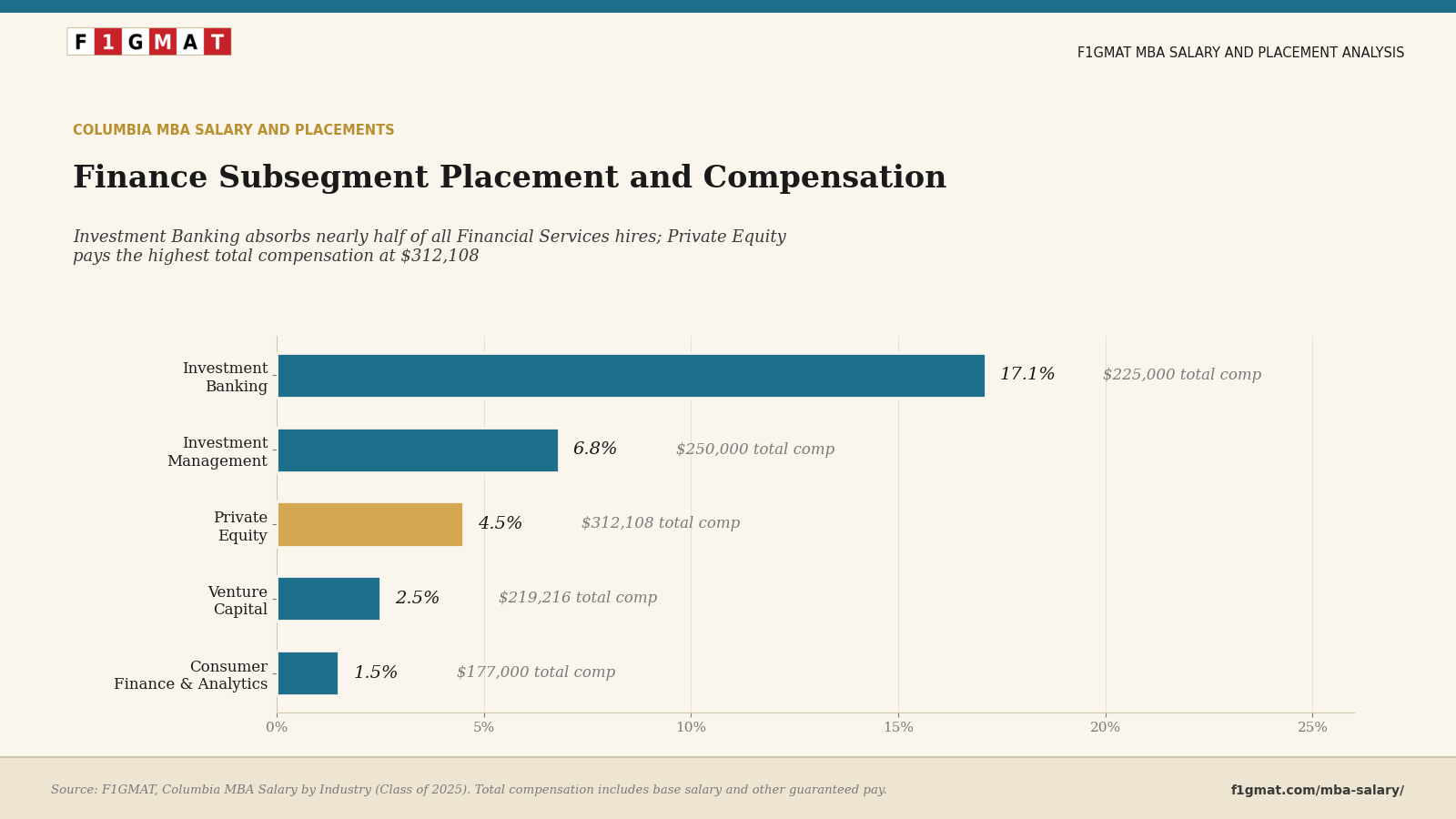
Financial Services emerged as the largest industry for the Columbia MBA Class of 2025 at 35.4 percent of total hires[1]. The median base salary held at $175,000 with $70,000 in guaranteed compensation, producing a total median of $245,000.
Within the industry, Investment Banking (17.1%) led, followed by Investment Management (6.8%), PE (4.5%), and Venture Capital (2.5%).
Application Tips for Columbia MBA Finance Applicants
Even if the placements are highly skewed towards Investment Banking, Financial Services now require greater cross-segment fluency.
The underlying mechanics (capital structure, valuation, regulatory frameworks) remain the same, but again, systems thinking, where an applicant has the ability to see the entire financial system as one interconnected ecosystem, is valued over super specialization.
This is not a speculative theory i built. The Q1 2026 IB ECM backlog of $31 billion in convertible issuance directly affected PE exit timing. The Blue Owl OTIC redemption queue of 40.7 percent affected both IM allocation and PE private-credit fundraising. Everything is connected. A Finance applicant must show this awareness in the essay.
Prioritize Data and Insights
AI can extrapolate hundreds of variables into new insights, but only a human can prioritize the dataset or even the insight. Not all insights are equal or relevant.
Now, recruiters at Goldman, JPMorgan, Morgan Stanley, and the MBB firms ask for "what have you read recently" and expect a specific answer around an S-1, a quarterly earnings call transcript, a fund LP letter, or a regulatory filing.
A quick exercise before you write the Columbia MBA essay is to run the analysis through Claude. Don’t read it. Now, you spend 1-2 hours reading one of the reports. Take notes. Compare notes.
What are the angles and perspectives are you bringing to the table?
Reflect back to a time when such ‘unique’ angles were brought to the team’s attention.
The ‘unique’ angles are what should be subtly introduced into the essay.
Decoding Incentives
Perhaps you can decode the incentives of certain news releases or the positioning of companies by interpreting the motivation behind certain S-1 filings. A Space technology giant recently positioned itself as an AI-first company, even though their commercial entry was only recent. Such manipulation is tough for AI to spot. The incentives are clear – the exit and more funds for scaling AI infrastructure for the company, or merging their automotive and loss-making social media companies into one space technology company.
A human financial analyst can find such deeper incentives and not just rely on ‘text’ as AI does. They can physically visit the factory, experience the product and competitor’s products, and then make assumptions.
Choosing such examples where your analysis went beyond the desk is a way to stand out for the Columbia MBA application.
Flexibility in post-MBA Roles
Schools are in a tough place. The median base salary has been stagnant for 3 years. The demand has surged for Finance around AI deals. But they would love to accept applicants who are realistic about their fit to a post-MBA finance role. Although IB is the most preferred path for Columbia MBA graduates, if your core due diligence skills are now valuable for Investment Management or Venture Capital, a self-awareness of the changing skill demand reads well for the Columbia MBA goals essays.
Case Study: Columbia MBA Goals Essay
You can also be more ambitious. M7 MBA programs, including Columbia MBA, look forward to such mapping of skills like “My pre-MBA work on tariff scenario modeling for industrials gave me the signal-and-noise muscle that the Trade Policy Risk in LBO Models skill values. I am targeting PE consumer-and-industrials diligence over IB consumer M&A advisory with a Columbia MBA."
The tariff scenario modeling for industrials in this case must be a stand-out contribution to frame any such goals.
Columbia MBA Essay Angle
A pre-MBA experience where an applicant’s work touched two finance segments – buy-side, which gave them exposure to IB processes, and an advisory role that crossed over to Private credit has the best skill matching that the admissions team now values.
Trend 2: Consulting at 33.2 percent Shifts to AI Implementation and Governance
Consulting hired 33.2 percent of the Columbia MBA Class of 2025 by industry, with the function-level share reaching 40.1 percent[2]. The median base salary increased to $190,000 with a $30,000 guarantee, producing $220,000 total compensation.
Despite the increase in median base salary to $190,000, there are structural changes for consulting waiting to happen in 2027 and 2028.
Deloitte announced on January 22, 2026, that it would scrap traditional analyst-to-manager job titles effective June 1, 2026. This is the first large consulting company acknowledging that AI now handles the analyst-grade work the consulting pyramid was built to absorb.
A consultant post-MBA now must evaluate the analyst-grade work that AI generates.
The feedback now expected is in training the models or creating the right environment for the model to improve itself. This could be more dataset, the right data, or a nudge in a direction that iteratively improves the work of the AI.
McKinsey's Lilli, which has 40,000 consultants alongside roughly 20,000 AI agents, with Lilli handling over 500,000 prompts per month, also experienced a breach on March 9, 2026, exposing 46.5 million chat messages, 728,000 files, and 57,000 user accounts. In addition to the vulnerability, we now see the scale of the AI integration.
A consultant must be aware of a defensable governance posture [5], both at a technical and operational level, to prevent such leaks.
Application Tips for Columbia MBA Consulting Applicants
Technical proficiency, especially in cybersecurity, is an added advantage for Columbia MBA applicants returning to or entering the industry.
Agent Orchestration and Builder Profile
Although for post-MBA career, experience with Tier-1 orchestration platform like Salesforce Agentforce, Microsoft Copilot Studio, Agent 365, or ServiceNow AI Agents, and even LangGraph or CrewAI is valuable. For Columbia MBA essays, the larger skill the school is looking for is that of a Builder.
Case Study: Columbia MBA Inclusive Leadership Essay
Product rollout stories where a client was skeptical about your strategy or a product feature match the CBS MBA Essay 2 on inclusive leadership.
Perhaps one of your sceptics were right on tactic, but wrong on the strategy that you pushed for.
Accepting and incorporating diverse viewpoints now is a good example for the Columbia MBA inclusive-leadership narrative.
The challenge is in breaking down the ‘conflicting’ ideas into a palatable essay that a non-consulting person can understand.
Outcome Driven Planning and A Scientific Mind
73% of private sector clients now favor value-based or outcome-driven pricing.
The strategy-only consultant is long gone. Now the skills the market expects are an obsession to define KPI that have a direct impact on the outcome.
The old school ‘scientific mind’ that can measure every small variable, find correlation, and prioritize the variable that has the most impact on the outcome is now back in fashion.
Even better examples are when applicants managed a KPI, found a non-obvious correlation, and pushed forward to kill a feature or change the project’s direction.
Escalation examples are never out of fashion in a pre-AI or a post-AI world.
Even if you don’t have such an impactful escalation or intervention example, your contribution and advocacy for keeping certain KPI in focus is enough to show your fit in an Outcome-Driven consulting engagement.
Trend 3: Investment Banking Absorbs 17.1 percent at $225,000 with a Bespoke Capital Stack
Investment Banking alone absorbed 17.1 percent of the Columbia MBA Class of 2025 by industry, and 19.1 percent by function[1][2], making it the single largest finance function. Median base salary was $175,000. The $50,000 guaranteed income took the total to $225,000.
JPMorgan Chase was the largest employer, hiring 22 from the Class of 2025 graduates [4].
The primary reason for the IB boom was that Big Five hyperscaler capex doubled to $660-725 billion for 2026, with Microsoft holding $80 billion in unfulfilled Azure orders because of power-grid constraints.
Predictably, Q1 2026 brought the strongest IB hiring environment in four years with Global M&A reaching $1.6 trillion in announced deal value, a 50.6 percent year-on-year increase, and a new quarterly record.
The top performance in the quarter was not restricted to JPMorgan, with a record $11.6 billion in quarterly revenue. Goldman advisory revenue was also up 89 percent year-on-year, and Morgan Stanley completed the boom cycle at 74 percent growth.
The boom is unlikely to stop this year.
The Trump government’s deregulation through the GENIUS Act, and stablecoin supply hitting $315 billion, put the fund movements on steroids as on March 19, 2026, the Federal Reserve, OCC, and FDIC re-proposed the US bank capital framework, reducing aggregate capital requirements at the largest US banks by approximately 6 percent[8].
We are entering an era of irrational exuberance.
Although IB firms won’t spell out the risks in public, they are aggressively looking for Columbia MBA candidates who have worked in risk and developed an end-to-end understanding of Financial systems and deal flow.
Application Tips for Columbia MBA Investment Banking Applicants
Breaking down the incentives of the client or a founder is even more important now as strategic consolidation goes beyond long-term financials. There are non-financial aspects to certain mergers that are not visible to IB candidates who are knee deep in numbers.
Bespoke Capital Architecture and Incentives
The Paramount-Warner Bros. Discovery financing showed what was expected from an IB firm. The deal closed with senior bank debt, private credit, structured equity (convertibles), and family-office equity with a never-before-seen $43.3 billion personal guarantee from Larry Ellison. A banker, in addition to understanding Bespoke Capital Architecture, must also understand why the founder is pushing to close a deal. The larger strategic objective is now as important as deal mechanics to expand the search for diverse asset classes to meet the funding gaps.
Columbia MBA Essay Angle
A pre-MBA story where the deal moved from the technicals to structural reasoning around the client’s objective is important to show fit for large deals like The Paramount-Warner Bros. Discovery financing.
Strategic Understanding of AI and New Products
Like breaking down the incentives of entrepreneurs and clients beyond financials, breaking down the incentives and assumptions behind Big Five hyperscalers’ capex spending (doubling to $660-725 billion for 2026) should be interpreted based on geopolitical developments.
Northern Virginia and parts of Texas have stopped accepting new data-center projects entirely. The public outrage against excessive water usage and polluting groundwater has stalled the infrastructure build out.
On first analysis, an IB professional might consider these developments as outside their scope of work, but by expanding the search for assets to power-and-utilities, infrastructure, and real-assets, the candidate is now strategically recalculating and reallocating funds from Telecom and Media that they traditionally deploy.
A strong understanding of emerging unit economics of AI, and building products like PPA structures (Corporate, Virtual, Sleeved) or innovating with data-center sale-leaseback math are examples most relevant for Columbia MBA essays.
The challenge is how to break down such innovation for a general audience.
Simplify with constraints, pivots, and goals to explain the Finance jargon.
Columbia MBA Essay Angle
A pre-MBA example of the applicant learning a domain, preferably energy, infrastructure, real estate, operations, or manufacturing and applying the constraints & opportunities into a model that a team used for a financial decision is the most relevant example for Columbia MBA application.
Market Timing and Long-Term Thinking
Q1 2026 saw $31 billion in convertible issuance alone, with dual-track IPO-and-sale processes replacing single-path IPOs for the largest issuers.
A Columbia MBA applicant must narrate why a certain quarter was the right time to enter into a transaction or introduce a sophisticated product.
Columbia MBA Essay Angle
A pre-MBA story where you showed judgment when the due diligence was pivoted based on uncertainty in policy or consensus, all add up to an engaging narrative.
Digital Asset Literacy and Regulatory Framework Exposure
Stablecoin literacy alongside Basel III capital allocation and antitrust laws are now cited as one of three core regulatory frameworks any banker must be armed with to advice clients.
An additional deregulatory step - the OCC granting national trust bank charters to Circle, Paxos, BitGo, Ripple, and Fidelity in late 2025, and the March 19, 2026, Basel III re-proposal reduced aggregate capital requirements at the largest US banks by approximately 6 percent. The move with the goal to expand the Finance pie will also introduce new systemic risks.
Columbia MBA Essay Angle
A pre-MBA story built up with pivots, the conflicts, and the consensus to show the applicant's judgment under uncertainty reads well for the inclusive leadership essay, where ‘regulatory’ consensus was the underlying thread.
Trend 4: Private Equity Pays $312,108, the Highest at Columbia, on AI Diligence Premium
Private Equity hired 4.5 percent of the class by industry (6.6 percent by function) at $175,000 base salary, $137,108 in guaranteed compensation, taking the total to $312,108 total[1][2], the highest total compensation across all industries at Columbia.
When Q1 2026 produced 5,100 PE transactions valued at $481.6 billion against $2 trillion in dry powder[6], AI captured over 80 percent of total global venture funding, and late-stage AI funding surged 205 percent year-on-year to $246.6 billion. If you break down the funding, $64 billion was in US data center projects, which have been blocked or delayed by organized local opposition.
Despite the surge in valuation and exits, PE fundraising stayed flat at $86 billion.
Application Tips for Columbia MBA Private Equity Applicants
Every PE-bound Columbia applicant in 2026-27 should understand the dual trends where continuation vehicles and GP-led secondaries are moving assets from expiring funds to continuation vehicles while deals around AI have increased the scale of the transaction.
Continuation Vehicle vs. Exit
One such example is around Software EV/NTM, whose revenue multiples are at 3.3x against a 7.1x five-year average.
The challenge for applicants is that the essay shouldn’t sound like a thesis. The storytelling elements must be strongly present to convert such a dry topic to an action-oriented narrative on how you persuaded the fund to exit or even better facilitate sponsor-to-sponsor deals, until the multiples recover and the market is ready for strong IPO exits. The ups and downs and the W-pattern covered in F1GMAT’s essay guide should be incorporated to show how the sponsors pushed back against your idea, and each new data or deal structure convinced the stakeholder to reverse the position.
Sovereign Fund and Export Compliance
With ReArm Europe committing EUR 800 billion over a decade to defense, structuring around LP restrictions on defense investments and managing export-control compliance are now expected in any sovereign fund with capital exposure to international markets.
For Columbia MBA applicants working with sovereign funds, the challenge is building up a story, even conflicts around constraints – legal, cultural, and political. The risk of fine vs. the risk of loss to structural challenges of incorporating international compliance standards in these financial products must be explained in simple terms.
Credit Risk vs. Liquidity Risk
Another relevant theme for PE applicants is the Credit vs. Liquidity Risk. When Blue Owl OTIC saw redemption requests for 40.7 percent of its shares in a single quarter, the new problem of whether the fund can weather liquidity risk and not just credit risk should be explained in a story format.
Again, for the CBS MBA essay, the challenge is how to create a story around it.
One way I have recommended in F1GMAT’s essay guide is through the pillaring technique, where you build multiple plot points that resolve in the final act.
One plot point could be the redemption request, like the one Blue Owl OTIC experienced.
The second plot point is the pressure on the underlying asset it was supporting.
And the third plot point could be the macro impact on the credit risk.
Three plot points developed in parallel and were resolved in the final 100 words.
Columbia MBA Essay Angle
The applicant must breakdown the reality of the PE market, and explore angles where they negotiated for an exit when continuation was the consensus. These decisions should be explained through competing priorities, risk appetites, and market realities around AI.
Trend 5: Investment Management at $250,000 Hires for Judgment
Investment Management accounted for 6.8 percent of Columbia MBA hires by industry at $175,000 base, $75,000 in guarantees, and $250,000 in total[1]. By function, Investment Management represented 4.8 percent at $150,000 base, $61,750 guarantee, taking the total compensation to $211,750 total[2].
The biggest shift in Investment Management and Hedge funds is AI’s deep integration into financial modeling, trade reconciliations, security research, portfolio compliance, earnings-transcript analysis, and basic performance attribution.
Application Tips for Columbia MBA Investment Management Applicants
What extra a candidate can bring to the plate should be the focus of the Columbia MBA essay narrative.
Even with strong AI integration, quantitative fluency and cross-asset judgment to move funds based on measurable trends are two qualities the firms still seek now.
From finding dataset that is messy even after AI simplification and adding context or support through integration into a live project, or simplifying complexity for auditors, regulators, and public markets are a few examples worth exploring.
Columbia MBA Essay Angle
Another unique angle is exploring unconventional data sources like satellite imagery, credit card transactions, geolocation, web traffic, and social sentiment, to find insights that traditional financial statements or policy documents can’t produce.
For the goals essay, the post-MBA role must be precise. It can be as wide as fundamental analyst at an established value shop or quant at a multi-strategy fund.
Trend 6: Technology Stays at 10.2 percent as Hiring Shifts to Strategy and Infrastructure
Technology hiring for the Class of 2025 stayed at 10.2 percent, effectively flat against the Class of 2024 and well below the 17 percent level observed in 2021[1]. The median base salary rose to $170,000 with $32,000 guaranteed bonus taking the total to $202,000. Amazon hired 21 graduates and remains Columbia's only technology employer at scale. IBM hired 4[4].
Even though the Combined Big Five hyperscaler capex sits at $660-725 billion for 2026, nearly double 2025[8], the technology labor market is now sharply bifurcated with firms continuing large-scale layoffs in non-AI, non-core, and operational roles while aggressively recruiting for AI strategy, infrastructure economics, governance, and AI commercial fluency in enterprise deployments.
Application Tips for Columbia MBA Technology Applicants
Columbia is not the school for a Product Manager at a frontier AI company.
Stanford GSB and Berkeley Haas hold that advantage.
Columbia's technology hires concentrate in operational, finance, strategy, and infrastructure-economics roles inside technology companies.
Knowing the mix should guide your application strategy.
Columbia MBA Essay Angle
Let us say you are one of those minority Product Manager from New York targeting Columbia to enter into AI strategy, choose two examples:
- AI Deployment and Scaling Experience
Demonstrate comfort with uncertainty, which most product managers experienced while testing multiple AI models during the initial phase of the integration. But such examples are overplayed. Build on the uncertainty narrative and explain the decision behind architectural choices with a full awareness of the hardware restrictions like Microsoft's $80 billion in unfulfilled Azure orders, Northern Virginia's grid moratoriums, and Oracle's data-center capital strain. Show cross functional awareness.
- Enterprise AI and Change Management
Fundamentally AI roll out at enterprise is a change-management problem. A pre-MBA experience that shows scope thinking past the feature or product, and into how an organization deploys, governs, or scales AI will show your thinking and fit into an AI strategy role post-MBA.
Trend 7: Marketing and Brand at 16.2 percent After 92 percent of Campaign Work Was Automated
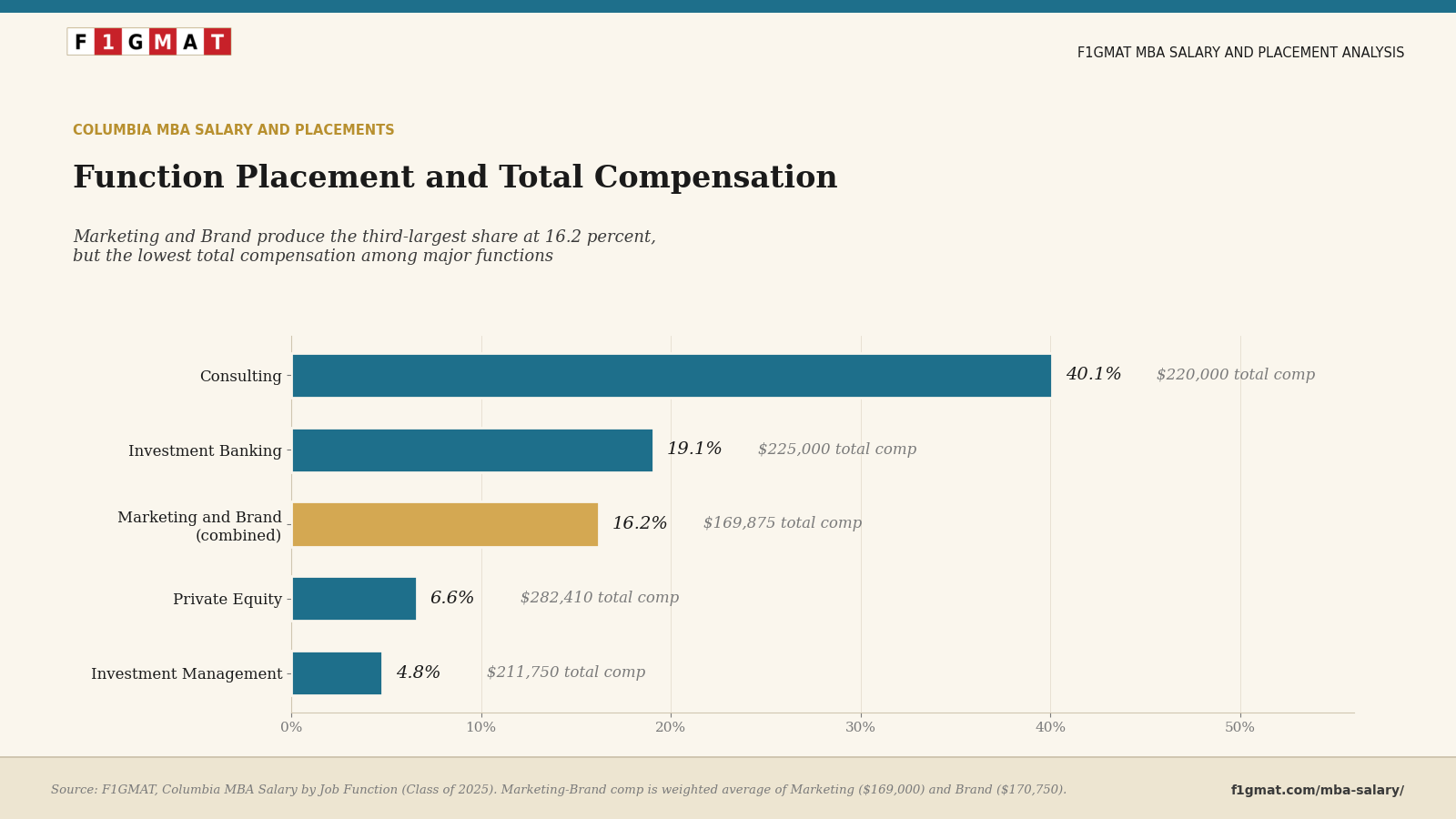
Marketing accounted for 10.3 percent of hires by function, with Brand and Product Management adding another 5.9 percent for a combined 16.2 percent[2]. The base salary in Marketing was $137,000. $32,000 in guaranteed pay took the total to $169,000.
The reality in the current Agentic AI market is that the Marketing and SDR/Outbound function had an 8 percent Human in the Loop rate and the fastest ROI of 3.4-month.
Routine campaign production, media buying, A/B copy generation, and email sequencing have all migrated to agents.
Application Tips for Columbia MBA Marketing and Brand Applicants
With 81% Gen-Z and Millennial consumers switching brands when cost increases, Marketing has moved from NPS and loyalty to smart segmentation.
The Marketing applicant in 2026-27 must reposition the goal away from anything an agent can handle end-to-end.
The segmentation choice is driven by AI in highly evolved enterprises where AI systems are fed with clean and large data, but the judgment that this year, for the summer, the ROI will be lowest for high net worth individuals planning a vacation in Dubai because of the war in Iran, is a human skill.
The data and case building can be made by an AI, but the human must intercept trends through multiple data sources, create small sample set and drive live in-person interviews.
None of these validations can be done by AI.
Only through one-on-one interviews and in-person market research can the human add value.
Columbia MBA Essay Angle
A pre-MBA example of choosing a new market segment based on changing unit economics and the rationale behind the choice is an ideal example for the Columbia MBA application.
Trend 8: U.S. Concentration at 82 percent Signals Hyper-Optimization to New York
For the 2025 graduating class, 82 percent of hires were placed in the United States at a median base salary of $175,000, a $30,000 sign-on, and a total salary of $205,000 [3].
New York is the central character for Columbia MBA. You must acknowledge this fact by sharing how you will take advantage of the CBS MBA Alum network in consulting, investment banking, private equity, internal consulting, and advanced analytics.
Also, strategically quote at least one deal from the recent news cycle as all large-scale M&A transactions, sponsor-led refinancings, continuation funds, and complex restructurings were anchored in New York.
U.S. placement below 90 percent has historically been a recession indicator. Columbia concentrated placements in Investment Banking, Technology, and Consulting, and the rest of the industries were deprioritized, producing a return-to-home trend for graduates outside those three industries.
Application Tips for U.S.-Bound Columbia MBA Applicants
Centering the essay around New York is crucial if you are planning to work in Investment Banking, Technology, or Consulting.
The motivation to settle in New York is especially important for the Goals essay where the school’s connections and infrastructure - the Heilbrunn Center, the Paul Milstein Center for Real Estate, or the Sanford C. Bernstein Center for Leadership and Ethics, should be strategically mentioned.
Research about the top employers in the latest CBS MBA recruitment cycle and avoid mentioning West Coast tech, Bay Area VC, or Houston energy firms. The admissions team will pick up the mismatch in 30 seconds.
Trend 9: International Hiring Strongest in Africa and the Middle East with $211,000 Pay
International placement for the Columbia MBA Class of 2025 was Asia at 7 percent, Central and South America at 5 percent, Europe at 4 percent, and Africa and the Middle East at 2 percent[3].
Gulf economies deployed capital aggressively into energy transition, infrastructure, sovereign investment, and national transformation initiatives, where the hiring was focused on investment, strategy, and large-scale project roles, often within sovereign wealth funds, state-backed entities, or global advisory teams.
Application Tips for International Columbia MBA Applicants
Applicants from the Middle East and Africa should prioritize sovereign wealth fund, or an energy-transition fund as a target post-MBA role.
The Sovereign Fund Eligibility skill described in the PE section[6] applies directly to Gulf sovereign funds as well. Here, structural creativity within the constraints of international regulation is the right motivation for the Columbia MBA goals Essay.
Opportunities in regulated finance, sustainability advisory, ESG assurance, and CSRD-linked consulting are evident through the $61,944 sign-on bonus in Europe for such roles.
The Q4 2025 venture capital analysis[7] describes the underlying buyer as someone who can bridge anti-ESG sentiment with the physical reality of the energy transition, and reason through multiple constraints around political and financial systems.
For Asian and Latin American applicants, the international-return data show large compensation gaps.
If you plan to return home, the financial case for Columbia weakens, and your essays must build a clear, non-financial rationale - family back home, a unique regional opportunity, or plans to start a venture back home.
Trend 10: Top 5 Employer Concentration
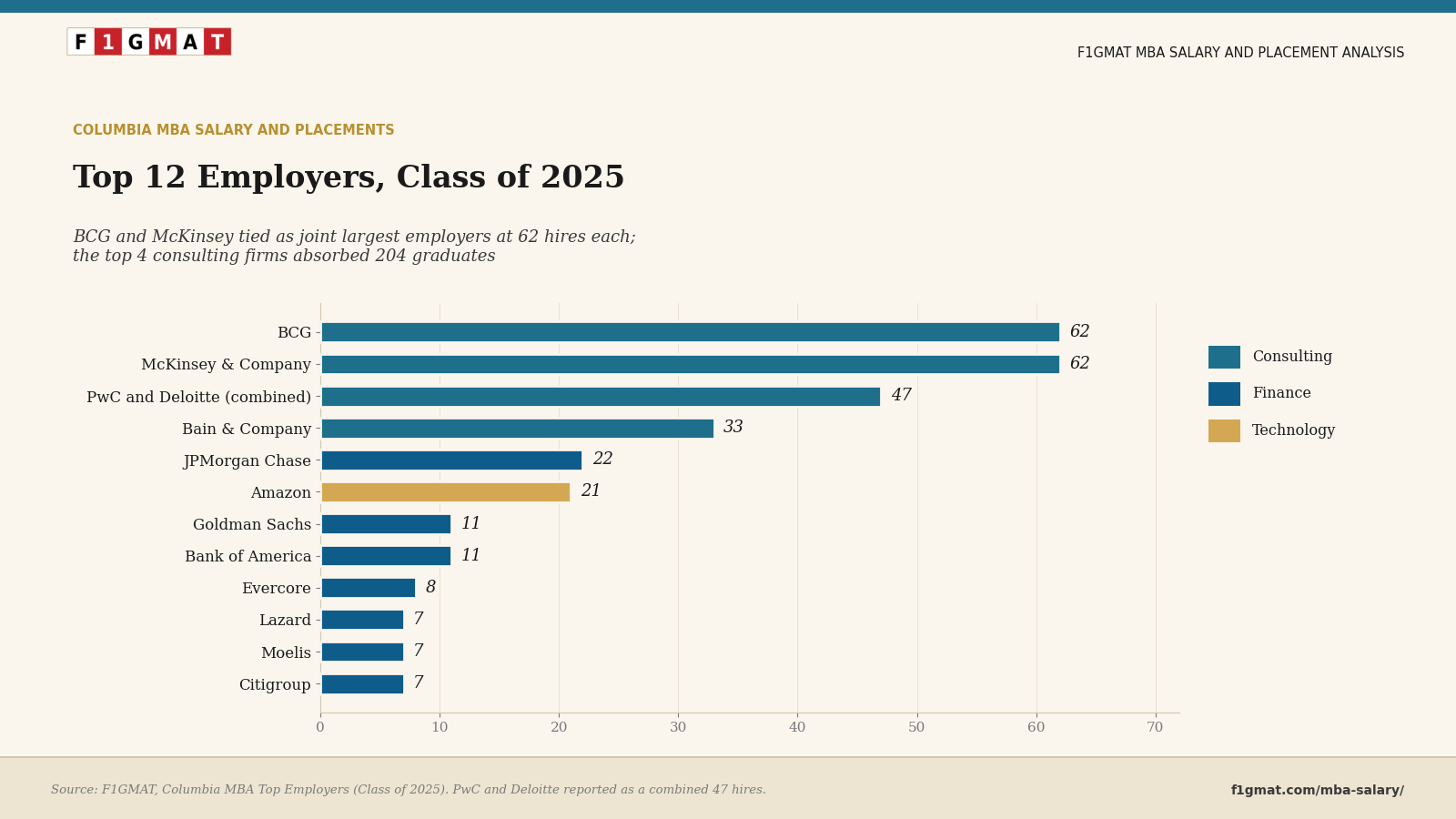
The Top Employers list for the Class of 2025 shows strong reliance on a limited set of repeat recruiters[4]. Boston Consulting Group and McKinsey & Company each hired 62 graduates.
Bain & Company followed with 33. PwC and Deloitte together added another 47.
JPMorgan Chase was the single largest finance employer with 22, followed by Goldman Sachs (11), Bank of America (11), Evercore (8), Lazard (7), Moelis (7), Citigroup (7), UBS (6), Guggenheim Securities (5), Perella Weinberg (5), and PJT Partners (4). Amazon (21 hires) and IBM (4) were the only two Technology giants among the top employers.
Two shifts are visible compared to the Class of 2024.
First, BCG, McKinsey, and Bain increased or maintained their total hiring while mid-tier firms did not scale proportionately.
The AI-integration advantages are first absorbed by large consulting firms.
Second, the ratio of new MBA hires to returning-consultant hires narrowed.
Returning consulting employees and sponsored candidates filled a larger share of consulting offers[5].
Application Tips Around Repeat-Recruiter Concentration
If your target post-MBA is at BCG, McKinsey, Bain, JPMorgan, Goldman Sachs, or Amazon, Columbia is one of the highest-yield programs in the world for these targets. Mention these firms directly in Essay 1.
If you are a career switcher entering consulting, your essays must answer why a firm should bet on you over a returning analyst from BCG or McKinsey with two years of context already acquired with their experience.
Beyond the named firms, Columbia's recruitment target pivots toward boutique advisory shops, mid-tier consultancies, and specialist asset managers.
Build the network plan into Essay 3 (co-create at CBS) and name the clubs, treks, and conferences you will use to transition into your target Employer.
Key Takeaways
1. Understand and Position yourself according to the post-AI version of every function
The post-AI version of every function rewards systems thinking across instruments, regulations, and stakeholders.
Consulting now requires evaluating analyst-grade work that AI generates and retraining the model when output diverges.
Investment Banking now requires comprehension and management of complex bespoke capital architecture.
Private Equity prioritizes emerging skills in Trade Policy Risk in LBO Models to AI Infrastructure Diligence.
Investment Management hires for human judgment that prioritizes data sets and the hundreds of insights AI generates.
Technology hiring concentrates on AI strategy, infrastructure economics, governance, and AI commercial fluency.
Marketing rewards customer-economics judgment where the candidate chooses which customers to serve and which to deprioritize.
2. Columbia is the most New York-anchored M7 program by design.
82 percent U.S. placement, with New York absorbing nearly every execution-heavy role, should guide your goals essay. The school's self-selection mechanism rewards applicants whose post-AI location is clearly New York's finance, advisory, or large-tech infrastructure economy.
3. Consulting and IB hiring concentrate in firms with the deepest AI infrastructure.
BCG and McKinsey each hired 62 graduates. JPMorgan hired 22. These firms also run the deepest internal AI stacks (Lilli, GENE, Sage, ChatPwC, Sidekick, EYQ, Workbench, Agent OS, AI Refinery). The applicant should strategically mention familiarity with the stacks, either directly or with a product that has a similar appeal.
4. Private Equity is the highest-paying path at $312,108 because the diligence work has changed.
AI Infrastructure Diligence, Continuation Vehicles, and Trade Policy Risk in LBO Models are the emerging skills now priced into the $137,108 guaranteed-pay premium. Show competence in these niches by selecting matching experiences for the essays in product customization in PE, assessing tariff’s impact on clients, and doing due diligence for infrastructure projects.
5. Technology and Marketing applicants must reposition away from work that agents now own.
Product Managers have now been deprioritized. Technology hiring is super specialized into AI strategy, infrastructure economics, governance, and AI commercial fluency.
Marketing hiring is for customer economics judgment, segmentation, brand loyalty architecture, and AI-deployment governance, not creatives, which AI has mastered.
Repositioning Essay 1 around what survives as human creativity should be the non-negotiable part of brainstorming before writing a single line for the Columbia MBA Application.
References
- Columbia MBA Salary: By Industry (2025) (Analysis), F1GMAT
- Columbia MBA Salary: By Job Function (2025) (Analysis), F1GMAT
- Columbia MBA Salary: By Job Location (2025) (Analysis), F1GMAT
- Columbia MBA Top Employers 2025: BCG, McKinsey, JPMorgan Lead Hiring, F1GMAT
- Q1 2026 Consulting Trends: Outcome-Based Pricing and AI Agents Reach Production, F1GMAT Premium
- Private Equity Industry Trends Q1 2026: 7 Forces Reshaping PE Careers, F1GMAT Premium
- Venture Capital Industry Trends Q4 2025, F1GMAT Premium
- Investment Banking Industry Trends Q1 2026, F1GMAT Premium