Applicants are confused and want to know whether the Wharton and Columbia MBA programs should be compared for their Consulting or Finance strengths.
On the surface, when you look at the Finance numbers, Wharton placed 13.4% of its Class of 2025 into Private Equity against Columbia's 4.5%, at a $200,000 median base against Columbia's $175,000 [1][2].
Columbia placed 17.1% into Investment Banking against Wharton's 14.2%, and 33.2% into Consulting against Wharton's 28.2% [1][2].
On the function tables, where the two schools sort the same graduates by what they actually do, the gap widens.
Columbia sent 40.1% of the class into consulting functions, and Wharton sent 31.4% [3][4].
For the 2026 comparison, I evaluated the Class of 2025 employment reports both schools published, along with Columbia's firm-by-firm employer list.
TL;DR (At a Glance)
- Wharton is the stronger MBA for Private Equity and the buy side. Wharton placed 13.4% of the Class of 2025 into Private Equity at a $200,000 median base, against Columbia's 4.5% at $175,000 [1][2].
- Columbia is the stronger MBA for Investment Banking by volume, at 17.1% of the class against Wharton's 14.2%, with both at a $175,000 median base [1][2].
- Columbia is the stronger MBA for Consulting, at 33.2% of the class against Wharton's 28.2%, with both at a $190,000 median base [1][2].
- Base salary parity is a tie. Consulting pays $190,000 at both schools, and Investment Banking pays $175,000 at both. The schools separate on hiring share and on guaranteed compensation.
- Columbia disclosed guaranteed compensation, and Wharton does not, which makes Columbia's Private Equity total of $312,108 the highest single figure in either report. Whether Wharton is using a strategic omission is up for speculation[2].
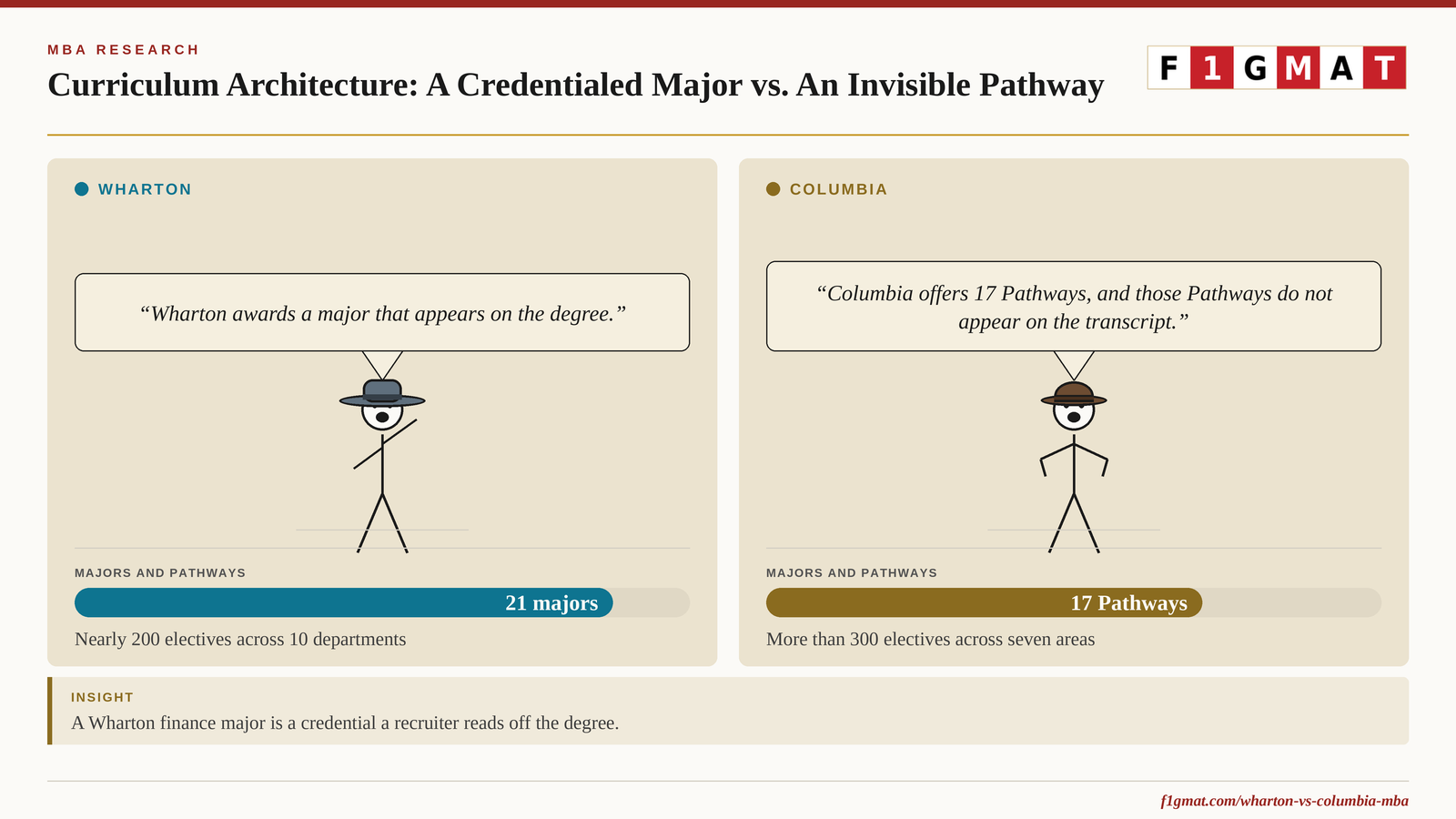
- Specialization is credentialed at Wharton and invisible at Columbia. Wharton awards one of 21 majors on the degree; Columbia's 17 Pathways guide course selection but doesn’t appear on the transcript [14][15].
- Columbia's employer concentration is extreme. BCG and McKinsey hired 62 graduates each, Bain hired 33, and JPMorgan Chase led finance with 22 [4].
- Wharton's Investment Management base of $190,917 and Private Equity and Venture Capital investor base of $188,879 are both above its own Investment Banking base of $180,982, which has an inverse correlation to the payments across M7 [3].
Contents
- Finance School or Consulting School: Wharton vs. Columbia MBA
- Proximity Argument and the Recruiting Calendar
- Curriculum Architecture: A Credentialed Major vs. An Invisible Pathway
- Investment Banking Curriculum
- Private Equity and Alternative Investments Curriculum
- Investment Management and the Value Investing Question
- Consulting Curriculum
- Who teaches strategy at Wharton and at Columbia?
- Which MBA is better for AI-implementation consulting?
- Employment Outcomes by Industry (Class of 2025)
- Employment Outcomes by Function (Class of 2025)
- Columbia MBA vs. Wharton MBA – The Final Answer (Finance or Consulting School)
- Verdict for the Finance Applicant
- Verdict for the Consulting Applicant
- Methodology Note
- Related F1GMAT Reads
- References
Finance School or Consulting School: Wharton vs. Columbia MBA
When applicants compare Wharton and Columbia, the intent underneath the question is a finance question.
Wharton owns the finance brand in U.S. business education; Columbia is eight subway stops from the New York Stock Exchange.
The applicant, who knows that Wharton is a stretch school, wants to know if Columbia is enough.
The Class of 2025 data complicates that question in one way.
Financial Services was the largest industry at both schools, at 38.2% for Wharton and 35.4% for Columbia [1][2]. The two schools are within four percentage points of each other on aggregate finance placement.
On the buy side, in Private Equity and Investment Management, Wharton is ahead by a wide margin on Private Equity and behind on Investment Management share.
On the sell side, meaning Investment Banking coverage and advisory, Columbia is ahead on volume at identical base pay.
On consulting, Columbia is ahead on both the industry table and the function table.
Proximity Argument and the Recruiting Calendar
Wharton’s location in Philadelphia, on Penn's campus in University City, is ninety minutes from midtown Manhattan by Amtrak. Columbia is in Manhattanville in West Harlem, on the 1 train, with the Financial District and Midtown inside a single subway ride.
The proximity argument matters less for these two schools than it does for a Chicago-against-New York comparison, because Philadelphia is inside the Northeast corridor where the Class of 2025 deal activity concentrated.
F1GMAT's Wharton analysis attributes part of the school's investment banking stability to exactly that geography, noting that the sponsor-led carve-outs and take-privates of the period were concentrated in the U.S. Northeast, where Wharton historically places a large share of its finance-bound graduates [1].
Columbia's proximity advantage shows up in the composition of its finance employer list.
Columbia's incremental finance hiring in 2025 came from advisory-heavy firms specializing in complex M&A, restructuring, and sponsor-led transactions, with Evercore at 8 hires, Lazard at 7, Moelis at 7, Citigroup at 7, UBS at 6, Guggenheim Securities at 5, Perella Weinberg at 5, and PJT Partners at 4 [4].
These are firms where the New York office is everything.
Wharton's advantage is different.
A Wharton student targeting a megafund does not need to be within walking distance of the sponsor, because sponsor recruiting runs through headhunters on tight deadlines that are indifferent to campus location.
The Wharton advantage in Private Equity is in its network and curriculum.
Curriculum Architecture: A Credentialed Major vs. An Invisible Pathway
Wharton runs a two-year program with a core of 9.5 credit units split into a fixed and a flexible segment [14].
The fixed core is six required classes, including Leadership: Foundations of Teamwork and Leadership, Microeconomics for Managers, Statistics: Regression Analysis for Managers, and Management Communication: Speaking and Writing [14].
The flexible core lets a student choose the specific course inside broad areas including Accounting, Corporate Finance, Operations, Information, and Decisions, and Management.
A candidate with an accounting background can satisfy the flexible core and reach electives sooner [14].
After the core, Wharton students choose from 21 majors, of which 10 are STEM-certified, and can take a double major or build an individualized major [14].
The elective catalog runs to nearly 200 courses across 10 Wharton departments, with up to four courses available at other Penn schools [14].
Columbia Tackles Wharton’s Flexible Core with Exemption Exam
Columbia runs a 60-credit program, 18 credits of required core against a minimum of 42 credits of electives, with all 60 credits earned in residence [15].
The core is two full-term and eight half-term courses, including Strategy Formulation, Corporate Finance, Foundations of Valuation, Managerial Statistics, and Business Analytics [15].
A student who passes an exemption exam can replace a core course with an elective, which recovers part of the first-year flexibility that a core-first sequence otherwise removes [15].
Columbia's elective catalog is the larger of the two, at more than 300 courses across seven areas: Accounting, Decision Risk and Operations, Economics, Entrepreneurship, Finance, Management, and Marketing [15].
The Difference – Wharton’s Major is Printed on the Degree
Wharton awards a major that appears on the degree.
Columbia offers 17 Pathways, curated course roadmaps including Strategy, Private Equity, Venture Capital, Fundamental Analysis, and Asset and Wealth Management, and those Pathways do not appear on the transcript [15].
Recruiter Perspective - Majors
A Wharton finance major is a credential a recruiter reads off the degree.
Columbia’s J-Term – For Career Enhancers
Columbia's second architectural feature is the January entry.
J-Term students complete the core over the spring and summer, skip the summer internship, and merge with the August class in the fall of the second year [15]. That path suits a sponsored candidate or one returning to a prior employer. The option removes the internship that consulting and banking career switchers target with MBB or a bulge bracket bank.
Investment Banking Curriculum
Which MBA is better for investment banking, Wharton or Columbia?
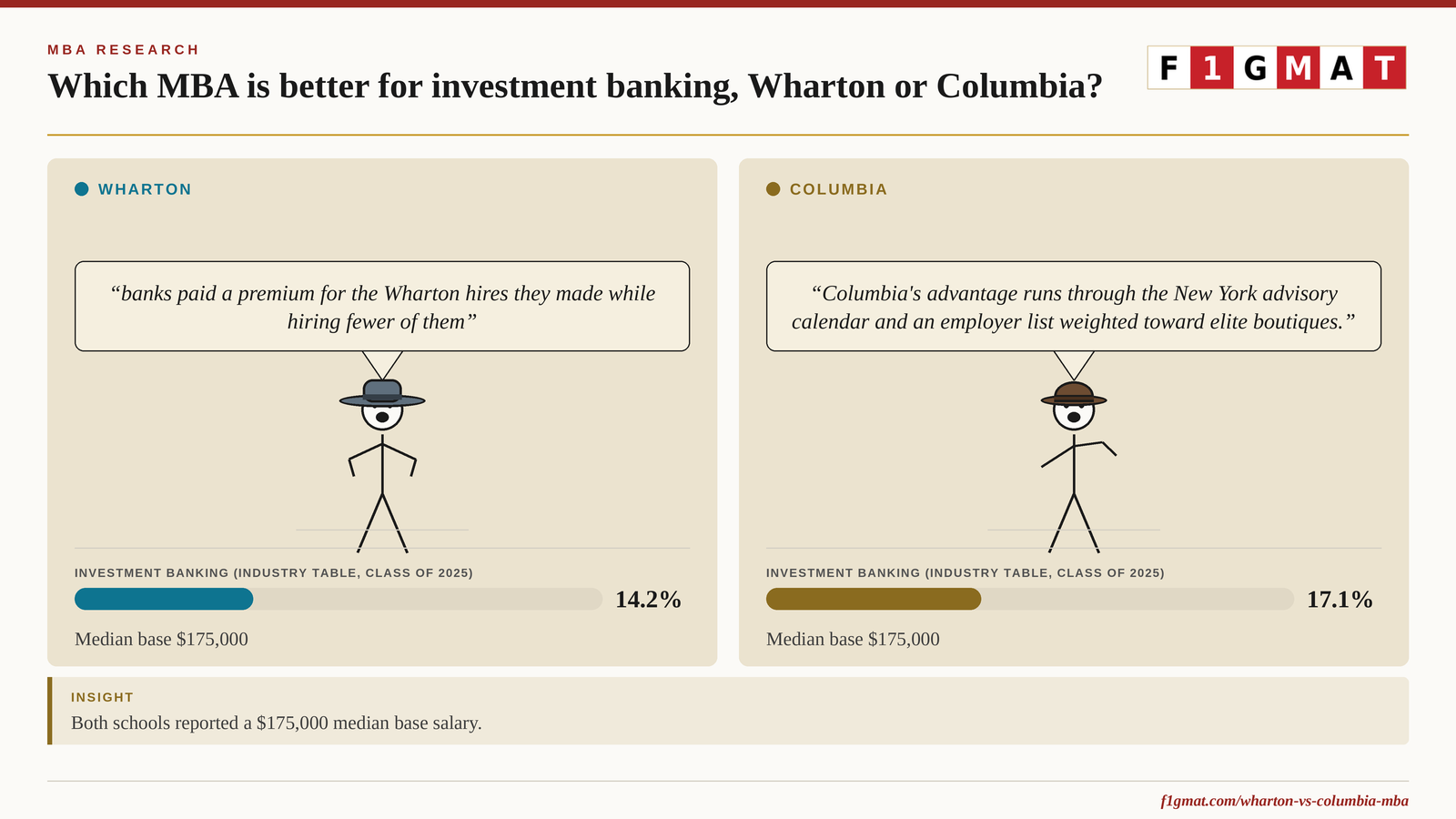
Columbia is the stronger MBA for Investment Banking by placement volume, with 17.1% of the Class of 2025 entering Investment Banking against Wharton's 14.2% [1][2].
Both schools reported a $175,000 median base salary.
Columbia's advantage runs through the New York advisory calendar and an employer list weighted toward elite boutiques.
On the function table, which counts the job a graduate does instead of the industry that employs them, Columbia placed 19.1% into Investment Banking and Wharton placed 13%, with Wharton's function-level base at $180,982 [3][4].
Wharton’s $180,982 median base is above the $175,000 standardization that held across M7 and Top 15 programs in the Class of 2025 cycle, which means banks paid a premium for the Wharton hires they made while hiring fewer of them [3].
What does the Wharton banking curriculum cover?
Wharton's banking orientation is achieved through Corporate Finance, Mergers and Acquisitions, Advanced Corporate Valuation, and Financial Statement Analysis - a sequence built on transaction mechanics, capital structuring, and modeling under uncertainty [3].
F1GMAT's analysis correlates the orientiation pressure to the compensation outcome, arguing that the curriculum did not protect students from banking selectivity, visible in the drop in hiring volume, but did produce the compensation premium, which indicates that employers valued deal execution skill.
How does Columbia prepare candidates for advisory and restructuring roles?
Columbia's banking preparation is less a designed sequence and more a set of electives taught by practitioners who work in the buildings the students will interview in.
The employer data shows that Columbia's 2025 finance hiring shifted toward advisory-heavy banks. The shift away from balance-sheet-intensive growth, was forced upon the firms with the heavy concentration of funds in AI that paused M&A of anything outside AI. The incremental hiring coming from firms specializing in complex M&A, restructuring, and sponsor-led transactions where data centers and energy sourcing were the primary business [4].
For a candidate targeting a restructuring group at Guggenheim, Perella Weinberg, or PJT, Columbia's employer list shows live pipelines at each firm in a single graduating class [4].
Wharton does not publish a firm-by-firm equivalent, which limits the comparison.
| Investment Banking Associate seat | Which school, and why in one phrase |
|---|---|
| Bulge-bracket coverage (TMT, Healthcare, Industrials, FIG) | Columbia, on 17.1% placement and the JPMorgan, Goldman, Bank of America pipeline |
| Elite boutique M&A (Evercore, Lazard, Moelis, Centerview) | Columbia, on eight boutiques appearing in one employer list |
| Restructuring and liability management | Columbia, on Guggenheim, Perella Weinberg, and PJT appearing at 4 to 5 hires each |
| Sponsor coverage and leveraged finance | Wharton, on the Harris Program and the sponsor-side alumni base |
| Compensation per seat | Wharton, on the $180,982 function-level base against the $175,000 standard |
Private Equity and Alternative Investments Curriculum
This is the second structural difference.
Which MBA is better for private equity, Wharton or Columbia?
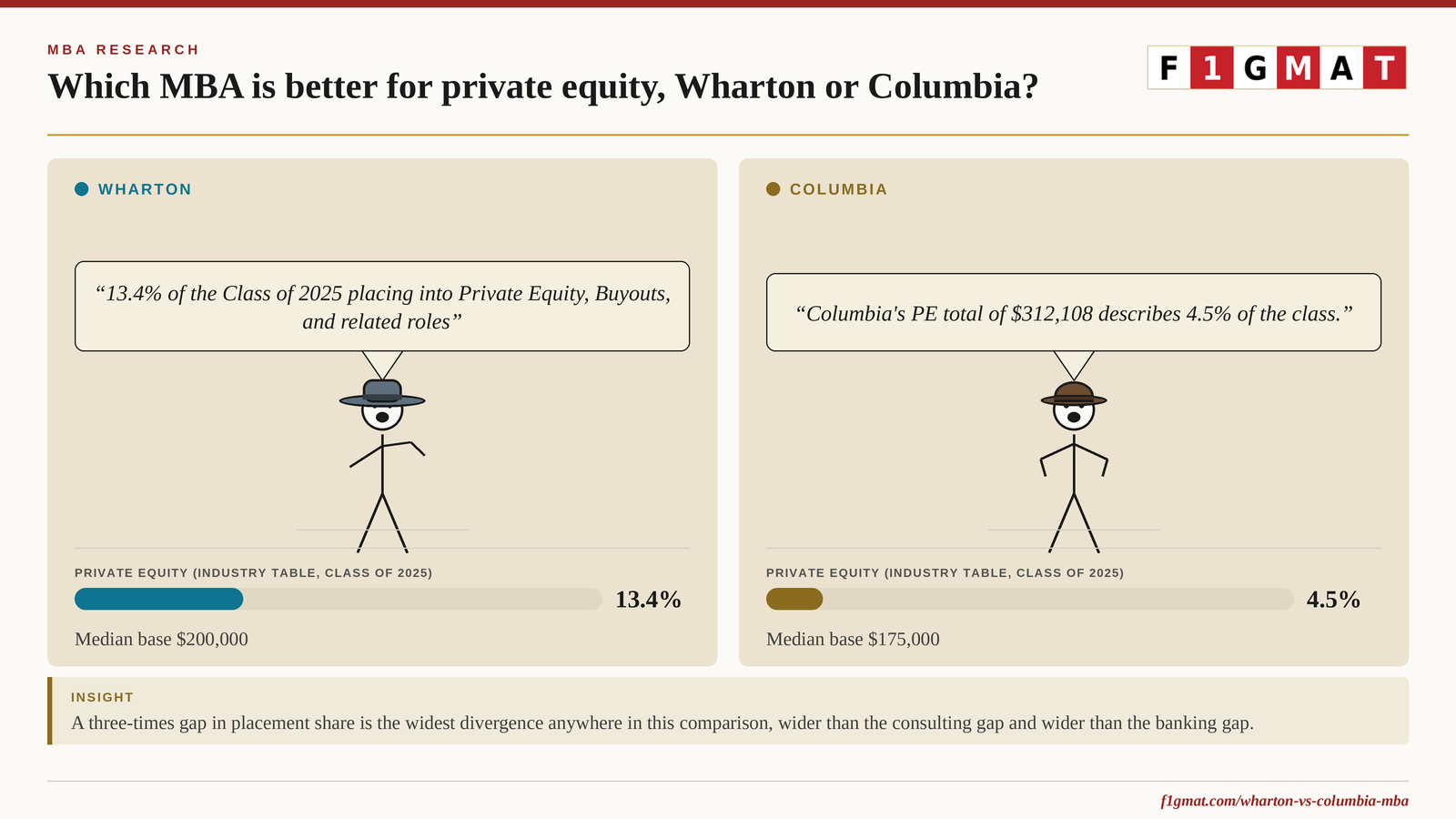
Wharton is the stronger MBA for Private Equity, with 13.4% of the Class of 2025 placing into Private Equity, Buyouts, and related roles against Columbia's 4.5% [1][2].
Wharton's PE median base of $200,000 was the highest base of any industry in its report, above Consulting at $190,000 and Investment Banking at $175,000 [1]. Columbia's PE base was $175,000 [2].
The function table confirms the pattern from the other direction. Wharton placed 13% of the class into Private Equity and Venture Capital investor roles at a $188,879 median base, while Columbia's private equity function share was 6.6% [3][4].
A three-times gap in placement share is the widest divergence anywhere in this comparison, wider than the consulting gap and wider than the banking gap.
What explains the Wharton private equity advantage?
The Harris Family Alternative Investments Program is the institutional answer. Established through a $10 million gift in 2019, the program covers private equity, hedge funds, venture capital, and investment management, and integrates alternative investments research into the degree curriculum [12].
Bilge Yilmaz, the Wharton Private Equity Professor and Professor of Finance, is its academic director, with Burcu Esmer as academic co-director and Kevin Kaiser as an adjunct full professor of finance and senior fellow [12][13].
The course sequence is still desgined around all the old-school fundamentals in PE and Investment Management - starting with Private Equity, Venture Capital and the Finance of Innovation, Distressed Investing, and Applied Investment Management, followed by the Private Equity and Venture Capital Lab to offer the practical experience. Students with the course sequence are exposed to live deal evaluation, portfolio diagnostics, and investment committee processes [3].
F1GMAT's analysis identifies experiential depth as the decisive factor in a cycle when sponsors were unwilling to train hires from the beginning.
Columbia is not without private equity infrastructure, which makes the placement gap harder to explain by curriculum alone.
Columbia runs a Private Equity Program among its formal industry programs, a Private Equity Pathway among its 17 course roadmaps, and a Private Equity Field Study elective inside the Finance division [15].
The curriculum exists.
The 4.5% placement against Wharton's 13.4% indicates that the constraint is arising in recruiting access and sponsor-side alumni density [1][2][15].
Why did Columbia's private equity compensation exceed Wharton's on total pay?
Columbia's Private Equity hires reported guaranteed compensation exceeding $137,108 and total median compensation of $312,108, the highest total across all Columbia industries [2]. Wharton does not disclose guaranteed compensation in its industry table, so no like-for-like total exists.
Columbia's PE total of $312,108 describes 4.5% of the class.
Wharton's $200,000 base describes 13.4% of the class, with the bonus component undisclosed.
The Columbia number reports what a small group of hires earned; the Wharton number reports how many people got in.
An applicant optimizing for the probability of a PE offer should consider the placement share.
An applicant already confident of the offer should closely analyze the compensation.
F1GMAT's Columbia analysis attributes that compensation level to a labor scarcity effect, with sponsors hiring selectively for candidates capable of supporting AI-enabled due diligence, operational value creation, and portfolio optimization, with deal sourcing on its own no longer remaining a differentiated skill [2].
| Private Equity Associate Role | Which school, and why in one phrase |
|---|---|
| Megafund buyout Associate | Wharton, on 13.4% placement and the Harris Program alumni base |
| Middle-market buyout Associate | Wharton, on the Private Equity and Venture Capital Lab live-deal work |
| Growth equity Associate | Wharton, on Venture Capital and the Finance of Innovation extending the PE core |
| Portfolio operations Associate | Wharton, on Kevin Kaiser's value creation work inside the Harris Program |
| Private credit and distressed Associate | Wharton, on the Distressed Investing elective |
| Highest disclosed total compensation per seat | Columbia, at $312,108 total against an undisclosed Wharton bonus |
Investment Management and the Value Investing Question
Investment Management is the one finance sub-industry where Columbia placed a higher share than Wharton, at 6.8% against 5.3%, with both at a $175,000 median base [1][2].
Columbia's Investment Management hires reported $75,000 in guaranteed compensation for a $250,000 total [2].
Which MBA is better for value investing and fundamental buy-side research?
Columbia is the stronger MBA for fundamental, value-oriented investing. A big factor is the Heilbrunn Center for Graham and Dodd Investing, which runs the Value Investing Program, a selective second-year curriculum for 40 students taught by practitioners, and supports more than 35 class sections and more than 1,500 students per year across the school, with more than 40 adjunct faculty affiliated with the program [11].
Tano Santos, the David L. and Elsie M. Dodd Professor of Finance, is the Center's faculty director [11]. Michael Mauboussin, Head of Consilient Research on Counterpoint Global at Morgan Stanley Investment Management, teaches as an adjunct faculty member and co-hosts the Center's Value Investing with Legends podcast with Santos [11].
Inside the degree, the strong institutional support translates as the Value Investing with Legends elective, and Columbia designed the surrounding coursework through its Fundamental Analysis Pathway and its Asset and Wealth Management Pathway [15].
No U.S. MBA program has a comparable single-discipline investing institution.
A candidate targeting a fundamental long-only or long-short role at a Bauhaus-style shop should read the Heilbrunn Center as a reason to pick Columbia over Wharton, and should understand that admission to the Value Investing Program itself is competitive at 40 openings.
Where does Wharton win inside investment management?
On compensation and on breadth. Wharton's Investment Management and Portfolio Management function reported a $190,917 median base, the highest base of any Wharton function including Investment Banking and Private Equity [3]. The supporting electives include Investment Management, Advanced Topics in Portfolio Management, Behavioral Finance, and Fixed Income Securities [3].
The distinction is between a school with the deepest institution in one investing philosophy and a school paying the highest base across investing roles.
A candidate who has already decided on Graham and Dodd fundamentals should pick Columbia.
A candidate targeting a multi-strategy platform, a fixed income desk, or a systematic role should pick Wharton.
Columbia's buy-side employer intake was thin in this class, with BlackRock and AllianceBernstein appearing at 4 hires each [4].
Columbia's own analysis attributes the low volume to fee crash, passive flows, and automation in research and portfolio construction. Cross-asset judgment and quantitative fluency was valued the most. [2].
Consulting Curriculum
Which MBA is better for consulting, Wharton or Columbia?
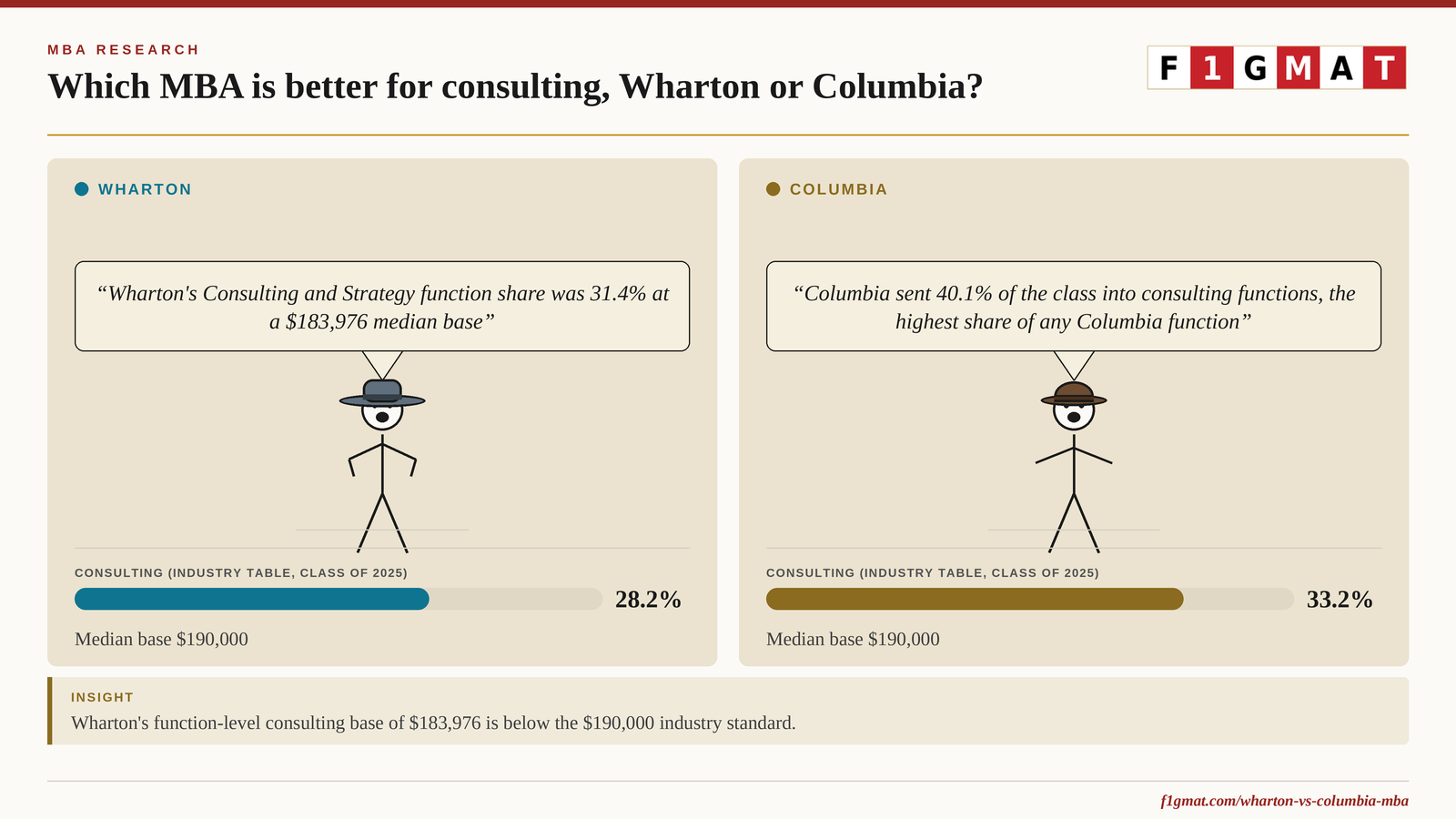
Columbia is the stronger MBA for Consulting on placement share, at 33.2% of the Class of 2025 against Wharton's 28.2%, with both schools reporting a $190,000 median base [1][2]. Columbia's consulting hires reported $30,000 in guaranteed compensation for a $220,000 total [2].
The function table widens the gap. Columbia sent 40.1% of the class into consulting functions, the highest share of any Columbia function, while Wharton's Consulting and Strategy function share was 31.4% at a $183,976 median base [3][4].
Wharton's function-level consulting base of $183,976 is below the $190,000 industry standard. Consulting firms didn't value Wharton in the same way a PE firm did. They preserved compensation discipline while hiring into shorter project cycles with tighter accountability for return on the engagement [3].
What happened to consulting demand during the Class of 2025 cycle?
Both schools recruited into an enterprise market where budget was cut from open-ended strategy work [1][2].
Enterprises moved spending toward AI roadmap design, operating-model redesign, supply-chain reconfiguration, and regulatory compliance, while pulling back from open-ended strategy work [1][2].
By early 2025, fewer than 10% of enterprises deploying generative AI were achieving measurable return. Clients were unwilling to fund long exploratory engagements [2]. By the first quarter of 2025, firms including BCG and Bain were reporting 20% to 25% reductions in project delivery timelines through internal AI tools while tightening campus hiring [2].
The effect on hiring was a shift from generalist problem-solvers toward candidates with demonstrable fluency in analytics, digital operations, and AI-enabled transformation [2].
How do the two curricula prepare for that market?
Consulting preparation at both schools starts with the strategy core and differentiates at the elective layer.
Wharton's consulting sequence runs through Strategic Management, Decision Models, Operations Strategy, and Managing Organizational Change, with the Management Consulting Practicum and Global Modular Courses supplying live operational experience [3][14].
A consulting-bound Wharton student converts that schedule into a Strategic Management major or a Management major, and adds it with the Business Analytics major or the Operations, Information and Decisions major for the analytics-weighted work that dominated the 2025 graduating class [3][14].
F1GMAT's analysis credits that applied orientation with reducing the training burden on firms in a year when consulting margins shrunk, which is the reason behind Wharton's recovery from a 25.2% consulting function share in 2024 to 31.4% in 2025 [3].
Columbia's consulting sequence begins with Strategy Formulation in the core and continues through the Management division electives, with the Strategy Pathway supplying the roadmap [15].
The Decision, Risk and Operations division adds the analytics layer through Python for MBAs and Generative AI for Business, which maps onto the AI-implementation work that is reshaping consulting work[15].
Managerial Negotiations and Entrepreneurship Through Acquisition is also offered in the same division for candidates who treat consulting as a route into an operating role [15].
Who teaches strategy at Wharton and at Columbia?
Nicolaj Siggelkow and Harbir Singh teach strategy at Wharton, and Rita McGrath teaches strategy at Columbia.
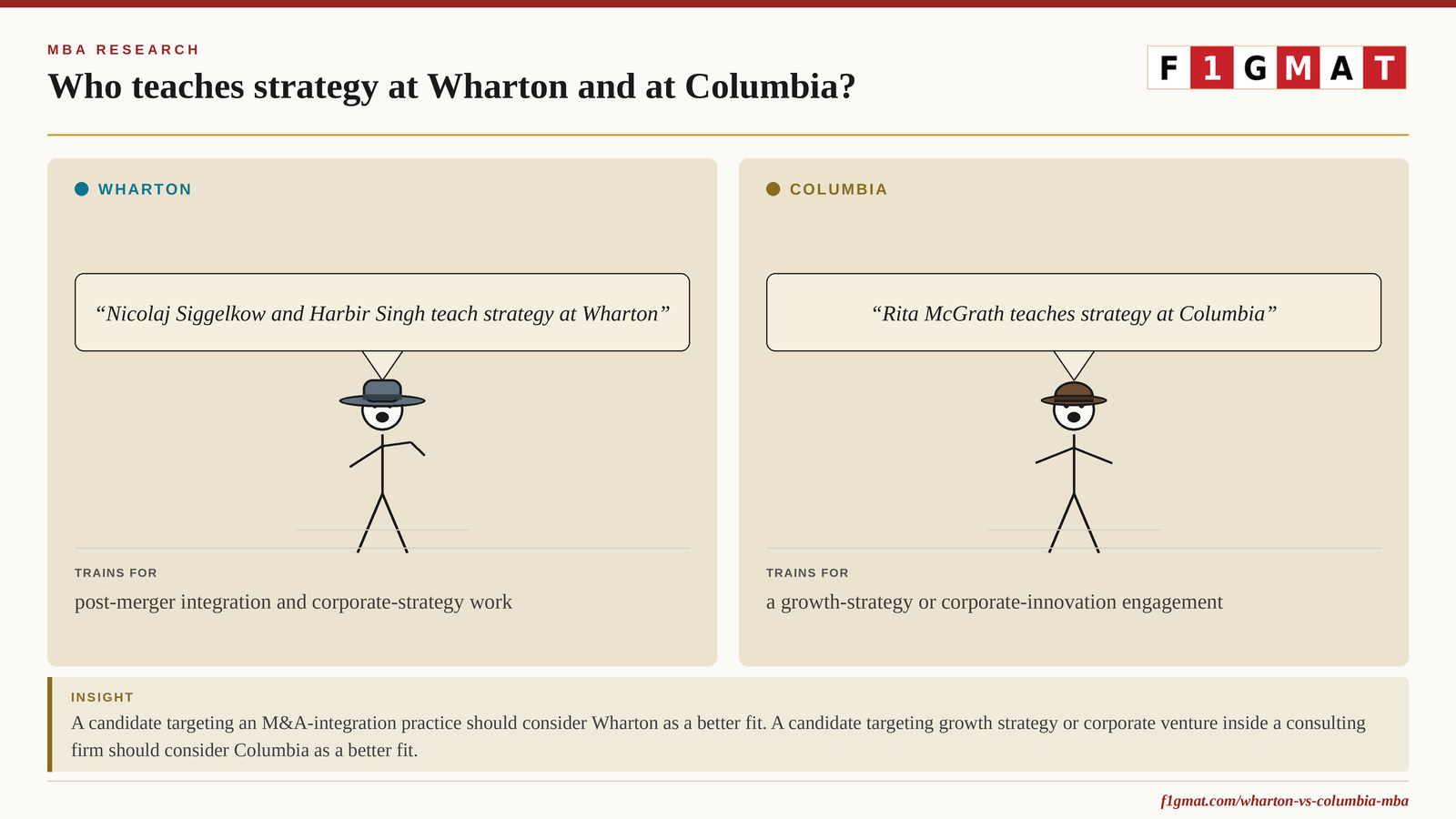
Siggelkow is the David M. Knott Professor, Vice Dean of the MBA Program, and a co-director of the Mack Institute for Innovation Management, and his research treats firms as systems of interconnected choices, the framework behind his Connected Strategy work [16][17].
Singh is the Mack Professor of Management, the other Mack Institute co-director, and a Fellow of the Strategic Management Society, with research covering corporate acquisitions, alliances, joint ventures, and corporate restructuring [16].
Wharton: Trains for post-merger Integration
A Wharton student trained on the Siggelkow and Singh material is prepared for post-merger integration and corporate-strategy work, which is precisely the work that expanded during the Class of 2025 cycle when deal value rose while deal counts fell [3].
Columbia: Trains for Strategic Thinking
McGrath approaches strategy from an equilibrium perspective. Her research on discovery-driven planning and on the erosion of competitive advantage assumes that a market position decays. Her research trains a student to detect the inflection point before the decay reaches the financials [18]. That orientation fits a growth-strategy or corporate-innovation engagement.
A candidate targeting an M&A-integration practice should consider Wharton as a better fit.
A candidate targeting growth strategy or corporate venture inside a consulting firm should consider Columbia as a better fit.
Does either school offer a live consulting project?
Both do.
Wharton runs the Management Consulting Practicum, and its Global Modular Courses place students on site in a relevant country for an intensive, full-credit course [3][14]. The Wharton-INSEAD Alliance and the Global Immersion Programs extend the same model into Europe and Asia [14].
Columbia's experiential consulting is on the social-impact side. Pangea Advisors places students on pro bono consulting projects for social enterprises in developing countries, the year-long Nonprofit Board Leadership Program teams students with nonprofit boards for strategic consulting and board governance exposure, and the International Development Consulting Project Travel Fund offsets travel costs for overseas assignments [15]. Chazen Global Study Tours and the Chazen MBA Exchange complete the international exposure [15].
For a candidate who wants an engagement that resembles their post-MBA job, Wharton's practicum is a closer fit.
For a candidate who wants board-level and nonprofit exposure, Columbia's program go further.
Which MBA is better for AI-implementation consulting?
Columbia has the deeper course inventory, and Wharton has the credential.
Columbia's AI teaching is function-focused with an eye on risks and operations, with the support of the Decision, Risk and Operations division.
The skills development is carefully structured.
Foundations of AI for Business (B8143), taught by Hongseok Namkoong, is the 1.5-credit entry point [22].
Business Analytics III: Modern AI, Deep Learning, and Generative AI (B7117), taught by Ashwin Kamath and Daniel Guetta, requires that course or Business Analytics II: Foundations of AI (B7103) beforehand, and covers the deep learning and generative layer [22].
Programming Generative AI Applications (B8126), taught by Hardeep Johar, runs as a January block week and covers the Data Analytics and AI Pathway alongside the Product Management Pathway [22].
Generative AI for Business (B8631), taught by Olivier Toubia and Malek Ben Sliman out of the Marketing division, extends the material toward the commercial side [22].
Python for MBAs supplies the tooling underneath [15].
Columbia states that its students choose from close to 30 AI-related courses [21].
Columbia – AI Learning Ends with Application Development
A Columbia student moves from foundations to deep learning to a built application within one academic year, and the January block-week format lets a second-year student add Programming Generative AI Applications without committing a full term to it [22].
Wharton – The AI for Business Major
The Artificial Intelligence for Business major launched in fall 2025 as one of 21 MBA majors, is STEM-certified, and is jointly administered by the Statistics and Data Science department with the Operations, Information and Decisions department [20]. The required ethics foundation is offered through the Big Data, Big Responsibilities: Toward Accountable Artificial Intelligence, taught by Kevin Werbach, who directs Wharton's Accountable AI Lab [20].
Foundations of Deep Learning supplies the technical base within the statistics department, and Artificial Intelligence for Business, taught by Kartik Hosanagar, covers the applied layer [20].
Generative AI and Business Transformation addresses implementation in a business context, with competition, innovation, ethics, and governance frameworks in scope [19].
Wharton also issued ChatGPT Enterprise licenses to its full-time and executive MBA students, the first arrangement of its kind between a business school and OpenAI [20].
Winner: AI-Implementation Role
Since firms shifted hiring toward candidates with demonstrable fluency in analytics and AI-enabled transformation [2], the Wharton major is the stronger resume signal, because a recruiter reads Artificial Intelligence for Business off the degree while a Columbia Pathway is never cited in the transcript [14][15].
However, for the true learners, Columbia is the faster route to specific skill acquisition, because its learning sequence is prerequisite-gated and ends in a working application.
A candidate targeting AI governance or responsible-AI advisory work should weigh Werbach's ethics anchor and the Accountable AI Lab, since that is where the regulatory mandates are concentrated [19][20].
A candidate targeting AI product and delivery work inside a consulting firm should weigh Programming Generative AI Applications, the one course on either list that is part of the product pathway as well as an analytics pathway [22].
What does the employer data show – Columbia or Wharton for Consulting Roles?
Columbia's consulting advantage comes from the class structure and location instead of a distinctive course sequence.
The core-first requirement gives every graduate the same analytical foundation. A firm hiring 60 people from one school does not have to screen for coursework. The cluster system reinforces that uniformity by putting about 65 peers through the entire core together [15], which builds the referral network that consulting recruiting depends on.
Location settles the rest, since Columbia is in the city where all three MBB firms run major U.S. offices.
The employer concentration is the proof.
BCG and McKinsey each hired 62 Columbia graduates and Bain hired 33, which is 157 MBB hires out of one class.
PwC and Deloitte together added 47, and L.E.K. appeared with 4 [4].
The full role-by-role consulting course map, with the specific Wharton majors and Columbia Pathways behind each Associate variant, the MBB-versus-implementation split verdict, and a term-by-term sequencing plan for each school, is in F1GMAT Premium.
Employment Outcomes by Industry (Class of 2025)
| Industry | Wharton % hired | Wharton median base | Columbia % hired | Columbia median base | Columbia guaranteed | Columbia total |
|---|---|---|---|---|---|---|
| Consulting | 28.2% | $190,000 | 33.2% | $190,000 | $30,000 | $220,000 |
| Financial Services (all) | 38.2% | $175,000 | 35.4% | $175,000 | $70,000 | $245,000 |
| Investment Banking | 14.2% | $175,000 | 17.1% | $175,000 | $50,000 | $225,000 |
| Investment Management | 5.3% | $175,000 | 6.8% | $175,000 | $75,000 | $250,000 |
| Private Equity | 13.4% | $200,000 | 4.5% | $175,000 | $137,108 | $312,108 |
| Venture Capital | 2.8% | $170,000 | 2.5% | $157,500 | $61,716 | $219,216 |
| Consumer Finance and Analytics | Not broken out | 1.5% | $142,000 | $35,000 | $177,000 | |
| Technology | 15.3% | $164,250 | 10.2% | $170,000 | $32,000 | $202,000 |
| Health Care | 3.8% | $155,000 | 2.9% | $148,000 | $30,000 | $178,000 |
| Real Estate | Not broken out | 3.8% | $150,000 | $17,500 | $167,500 | |
| Consumer Products | Not broken out | 3.7% | $132,000 | $25,000 | $157,000 | |
| Retail | 2.1% | $162,500 | Not broken Down | |||
| Legal and Professional Services | 2.5% | $235,000 | Not broken Down |
Source: F1GMAT industry analyses of the Class of 2025 employment reports for Wharton and Columbia [1][2]. Wharton's table publishes median base only. Columbia's table publishes median base, other guaranteed compensation, and total.
Four Conclusions from the table.
- Private Equity is the decisive divergence, at 13.4% against 4.5%, and it runs in Wharton's favor on both share and base [1][2].
- Investment Banking runs in Columbia's favor on share, at 17.1% against 14.2%, at an identical base [1][2].
- Consulting runs in Columbia's favor on share, at 33.2% against 28.2%, at an identical base [1][2].
- Technology runs in Wharton's favor on share, at 15.3% against 10.2%, and in Columbia's favor on base, at $170,000 against $164,250 [1][2].
- Wharton's own analysis shows that a flat base salary is evidence that technology firms valued precision over scale in MBA recruitment during the cycle [1].
Employment Outcomes by Function (Class of 2025)
| Function | Wharton % hired | Wharton median base | Columbia % hired |
|---|---|---|---|
| Consulting and Strategy | 31.4% | $183,976 | 40.1% |
| Investment Banking | 13% | $180,982 | 19.1% |
| Private Equity and Venture Capital (investor) | 13% | $188,879 | 6.6% (private equity only) |
| Investment Management and Portfolio Management | 6% | $190,917 | 4.8% |
| General, Project and Management Development | 10.2% | $152,169 | Not published in the source |
| Product Management | 5.9% | $179,721 | Not published in the source |
| Business Development | 4.2% | $171,989 | Not published in the source |
| Legal Services | 2.8% | $218,125 | Not published in the source |
| Product and Brand Marketing | 2.3% | $155,333 | Not published in the source |
Source: F1GMAT's Wharton job-function analysis [3] and the Columbia top-employers analysis, which reports Columbia function shares for consulting, investment banking, private equity, and investment management [4]. Columbia's private equity function figure of 6.6% is not directly comparable to Wharton's combined private equity and venture capital investor figure of 13%.
The function table is the more useful of the two for a candidate choosing between the schools, because it removes the industry-label problem.
A graduate doing corporate development inside a bank appears under Financial Services on the industry table and under Business Development on the function table.
Columbia MBA vs. Wharton MBA – The Final Answer (Finance or Consulting School)
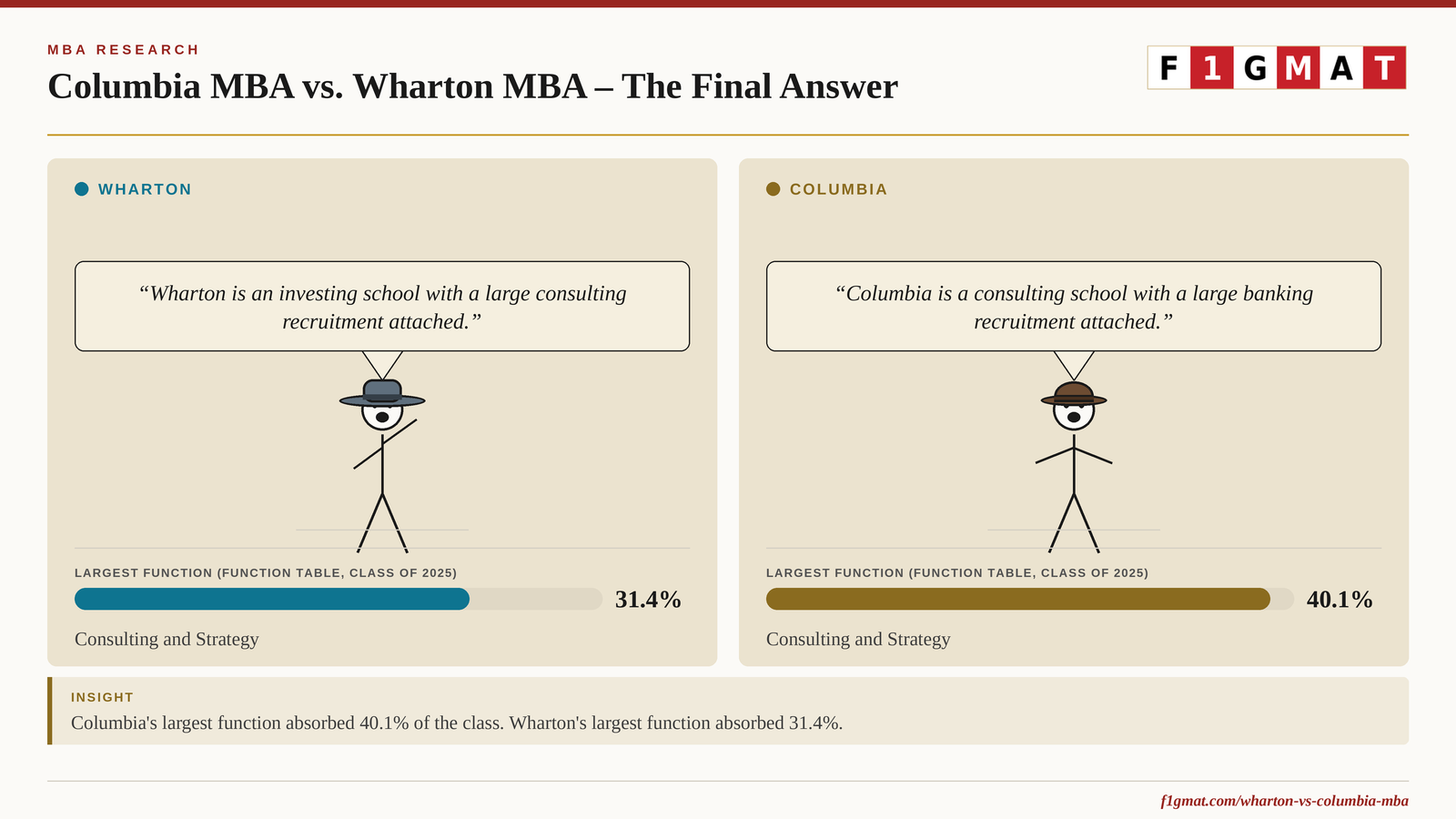
Columbia is a consulting school with a large banking recruitment attached, and Wharton is an investing school with a large consulting recruitment attached.
Columbia's largest function absorbed 40.1% of the class.
Wharton's largest function absorbed 31.4%, and its investor functions - private equity, venture capital, and investment management combined- absorbed 19% at bases above every other Wharton function except Legal Services [3][4].
The Guaranteed Compensation Gap
Columbia's Financial Services guaranteed compensation reached $70,000 for a $245,000 total, and its Private Equity guaranteed compensation exceeded $137,108 for a $312,108 total [2]. F1GMAT's Columbia analysis hints that the expansion of guaranteed cash is employers ' way of offsetting uncertainty around exits, deal timing, and discretionary bonuses [2].
Wharton publishes no guaranteed compensation figures in the industry table, which means no total compensation comparison between the two schools is possible from the published data.
At Columbia, the compensation spread between industries comes from the guaranteed component, since base is pinned at $175,000 across four of the finance sub-industries and moves only for Venture Capital, Real Estate, Consumer Products, and Healthcare [2]. At Wharton, the compensation spread comes from base itself, with Private Equity at $200,000, Consulting at $190,000, and Investment Banking at $175,000 [1].
Top Employers and Recruiter Concentration at Columbia MBA
Columbia publishes a firm-by-firm employer list, and Wharton does not.
Across 338 hires at the top employers, consulting absorbed 62.7%, investment banking and capital markets absorbed 27.5%, technology absorbed 7.4%, and buy-side asset management absorbed 2.4% [4].
BCG and McKinsey each hired 62 graduates, making them joint largest employers.
Bain followed at 33.
JPMorgan Chase led finance at 22. Amazon at 21 was the only technology firm hiring at scale, and IBM at 4 was the only other technology firm on the list. Goldman Sachs and Bank of America tied at 11 each [4].
Two insights for Columbia MBA Applicants
The first is that Columbia's consulting pipeline is concentrated in firms with global delivery infrastructure, since the top three consulting firms held or grew hiring while mid-tier and specialist firms did not scale proportionately [4].
A candidate targeting a boutique strategy firm gets less from Columbia's employer concentration than a candidate targeting MBB.
The second is that Columbia's buy-side pipeline is thin in absolute terms, with BlackRock and AllianceBernstein at 4 hires each [4].
A candidate targeting asset management should weigh that against the Heilbrunn Center's curricular depth.
Verdict for the Finance Applicant
- Choose Wharton if the target is Private Equity or a buy-side investing seat
- Choose Columbia if the target is Investment Banking, particularly advisory and restructuring.
- Choose Columbia if the target is fundamental value investing
- Choose Wharton for compensation per finance role
- Neither school is a reliable venture capital school
Verdict for the Consulting Applicant
- Choose Columbia if the target is MBB. Columbia placed 33.2% of the class into Consulting on the industry table and 40.1% into consulting functions, against Wharton's 28.2% and 31.4%, at an identical $190,000 industry median base [1][2][3][4]. BCG and McKinsey hired 62 Columbia graduates each, and Bain hired 33 [4].
- Choose Columbia if the target is implementation and transformation work. PwC, Deloitte, and EY collectively hired 51 Columbia graduates into advisory and transformation roles instead of accounting or audit [4].
- Choose Wharton if consulting is a route into investing: A Wharton candidate can combine the Management Consulting Practicum with the Harris Program electives, which suits commercial due diligence work and a later move to the sponsor side. The 13.4% PE placement is the exit that a Columbia consulting hire would have to plan independently [1][3].
- Choose Wharton for operations-weighted consulting: The Operations, Information and Decisions major and Operations Strategy elective align with the supply-chain and operating-model work that dominated 2025 pipelines [3].
- Expect the same base salary either way: Consulting paid a $190,000 median base at both schools [1][2]. Columbia adds $30,000 in guaranteed compensation for a $220,000 total; Wharton does not disclose its equivalent [2].
Methodology Note
Numbers are reproduced verbatim from F1GMAT's 2025 industry, job-function, and top-employer analyses, which cite the schools' Class of 2025 employment reports.
Wharton and Columbia use different reporting conventions. Wharton publishes median base salary by industry and by function, and does not break out guaranteed compensation by industry. Columbia publishes median base, other guaranteed compensation, and total by industry, and publishes a firm-by-firm employer list. Wharton does not publish a comparable employer list, so the employer section of this comparison is one-sided.
Function-level figures for Columbia are drawn from the top-employer analysis, which reports consulting at 40.1%, investment banking at 19.1%, private equity at 6.6%, and investment management at 4.8% [4]. Columbia's private equity function figure is not directly comparable to Wharton's combined private equity and venture capital investor figure of 13% [3].
Curriculum structure is drawn from F1GMAT's Wharton and Columbia curriculum analyses [14][15]. Wharton's figures are 21 majors, 10 of them STEM-certified, a 9.5 credit-unit core, and nearly 200 electives across 10 departments. Columbia's figures are 60 credits, 18 of core against a minimum of 42 of electives, more than 300 electives across seven areas, and 17 Pathways that do not appear on the transcript.
Class profile figures for the entering Class of 2027 are deliberately omitted from this comparison, since the two schools update those figures during the academic year. See F1GMAT's Wharton MBA 2027 Class Profile and Columbia MBA Class of 2027 analyses for the current numbers.
Related F1GMAT Reads
- Wharton MBA Salary: By Industry (2025) (Analysis) | the full ten-industry breakdown behind the Wharton figures used here.
- Columbia MBA Salary: By Industry (2025) (Analysis) | the eleven-industry breakdown with guaranteed compensation.
- Columbia MBA Top Employers 2025 | the firm-by-firm hiring list.
- Chicago Booth vs NYU Stern MBA for Finance | the equivalent comparison one tier down the finance pipeline.
- Wharton MBA Curriculum Analysis | the 21 majors, the fixed and flexible core, and the elective catalog.
- Columbia MBA Curriculum Analysis | the 60-credit rule, the 17 Pathways, and the J-Term structure.
- Wharton MBA Essay Tips 2026-2027 | how to write the goals essay when the goal is investing.
- Columbia MBA Application Tips using placement data | how the consulting concentration should shape a CBS application.
- Real Columbia MBA Interview Questions and Winning Tips | interview preparation for the CBS alumni format.
- 14 Wharton MBA Interview Tips: Master the Team-Based Discussion | preparation for the Wharton TBD.
References
- F1GMAT: Wharton MBA Salary: By Industry (2025) (Analysis) ↩ ↩ ↩ ↩ ↩ ↩ ↩ ↩ ↩ ↩ ↩ ↩ ↩ ↩ ↩ ↩ ↩ ↩ ↩ ↩ ↩ ↩ ↩ ↩ ↩
- F1GMAT: Columbia MBA Salary: By Industry (2025) (Analysis) ↩ ↩ ↩ ↩ ↩ ↩ ↩ ↩ ↩ ↩ ↩ ↩ ↩ ↩ ↩ ↩ ↩ ↩ ↩ ↩ ↩ ↩ ↩ ↩ ↩ ↩ ↩ ↩ ↩ ↩ ↩ ↩ ↩ ↩ ↩
- F1GMAT: Wharton MBA Salary: By Job Function (2025) (Analysis) ↩ ↩ ↩ ↩ ↩ ↩ ↩ ↩ ↩ ↩ ↩ ↩ ↩ ↩ ↩ ↩ ↩ ↩ ↩ ↩ ↩ ↩
- F1GMAT: Columbia MBA Top Employers 2025 ↩ ↩ ↩ ↩ ↩ ↩ ↩ ↩ ↩ ↩ ↩ ↩ ↩ ↩ ↩ ↩ ↩ ↩ ↩ ↩
- Wharton MBA Career Report, Class of 2025 (primary source)
- Columbia Business School Class of 2025 Employment Report (primary source)
- F1GMAT Premium: Investment Banking Industry Trends (Q3 2025 to Q1 2026)
- F1GMAT Premium: Private Equity Industry Trends (Q3 2025 to Q1 2026)
- F1GMAT Premium: Venture Capital Industry Trends (Q3 2025 to Q1 2026)
- F1GMAT Premium: Consulting Industry Trends (Q1 2026)
- Heilbrunn Center for Graham and Dodd Investing, Columbia Business School ↩ ↩ ↩
- Harris Family Alternative Investments Program, The Wharton School ↩ ↩
- Bilge Yilmaz, Wharton Finance Department faculty profile ↩
- F1GMAT: Wharton MBA Curriculum Analysis ↩ ↩ ↩ ↩ ↩ ↩ ↩ ↩ ↩ ↩ ↩ ↩
- F1GMAT: Columbia MBA Curriculum Analysis ↩ ↩ ↩ ↩ ↩ ↩ ↩ ↩ ↩ ↩ ↩ ↩ ↩ ↩ ↩ ↩ ↩ ↩ ↩
- Faculty, Senior Fellows and Management, Mack Institute for Innovation Management, Wharton ↩ ↩
- Nicolaj Siggelkow, Wharton Management Department faculty profile ↩
- Rita McGrath, Columbia Business School faculty profile ↩
- The Wharton School, press release: Wharton Introduces New Undergraduate Concentration and MBA Major in Artificial Intelligence for Business ↩ ↩
- The Wharton School, How Wharton Prepares Business Leaders in the AI Era ↩ ↩ ↩ ↩ ↩
- Columbia Business School, In the age of AI, the MBA must go one level deeper ↩
- Columbia Business School MBA course register: B8143, B7103, B7117, B8126, B8631 ↩ ↩ ↩ ↩ ↩ ↩


