The Columbia interview is entirely driven by your resume. They don't read your essays.
In this in-depth Columbia MBA Interview Tips, we cover:
• Format
• Duration
• Style
• Location
• Do’s
• Don’ts
• Interview Questions
Format
The interview is driven by the entries you have captured in the resume. With follow-up questions key part of building your story, leaving enough gaps for the interviewer to lean in without removing critical performance milestones and life experiences is essential for a good Columbia MBA interview performance.
The interview is conducted by Alumni, second-year students, or admissions committee members.
Duration
The duration of the interview is between 30 and 60 minutes. Be mindful of the pacing, as spending more time on questions that have limited consequence on your candidacy can overshadow ‘Walk me through your resume’, ‘success’, ‘failure’, ‘weakness’, ‘leader you admire’ and ‘why Columbia MBA’ questions.
Style
The style of the interview is conversational and resume-driven.
Applicants tend to relax when the style is conversational, assuming the style dictates admission chances. The farthest is the truth.
A conversational style helps the interviewer sneak in interesting segues that could affect the momentum of the answers.
Be on guard even if the interview style is conversational.
F1GMAT's Mock Interview Service - Interview Prep with Atul Jose (Admissions Consultant, F1GMAT)
With F1GMAT's Mock Interview Service, you'll gain three key advantages:
- The ability to deliver confident, concise answers in 1 to 1.5 minutes.
2. The skill to infuse your responses with genuine emotion and authenticity.
3. Expert guidance to craft scripted answers that feel fresh, original, and free of clichés.
For any questions about F1GMAT's Mock Interview service, email me, Atul Jose, at [email protected]
Covered in the 3-hour MBA Admissions Mock Interview session:
1) Planning and practicing the answers for the standard interview questions
• How to answer the “Tell us about yourself” introductory question?
• How to answer Walk me through your resume?
• What is the greatest accomplishment in your professional career?
• What is your leadership style?
• How would you contribute to the School Community?
• What is the most difficult obstacle you overcame?
• Are you a Creative Person?
• How do you define Success?
• How to answer about Innovative Solutions?
• Answering Frequent Job Switch
• How did you Handle Conflict?
• How did you manage Change?
• Give an Example of an Ethical Dilemma you faced. How did you handle it?
• Answering Greatest Accomplishment
• How did you Handle a Difficult Boss?
• Tell me a time when you made a Mistake. What did you learn from it?
• How to summarize your Career?
• How to explain low grades?
• How to answer Scenario Questions?
• How to answer the Backup Plan Question
• How to discuss about Industry Experience & your Role?
• What Questions should you ask the AdCom after an MBA Admissions Interview?
• Tell me about yourself that is not covered in the application
• What are your post-MBA goals?
• What is your plan B if you can’t achieve your short-term goals?
• Why consulting/finance/marketing/general management (if you are a career switcher)
2) Follow-up Questions based on your resume
3) Follow-up Questions based on your essays
If you need help, subscribe to our $349 (3 hours) mock interview session, where I will offer immediate feedback after each question on improving:
1) The tone
2) The transitions
3) The style and
4) The narrative of your overall story, covering the broader achievements in your career and the choices in your life
I will ensure that your answers sound authentic.
Next Step
1. Purchase the service from F1GMAT's Store
2. Send an email to Atul Jose (Admissions Consultant)([email protected]) with your latest resume and the essays used for the application.
Location
The style of the interview is Virtual - Zoom or phone.
Do’s
1. Know Your Resume Like the Back of Your Hand
Since the Columbia interview is resume-driven, you need to be ready to unpack everything that’s captured in your resume with depth and at least 1-2 stories around it. That includes not just what you did but why you did it, what impact you had, and how it fits into the bigger story you’re telling.
For example, if you switched industries or took a lateral move, be ready to explain your decision-making process and the skills you picked up along the way.
Practice walking someone through your resume chronologically and tying each part to your goals.
2. Have a Clear and Personal “Why MBA, Why Now”
Don’t just say, “I want to pivot to consulting,” or “I need an MBA to grow as a leader.”
Everyone says that.
Talk about what you've learned so far in your career and, more importantly, what you haven’t.
Be specific about the limitations you're facing without an MBA and how Columbia fills those gaps right now, not five years ago, not five years later.
Frame it as a personal journey, not a generic MBA sales pitch.
This question is about the fit between your goals and Columbia’s unique strengths. Be specific.
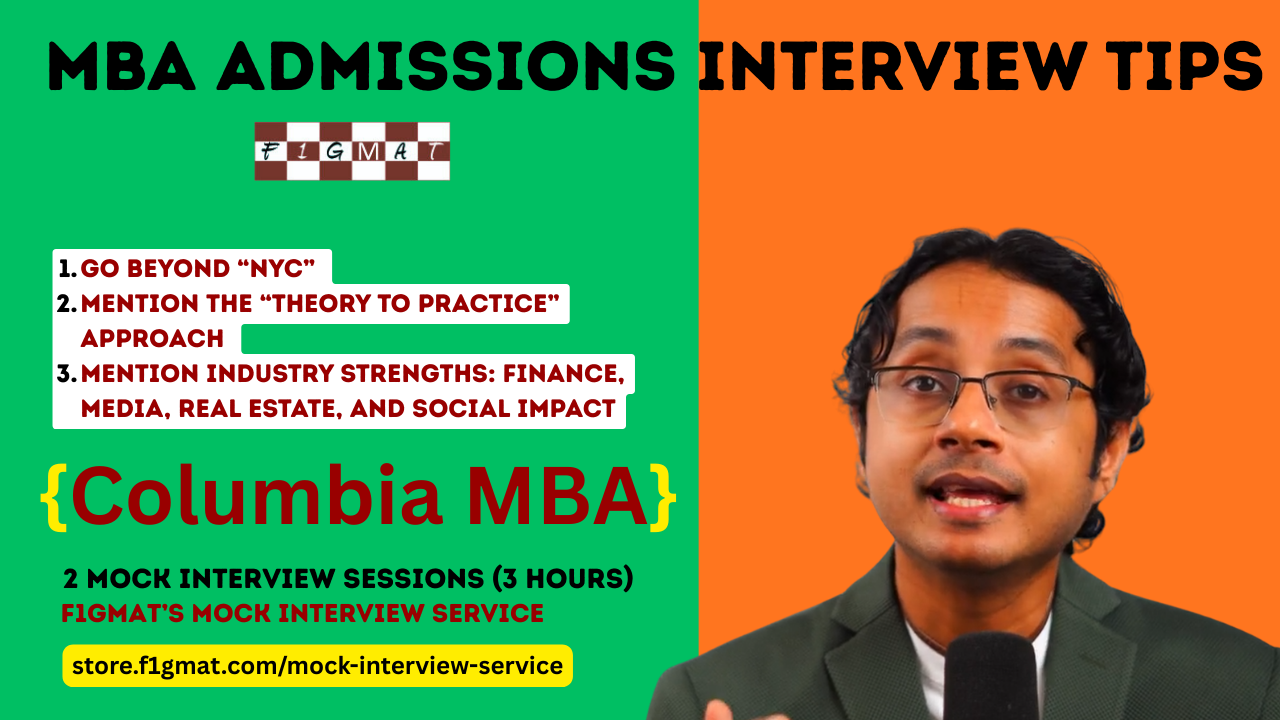
a) Go beyond “NYC”
Connect the location to real opportunities like access to Wall Street, startups, or the Columbia Startup Lab.
b) Mention the “Theory to Practice” approach
CBS’s Master Classes, like Global Immersion or Value Investing, are built for hands-on learning.
c) Refer industry strengths
Finance, media, real estate, and social impact all have strong centers and alumni pipelines (e.g. Heilbrunn Center, Lang Center, SIPA crossover).
d) Highlight Columbia’s community structure
The Cluster System and the Inclusion programs are two unique learning structures and initiatives that foster close collaboration and inclusive leadership.
e) Talk about people you Networked With
Show you’ve engaged with students or alums and learned something you couldn’t find online.
3. Show That You’ve Really Done Your Homework on Columbia
Columbia doesn’t want people who just want “an Ivy League MBA.” They want people who want Columbia. So, go beyond talking about the New York advantage.
Mention courses like “The Entrepreneurial Greenhouse Program” if you're interested in startups or how you're drawn to the “Value Investing Program” if finance is your speciality.
If you’re into social impact, maybe the Tamer Center speaks to your goals.
Talk about specific clubs you’d join, guest speakers you’ve seen in videos or on panels, or even research you’ve done with current students.
Make it clear that you see yourself living and contributing there, not just attending.
4. Lean Into Your Leadership and Team Skills
Whether or not your job title includes “manager,” Columbia is looking for people who can lead.
Share a story where you rallied a team, took initiative, or influenced stakeholders, especially in a tough or high-stakes situation.
If you’ve worked in diverse teams or cross-functional groups, talk about how you built trust, handled conflict, or made decisions.
Be real.
The best leadership stories often explore multiple contexts that clearly show the candidates' resilience under time or client pressure.
5. Be Authentic and Self-Aware
This is not the time to recite a memorized pitch.
Columbia values emotional intelligence and humility just as much as confidence.
If you made a mistake in a leadership role, talk about what you learned.
If you’re nervous about some part of the MBA experience (like being out of school for years or a non-traditional background), it’s alright to mention it; just show how you're preparing to overcome it.
Being genuine can make you more memorable than any perfect answer.
6. Ask Thoughtful Questions That Reflect Curiosity and Fit
The “Do you have any questions for me?” part of the interview isn’t a throwaway; it’s your chance to deepen the conversation.
Don’t ask questions you can Google. Instead, ask about the interviewer’s experience in a specific Columbia program or how they found community on campus.
If they’re an alum, ask how the network supported them post-MBA. Great questions show you’ve thought deeply about this decision.
7. Practice
You want your answers to feel polished but natural.
If you memorize answers word-for-word, you’ll come off as robotic.
Instead, practice storytelling with a coach, and focus on themes, key details, and structure.
You should know the points you want to hit, but still leave room for spontaneity. This helps you sound confident but human.
Don’ts
1. Don’t Wing the Interview Setup
Too many candidates underestimate the logistics of a virtual interview.
Make sure your camera, mic, and internet connection are solid.
Choose a clean, well-lit space where you won’t be interrupted.
Look into the camera, not the screen, to make eye contact.
Treat it like a job interview; you don’t want technical issues to distract from what you’re saying.
2. Don’t Use Clichés or Corporate Jargon
Columbia interviews are conversational; they’re not corporate pitches.
Don’t say things like, “I’m a results-oriented thought leader with a passion for innovation.”
Speak like a real person.
For instance, if you're pivoting from engineering to finance, don’t say “strategic synergies”, say,
“I realized I enjoy solving problems. It doesn't matter if it is technical, organizational, or business-related.”
Plain language is powerful.
3. Don’t Be Vague About “Why Columbia”
Saying “because it’s in New York” or “because it’s prestigious” won’t cut it.
Columbia has a distinctive approach to business education, which emphasizes fast-paced leadership, entrepreneurship, global perspectives, and using NYC as a real-time business lab.
Talk about how you will use the city - will you attend events at the UN? Network with VCs for your startup idea?
Intern at a boutique consulting firm in your second semester?
Make it personal.
4. Don’t Try to Impress With Buzzwords
Some candidates think they have to sound like they’ve already been to business school.
You don’t.
You’re there to learn.
Don’t overuse phrases like “synergy,” “scalability,” or “disruption” unless you can tie them to something real and specific.
Overdoing it can backfire and make you seem like you're trying too hard.
5. Don’t Downplay Mistakes or Weaknesses
Columbia appreciates honest self-reflection.
If you’re asked about a failure or challenge, don’t blame the situation or brush it off.
Talk about what you learned and how it shaped your behavior moving forward.
A well-told “failure” story can be more impressive than a generic success story.
6. Don’t Underestimate the Interview’s Weight
A good interview can tip the scales for you.
Columbia’s process gives weight to this conversation, especially since it's blind and often led by alumni who care about fit.
Take it seriously. That means dressing appropriately, showing up early, and being respectful throughout, even in your thank-you note afterward.
7. Don’t Forget to Show That You’re a Community Contributor
At Columbia, how you plan to give to the community matters more than how you will gain value from the MBA program.
Whether it’s mentoring younger students, helping organize conferences, or bringing a unique perspective to classroom discussions, be sure to communicate how you’ll contribute to the culture and community.
Mention student clubs, diversity initiatives, or cross-school collaborations you’d love to be part of. Columbia wants doers, not just dreamers.
Interview Questions
Personal Background & Self-Awareness
1. Walk me through your resume.
2. What’s your proudest professional achievement?
3. What’s a misconception people have about you?
4. How do you define success, personally and professionally?
Motivation & Fit
5. Why do you want to pursue an MBA now?
6. Why Columbia Business School?
7. What are your short-term and long-term goals?
8. How would you contribute to the Columbia MBA community?
9. What clubs or organizations would you join at Columbia?
Leadership & Teamwork
10. Tell me about a time you led a team.
11. Describe a conflict and how you handled it.
12. What’s a professional challenge you've faced?
13. How have you worked across cultures or diverse teams?
14. What kind of leader are you?
Problem-Solving & Decision-Making
15. What’s your backup plan if your main career goal doesn’t work out?
16. Tell me about a time you received critical feedback.
Extracurriculars & Interests
17. How do you spend your time outside of work?
18. What book, podcast, or article has influenced your thinking recently?
19. How will you take advantage of being in New York City?
Closing & Final Thoughts
20. Do you have any questions for me?
