For applicants writing Harvard MBA essays for the 2026-27 cycle, the Class of 2025 employment report should be read with the industry-function data, not just through the placements by industry.
F1GMAT's Harvard MBA Application Guide, based on Employment trends, should be read through the lens of three Harvard essays for the 2026-27 admissions cycle - the Business-Minded essay (300 words) on career choices and aspirations, the Growth-Oriented essay (250 words) on curiosity and growth, and the Leadership-Focused essay (250 words) on how you invest in others and how you lead.
Each of the six trends carries a positioning & personal branding recommendation written for the specific function within the industry that HBS graduates entered in 2025.
TL;DR: Nine Class of 2025 Trends That Should Shape Your 2026-27 Harvard MBA Application
• Technology accounted for 22% of placements and replaced Product Management (36% of Tech hires), Business Development (20%), and General Management (16%), making commercial fluency the through-line for Tech applicants.
MBA Application tip: Position a commercial career arc (revenue-team, business-development, or general-management work) over an engineering-to-Product-Management ladder, and name the kind of Technology company you want to operate inside.
• Consulting share was stable at 21% despite peers struggling, but the hires were reoriented toward AI deployment, post-merger integration, and operating-model redesign. Open-ended strategy roles with generalist skills collapsed.
MBA Application tip: Show evidence of staying with hard problems through implementation, beyond the point at which the analysis was complete. Aspirational language about "shaping strategy at the C-suite level" reflects an outdated view of the skills in demand right now.
• Private Equity placements fell from 19% to 14% as total compensation rose to $217,500 - a shift toward operator and value-creation roles inside portfolio companies.
MBA Application tip: Replace the deal-modeler narrative with an operator one. Spend essay words on the time spent on operational due diligence, transformation programs at PE-owned companies, or finance roles inside portfolio businesses.
• Investment Management and Hedge Funds at 7% paid the highest total compensation at HBS, $232,500, on a $50,000 signing bonus, with AI-augmented quantitative work replacing traditional new hires.
MBA Application tip: Articulate a defensible investment thesis you have tested and updated. Applicants describe investing as a fascination, with investors, frameworks, and influencers (Warren Buffett & Charlie Munger), overmentions are not the right substitute for the applicant's own record of views formed and revised when wrong.
• Investment Banking held at 6%, with 83% of those hires placed in the Northeast and sector-specific deal experience prized over generalist M&A exposure.
MBA Application tip: Commit to a single sector across your resume and essays. Don't hint that you are exploring broad geographies like London or other non-New York destinations. The opportunities are exclusively in New York.
• Venture Capital paid the highest base salary in the Class, $200,000, even though only 4% were placed in the industry. With the signing bonus doubling from $15,000 to $30,000, funds were rebuilt around late-stage AI infrastructure theses.
MBA Application tip: Be precise about which venture segment you are targeting. HBS places into late-stage growth investing, especially AI infrastructure, with seed-stage placements going through a different applicant pool that HBS does not select for.
• Healthcare (6%) and Manufacturing (5%) placed operators working on consolidation, payer-tech integration, supply-chain redesign, and automation, with Healthcare placing 52% in the Northeast and Manufacturing 40% in the West.
MBA Application tip: Show pre-MBA operating experience inside the industry you are targeting. The admissions committee discounts industry-preference signals from candidates whose resume is specialized for Finance or Consulting roles.
• Finance as a function fell from 38% to 33% of placements as investor roles (PE, VC, Investment Management) replaced execution roles (Investment Banking) inside the Finance umbrella.
MBA Application tip: Make a directional choice between the investor track and the execution track. Hedging across PE, VC, Investment Management, and Investment Banking inside one essay gives the impression that the applicant has not yet decided on a track. Decide before you draft your Harvard MBA Essays.
• Geography split the Class between two coasts, with 48% of hires in the Northeast and 24% in the West, leaving 28% spread across six other regions including 8% international.
MBA Application tip: The feasible geography choice alone is not sufficient. If mid-cap focused PE in New York looks like a logical progression for your experience, choose New York. If the enterprise AI infrastructure in the Bay Area looks most feasible for your experience, choose the Bay Area. Regardless of the location, closely tie that location goal to the pre-MBA experience and the small set of employer types that hire in the niche
Contents
- MBA Application Tips Based on 6 Harvard MBA Placement Trends
- Trend 1: Technology has the largest share with Commercial Roles Replacing Engineering Tracks
- Application Tips for HBS Technology Applicants
- Trend 2: Consulting Held at 21% but Reoriented Around AI Deployment and Implementation Work
- Application Tips for HBS MBA Consulting Applicants
- Trend 3: Private Equity Fell to 14% as Total Compensation Rose to $217,500
- Application Tips for HBS Private Equity Applicants
- Trend 4: Investment Management and Hedge Funds Paid the Highest Compensation in the Class at $232,500
- Application Tips for HBS Investment Management Applicants
- Trend 5: Investment Banking Held at 6% with 83% of Hires Concentrated in the Northeast
- Application Tips for HBS Investment Banking Applicants
- Trend 6: Healthcare and Manufacturing as Counter-Cyclical Operator Pathways
- Application Tips for HBS Healthcare and Manufacturing Applicants
- Related Download
- Related Service
- References
MBA Application Tips Based on 6 Harvard MBA Placement Trends
Trend 1: Technology has the largest share with Commercial Roles Replacing Engineering Tracks
Technology accounted for 22% of the Class of 2025 but Marketing absorbed 36% of HBS Tech hires, Business Development absorbed 20%, and General Management absorbed 16%. 72% of these placements were into commercial roles oriented around revenue, partnerships, and operator-level decisions. Product Management, the role most often described in HBS MBA Application essays as the canonical post-MBA Technology path, did not appear in the top three functions.
The market required leaders who could translate a model into a buyable product and an enterprise partnership into recurring revenue.
The geography reinforces the pattern. 46% of HBS Technology hires went to the West (the San Francisco Bay Area, Seattle, and Los Angeles) and 42% went to the Northeast (Boston and New York). The two coasts together placed 88% of Tech hires, which mirrors where AI commercialization activity concentrated through the cycle.
Application Tips for HBS Technology Applicants
How to Build the Narrative Around Your Expertise
If you are writing an HBS application targeting Technology, the most expensive mistake you can make is to describe your post-MBA aspiration as Product Management at a large platform company. The data shows HBS does not place its graduates into that function at any measurable scale.
Business-Minded Essay (300 Words)
The Business-Minded essay asks how your choices have influenced your career path and aspirations.
A consultant who chose enterprise software clients over financial services clients made a commercial choice.
An engineer who chose a product-marketing rotation over a senior engineering role made a commercial choice.
A startup operator who chose the head-of-revenue path over the head-of-engineering path made a commercial choice.
The essay should name two or three such inflection points.
Explain the trade-off you saw at the time, and connect each choices to a post-MBA goal that is within Marketing, Business Development, or General Management at a specific kind of Technology company (enterprise AI infrastructure, applied AI in a regulated industry, or vertical SaaS).
The fit with the post-MBA role should be obvious from the narrative.
Start by creating a short mission-statement like line for the draft essay, "Post-MBA, I want to be a Director of Product Marketing at an enterprise AI infrastructure company in the West".
Use this statement as the guiding force for your entire essay.
What to avoid
Positioning your career progression as a series of technical promotions that culminate in a Product Management role.
The admissions committee will read your resume and confirm the technical depth, but that doesn't mean you fit in the HBS MBA technology cohort.
Brand yourself from the resume to essay to recommendation letter as the commercial technology applicant, not the technology applicant who was knee deep only in the technology architecture.
Growth-Oriented Essay (250 Words)
The Growth-Oriented essay asks for an example of how you have demonstrated curiosity and how that curiosity influenced your growth.
For a Technology applicant, the curiosity could be about the commercial mechanics of a Technology product, not curiosity about the Technology itself.
A software engineer who spent six months shadowing the enterprise sales team to understand why deals close is a clear sign of showing commercial curiosity.
A McKinsey consultant who built a side project benchmarking pricing models across a Technology vertical shows commercial curiosity.
A product manager who interviewed twenty customers to understand why the activation rate stalled shows commercial curiosity.
The essay should describe one specific instance, what you noticed that others ignored, what you did about it, and what you learned that changed how you operate.
The story should resolve to a behavioral change that you carried into the next role.
Harvard reads the Growth-Oriented essay as evidence that you have a track record of converting curiosity into life-long capabilities.
What to avoid
Writing about curiosity for the underlying Technology itself (large language models, transformer architectures, distributed systems). That curiosity belongs to the engineering candidates Technology companies hire from computer-science PhD programs.
Leadership-Focused Essay (250 Words)
The Leadership-Focused essay asks what experiences have shaped how you invest in others and how you lead.
For a Technology applicant targeting Marketing, Business Development, or General Management, show influence without formal authority, a constraint most of you in the 27-32 age group had to deal with.
A Marketing leader at a Technology company spends most of their week influencing Product, Engineering, Sales, and Finance teams, dealing with the eccentricities and narrow focus of each function. They do not report to the applicant.
A Business Development leader has the skills to negotiate with external partners and internal stakeholders simultaneously.
A General Manager runs a profit-and-loss line by aligning teams that have competing incentives. The essay should describe one experience in which you shaped an outcome by investing in people who did not work for you, what you noticed about them as individuals, how you adjusted your approach, and what they did differently as a result.
The most persuasive HBS MBA Leadership essay names the key stakeholders, the context of the challenge, and the specific change in their behavior to show the applicant's influence.
What to avoid
Leadership stories built around hierarchical authority is obvious. They do carry weight. But without structuring a conflict narrative or building up enough context around the 'large' problem the team was solving, the story won't hold up.
Managing a team of direct reports is a useful experience, but it does not map to the cross-functional, influence-without-authority work that defines commercial leadership inside Technology.
Trend 2: Consulting Held at 21% but Reoriented Around AI Deployment and Implementation Work
Consulting placed 21% of the Class of 2025 at a median base of $190,000, a signing bonus of $30,000, and total compensation of $220,000. The share held flat against 2024, which is significant in a market where total Consulting hiring slowed across the industry. The geography distribution was concentrated with 44% of hires in the Northeast, reflecting the Boston and New York office concentration of McKinsey, Bain, and BCG, the three firms that dominate HBS Consulting recruiting.
What changed between 2024 and 2025 is the nature of the work the firms staff HBS graduates onto. Through Q3 2024 and Q2 2025, client demand at the major firms shifted away from open-ended strategy assignments, the multi-month engagements that ended with a 200-page deck and a board recommendation, toward AI deployment, post-merger integration, and operating-model redesign.
AI deployment means moving a client from a proof-of-concept that runs on a single dataset to a production system that runs the client's business.
Post-merger integration means combining two operating models, two technology stacks, and two cultures after a transaction closes.
Operating-model redesign means rebuilding how a client organizes its people, its processes, and its decision rights to absorb a major shift in the market.
All three are implementation-heavy.
They reward candidates who can sit inside a client organization for nine months and produce a working result over candidates who can produce a recommendation and exit.
This change in work type also explains why HBS Consulting compensation held flat at $220,000 while compensation at boutique strategy houses softened. The firms paying the HBS rate are the firms with the largest implementation books of business.
Application Tips for HBS MBA Consulting Applicants
How to Build the Narrative Around Your Expertise
For a Consulting applicant, the positioning task is to convince the admissions committee, and by extension the recruiters at McKinsey, Bain, and BCG who interview HBS students in the fall of their first year, that you can do implementation work.
The candidates who pattern-match to the old Consulting archetype, the recommendation-builder who writes a clean memo and walks away, no longer match the function as it is hired today.
Business-Minded Essay (300 Words)
The choices to highlight should be around hard problems past the point at which most analysts walk away or accept failure.
An investment banking analyst whose formal role ended at the signing of a deal, but who stayed for three weeks to sit in on the post-close integration meetings, made an implementation choice.
The deal's economic case depended on merging two sales teams onto a single compensation plan in the first ninety days, and the analyst wanted to learn whether that work held together once the bankers had moved on to the next mandate. That is an explicit leadership narrative that went beyond and above the applicant's responsibility. Now if the IB applicant shows interest in consulting, the motivation will align.
A product manager who chose to run the launch operations instead of handing off to the launch team made an implementation choice. For example, the product might have tested well in beta with five customers, but the activation rate on the broader release was the variable the executive team cared about, and the product manager wanted to see for themselves which of the launch decisions (the trial length, the onboarding email sequence, the first-touch sales motion) the data would reject
A nonprofit operator at a youth education organization took charge of the revenue line item, the fees the organization charged school districts for its programs. That revenue covered 35% of the budget but was being run like a grant program. The operator wanted to learn whether they could run it like a business, with competitive renewal rates and gross margin per district replacing impact stories alone. This applicant is addressing the biggest believability gap when writing Harvard MBA Business minded essay - competency to pivot from non-profit to for-profit consulting.
The essay should name one of these moments, and describe why you stayed. The 'Why' subtly answers the curiosity angle too even for the business minded essay, and explain how that pattern shaped your post-MBA aspiration.
The aspiration should be specific to the work the major firms now staff HBS graduates onto - AI-deployment engagement at a financial services client, now with Agentic AI & governance initiatives, a post-merger integration at a healthcare services platform with regulatory and privacy hurdles, an operating-model redesign at a consumer goods company facing margin pressure to address the price sensitivities of Gen Z. The reader should see that you understand what a Senior Associate at McKinsey does day to day in 2026-27.
What to avoid
Framing Consulting as where you will learn business.
The major firms pay HBS associates $190,000 in base salary on the assumption that the associate arrives fluent enough in operating mechanics and basic financial analysis to be deployed onto a client problem from week one.
An aspirational line written as "I want to use Consulting to build my foundation in general management" is a weak connection to the post-MBA goal.
The admissions team will assume the applicant is one or two years too early in their career, even if that line might be used to show enthusiasm.
Growth-Oriented Essay (250 Words)
The curiosity narrative should describe an instance in which you went past the standard analysis and learned how the work got done in its nitty gritties. Most interesting insights are hidden from superficial analysis.
The HBS MBA Admissions team is figuring out how you unearth these insights and grew with it.
Case Study: Finding Process Fault-lines
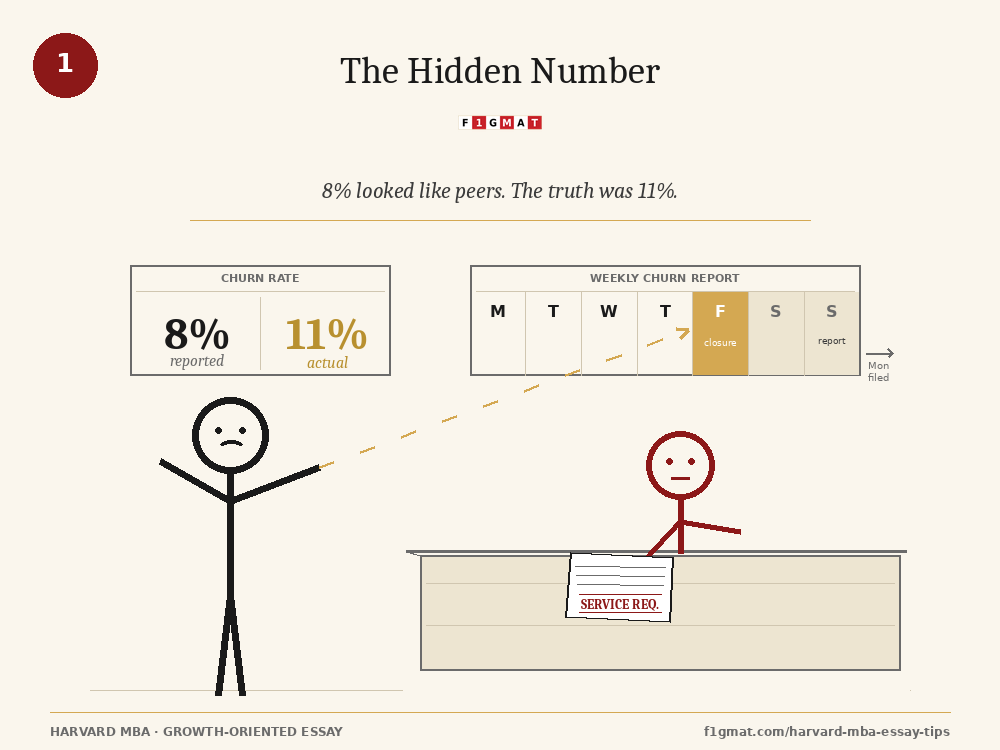
A consultant on a customer-retention study at a regional bank was told the churn rate was 8%, in line with the churn rate seen among competitors. Three weeks of working with the branch teams revealed that the bank's largest single source of attrition was customers who closed an account on a Friday afternoon. Because the closure paperwork was filed the following Monday and the weekly churn report ran Sunday night, the branch staff coded the closure as a "service request" rather than a customer losing event.
The consultant's recommendation was to timestamp every closure event immediately so that when the report ran the next Sunday, the closure paperwork and the timestamp matched.
The true churn rate was 11%, a data that the marketing and operational team kept a close eye on. The metric defined the bank's entire strategy.
The essay should describe such curiosity moments and what you learned from it.
The growth should be visible in a later episode, because curiosity without behavioral change reads as anecdotes about your professional contribution. That is not the intent behind the question.
What to avoid
Curiosity essays where the entire focus is on you - you saw the pattern, you broke down the problem, you intervened, you escalated. It is all you, you, you.
In real consulting work, you would be wrong many times. You will certainly be in a room where there are colleagues who know more than you.
A curiosity essay with no supporting character or no conflict or even push back, brings down the intellectual range that is present in good Growth oriented and curiosity HBS MBA Essay.
Leadership-Focused Essay (250 Words)
The leadership story that maps to AI-deployment and post-merger-integration work is leadership inside a client environment, in which you have no authority over the client's employees and limited authority over your own team's time.
The essay should describe an experience in which you influenced cross-functional stakeholders over a sustained period without being their manager.
Case Study: Receiving Buy-In from Influential Stakeholders
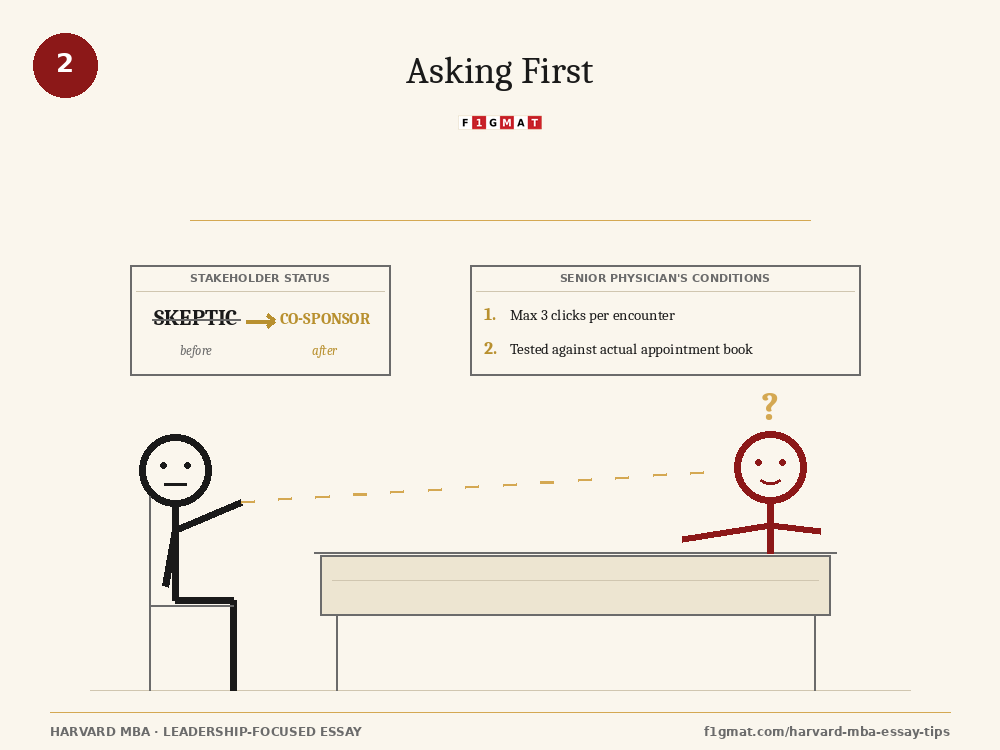
For one consultant, the first example of influencing stakeholders outside their team was getting the physicians to let the applicant into the exam rooms. He went to the practice's monthly partners' meeting, sat in the back, and asked the senior physician what would have to be true about a new system for the practice to consider it worth the disruption.
The senior physician, who had objected to previous attempts from other IT vendors, cited two conditions - the system could not add more than three clicks to a routine encounter, and the configuration would have to be tested against the practice's actual appointment book before going live, to measure the efficiency of such a system. The applicant agreed to both in the room, in front of the other partners, which converted the senior physician from a skeptic to a co-sponsor.
The second example of influencing was the IT director. The director had pre-selected the corporate-default configuration on the grounds that any deviation would create a maintenance burden for the platform team across the system's other twenty-three practices. The applicant did not argue the technical merit of the revised configuration in the director's office. He presented the director through the exam-room observations one workflow at a time, and let the director ask their own questions about which deviations were genuinely needed and which were just preference.
The IT director pre-selected the features that the applicant had prioritized and let the director feel ownership for the change.
What to avoid
Leadership stories about mentoring a direct reportee. The story is good for Top 15 MBA programs outside the M7, but it does not stand out among HBS peers, who has several client-facing, influence-based leadership examples to cite.
Trend 3: Private Equity Fell to 14% as Total Compensation Rose to $217,500
Private Equity placed 14% of the Class of 2025 for a total compensation of $217,500, down from 19% in 2024 - a five-percentage-point decline, or roughly forty fewer HBS graduates entered PE year over year. The Total compensation rose from $211,363, a small increase that signals the remaining roles became more selective and more operator-oriented.
Private Equity funds make money when they sell portfolio companies, either through an Initial Public Offering (the company's first listing on a public stock exchange), a sale to a strategic buyer (another operating company), or a sale to another financial sponsor (another PE fund) or through a continuation vehicle (continue under a different fund name).
In 2025, the IPO window remained narrow, and strategic buyers held back on large transactions, which left PE funds holding portfolio companies longer than their typical 7-year hold period.
Limited Partners, the institutional investors who put capital into PE funds, responded by pressing General Partners (the fund managers) for Distributions to Paid-In Capital, the cash that comes back to investors.
To generate distributions without favorable exit markets, GPs leaned harder on operational value creation inside their existing portfolio companies, which required hiring HBS graduates into operator-adjacent roles such as Vice President of Operations, Portfolio Operations Associate, and Chief of Staff to the CEO, in place of the traditional deal-team associate role.
The geography held its historical pattern, with 49% of PE hires in the Northeast (New York and Boston), the concentration of large buyout platforms.
Application Tips for HBS Private Equity Applicants
How to Build the Narrative Around Your Expertise
For a PE applicant, the positioning shift is from "I can model a leveraged buyout" to "I can work with a portfolio company and change how it operates."
Business-Minded Essay (300 Words)
A two-year investment banking analyst who chose a third year doing operational due diligence on a portfolio company made an operator-leaning choice.
A management consultant who chose to run a transformation program for a PE-owned company made an operator-leaning choice.
A startup operator who chose a finance role inside a portfolio company made an operator-leaning choice.
All three roles fit the ideal PE post-MBA Harvard role.
The essay should name these moments, describe the trade-off you saw, and connect them to a post-MBA aspiration inside a PE-owned operating environment.
The aspirations should match the ambition of the fund - large-cap buyout, mid-cap operationally focused or sector-specialist and the kind of role valued in these funds.
A reviewer should be able to picture the next ten years of your career.
What to avoid
Any value creation example with no second order impact.
For example, saving procurement costs would also involve working towards capital recovery or building new supply chain partners.
Applicants who talk like an analyst often talk in percentage or short engagements (3-6 months), which is typically what a PE deal analysis involve.
The operator role are 9 to 12 months in duration and the breadth of how the applicants talks about portfolio company is a tell on whether they were involved in operations.
Growth-Oriented Essay (250 Words)
Deal mechanics are taught in the second-year analyst class at any bank. The negotiation and incentive work is taught nowhere and learned only by sitting close to people whose money or authority is on the table.
The story should describe a moment when you watched a negotiation up close.
Case Study: Misaligned Incentives
The CFO of a target company was walking through the projected sales.
An associate, who sat in on a working session spent most of his time on two documents - the CFO's retention package and the head of sales' commission structure.
The CFO was paid against the EBITDA targets the new accounts produced.
The head of sales was paid against existing-account volume, with new-account openings carrying a flat bonus last negotiated in 2021.
The new plan asked the head of sales to spend his team's time opening new accounts instead of selling more into the existing ones. The existing accounts paid him commission on every dollar of volume.
By curiously breaking down the incentives of key stakeholders, the applicant could spot the mismatch between the incentives and the turnaround plan.
What to avoid
Curiosity stories about following the deal market or admiring a particular fund would give the impression that the applicant is a distant spectator cheering on the sidelines. The curiosity narrative should be around data, but it is not about top-level insights, but around the deal details that require working closely with the stakeholders.
Leadership-Focused Essay (250 Words)
The leadership story that maps to operator-leaning PE work is leadership inside an operating environment, in which you shaped outcomes by working through line managers, frontline employees, or functional leaders.
The most persuasive essay narratives takes place in a setting that resembles a PE-owned portfolio company where there are delicate egos and dynamics that need careful maneuver.
Nothing is cut and dry like a Harvard MBA case study.
Case Study: Strategic Leadership
A second-year investment banking analyst at a bulge-bracket bank, was chosen for a rotational leadership program in her third year where she was assigned as a portfolio operations associate inside a mid-cap PE sponsor's $1.4 billion industrials platform.
The role reported jointly to the platform CFO and the sponsor's operating partner, and it required her to support the 100-day plan the deal thesis had promised the limited partners.
Three months into the rotation, she found that the deal thesis's 400-basis-point margin improvement required terminating two regional suppliers whose owners were personal friends of the platform CEO.
The platform CFO had known for weeks about the cozy relationship but had not raised it, because asking the CEO to end two friendships was a fight the CFO did not have the political capital with the CEO to win.
The applicant concluded that the suppliers had to go.
But taking the view to the operating partner herself would burn the CFO relationship that made her position viable.
So she built the IRR impact of terminating in month four versus month nine versus month eighteen, with the cost of preserving the friendships quantified as a line item.
By analyzing previous tough decisions, the applicant knew that if she directly raised the issue, the CEO would defend his position but he tend to accept decisions that were fund mandated.
The CFO presented the brief at the monthly operations review with the line item on cost vs. benefit for letting go the supply chain friends.
The operating partner took the call to the investment committee and the committee chose month-four termination, which they communicated to the CEO as a fund mandate.
The terminations happened on schedule and the year-one margin improvement came in on the deal-model curve.
The applicant’s could strategically maneuver a delicate political decision and the CFO offered a recommendation letter confirming her maturity and her unique insight to bring the decision as a fund mandate.
What to avoid
If you don’t have the operator leadership role, don’t manufacture a story. Instead share a story of how you created a system that continue to guide the team.
Even better, explore extra-curricular and volunteering experience where operator role was critical for the reach, funding or impact in the community.
Trend 4: Investment Management and Hedge Funds Paid the Highest Compensation in the Class at $232,500
Investment Management and Hedge Funds together placed 7% of the Class of 2025 at a median base of $182,500, a signing bonus of $50,000, and total compensation of $232,500. The total figure was the highest among the major industry clusters, exceeding even Private Equity. The signing bonus, at $50,000, signals selective hiring with high upfront compensation, the pattern that asset managers and hedge funds use to compete for a narrow set of candidates.
53% of IM/HF hires were in the Northeast (New York and Greenwich, Connecticut) and 25% in the West (San Francisco, where several large quantitative funds have offices).
Application Tips for HBS Investment Management Applicants
How to Build the Narrative Around Your Expertise
Business-Minded Essay (300 Words)
For an Investment Management applicant, the positioning challenge is that this is the smallest of the major HBS Finance tracks and the most selective.
To build a credible business-minded essay, the applicant must show the origin of their interest.
Case Study: The Journal of Investments
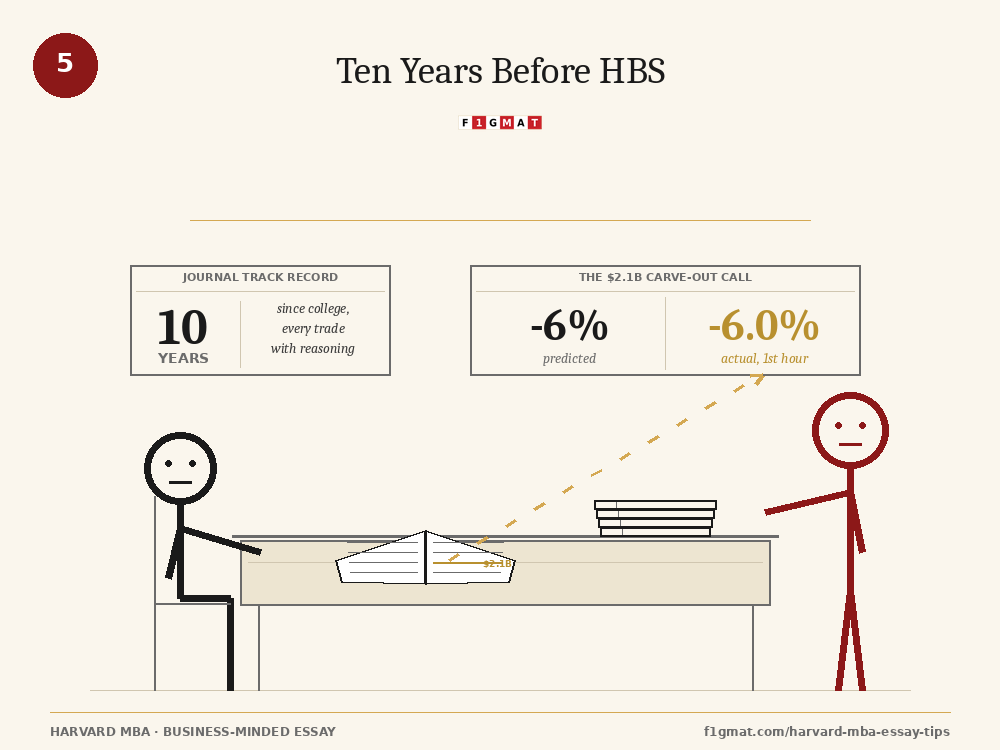
Starting as a college student, when an applicant kept a journal of every trade with his reasons for exits and buys is a good hook on the origins of the applicant's interest in the HBS MBA Business-Minded essay, but it is the middle when the applicant reveals why the journal became a key decision-making tool that builds the essay.
By the second year, the applicant was the analyst the M&A partners called when they wanted a quick opinion on whether the equity market would punish a buyer's stock the morning a deal was announced.
The defining moment came on a $2.1B carve-out where he had argued, in the staffing meeting, that the market would discount the buyer because retaining a customer base influenced the pricing. The trend was elaborately documented throughout the years in the journal.
The deal was announced, and the stock fell six percent in the first hour.
Writing the post-mortem made the applicant realize that he had built up the discipline to be in investment management for over two decades.
Harvard MBA is a formalization of a path he had already traversed.
What to avoid
Using generalities of investment management without any specifics.
"Post-MBA, I want to join a fundamental long-short equity fund focused on the consumer sector. My pre-MBA work in consulting has given me deep exposure to consumer companies, and I have developed a research process that combines management-team evaluation with bottom-up unit-economics" is a generality.
"Post-MBA, I want to join MaverickCapital's consumer team as a senior analyst supporting Andrew Warford on the discretionary-retail book. Maverick currently runs long positions in TJX and Costco that I would argue are positioned against the same secular shift in consumer-staples pricing power that I worked on for a private-label client at Bain last year," is a line that shows specific IM goal only an applicant with real ambition and experience can write.
Growth-Oriented Essay (250 Words)
The curiosity that reads as credible for an Investment Management applicant is curiosity about a specific market, sector, or instrument that you have followed long enough to be wrong about and then have updated your position. It should not just be around a theory or perspective. You must have lost and learned.
A lot of curiosity narratives are around thinking. For Investment management, it should be about loss, course correction, and optimization.
An applicant who shorted a stock that doubled, learned why their thesis was wrong, and developed a more disciplined framework for separating quality businesses from cheap ones.
The curiosity behind the exploration is an interesting read over the conclusion.
What to avoid
Curiosity stories about the financial markets in general, the macroeconomy in general, or a famous investor's biography.
Leadership-Focused Essay (250 Words)
Two analysts looking at the same company can run the same numbers, reach the same earnings estimate, and produce the same model.
One will ask" what does this company earn next year," and the other will ask" what would have to be true about this company for our position to be wrong by 30%."
The second question is the one that an IM applicant should build the narrative around. The " doubt " is what makes an interesting leadership story.
Keep the chance of ruin across the narrative.
Trend 5: Investment Banking Held at 6% with 83% of Hires Concentrated in the Northeast
Investment Banking placed 6% of the Class of 2025 at a median base of $175,000, a signing bonus of $50,000, and total compensation of $225,000.
The share held flat against 2024 numbers in absolute terms. This is a good sign after the deeper declines of 2022 and 2023, when slower deal markets reduced banking hiring across business schools.
The geography pattern is unique - 83% of HBS Investment Banking hires went to the Northeast, a single-region concentration unmatched by any other major industry in the report.
The firms hiring HBS graduates for the M&A advisory work and the sector-specific coverage roles were the bulge-bracket banks and the elite boutiques (Centerview, Evercore, Lazard, Moelis, PJT Partners, Guggenheim), all of which concentrate their senior MBA hiring in New York. The 17% of hires placed outside the Northeast went to a small number of West Coast (San Francisco) Technology-banking roles, Houston-based energy banking roles, and Chicago-based industrials roles.
The signing bonus, at $50,000, matches what IM/HF paid and exceeds what Private Equity paid.
Application Tips for HBS Investment Banking Applicants
How to Build the Narrative Around Your Expertise
The traditional investment banking schools are Wharton, Columbia, and Stern, all of which place a larger share of their class into bulge-bracket and elite-boutique seats than HBS does.
For the application essays, the positioning should be to highlight the general-management training HBS is known for.
Even more important is to position yourself as a trusted advisor.
The trusted advisor has four distinguishable capabilities.
The trusted advisor knows what the client is not saying, anticipating the board-level concern or political constraint the CEO has not revealed.
The trusted advisor evaluates the second-order consequences of a transaction, the impact on the top customers, the regulator, the institutional shareholder, and the activist building a stake.
The trusted advisor manages the room, sequencing a multi-stakeholder conversation so that the CEO, the CFO, the board, and the activist each hear what they need to hear.
The trusted advisor keeps the relationship alive between transactions, staying in contact with research the client can use.
These characteristics of the ‘trusted advisor’ must be captured throughout your Harvard MBA essays.
Business-Minded Essay (300 Words)
The 300 words cannot cover all four trusted-advisor capabilities.
Pick the one that best matches the pre-MBA experiences you have drawn on and build the essay around that single capability.
The capability of reading what the client is not saying fits the applicant who has worked closely with senior client-side executives and developed a feel for the political constraints those executives operate under.
The pre-MBA experience where the applicant identified an unstated concern - a board member's objection the CEO was dodging, a regulator's view the general counsel had not formalized, and a key customer's displeasure that had not yet surfaced in the relationship are all good examples
The capability of reading second-order consequences fits the applicant whose analytical work has gone beyond the deal model.
The capability of managing the room fits the applicant whose pre-MBA work has prepared and briefed a senior banker, a senior consultant, or a senior executive for a multi-stakeholder meeting.
The capability of keeping the relationship alive between transactions fits the applicant who has built a working relationship with a client outside the boundaries of any single mandate or transaction
Whichever capability the applicant picks, the essay should connect the capability to the case method and to a specific kind of senior-advisory role as a goal - elite-boutique advisory at Centerview, Evercore, or PJT; sponsor-coverage at the bulge brackets or boutiques; bulge-bracket sector coverage at the VP-and-above level.
What to avoid – Harvard MBA Business-Minded Essay
A generic Mergers and Acquisitions narrative that treats banking as a single function fails to impress the Harvard MBA AdCom.
Naming all four capabilities in 300 words ends up diluting the entire narrative.
Pick one trusted advisor narrative and build your entire pre-MBA IB experience around it.
Growth-Oriented Essay (250 Words)
Curiosity narrative for Investment Banking applicants must be around second-order effect.
Case Study: Finding Weakness in Strategic Acquisitions
For one applicant, a large regional hospital was the target of the acquisition. To truly understand the hospital’s unique positioning in the market, he had to study the payer model. Patients don’t directly pay hospitals. The patient’s health insurance company pays the hospital on the patient’s behalf.
The applicant’s curiosity drove him to find the levers each stakeholder had in the region.
The regional hospital’s leverage was in the trust local patients had in their brand.
For the insurance company, the leverage came from the wider pool of patients it covers.
The hospital had a weak negotiating position because it had only one payer.
The insurance company accounted for 31% of the hospital’s revenue.
On the other hand, the insurance company had acquired a Medicare Advantage organization, a privately administered Medicare program that gives the insurance company a fixed amount per enrollee per month, giving them a predictable cashflow and a unique leverage to negotiate price with the hospital.
The deal team didn’t think about such market dynamics before the negotiation.
The applicant with his curious exploration shared the variable reimbursement the insurance company deployed with the hospital.
Based on the leverage the insurance company had, the team priced the deal accurately and went into the negotiation better prepared for asking the right price for acquiring the hospital
What to avoid – Harvard MBA Curiosity Essay
For any deal story, you must be part of the deal. Don’t write a thesis around a deal or your perspective on a deal.
Harvard wants to see you in action.
Leadership-Focused Essay (250 Words)
For the leadership essay, focus on mentorship.
Case Study: Mentoring and Learning from a Mentee
The same IB applicant when he was in his 3rd year worked with a junior analyst, who was building a model on strong technical foundation. The numbers were perfect, the understanding about the market was strong and she had done her homework on the regional surgical-center platform, the team was about to buy.
Interestingly, she has not asked a single question from the applicant or his peers, who all had worked in the niche for over two years.
The applicant pro-actively started coaching the junior person on the importance of evaluating reimbursement, which determined the profit forecast.
She had assumed that by focusing on R&D, and strategic acquisitions, she could have a better perspective on the potential of the platform.
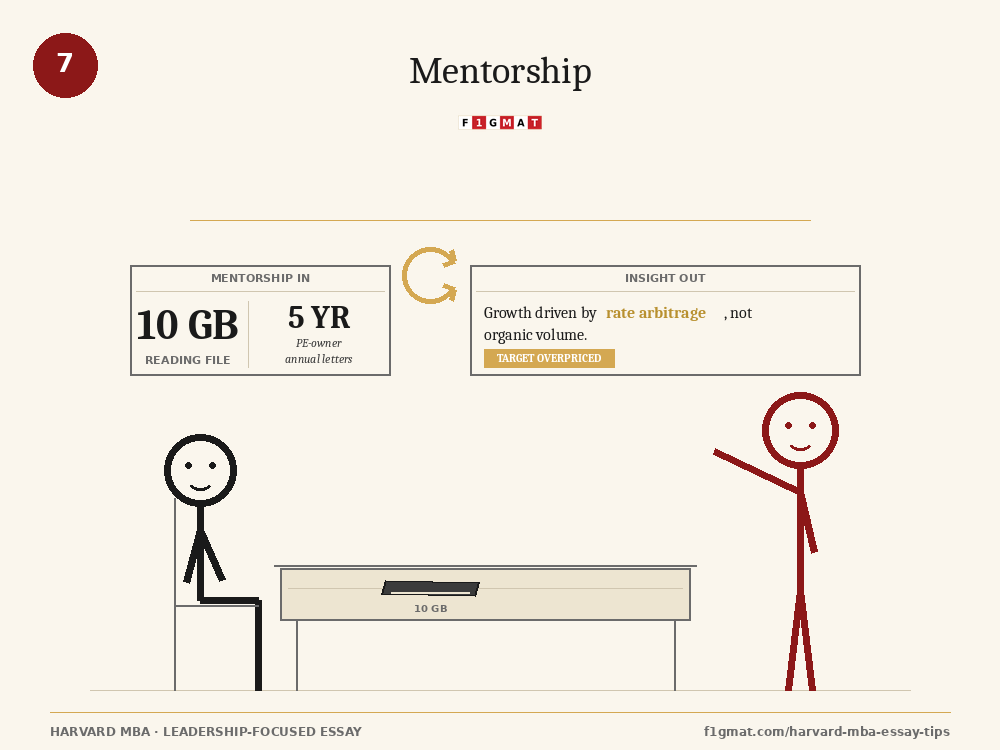
The applicant shared a 10GB reading list that covered every single annual letters the PE owner had shared over the past five years. Because the fund was exclusively focused on surgical-center platforms and associated assets, the insights were gems that not many LLM or even first-hand research could reveal.
The junior analyst read the entire 10GB worth of research material over the weekend and shared her deep gratitude for the guidance.
In the kickoff meeting, the lead Vice President asked the team what they thought of the asset's quality and she broke down the rate-change arbitrage the regional surgical-center platform was leveraging over organic volume growth.
The target was overpriced.
Although the applicant had built a general consensus on the target, he learned a new insight on where the entire healthcare platforms market was heading.
In addition to being a mentorship experience, he also learned from his mentee on the direction in which targets should be evaluated.
What to avoid – Harvard MBA Leadership Essay
Leadership stories that center on a recreational team, a college club presidency, or a volunteer board is the go-to narrative for most.
Keep it as the second option.
Focus exclusively on professional leadership if you had the chance to mentor or build a team.
Trend 6: Healthcare and Manufacturing as Counter-Cyclical Operator Pathways
Healthcare placed 6% of the Class of 2025 at a median base of $160,000, a signing bonus of $30,000. The total compensation of $190,000 also placed 52% of hires in the Northeast (Boston, New York, Philadelphia).
Manufacturing was surprisingly stable at 5% of the class despite a relatively low median base salary of $162,000, a $15,000 signing bonus, and total compensation of $177,000. The 40% of hires were surprisingly concentrated in the West - San Francisco Bay Area, and the Pacific Northwest, unlike the boom one has seen in the South and the Midwest.
The two industries served as counter-cyclical pathways through 2024 and 2025 placements.
Healthcare placed HBS graduates in payer-technology integration (health insurance operations and technology platforms), provider consolidation (the operational work of merging hospital systems and physician practices), and value-based care strategy.
Manufacturing placed HBS graduates into supply-chain redesign where the pricing pressure from the disruption in 2020-22 started a new wave of nearshoring and resilient logistic network. The tariff pressure accelerated the demand for nearshoring strategy, mostly in moving production from Asia to Mexico, Central America, and the United States.
A parallel automation deployment was scaling with the arrival of Physical AI in manufacturing and Ambient AI systems in healthcare workflows.
Application Tips for HBS Healthcare and Manufacturing Applicants
How to Build the Narrative Around Your Expertise
The applicant targeting Healthcare or Manufacturing out of HBS is choosing a function that pays $30,000 to $50,000 less in total compensation than the Finance and Consulting tracks.
The admissions committee reads the application closely to understand why you want to persist in the industry.
The committee is figuring out your mission-driven thinking to continue in the industry.
They are also trying to understand where you fit in a Physical AI world and in an increasingly consolidated and inefficient healthcare system.
The dominant feeders for Manufacturing operating roles post-MBA are offered by Ross, Tuck, and Kellogg, all of which have stronger operations curricula and stronger industrial-employer relationships than HBS does.
The HBS positioning should be around general-management training applied to operationally complex businesses, with strong regulatory barriers, capex, and customer concentration.
Business-Minded Essay (300 Words)
The choices in your career should be built on a backdrop of the operating environment. The constraints and opportunities should also reveal why you want to continue in the industry.
A strong sense of 'born' to be in the industry is a theme I consistently sense in these essays.
For Healthcare, the operating exposure might be a year inside a hospital system where the candidate watched the CFO model different scenarios for revenue maximization. He might have shown a strong insight into the latest regulations and laws around insurance and coverage.
It might be a role in a PE-backed roll-up, where the candidate watched a single acquired practice's struggle to integrate into a corporate management system, and learned why the integration was harder than the deal model assumed.
For Manufacturing, the operating exposure might be a year on the factory floor of a mid-cap industrial company. It should ideally be during an automation deployment, where the candidate learned why the production-engineering team's automation case missed the union-contract constraints.
It might be a procurement role during a nearshoring transition, where the candidate learned why the supplier-qualification process for a new Mexican facility took eighteen months rather than the six the strategy plan assumed.
The essay should build the narrative around these operating constraints and explain what the exposure taught the applicant about the industry's mechanics.
The post-MBA role should be precise - a Director of Strategy at a PE-backed platform, a General Manager at a mid-cap industrial company executing a nearshoring strategy, or a Vice President of Operations at a Healthcare-focused growth-stage company.
Show preference for the high-pressure high-impact roles.
That is the only way you can justify Harvard over Ross, Tuck, or Kellogg.
What to avoid
Don't look at these two industries as opportunities for making a difference, changing the culture, or bringing innovative solutions.
These are dinosaurs in a bird world.
Focus instead on a few niche functions where you could have a realistic impact.
Pick your niche before writing the essay.
Growth-Oriented Essay (250 Words)
The curiosity narrative is all around, sharing an insight that the AdCom would be surprised to learn. Showcasing operating knowledge in a narrative format, built around your journey, is one way to show deep expertise.
For example, a consultant on a hospital operating-model engagement spent two weeks shadowing the central pharmacy and noticed that the medication-error rate was 40% higher on the night shift than on the day.
The deal team had been asked to reduce overall medication-error rates by 20%, and the standard answer would have been more training and tighter pharmacist supervision.
She sat through three night-shift handoffs and saw that the handoff document was a printed paper sheet that the day-shift pharmacist filled out in the last fifteen minutes of their shift, after they had been working for eleven hours.
The fatigue was built into the error rate.
The consultant's recommendation was not to retrain the pharmacists but to redesign the handoff document with three structured fields for medication changes, and to move the document-completion task from the last fifteen minutes of the day shift to the first thirty minutes of an overlap window the staffing schedule already allowed.
The night-shift error rate dropped by 60% in the next quarter, and the engagement's overall medication-error reduction came in at 38% instead of the 20% target.
The curiosity angle is that the consultant started asking, on every subsequent hospital engagement, what the night-shift handoff document looked like and when in the shift it was completed.
On her next two engagements, she found similar handoff-design issues in two different operational areas.
The Harvard case method rewards this kind of curiosity.
Lean into any operational and productivity improvement narratives.
What to avoid
The worst examples are all macro-level analyses about healthcare delivery, automation, or corruption in the system. These are all good critiques about the industries, but tough to adapt into an essay narrative for Harvard MBA, unless you had a measurable impact on changing systems, preferably published in a newspaper.
Leadership-Focused Essay (250 Words)
All leadership-focused essays that I still remember had some element of the applicant remaining closer to where the action was.
The essay should describe a moment when the applicant changed how a group of frontline employees worked, how the applicant intervened, and what was the observation that the floor team had missed.
It should feel raw and around real challenges.
Case Study – Improving Packaging Productivity
An applicant who, as a continuous-improvement engineer at a mid-cap industrial company, was asked to reduce changeover time on a packaging line from 22 minutes to 14 minutes. The obvious observation was that the line operators were not following the standard work procedure.
The applicant spent two weeks running changeovers alongside the line operators and discovered that the standard work procedure had been written by an engineer who had never run the changeover at the line's actual production speed, and that two of the procedure's steps were physically impossible to complete in the order specified while the machine was hot.
The applicant asked the four line operators to write a new procedure together over a two-day workshop.
The operators produced a procedure with the same target time but a different sequence of steps.
The line hit 14-minute changeovers within a month, and the two operators who had led the workshop became the trainers for the other shifts.
Eighteen months later, when the applicant had moved on to a different plant, the operators had revised the procedure twice more on their own as they discovered further improvements, without the involvement of the engineer.
The leadership example was not about the applicant's leadership trait. It was all about empowering the operators and creating a culture that self-improves, with each operator given an incentive to iteratively improve productivity.
The applicant suggested a bonus structure that was recently adopted to credit operators who had improved the efficiency of the packaging unit.
The leadership was around ownership, empowerment, and incentives.
What to avoid
Second-order leadership, where you intervened one step above, but the real work was done by a team member below your role.
Related Download
Related Service
References
- Harvard Business School Class of 2025 Employment Report
- F1GMAT Harvard MBA Salary by Industry, Class of 2025 Analysis
- F1GMAT Harvard MBA Salary by Job Function, Class of 2025 Analysis
- F1GMAT Harvard MBA Salary by Job Location, Class of 2025 Analysis
- F1GMAT Harvard MBA Essay Tips, Analysis, and Strategies
- F1GMAT Harvard MBA Curriculum Analysis
- F1GMAT Harvard MBA Return on Investment Analysis