Wharton MBA interviews are by invitation only and feature a unique two-part format designed to mirror the school’s collaborative, team-based learning environment.
In this in-depth Wharton MBA Interview Tips, we cover:
• Format
• Duration
• Style
• Location
• Do’s
• Don’ts
• Team Based Discussion - Questions
• Interview Questions
Format
Once invited, you’ll participate in a Team-Based Discussion (TBD) with 4–5 other applicants, followed by a 10-minute one-on-one interview with a member of the admissions team.
Duration
The duration of the Team-Based Discussion (TBD) is 35 minutes, while the one-on-one interview with the admissions team is 10 minutes.
Style
The style of the TBD is highly interactive, collaborative, and dynamic, where you are expected to meaningfully contribute to the discussion while allowing your peers to express themselves meaningfully.
While coaching for TBD and interviews, we have emphasized the need to incorporate strategies that push the discussion forward. This involves preventing the discussion from getting lost in the details or not interrupting too soon. The balance is the key here.
Location
The interview is conducted by the admissions staff or trained second-year students, depending on the region and timing.
Do’s
1) Think Beyond Speaking – It’s About Listening and Building
The Wharton TBD is not a “speak the most” contest. Interviewers are evaluating how well you build on others’ ideas, not how quickly or aggressively you push your own. That means listening carefully, using phrases like “building on what Alex said…” and weaving in ideas that move the team forward.
It’s more like an executive boardroom meeting than a debate.
Think of yourself as someone who is trying to co-create a great idea, not dominate the conversation.
2) Lead, But Know When to Step Back
It’s natural to want to lead, but Wharton values inclusive and adaptive leadership.
Try initiating the discussion or keeping time, but don’t bulldoze.
If someone is being left out, make room for them.
If the team is stuck, help redirect. A strong candidate is someone who can guide and empower others, not just take the spotlight.
Leadership here means influence, not dominance.
F1GMAT's Mock Interview Service - Interview Prep with Atul Jose (Admissions Consultant, F1GMAT)
With F1GMAT's Mock Interview Service, you'll gain three key advantages:
1. The ability to deliver 3-5 ideas for the TBD
2. The skill to infuse your responses with genuine emotion and authenticity.
3. Expert guidance to craft a 1-minute pitch that feels fresh, original, and free of clichés.
For any questions about F1GMAT's Mock Interview service, email me, Atul Jose, at [email protected]
Covered in the 3-hour MBA Admissions Mock Interview session:
1) Planning and practicing the answers for the standard interview questions
• How to answer the “Tell us about yourself” introductory question?
• How to answer Walk me through your resume?
• What is the greatest accomplishment in your professional career?
• What is your leadership style?
• How would you contribute to the School Community?
• What is the most difficult obstacle you overcame?
• Are you a Creative Person?
• How do you define Success?
• How to answer about Innovative Solutions?
• Answering Frequent Job Switch
• How did you Handle Conflict?
• How did you manage Change?
• Give an Example of an Ethical Dilemma you faced. How did you handle it?
• Answering Greatest Accomplishment
• How did you Handle a Difficult Boss?
• Tell me a time when you made a Mistake. What did you learn from it?
• How to summarize your Career?
• How to explain low grades?
• How to answer Scenario Questions?
• How to answer the Backup Plan Question
• How to discuss about Industry Experience & your Role?
• What Questions should you ask the AdCom after an MBA Admissions Interview?
• Tell me about yourself that is not covered in the application
• What are your post-MBA goals?
• What is your plan B if you can’t achieve your short-term goals?
• Why consulting/finance/marketing/general management (if you are a career switcher)
2) Follow-up Questions based on your resume
3) Follow-up Questions based on your essays
If you need help, subscribe to our $349 (3 hours) mock interview session, where I will offer immediate feedback after each question on improving:
1) The tone
2) The transitions
3) The style and
4) The narrative of your overall story, covering the broader achievements in your career and the choices in your life
I will ensure that your answers sound authentic.
Next Step
1. Purchase the service from F1GMAT's Store
2. Send an email to Atul Jose (Admissions Consultant)([email protected]) with your latest resume and the essays used for the application.
3) Practice Strategic Thinking in Real Time
You’ll be given a prompt ahead of the TBD, and you can prepare by brainstorming several angles and connecting them to real-world business cases or ideas you care about. But also leave room to improvise.
What the admissions team wants to see is whether you can think critically under time pressure, align ideas quickly, and co-create a structure or framework.
Practicing with peers or a coach can help refine your approach.
4) Make the One-on-One Personal
The 10-minute one-on-one interview after the TBD isn’t just a formality.
The admissions officer might ask you to reflect on your performance, but often they also want to know why Wharton, or how you think about your career, and community.
Be ready with a tight narrative: what you learned from the group dynamic, what motivates you, and how Wharton fits into that journey.
This is your moment to add a human, introspective angle to your performance.
5) Master the “Why Wharton” Question – And Mean It
When you’re asked, “Why Wharton?” don’t recite the brochure.
Show that you’ve made a real discovery.
Maybe you want to leverage the Lauder Institute for your global ambitions or the flexible core that lets you explore fintech and healthcare together.
Mention programs like Wharton Interactive, Leadership Ventures, or the McNulty Leadership Program, but tie them back to your path.
Wharton wants people who know why they’re coming, not just why they’re leaving their current job.
You should tactfully rephrase the Why Wharton narrative from your essays.
Applicants, when they practice with us, share their worry that rephrasing their essays would be seen as a lack of creativity.
I argue that the contrary is true.
If you fumble and stumble through your answers
6) Know Your Resume Inside-Out
You won't just be evaluated on the TBD; your background will also come up in the one-on-one. Be ready to talk about your professional choices, the “why” behind career moves, and the impact you've had.
Wharton values people who have shown growth, curiosity, and responsibility, even if their path isn't linear. Every bullet point in your resume should have a clear story behind it.
7) Use the Interview to Reflect Wharton’s Mission
Wharton is about elevating business to serve a broader purpose, social impact, global advancement, and innovation.
When you share your goals or stories, align them with this larger purpose.
Are you aiming to lead a sustainability-driven supply chain?
Build more inclusive fintech platforms?
Shape equitable healthcare access?
Weave that vision into your responses so you sound like someone who truly belongs at Wharton.
Don’ts
8) Script a strong 1-minute Pitch bit, not the entire TBD
Some candidates memorize a full proposal for the TBD and try to force it in. That backfires.
Only script for the 1-minute pitch.
Don't script narratives for the entire team-based discussions.
The discussion is unpredictable and dynamic.
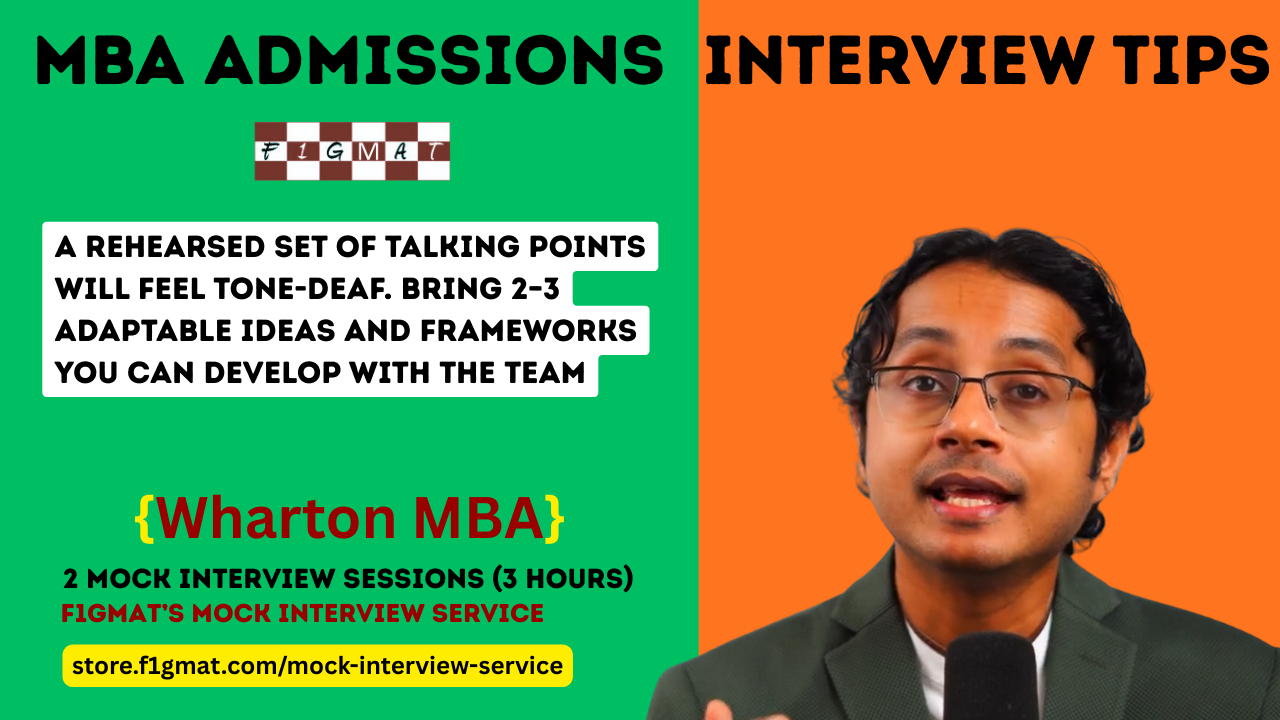
A rehearsed set of talking points will feel tone-deaf if it doesn’t match the team’s direction.
Instead, bring 2–3 adaptable ideas and frameworks you can develop with the team.
It shows flexibility and strategic thinking, both key traits Wharton values.
9) Don’t Dominate the Discussion
Speaking more doesn’t equal scoring more. In fact, it can hurt you.
If you speak for too long without giving space to others or acknowledging their contributions, you’ll be seen as a poor collaborator.
Use your voice to guide, not dominate.
Collaboration is a leadership skill at Wharton, not just a checkbox.
10) Don’t Ignore the Business Context
The TBD prompt is usually tied to real-world business, student life, or community in and around Wharton.
Don’t give vague or abstract responses.
Think like an MBA student: bring structure, feasibility, and business logic.
If you're proposing a new initiative, consider resources, stakeholders, risks, and alignment with Wharton’s values.
You’re being evaluated on how you think like a future Wharton leader.
Balance ambition with realistic plans.
11) Don’t Underestimate the One-on-One
Many candidates over-focus on the group and treat the one-on-one interview as a time for relaxing.
Big mistake.
The admissions officer wants to see reflection, humility, and insight. Don’t be defensive or overly self-congratulatory about your TBD performance.
Share one thing you thought went well, one thing you’d do differently, and tie it back to how you learn and grow.
12) Don’t Try to Be Someone You’re Not
Wharton has a diverse student body: consultants, engineers, social entrepreneurs, and marketers.
There’s no “ideal persona.”
Don’t try to mimic someone else’s voice or leadership style in the TBD.
Be your authentic self: if you’re analytical, show how you simplify complexity.
If you’re empathetic, highlight how you help build consensus.
The admissions team wants you, not a polished caricature.
13) Don’t Skip the intent behind the TBT Prompt
You’ll get the TBD prompt a few days in advance.
Don’t skim it and show up with general ideas.
Break it down, analyze the keywords, and understand the hidden objectives.
Ask yourself: What problem are we solving?
Who are the stakeholders?
What resources does Wharton have?
What is lacking at Wharton?
How can your ideas help?
How can your background and experience help?
Can you bring a unique perspective from your experience that your peers cannot offer?
How to strategically quote your experience in the discussion to transition into the ‘big’ idea?
What outcome is Wharton looking for from this conversation?
14) Unique to Wharton – Don’t Forget to Reflect Team-Centric Values
Wharton puts a lot of emphasis on teamwork.
If you fail to demonstrate openness to diverse opinions or show signs of being too individualistic, it will raise red flags.
The school is big on collective excellence. You need to show through your behavior that you thrive in teams and can elevate those around you.
Team-Based Discussion - Questions
In the TBD, you're given a business or school-related scenario and are asked to collaborate with other candidates to develop a plan or idea. These are sample prompts from recent years or inspired by Wharton’s actual style.
1. Design a new course or program at Wharton that addresses the future of work and technology.
2. Propose a new initiative to improve diversity, equity, and inclusion across Wharton’s student body.
3. Develop a Wharton Global Modular Course focused on emerging markets—what country, what topic, and why?
4. Create a new alumni engagement strategy to strengthen Wharton’s global network.
5. Suggest a new Wharton student club or conference to address trends in sustainability and ESG investing.
6. Design a leadership initiative that prepares students to lead in times of crisis and uncertainty.
7. Propose a strategy for Wharton to support entrepreneurs who want to build ventures in underserved markets.
8. Create a student-driven initiative that increases collaboration between Wharton and other UPenn graduate schools.
9. Recommend a summer pre-MBA program that helps incoming students build leadership or technical skills.
10. Plan a new Wharton tradition or event that builds class cohesion and strengthens school spirit.
Interview Questions
The interview questions are personal, reflective, and focused on your motivations, background, and takeaways from the TBD.
Expect 2–4 of these, depending on how much you have contributed to the discussions.
1. How do you think your team performed in the discussion?
2. What role did you play in the team dynamic?
3. If you could do one thing differently during the TBD, what would it be?
4. Why MBA?
5. Why Wharton?
6. What are your short-term and long-term goals?
7. What other schools are you applying to, and why?
8. Tell me about a time you resolved conflict in a team setting.
9. What is a piece of feedback you’ve received that changed your approach to leadership?
10. How will you contribute to the Wharton community outside the classroom?
