Updated for the Class of 2028 | F1GMAT Research
The Columbia MBA is a two-year, full-time program at Columbia Business School in Manhattan, structured around 60 graduate-level credits (18 credits of required core, minimum 42 credits of electives) and offered through two entry points: August (20-month track) and January J-Term (16-month track).
TL;DR
- Class of 2027 enrolled 982 students from 7,477 applications, a 21% acceptance rate and a 13.1% enrollment rate.
- Test scores held: GMAT (Classic) 734, GMAT Focus 690, GRE 163Q/163V, GPA 3.6, average 5 years of work experience.
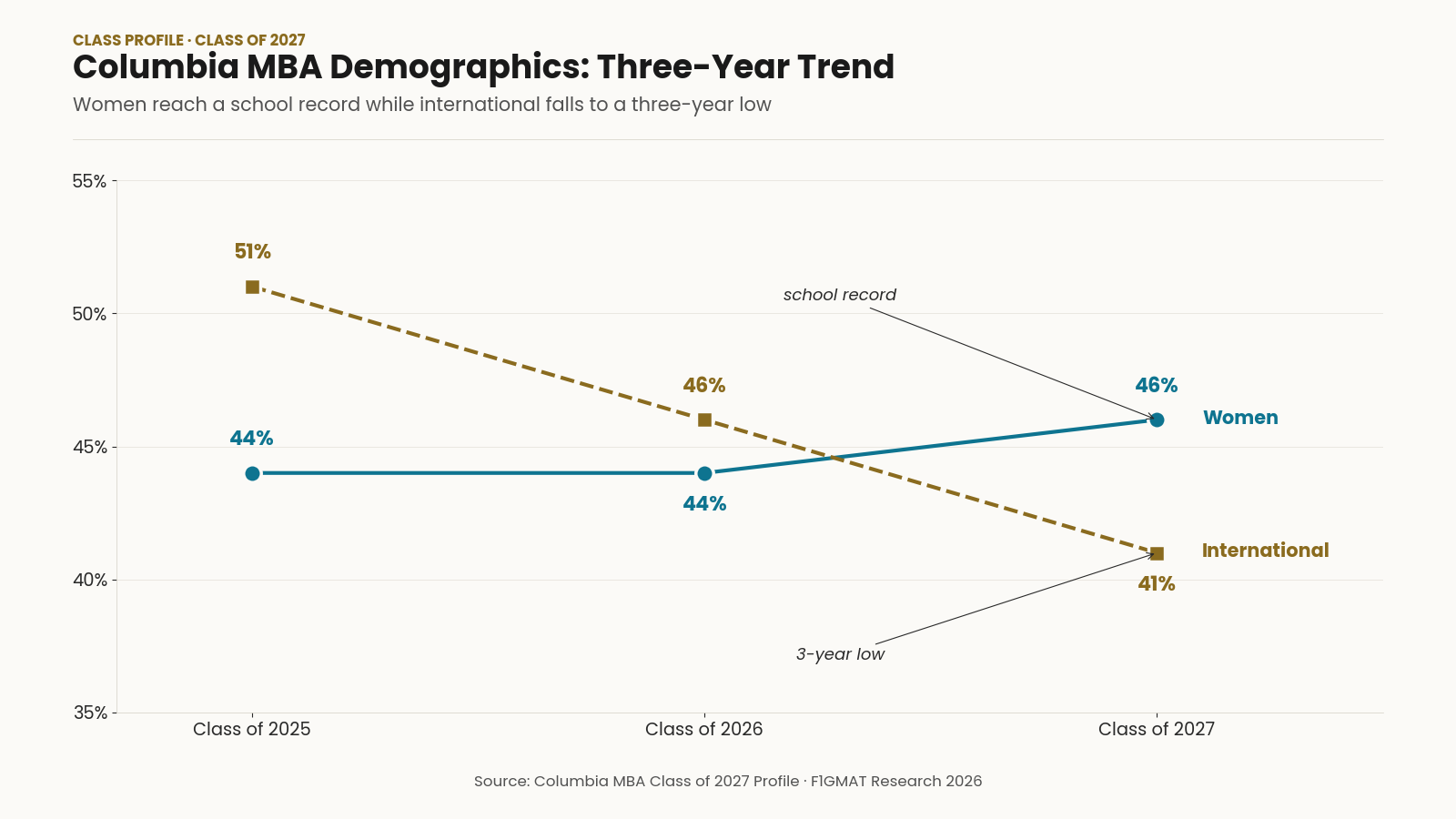
- Demographics: women 46% (school record), international 41% (3-year low), US minority 48% (school record).
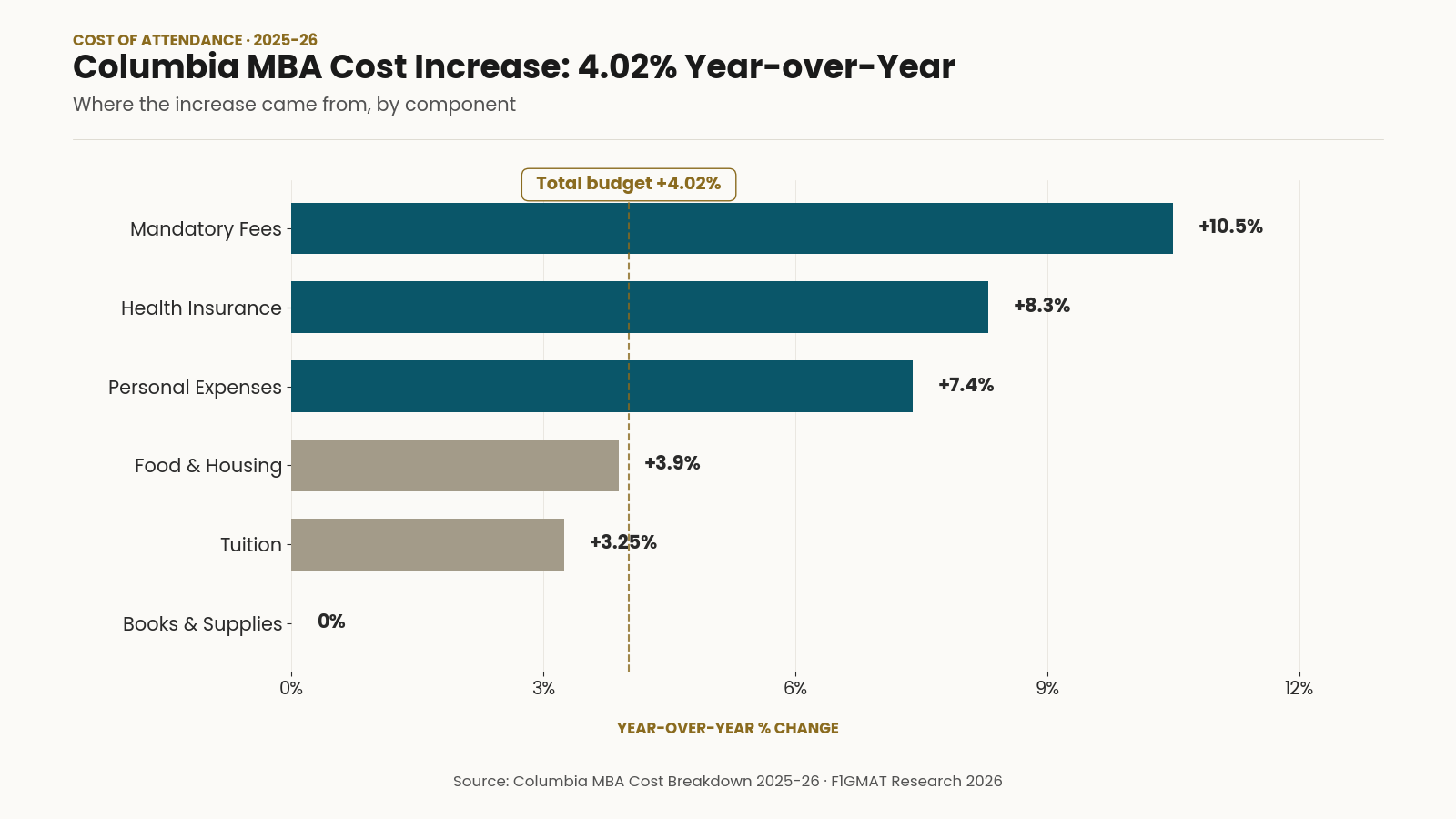
- 2025-26 first-year cost is $137,571, up 4.02% from $132,258. Tuition is $91,172, the highest among M7 programs.
- Columbia Business School MBA program demands a thorough 60-credit curriculum focused on seven key elective areas
- Students benefit from 17 diverse non-transcript pathways, alongside opportunities for ten dual degree programs and flexible J-Term entry options
- 92% of the Class of 2025 secured roles within three months of graduation
- A third in Financial Services ($245K total salary), A third in Consulting ($220K total salary), and 10.2% in Technology ($202K total salary)
Columbia continues to draw the largest financial-services pre-MBA cohort among the M7 MBA programs.
Contents
Columbia MBA Class Profile
Main Article: Columbia MBA Class of 2027: Profile and Analysis
Class Size and Admissions Funnel
From 7,477 applications[1], the Columbia MBA Class of 2027 enrolled 982 students, 758 in the August 2025 entry and 224 in the January 2026 J-Term. The acceptance rate is approximately 21%, with an estimated 63% yield rate and a 13.1% enrollment rate. Application volume held flat against the 7,487 record set the prior cycle, while enrolment continued to grow from 844 (Class of 2025) to 972 (2026) to 982 (2027).
Academic Profile
As we look at the 2027 Columbia MBA Class entry criteria, it's clear that the competition for CBS is getting fiercer. The average GMAT score for the Classic test has risen to 734, up from 732 in 2026 and 729 in 2025. However, things don't look as rosy for the GMAT Focus edition, a tougher version of the GMAT test, which saw its average score dip to 690 for the CBS MBA Class of 2027. This means that while applicants are getting more competitive overall, they are struggling to keep a similiar scaled performance in the Focus edition.
The toughness of the Focus edition has forced many to pivot to GRE, with the average in both Quant and Verbal sections now sitting at 163. Interestingly, the average GPA for undergraduate students remains unchanged at 3.6, which is still the magic number for U.S. applicants hoping to crack top MBA programs. And despite the rising stakes, work experience is staying steady at five years with Employers not keen on taking risks on inexperienced applicants, especially in our AI-first world where domain expertise matter.
Demographics
Despite the surge in female applicants, a record 46% of the class at Columbia, the decline in international students to 41% (lowest level in 3 years) could indicate that women from underrepresented countries are struggling to secure visas or are opting out of the program altogether.
The rise in U.S. minority applicants to a record high of 48% has pitted women of color against each other. While minority women applicants are finding a better outcome this year, limited scholarships and financial aid dedicated for women candidates have skewed a high potential demographic below the 50% threshold schools were aiming for three years ago.
Pre-MBA Industry
Financial Services, a traditional anchor for MBA applicants, remains a staple at 30%. However, the decline in Consulting to 23% - down from 25% in the previous cycle shows the the recession-proof consulting sector needs more specialized talents. MBA Applicants who traditionally targeted CBS MBA for strategy roles have opted out.
Instead a new breed of consultants transitioning from core Technology and Finance role have represented the CBS MBA class as the rise of STEM undergraduate majors to 31% clearly shows the new demand. Skills in AI-integration and AI-first workflow, shows the immediate need to offer candidates with AI-integrated coursework through electives and even core.
The modest growth in Government and Non-Profit applicants to 7% came after the 2023 boom in Goverment hiring, which crashed in 2025 with the Dodge and govt-wide budget cuts.
Military returned to 4% and energy, which was considered a non-existent industry, returned with 2% representation.
Columbia MBA Cost
Main Article: Columbia MBA: Cost Breakdown and Funding Tips
First-Year and Two-Year Cost of Attendance
The cost of pursuing an MBA has increased to $137,571 for the 2025-26 academic year[2], a 4.02% rise from the previous year. The primary driver of this growth is a 3.25% increase in tuition, now standing at $91,172. This is the highest annual tuition among M7 programs.
The total cost of attendance for the two-year program is estimated to range from $268,669 to $272,300, depending on the assumption for second-year tuition that the variable pays mandatory fees, health insurance, books, food, housing, personal expenses, and transportation remain within the inflationary upper limit. But if we go by the recent trends, Mandatory fees (+10.5% first year only)[4], health insurance (+8.3%), and personal expenses (+7.4%) drove the increase well above the 4.02% total.
Fellowships and Need-Based Aid
Merit fellowships include the Forté Fellowship (women), the Ronald O. Perelman Family Scholarship (full tuition), the Robert F. Smith '94 Scholarship, the Meyer Feldberg Distinguished Fellowship (full tuition), and the McGowan Fellowship (full tuition). One application can be used to consider both merit and need-based awards[3].
Need-based awards range from $25,000 to full tuition, with around half of applicants receiving an award. The average award is around $20,000. Additionally, veterans with 100% Post-9/11 GI Bill coverage can participate in the Yellow Ribbon Program, which provides up to $40,000 in additional tuition support annually.
Loans for Domestic and International Students
Federal Direct Unsubsidized Loans are capped at $20,500 per year for U.S. citizens and permanent residents, with Federal Graduate PLUS Loans covering the remaining gap to the cost of attendance. International students may access private loans through cosigners or no-cosigner lenders like Prodigy Finance and Quorum Federal Credit Union, which typically take 4-6 weeks to process.
Additional funding information can be found on the Columbia MBA cost analysis page, including the full year-over-year cost component breakdown and fellowship award amounts.
For a comprehensive guide to funding strategies across top MBA programs, see " How to Fund M7 and T20 MBA - A Complete Guide ".
Columbia MBA Curriculum
Main Article: Columbia MBA - Curriculum Analysis
The 60-Credit Rule and Two Entry Tracks
The Columbia MBA has a 60-credit structure[5], with 18 credits of required core coursework and a minimum of 42 credits of electives. Students who pass an exemption exam can replace a core class with an elective. Even with a large number of electives, there are no expemption to the 60-credit rule.
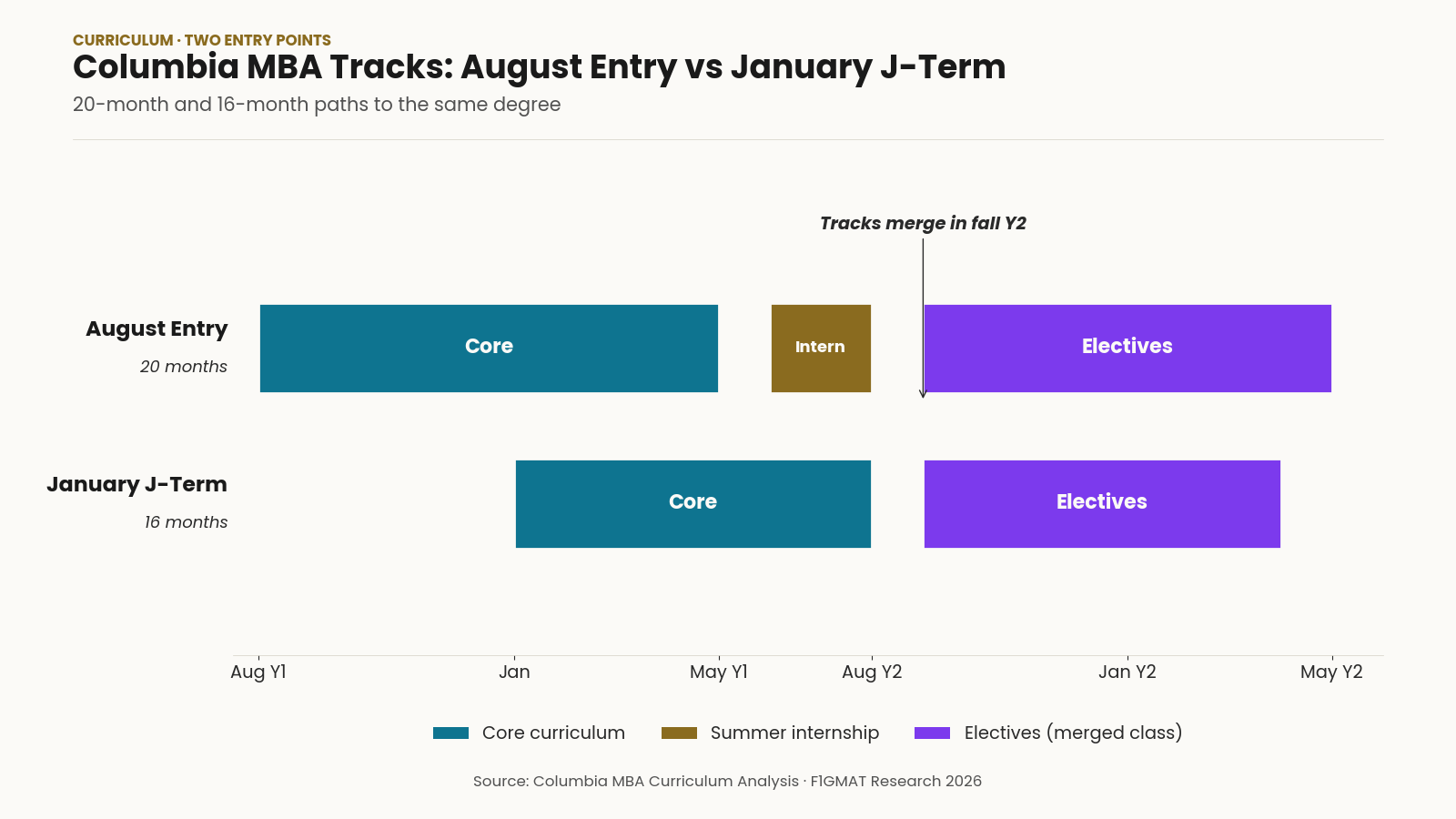
The August-Entry is a 20-month program. Students begin in late August and join a cluster of around 65 peers for all core classes, with the summer between Year 1 and Year 2 reserved for an internship.
The January-Entry (J-Term) is a 16-month program for students who do not need a summer internship, typically entrepreneurs, sponsored students, or applicants planning to stay in their pre-MBA industry. J-Term students complete the core over spring and summer terms and merge with the August class in the fall of the second year.
The two Columbia MBA entry points compared on a single calendar. August Entry runs 20 months across two academic years with a summer internship between them. January J-Term runs 16 months continuously through summer with no internship. Both tracks complete the same 60 credits and merge into a shared elective experience in the fall of Year 2.
Core Curriculum and Electives
The core coursework covers 18 credits divided into two full-term and eight half-term. The courses include Financial Accounting, Lead: People Teams Organizations, Foundations of Valuation, Corporate Finance, Marketing, and Global Economic Environment.
After completing the core, students can choose from over 300 electives[7], organized into seven areas: Accounting, Decision Risk and Operations, Economics, Entrepreneurship, Finance, Management, and Marketing. Among the seven focus areas, Finance has the deepest catalogue of courses we have seen in any top MBA program, including the long-running Value Investing with Legends and Private Equity Field Study courses.
Pathways and Specialized Programs
The school offers 17 non-transcripted Pathways[6] that help students choose electives related to specific careers, without limiting their options too much with a concentration.
These Pathways cover areas like Venture Capital, Private Equity, Climate, Data Analytics and AI, Asset and Wealth Management, and Real Estate.
The school also has several Centers that run research and programs, including:
- The Eugene Lang Entrepreneurship Center
- The Paul Milstein Center for Real Estate
- The Heilbrunn Center for Graham & Dodd Investing
Additionally, the school has several Formal Programs that focus on specific areas, such as:
- Healthcare and Pharmaceutical Management
- Media and Technology
- Private Equity
- Global Family Enterprise
Global Learning and Dual Degrees
The Chazen Institute for Global Business runs three formats: Global Immersion Programs, the MBA Exchange Program and Global Study Tours.
The Chazen Global Study Tours offer full-time MBA students an opportunity to immerse themselves in business culture in a foreign country, providing a more experiential and student-driven approach to learning. Unlike the Global Immersion Programs, the Global Study Tours have a shorter duration and typically have minimal on-campus classroom component.
These tours are student-organized with support from Chazen, allowing students to take ownership of their learning experience and explore business culture in a country or region of their choice. The Global Study Tours do not offer academic credit, but are designed to provide valuable learning and networking opportunities.
The Chazen MBA Exchange Program allows full-time MBA students to spend a full semester studying at a top international business school. This program provides a unique opportunity for students to immerse themselves in another country's business culture and educational system.
During the exchange program, CBS MBA students take classes and integrate into local life through prestigious institutions such as London Business School, HEC Paris, and National University of Singapore, among the two dozen partners, and gain a deeper understanding of the host country's business culture.
Academic credit earned abroad is transferable back to Columbia, and the program is competitive, with multiple application rounds per year.
Chazen Global Study Tours offer a flexible, experiential alternative to more structured international experiences. Led by student organizers, these 7-12 day trips provide a unique blend of business culture immersion and company access.
With faculty adviser support, students participate in company visits, executive meetings, government events, and cultural excursions, gaining a deeper understanding of the host country's business environment.
Students act as Columbia ambassadors, participating in all meetings, which are mandatory. No academic credit is offered, but students can earn travel grants through the Chazen Travel Fund.
Costs are relatively low, ranging from $2,000 to $3,000, and international airfare is not included. The program is open to current full-time CBS MBA students only. Student teams propose and lead tours, with applications due six months in advance. Successful leaders can become Chazen Leadership Fellows and receive subsidies on program fees.
Columbia offers ten dual degree options that combine the MBA with another graduate program, including the JD/MBA with Columbia Law, the MD/MBA with Physicians and Surgeons, and the MBA/MPH with the Mailman School of Public Health. The full list of dual degrees, the per-area elective catalogues , the experiential learning programs (Pangea Advisors, Nonprofit Board Leadership, International Development Consulting), and the complete pathways breakdown are on the Columbia MBA curriculum analysis page .
Columbia MBA Salary and Placements
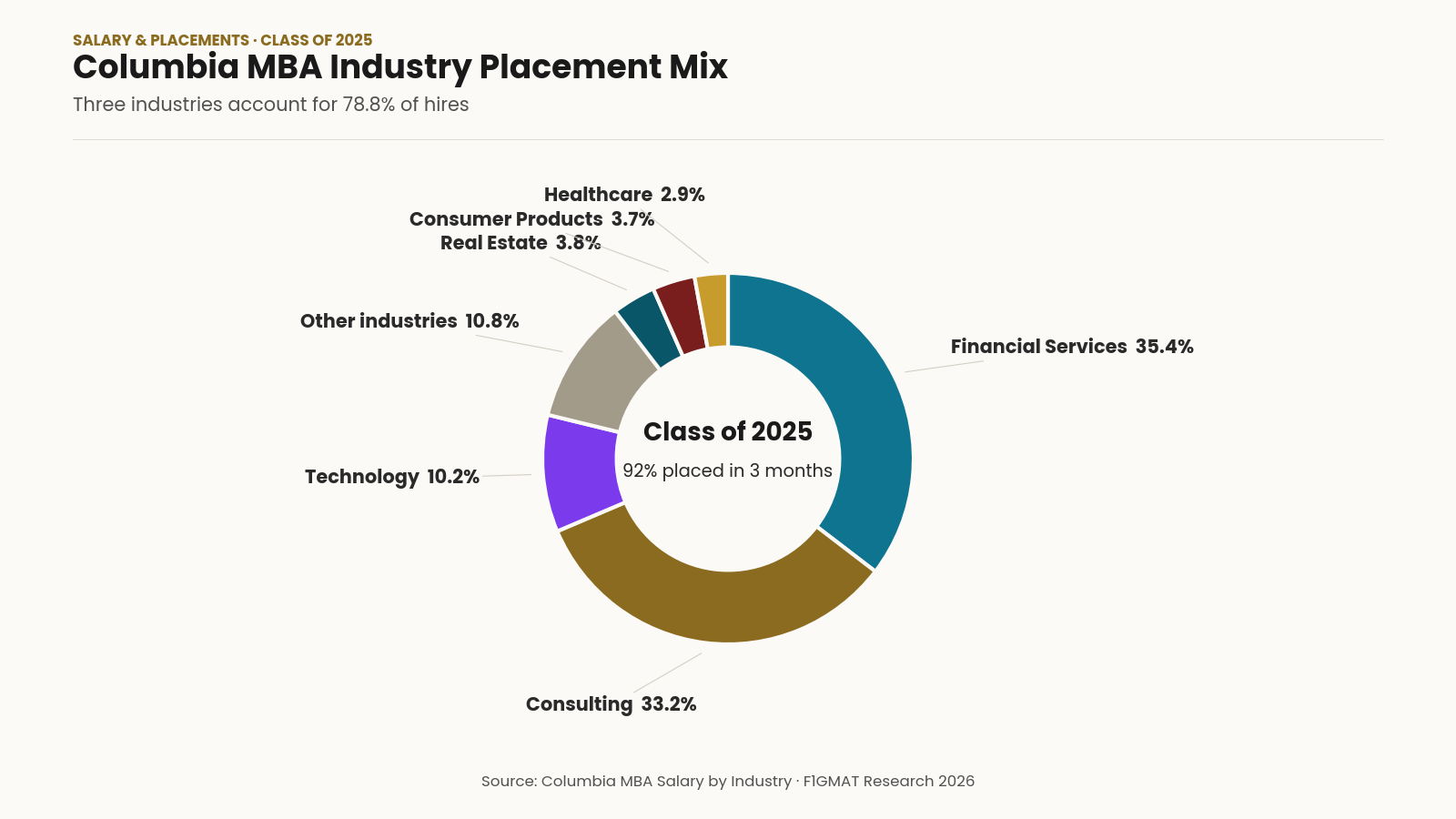
For the Class of 2025, Columbia Business School reported a strong placement track record. Ninety-two percent of graduates were placed within three months, with 78.8% of hires coming from just three industries:
Financial Services, Consulting, and Technology. The majority of placements were in the U.S., accounting for 82%.
Industry Mix and Compensation
Main Article: Columbia MBA Salary: By Industry (2025)
In the Class of 2025, the top industries for hiring were Financial Services, Consulting, and Technology[8].
Financial Services was the leading sector, with 35.4% of the class hired and a median compensation of $245,000.
Investment Banking and Private Equity were also in high demand, with Investment Banking at 17.1% and Private Equity at 4.5%.
Hiring trends showed Consulting as the leading sector at 33.2%, with a median compensation package of $220,000. The Technology sector maintained its share at 10.2%, averaging a median compensation of $202,000. This sector was heavily focused on emerging roles, including AI strategy, product leadership, and cybersecurity governance
The full 11-industry table including Investment Management, Venture Capital , Real Estate, Consumer Products, Healthcare, and Consumer Finance & Analytics is on the salary-by-industry page .
Industry placement mix for the Columbia MBA Class of 2025. Financial Services, Consulting, and Technology together absorbed nearly four in five hires.
Geographic Distribution
Main Article: Columbia MBA Salary: By Job Location (2025)
The global talent market is increasingly concentrated in North America, with the U.S. capturing 82% of placements and a median compensation of $205,000. However, Asia’s share is declining (7%) and European demand is shifting. In Europe, a high $174,178 sign-on bonus for specialists can be expected in regulated finance while CSRD compliance is driving recruitment. A surprising outlier is Africa & the Middle East (2%), which is experiencing high demand, exceeding the U.S. median, primarily for roles within sovereign wealth funds and energy finance
The full regional table including Central and South America placement data and the per-region cycle commentary is on the F1GMAT Salary and Placements By Location page .
Lead Recruiters and Hiring Patterns
Main Article: Columbia MBA Top Employers 2025: BCG, McKinsey, JPMorgan Lead Hiring
The Class of 2025’s employer placements underscore a trend toward consolidation in the recruiting market. The Boston Consulting Group and McKinsey & Company were joint top employers (62 graduates each), reflecting continued demand for premium consulting services. JPMorgan Chase led the finance sector with 22 hires, showcasing the ongoing importance of investment banking in expanding the reach of AI in all industries.
A key observation from the Class of 2025 employer list is the pronounced concentration of recruitment among established firms. While Amazon represented the only significant technology hire (21 graduates), the dominant forces were within consulting and finance.
The ‘Big Four’ accounting firms – Deloitte, PwC, and EY – collectively secured 51 graduates, a notable increase reflecting a shift toward repeat recruiters compared to 2024, when a more diverse range of firms engaged in the recruitment process. The complete list included prominent elite advisory firms (Evercore, Lazard, Moelis, etc.) and key buy-side employers (BlackRock, AllianceBernstein), indicating a competitive landscape across multiple sectors.
Columbia MBA Deadlines
The Columbia MBA deadlines for 2027 entry or the Class of 2029, fall across two separate schedules.
The August 2027 entry runs three rounds, closing September 9, 2026, January 5, 2027, and March 29, 2027.
The January 2027 entry, called J-Term, runs two rounds, closing June 17, 2026 and August 13, 2026.
Both paths consist of four terms and merge in the fall of the second year, ensuring identical academic rigor, student resources, and admissions competitiveness.
Columbia closes every round at 12:00 PM Eastern. Applicants often misread the PM reading and assumes the deadline is in the evening.
The August entry also rewards earlier rounds with priority fellowship consideration.
Applicants who complete by the Round 1 or Round 2 deadline qualify for awards that offset a first-year cost of attendance that reached $137,571 in 2025-26. By the time Round 3 opens, the school would have already awarded most of its fellowship money to applicants admitted in the earlier rounds.
The full Columbia MBA Deadlines (2027 Entering Class, Class of 2029) page covers every round's interview release date, final decision date, deposit schedule, reapplicant timeline, and the school's generative AI policy for applications.
Key Takeaways
Application volume plateaued; enrollment crept up: Applications stayed flat against the 7,487 record set the prior cycle, but enrolment grew from 972 (Class of 2026) to 982. The class is bigger without the funnel widening.
Demographics are pulling in opposite directions: Women hit a record 46% while international fell to a 3-year low at 41%, consistent with broader US graduate-program slowdowns tied to visa-processing delays.
Cost Tied to New York: Tuition rose only 3.25%, while health insurance (+8.3%), and personal expenses (+7.4%) drove most of the 4.02% total budget rise.
Curriculum flexibility favors career switchers and continuers alike: 17 pathways and 10 dual degrees give August entrants room to explore, while the January J-Term track suits sponsored students and entrepreneurs who do not need a summer internship.
Finance and Consulting Strong: Financial Services, Consulting, and Technology absorbed four in five hires with 2/3rd of all hires from Finance and Consulting. Within finance, Private Equity at 4.5% of the placements delivered $312,108 in total compensation, the highest for the Class of 2025.
Large Recruiters Dominant: BCG and McKinsey tied at 62 hires each, JPMorgan led finance at 22, Amazon led technology at 21. Firms with global delivery infrastructure scaled up; mid-tier specialists did not.
Related CBS MBA Resources
- Real Columbia MBA Interview Questions & Winning Tips
- Columbia MBA Essay Examples
- Sample Columbia MBA Essays
- Columbia Business School Deferred Enrollment Program Essay Tips 2026
- Columbia MBA Cost Trends (F1GMAT Premium)
- Columbia MBA Salary Trends (F1GMAT Premium)
- Columbia MBA vs. NYU Stern MBA vs. Cornell MBA Class of 2027 - Analysis
- Top 70 MBA Programs - GMAT and GPA Scores (2026)
- 14 Factors to Consider Before Choosing an MBA
- F1GMAT's Columbia MBA Essay Guide
- F1GMAT's Career Planning Service
- F1GMAT's Winning MBA Essay Guide (M7)
Services
References
- Columbia Business School. MBA Class Profile ↩
- Columbia Business School. Full-Time MBA Cost of Attendance ↩
- Columbia Business School. MBA Tuition and Financial Aid ↩
- Columbia University Student Financial Services. MBA Charges ↩
- Columbia Business School. MBA Degree Requirements (60-credit rule) ↩
- Columbia Business School. Curriculum Pathways (17 pathways) ↩
- Columbia Business School Electives ↩
- Columbia Business School. 2025 Employment Report
↩
