The Case Study method is a teaching methodology that condenses real-world experiences into concepts and ideas.
Harvard University, considered the pioneer in bringing this unique teaching methodology, began adopting the method at Harvard Law School in 1870. Slowly, other departments followed.
In 1920[2], Harvard Business School fully integrated this experiment into its primary teaching methodology through case books and a mix of partial storytelling & teaching while fully engaging the students in the subject matter.
What is the case study method?
The narrative format of the case-study method allows students to think like CXOs on the multidimensional nature of the problem. The points and counterpoints put forward by peers widen the scope of the discussion.
Professors ensure that the discussion remains relevant.
Before the class, students are required to do additional research, make calculated assumptions, and analyze the 20-30 page long case studies that cover a broad range of contexts and sources, from financials, economic factors, media coverage, and interviews of business leaders.
Even before the case study, the small study group will challenge the assumptions, further fine-tuning the argument.
Pioneering the method, Harvard Business School forms the upper tier, with 80% of its curriculum still based on the case method.
Darden School of Business, INSEAD, Berkeley Haas, IESE, and Ivey are also in the same league of case-intensive curriculums.
Yale School of Management stands out for its unique spin on case studies by bringing real-world chaos into the study.
By using RAW cases – with inconclusive data, market conditions, and trends, Yale MBA students had to make decisions with uncertainty, just like in real life. The high percentage of Consulting placements at Yale could be the direct impact of such a unique experiment.
Schools that are only focusing on the Case Study Method as their primary teaching methodology have some disadvantages, as we have pointed out in our analysis of Case Study Method vs Experiential Learning. With that caveat, let us look at schools that have pioneered and refined the Case Study Method.
Contents
- What is the case study method?
- What an MBA case actually looks like
- What is the difference between a raw case and a traditional case?
- Why did Yale SOM build the raw case format?
- Schools with the Case Method as Primary Teaching Tool
- Rank #1: Harvard MBA Program
- Rank #1: Ivey
- Rank #1: IESE
- Rank #2: Darden MBA
- Rank #2: INSEAD
- Rank #3: Yale School of Management
- Case Study Method: Top MBA Ranking
- Which MBA program has the best case method?
- Is Harvard or Darden better for the case method?
- References
Academic rigor
When compared to lecture-based or experiential learning programs, the preparation required for case-heavy programs like Darden or Harvard MBA is intense.
The case load is the single largest predictor of how students spend their first-year evenings, how they think about cold calls, and how they relate to their classmates.
How many MBA cases do students read in two years?
Harvard Business School's two-year MBA puts each student through more than 500 cases across the Required Curriculum in year one and the Elective Curriculum in year two[1]. Each 80-minute class meeting works through one or two cases, with a five- or six-person discussion group meeting the evening before class to pressure-test each member's reading and decision recommendation.
Darden's 21-month MBA also takes each student through more than 500 cases, with first-year students working through two to three case discussions per day across the core curriculum[7]. The case load is supported by a learning team of five or six students that meets most evenings to prepare the next day's cases, and the Class of 2027 carries 361 students divided into five sections of about 70 for case discussions[5].
IESE's MBA covers about 400 cases across the 19-month program, with first-year students preparing two to three cases each day[19]. The Class of 2026 entered with 445 students drawn from more than 50 nationalities, and the case discussions are supplemented by the mandatory EXSIM corporate board simulation in the first year, where the students must defend their position on a case to a board.
INSEAD's 10-month MBA condenses 200 to 300 cases into a single year, taught across two intakes (January and September) and four campuses (Fontainebleau, Singapore, Abu Dhabi, San Francisco)[9]. The case load is delivered alongside lectures and small-group work, and INSEAD faculty also write A/B/C case series that span multiple class sessions on a single strategic decision[8].
Ivey's 12-month MBA runs about 300 cases over the program, taught entirely through the case method across all required and elective courses[15]. The Class of 2027 entered with 154 students drawn from 28 nationalities, with 60% of the cohort coming from outside Canada [17].
Yale SOM's two-year MBA produces a lower total case count by design, since the integrated curriculum mixes traditional cases and raw cases with lectures and small-group work across stakeholder-perspective courses[11]. A single raw case can expand to a multi-discipline conversation that runs across two or three class sessions, which counts as one case in the catalog but requires three to five hours of student preparation[22].
What an MBA case actually looks like
Before working through how each school teaches with cases, it helps to see what an actual case looks like in structure. The traditional format is used at HBS, Darden, INSEAD, Ivey, and IESE, and the raw case format developed at Yale SOM.
Example 1: Unilever in Brazil (traditional case)
"Unilever in Brazil (1997-2007): Marketing Strategies for Low-Income Consumers" by Pierre Chandon and Pedro Pacheco Guimaraes is one of the most-cited cases in MBA classrooms worldwide[25].
The opening hook
The case opens with the exact passage
"After three successful years in the Personal Care division of Unilever in Pakistan, Laercio Cardoso was contemplating an attractive leadership position in China when he received a phone call from the head of Unilever's Home Care division in Brazil, his native country. Robert Davidson was looking for someone to explore growth opportunities in the marketing of detergents to low-income consumers living in the Northeast of Brazil".
The case adds that Cardoso was an alumnus of INSEAD's Advanced Management Programme who had joined Unilever in 1986 after graduating in business administration from Fundacao Getulio Vargas in Sao Paulo, and that he had witnessed the success of Nirma in India, which made him acutely aware of the threat posed by local brands targeted at low-income consumers.
Company background
Unilever holds an 81% market share in the Brazilian detergent powder market through three brands: Omo (the premium powder, launched in 1957 as the first detergent powder in Brazil), Minerva (sold in two forms - detergent powder and a laundry soap), and Campeiro (Unilever's cheapest powder brand).
Lever Brothers started operations in Brazil in 1929 and opened the first plant in Sao Paulo in 1930. The personal care brands followed in the 1960s. P&G holds a 15% share through Pop (acquired in 1996 along with the Bombril detergent business), Quanto, and Odd Fases. ASA, a Brazilian competitor, holds Campeiro's key competitor brand Invicto.
The Northeast Brazil low-income segment
The case lays out the demographic profile of the target segment - 48 million low-income consumers in Northeast Brazil, 28% of Brazil's total population, with a 40% illiteracy rate, an average per capita income of $2,250, and 53% living on less than two minimum wages.
Northeasterners differ from Southeasterners in the symbolic value they attach to cleanliness.
Many poor Northeasterners are proud of the fact that they keep themselves and their families clean despite their low income.
Geographic differences include soft water and high humidity in the Northeast versus hard water in the Southeast.
Consumer preferences for detergent are ranked based on foam quantity (used as the proxy for cleaning power), smell, ability to remove stains without laundry soap, ease of dissolution in water, and simple, recognizable packaging.
The harm caused to colors is the least important attribute.
The Everyman project
Cardoso assembles an interdisciplinary team and the case names them directly
"For this project, named 'Everyman,' Laercio assembled an interdisciplinary team including Marcos Diniz from Sales, Antonio Conde from Finance, and Airton Sinigaglia from Manufacturing".
The first phase of the project is extensive field research on the lifestyle, shopping, and laundry habits of low-income consumers.
The case's triggering scene comes from this field research.
"It was during one of these trips that Laercio met Maria Conceicao, where she lived with her daughter, Elizangela, 19. Like almost everyone in Brazil, Maria told Laercio that although she would love to buy Omo, Unilever's flagship brand, her tight budget meant that she could only afford cheaper local brands".
The internal opposition: Fernanda Machado
The case introduces the central internal conflict directly:
"The results of the Everyman project increased Laercio's conviction that Unilever should also target low-income consumers. Still, he was facing strong internal resistance from people like Fernanda Machado, the category manager for detergents".
The case then reproduces a representative argument between them. The full Machado-Cardoso dialogue runs across pages in the middle of the case and is one of the case's most-cited classroom devices.
Machado opens:
"Laercio, I think that we should stay away from the low-income segment. These people just have no money and I really don't see why we should divert money from our premium brands to invest it in a low price brand! In the short term this would simply cannibalise our high-margin sales with lower-margin ones. In the longer term this would certainly increase price competition in the category. How will I be able to sustain Omo's price premium if people can buy almost the same product at half the price?"
Cardoso responds that the low-income segment is a strategic necessity.
Unilever already holds 81% of the market, and that ignoring it would expose Omo to a P&G attack from below, with the Indian market as the precedent.
Machado pushes back further, citing Brazil's 95% detergent penetration vs India's 55%, Unilever's history of premium marketing in Brazil since 1929, and the risk of investor perception ("Unilever has lost its marketing skills and is abandoning its premium brands") with reference to Marlboro Friday as the cautionary precedent.
The decision question
The case presents three concrete decisions Cardoso must make.
- Whether to divert money from premium brands to target low-income consumers
- Whether to reposition or extend an existing brand (the candidates discussed in the case are Minerva and Campeiro) instead of launching a new one
- What price, product, promotion, and distribution strategy would deliver value without cannibalizing premium brands.
The case closes with Cardoso reviewing his recommendations the night before the strategy meeting.
The B case (the outcome) reveals that Unilever launched a new brand positioned between Campeiro and Minerva, closer to Campeiro.
Exhibits
The case carries numbered exhibits at the back of the PDF. Educator materials available from INSEAD Publishing include a "Unilever in Brazil Case Exhibits" slide deck and the "Unilever in Brazil Teaching Note Exhibits" (2013).
Exhibits in traditional cases are organized but comes in many forms. It includes a map of Brazil with the Northeast highlighted, income distribution data by region, detergent consumption per capita by income tier, Unilever's brand portfolio with positioning and price points, P&G's competing brand portfolio (Pop, Quanto, Odd Fases), washing-habits survey results from the Everyman field research, and financial data on Unilever Brazil's detergent business margins by brand.
How long is a typical HBS or INSEAD case?
Most cases run 10 to 20 pages of written narrative with five to ten pages of numbered exhibits at the back. The Unilever in Brazil case is 21 pages on INSEAD Publishing's official listing[25].
Multimedia cases add video segments and interactive elements, which extends the total content beyond what the page count suggests.
How are case exhibits structured?
Traditional cases place numbered exhibits at the back of the document.
Exhibits are typically financial statements, market share data, customer survey results, organizational charts, and competitor comparisons.
The student references exhibits during the discussion to support a recommendation.
In a 24-page case, six to eight exhibits is typical.
The author selects which exhibits to include.
Students see the data the author chose to surface.
This is the one drawback of a traditional case study.
The author’s judgement might not be holistic.
They might miss certain aspects of the competitor dynamics or pricing or culture.
A raw case empowers the student to explore angles that an author misses.
Example 2: Yale SOM's SELCO (raw case)
The Unilever in Brazil case shows the standard case-method format that HBS, Darden, INSEAD, Ivey, and IESE use.
Yale SOM built an alternative format.
The example below covers SELCO, Yale's most-cited raw case.
A traditional case is a single document with a defined beginning and end.
A raw case is a website[11].
Yale's own "How to Consume a Raw Case" guide describes the structure
- An overview page outlines all of the major topics under discussion
- The Introduction tab may have a Discussion Questions sub-page
- On any given page a block of text on the left top gives an overview of the topics, and a "bookshelf" panel in the upper right links to articles, videos, spreadsheets, and other supporting sources[27]
Students choose what to read first, what to read deeply, and what to skip.
Yale's pedagogical position is that this prioritization decision is the most important skill a manager develops, and the traditional case format skips it by pre-curating the source material[12].
Overview
The home page introduces SELCO [26] in three paragraphs and presents the 2009 dilemma.
The official Yale CRDT description reads: "SELCO is a company founded by Harish Hande in 1995 to provide solar electricity solutions to underserved communities in India... Despite having provided energy solutions to over 100,000 households, SELCO faces a significant dilemma - how to extend its impact.
With over 400 million individuals living in poverty in India, the company's leaders must decide whether to deepen their efforts by designing solutions for even poorer segments of the population or to expand geographically beyond their current areas in Karnataka and Gujarat".
The Overview tab carries a Discussion Questions sub-page that builds on this inquiry.
Yale tags the case under five Perspectives: Customer/Marketing, Innovation & Design, Social Enterprise, State & Society, and Sustainability.
Genesis SELCO: founding, near-collapse, and IFC restructuring
The Genesis SELCO section of the page walks through Hande's 1995 founding of the company, the focus on selling and servicing photovoltaic systems in Karnataka, and the financial challenges when SELCO's attempts to scale up through a franchised dealer network proved detrimental.
By the early 2000s the company needed to restructure, aided by the International Finance Corporation (IFC), which allowed SELCO to remain true to its mission and maintain a motivated core team.
The bookshelf for this section includes the SELCO Business Plan 2006-2010, the company's Innovations Brochure, and the ren21 industry report[22].
Protagonist video library
Hande appears in video interviews instead of being paraphrased in prose.
Students see him speaking for himself about why he founded SELCO in 1995, his view on the mission of solar electric products for the poor, and the strategic options he is weighing in 2009.
The case is also linked to a public YouTube playlist (titled "SELCO 2009: Determining a Path Forward") that mirrors the case's videos for faster downloads.
Background documents include Hande's later Ramon Magsaysay Award (2011) citation and articles about him from Indian and international press.
Marketplace and customer interaction – What Traditional Case Study Misses
This is the section that has no equivalent in a traditional case.
25 video segments show actual customer interactions[22] from solar panel installations in rural Karnataka homes, marketplace visits in coastal villages, customer interviews about how solar lighting changed their household economics, conversations with farmers about powering irrigation pumps, and small business owners using solar for sewing machines or for refrigeration.
The case also includes a separate Gallery section with SELCO organizational charts.
The Decision: 'deeper' or 'wider'
The closing section positions the 2009 dilemma in the company's own language - should SELCO go "deeper" (designing solutions for even poorer segments of the Indian population) or "wider" (expanding geographically beyond its current areas in Karnataka and Gujarat).
The case notes the company's decision to institutionalize its design process by building an innovation center, and to add products that provide energy solutions beyond solar.
The B case (published later) reveals that Hande went on to establish the SELCO Foundation in 2010 as a non-profit arm focused on user-centered Decentralized Renewable Energy (DRE) interventions for the rural poor.
Yale CRDT now publishes a separate SELCO Foundation case that picks up from there. The interesting insight on how Yale faculty follows up on a case is that there are no single recommended path, just discussion questions.[11]
Raw cases, closely mimics real-world business decisions.
Each path has a separate decision tree with or without potential. Some paths leaders would never take.
What is the difference between a raw case and a traditional case?
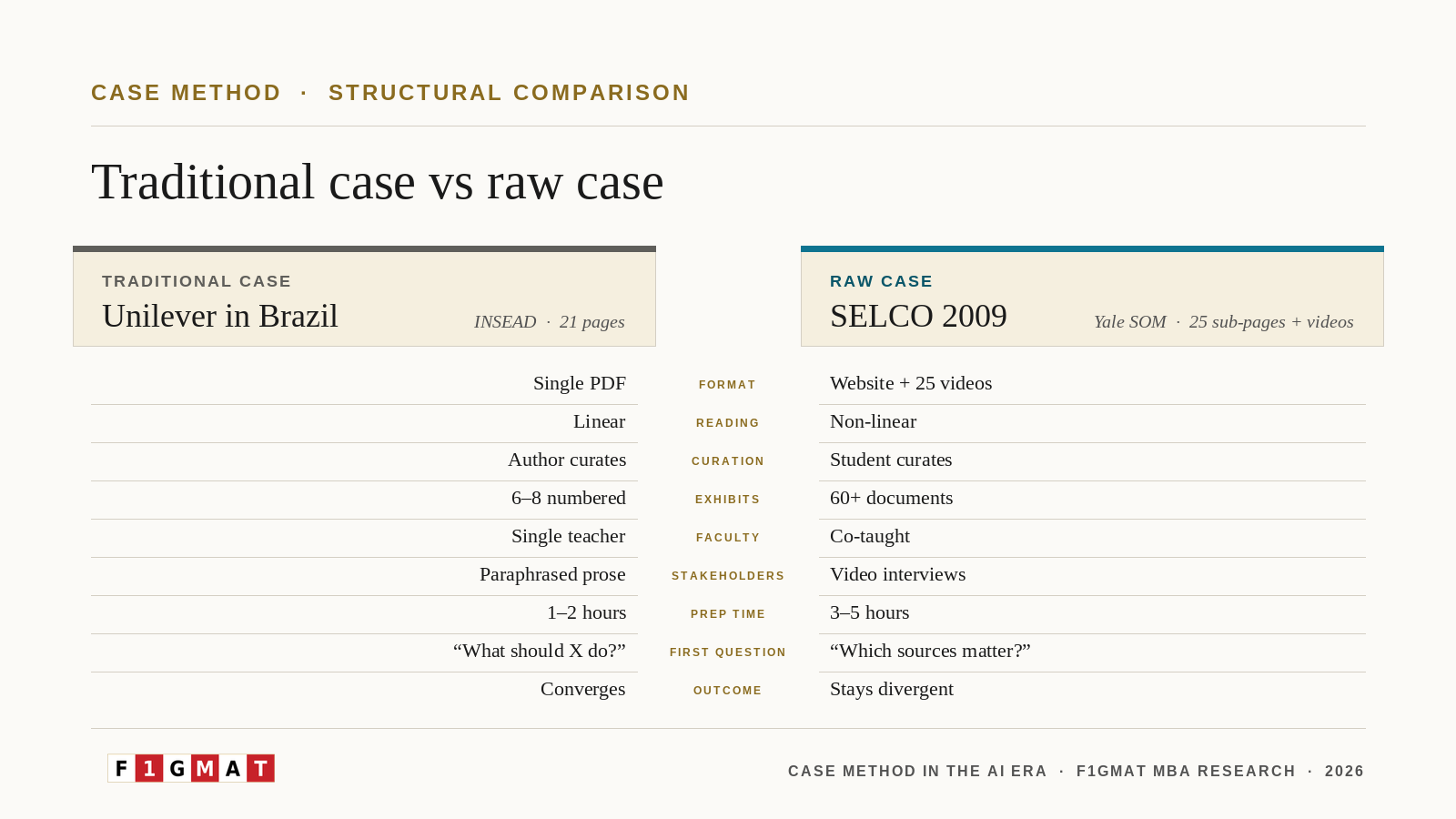
A traditional case is a single curated document, 10 to 25 pages, with the author selecting which information matters.
A raw case is a website with 25 or more sub-pages, dozens of source documents, video interviews, and financial spreadsheets, with the student selecting which information matters.
A traditional case asks students to decide what to recommend.
A raw case asks them to decide what to read first, then what to recommend.
Why did Yale SOM build the raw case format?
Yale SOM developed raw cases starting in 2006 to address a critique of the traditional case method - the author's curation pre-shapes the student's analysis[12].
Raw cases reduce that pre-shaping by giving students primary sources instead of a curated narrative.
The format also better matches how real management decisions arrive (in messy, multi-source bundles instead of clean 24-page documents).
Schools with the Case Method as Primary Teaching Tool
Rank #1: Harvard MBA Program
Harvard Business School built the case method into the core of its MBA in the early 1920s, with the first HBS case written in 1921 by graduate Clinton P. Biddle.
A century later, the case method still carries about 80% of HBS classroom instruction, and each student reads more than 500 cases across the two-year MBA where the average case runs 10 to 20 pages, written from the viewpoint of a real protagonist (a CEO, a product manager, a non-profit director) facing an unresolved decision.
A typical 80-minute HBS class opens with a cold call, where the professor selects one student without warning to frame the protagonist's choice and ask them to take a position from the protagonist's perspective. From there, the conversation moves through the section of about 90 students[23], with the faculty member shaping direction instead of lecturing.
Students do most of the talking, and class participation accounts for a significant share of the course grade.
How does HBS cold calling actually work?
Each 80-minute class opens with a cold call. The professor selects one student without warning and asks them to open the discussion by framing the protagonist's choice and stating a recommendation[1]. The selected student speaks for two to three minutes, then the professor turns to the rest of the section.
Class participation accounts for about half of each course grade.
Discussion groups of five or six students meet before class to pressure-test their reading.
How big is an HBS section?
About 90 students.
The HBS Required Curriculum places each student in one section for their entire first year.
The section takes every class together, builds shared norms, and develops a distinctive personality.
HBS's published class profile shows 44% women and 35% international students, drawn from approximately 60 countries and 296 universities across the full MBA class
HBS and AI
HBS provided all MBA students with access to ChatGPT in Fall 2023, the first leading business school to do so.
Master's students now have access to ChatGPT Edu, Harvard AI Sandbox, Claude, Claude Code, Lovable, Julius AI, Manus, and Gamma, according to HBS professor Iavor Bojinov, who restructured the school's required AI course into three modules covering workplace task transformation, AI-enabled business models, and AI safety and sovereignty[3].
Faculty have built live AI case exercises and AI-based simulations into the classroom.
What makes Harvard cases unique
- 500+ cases over two years: Each MBA student reads more than 500 cases across the Required Curriculum and the Elective Curriculum.
- Authorship engine that dominates the global case market: HBS faculty produce up to 80% of cases sold to business schools worldwide, distributed through Harvard Business Publishing.
- Field research dominant: Field cases (built from on-site company visits and protagonist interviews) outnumber library cases written from public sources
- Cold call as religion: Each 80-minute class opens with a cold call. Class participation accounts for about half of the course grade
- Section experience: 90-student sections, 44% women and 35% international students, drawn from approximately 60 countries[23].
- AI tool suite (2023 to 2026): All MBA students have access to a documented suite of AI tools, and faculty have built live AI case exercises into the Required Curriculum.
Rank #1: Ivey
Ivey Business School in London, Ontario, has used the case method since its founding in 1922 and now produces more cases than any school other than Harvard.
Ivey Publishing's active collection runs to over 7,500 cases[15], with about 690 Ivey Business Journal articles and more than 2,700 case translations. The school adds about 350 new classroom-tested cases per year, with deep collections on North America, China, India, the rest of Asia, the United Kingdom, the European Union, and South Africa.
Is Ivey 100% case method?
Yes. The Ivey MBA, HBA, and EMBA are taught entirely through the case method. Ivey's full-time MBA students work through approximately 300 cases over the 12-month program. The school's case publishing arm runs the second-largest active case catalog in the world (7,500+ cases) and adds about 350 new cases per year.
Ivey and AI
Ivey's EdTech team built AIBEL (Artificial Intelligence-Boosted Experiential Learning), an AI tutor that lets students engage in case discussions outside the classroom as preparation for the live session. AIBEL won the Learning Design Award at the Future of Management Education conference in Oslo in early 2026[16]. The school also launched Cloudforce's nebulaONE in February 2026, a Canadian first for business education, giving 1,200+ faculty, staff, and students enterprise GenAI access[24].
What makes Ivey cases unique
- Second-largest case catalog globally: 7,500+ active cases, 690 Ivey Business Journal articles, 2,700+ case translations.
- 350 new cases per year: Coverage of nearly 100 distinct countries.
- Foundational case-method books: Erskine's 1973 book on case writing, Teaching with Cases (1981), and Learning with Cases (1992) in 14 editions across six languages.
- Class of 2027 profile: 154 students, 60% international, 28 nationalities, 25% from India[17].
- AIBEL AI tutor for case prep: Won the 2026 Learning Design Award[16].
- nebulaONE enterprise AI deployment (Feb 2026): Canadian first for business education, 1,200+ users[24].
Rank #1: IESE
IESE Business School in Barcelona formed an alliance with Harvard Business School in 1963 and adopted the HBS case method from that point. Six decades later, the case method still carries the IESE MBA, with students preparing two to three cases each day during the first year and working through about 400 cases over the program[19].
Does IESE use the same case method as Harvard?
Yes. IESE adopted the HBS case method through a formal alliance in 1963. Their faculty now write their own cases (distributed through IESE Publishing) and run the method with strong cohort diversity (88% international, 50+ nationalities)
The school combines the traditional case method with the mandatory EXSIM corporate board simulation and an ethics integration that runs through every core course.
What is EXSIM at IESE?
EXSIM is a mandatory week-long Executive Simulation in the first year of the MBA. Students present recommendations on real business situations to a corporate board panel that includes directors from banks, family businesses, and trade unions. The board pushes back on the students' analysis under realistic time pressure, which adds a senior-stakes layer that pure case discussion does not provide.
IESE and AI
The September 2026 IESE MBA redesign integrates AI into more than 40 sessions across 18 first-year courses, with cases that now include an AI-generated analysis as a separate object of student evaluation. Students judge whether the AI framed the problem correctly, then defend their own decision in front of the section. Evgeny Kaganer, IESE's Associate Dean for Academic Affairs and Innovation, framed the redesign this way[18]
"Managerial work comes down to three things: deciding what should be done, getting it done, and then judging the outcomes and adjusting course. AI is now dramatically accelerating the middle, making the two ends, setting direction and exercising judgment, both harder and more valuable than before."
What makes IESE cases unique
- HBS lineage since 1963: Formal alliance, six decades of refinement.
- 400+ cases per MBA: Two to three cases per day in year one
- Largest international cohort in the article: 88% in ernational, 50+ nationalities
- Ethics: Covers Operational and ethical stakes in the same discussion.
- EXSIM corporate board simulation: Mandatory week-long Executive Simulation in year one, where students have to defend their case in front of a board.
- AI embedded inside the case (September 2026): AI-generated analysis as a separate object of student evaluation in 40+ sessions across 18 courses
Rank #2: Darden MBA
Darden has been a case-method school since its founding in 1955.
Full-time MBA students examine more than 500 cases during the 21-month program, with first-year students working through two to three case discussions per day.
The Class of 2027 entered with 361 students divided into five sections of about 70[5], then again into learning teams of five or six members who meet daily to prepare cases together before class. The Financial Times ranked Darden #3 for case impact in 2025, behind only Harvard and INSEAD[7]
Is Darden's case method tougher than Harvard's?
Darden earns the honors of the school with the highest daily case load in management education (two to three cases per day in year one), which puts more cases per week through the student than HBS does.
The mechanics of the case study are similar - cold call culture, 70-person sections, and high participation grade weightage, but the daily volume is higher.
The Financial Times ranks Darden #3 for case impact in 2025.
What is a Darden learning team?
Each Darden cohort of 361 students is divided into five sections of about 70, then into learning teams of five or six members.
Learning teams meet most evenings to prepare the next day's cases together. The team divides the analytical work, pressure-tests recommendations against one another, and supports members who are struggling with a particular subject. The learning team is the workhorse of the Darden first-year experience.
Darden and AI
In November 2025, Darden moved further on AI than any other top-tier case-method school.
The required first-year Strategy course (taken by all 359 students in the cohort) made generative AI a requirement.
Course head Jared Harris told students on day one that ChatGPT, Claude, CoPilot, or any chatbot was welcome for research, assignments, and exam preparation. Students also use a custom-built AI discussion agent called CAiSEY (Classroom Artificial Intelligence Studio for Engaging You).
Harris described the choice in a May 2026 Darden News piece[6]:
"We leaned into AI 100% in core strategy. That made us an outlier."
What makes Darden cases unique
- Daily load of two to three cases: First-year students work through 500+ cases across the 21-month program.
- Learning the structure:Each cohort of 361 is divided into five sections of about 70, then into learning teams of 5-6 who meet most evenings.
- Cold call culture from day one: Faculty direct the first cut of the decision to one student, then move through the section.
- U-shaped classrooms:Tiered, U-shaped rooms with direct sightlines between every student and the faculty member.
- Financial Times #3 ranking for case impact (2025): Behind only Harvard and INSEAD.
- Required in core Strategy (Fall 2025): Custom-built AI discussion agent CAiSEY available across the course.
Rank #2: INSEAD
INSEAD adopted the case method in 1963 through a partnership with Harvard Business School and then built its own case-writing engine across Fontainebleau, Singapore, Abu Dhabi, and San Francisco.
The school is ranked at #2 on The Case Center Impact Index for 2025, with 13 INSEAD cases on the Case Center's 2025 best-sellers list [9].
Across the Case Center's 50-year history, 14 INSEAD cases rank in the top 50 best-sellers, with six in the top 10, more cases in the top 10 than any other school.
INSEAD admits roughly 1,000 MBA students from more than 70 nationalities per year across two intakes (January and September). A single supply-chain case discussion can include perspectives from a German automotive engineer, a Brazilian retailer, a Nigerian fintech operator, and an Indian software-services consultant.
Does INSEAD use the case method like Harvard?
INSEAD adopted the HBS case method in 1963 through a formal alliance, but the school has built its own case engine over the past six decades.
INSEAD's MBA combines cases with lectures, simulations, and small-group work.
What is an A/B/C case at INSEAD?
A/B/C cases are written in multiple parts that trace a decision over time.
Students discuss part A, predict the outcome, then read parts B and C in subsequent sessions to see how the decision played out and what new information appeared.
The format is common at INSEAD and lets faculty build a multi-class arc around a single strategic question.
INSEAD and AI
INSEAD's Impact Focus on AI lists eight AI-focused case studies, seven AI- and data-focused executive education courses, and more than 50 short videos from faculty on AI questions.
The school's MBA and EMBA students now use an AI-driven role-play simulation and an AI strategy assistant as part of the learning experience, developed in partnership with AVRIS Technologies[8].
What makes INSEAD cases unique
- Six in the top 10 over 50 years: More cases in the Case Centre's all-time top 10 than any other school
- #2 on Case Centre Impact Index (2025): Up from #3 in 2024
- 70+ nationalities in each cohort: No single nationality dominates the section.
- Four-campus case engine: Fontainebleau, Singapore, Abu Dhabi, San Francisco.
- A/B/C case series: Multi-part cases that trace a decision over time.
- AI integration via Impact Focus: Eight AI cases, AVRIS VR AI partnership, AI-driven role-play simulation
Rank #3: Yale School of Management
Yale SOM redesigned its MBA around an integrated curriculum in 2006, and the redesign gave rise to a format the school calls the raw case[11]. Raw cases, developed by SOM's Case Research and Development Team (CRDT), combine a written narrative with primary source material: 10-Ks, 10-Qs, news articles, video interviews with stakeholders, organizational charts, spreadsheets, and product specifications. The student reading the case has to decide which pieces matter and which to set aside.
What is a Yale SOM raw case?
A raw case is Yale SOM's signature format. Instead of a single curated narrative with embedded exhibits, the raw case provides primary source material (10-Ks, 10-Qs, video interviews with stakeholders, news articles, organizational charts, spreadsheets) and requires the student to decide which sources matter. The format is taught in the integrated curriculum and in the capstone course "The Executive," and is co-taught by faculty from different disciplines.
How is Yale SOM different from HBS
Yale SOM uses an integrated curriculum that organizes the first-year core around stakeholder perspectives. Students will learn to think like the customer, the investor, the employee, the operations engine, the competitor, the innovator, the sourcer, and the state and society, instead of thinking like functional experts.
Sections at Yale are organized around 80 students, and faculty often co-teach raw cases across disciplines.
Yale SOM Raw Cases and AI
The Yale SOM senior faculty approved a new required course in Spring 2026 that instructs MBA students in the use of AI tools and methods[13]. Yale SOM also runs the Responsible AI in Global Business conference (in its third year), the AI Association student club, and a Large Language Models: Theory and Application elective taught by Kyle Jensen and K. Sudhir.
What makes Yale cases unique
- Raw case format pioneered at Yale: Raw cases depend on Primary source material instead of a curated narrative.
- Co-taught capstone (The Executive): Two or three faculty members in the room at once, each engaging the parts of a case relevant to their field.
- Integrated curriculum framing: Stakeholder perspectives instead of functional silos.
AI's direct threat to Raw Cases
Raw cases trained students to prioritize data sources from messy primary sources, just like the real world.
AI now does this source corroboration faster, putting holes in the premise that raw case mimics real-world decisions in a pre-AI world where sources could be diverse, and its insights, purely based on the diverse sources, are deeper.
Yale had to pivot with the new required AI course led by Tauhid Zaman, associate professor of operations management, launching in Fall 2026. Although the course focuses on the practical AI use cases of building AI agents, the traditional raw case will be disrupted soon. With AI, a larger raw dataset would be part of the source with a case method that prioritizes in-class debate in stakeholder judgment.
Case Study Method: Top MBA Ranking
The old way of comparing - volume of cases, age of the case method, and faculty research depth still matters, but they no longer settle the question of how the Case Study Method can offer real value.
We looked at seven new ranking factors:
The seven new ranking factors
Factor 1: Case method intensity
Case method intensity captures how completely the case method takes over the MBA learning experience. The most measurable metric is the total case volume. In that metric, Harvard and Darden lead at 500+ cases, 400 at IESE, around 300 at Ivey, and 200 to 300 at INSEAD's 10-month MBA. At Yale SOM, where the integrated curriculum takes the case through multiple perspectives and roles, the case volume is the lowest.
Factor 2: Cold call pressure
Cold call pressure depends on the influence of the class participation on grades, the size of the section mates – the group in front of whom you present your point of view, and the learning team with whom you bounce off your ideas.
The chance that you will receive a cold call question also depends on the size of the section.
From that single metric, Darden (70), Yale SOM (80), and Harvard (90) have more cold call pressure.
Because close to half of the grade is dependent on the case participation, Harvard and Darden MBA students face the most pressure.
Factor 3: Cohort diversity
The homogeneity of the culture in the class through similar socio-economic, cultural, and national identities limits disagreements in the class. For the most memorable learning experience, disagreement is a key feature.
Cohort diversity is measured by how section mates ask different questions when presented with similar facts. These questions are based on the peers’ functional, cultural, and lived experiences. A higher international student percentage influences cohort diversity.
In that regard, INSEAD (90%) leads, and IESE (88%) is 2nd, while Ivey is 3rd.
A professional mix, the spread across consulting, finance, technology, healthcare, and non-profit roles, adds another layer of disagreement to each case discussion.
Factor 4: AI era adaptation
Institutional AI tools - the suite of AI products provided as default to every MBA student, runs widest at HBS (ChatGPT Edu, Claude, Harvard's AI Sandbox, and other tools) and Ivey (AIBEL, nebulaONE).
The goal behind the tools is to reduce the burden of summarizing insights while keeping their sourcing judgment strong. For a case prep, they can combine a large dataset into their scenario analysis model with the help of these institutional AI tools. They can even use them for the first iteration of playing the devil's advocate to dissect their recommendations.
The risk is the change in behavior when the students become overly reliant on these tools. Will they discount the value of a peer who has lived experiences?
Will the lived experience match the deep insights these tools present through training on hundreds of cases?
Darden has understood the risk and keeps the learning team meeting mandatory for five evenings a week. Ivey, which doesn't have the learning teams in the traditional sense as HBS, has designed AIBEL as a rehearsal layer that precedes the live discussion instead of replacing it, and IESE's September 2026 redesign places live human judgment at the front of the case discussion, where AI cannot follow the nuances.
Another addition is the Faculty case agents.
Faculty case agents are custom AI assistants built by individual professors or curriculum teams for use inside specific courses, distinct from institutional tools because they are course-specific and faculty-controlled. The design pattern is similar across schools. They take a large language model, ground it on the case PDF and teaching note, and write a system prompt that constrains the agent to ask Socratic questions instead of giving away the case's answer.
Some agents speak as the case protagonist for a role-play, others act as a devil's advocate that challenges the student's draft recommendation.
A third design role plays for stakeholders the cohort will never include in person, such as a smallholder farmer or a regional bank examiner.
The design challenge is that a model trained on Socratic teaching won’t know when to let the students explore and go down the wrong direction, moments where new insights are found. Efficiency is a roadblock with such designs. While LLMs calibrated too softly would give away the answer without letting the students struggle.
Darden's CAiSEY (Classroom Artificial Intelligence Studio for Engaging You) is trained only for the rehearsal part before the live class instead of playing the role of a peer.
The Yale SOM faculty AI discussion group has built tools that fit a different slot - the live in-session classroom. The AI nudges the section to deepen the discussion when the section converges too quickly on a single answer.
Faculty control of the workflow placement is what distinguishes the faculty case agent from the institutional AI tool.
The school can require the agent to be used only after learning team prep or only inside the live classroom, which protects the peer interaction layer that the section discussion depends on.
A responsible AI integration is what we have prioritized for the ranking.
Factor 5: Case authorship and Relevance
Case authorship and relevance measures whether a school can publish and present the most relevant and diverse cases across industries and functions.
We used four variables:
- Throughput: The volume of new cases a school publishes each year. HBS produces several hundred new cases per year through Harvard Business Publishing, and Ivey Publishing adds roughly 350
- Depth: The active catalog size in cases currently available for classroom use. Ivey at 7,500+ cases ranks second only to HBS through Harvard Business Publishing
- Authorship: The share of the school's case output written by the school's own faculty is a sign of the school's research depth. HBS faculty authors close to 80% of cases sold globally to business schools.
- Relevance: The speed with which real-world market development can be incorporated in cases is another sign we looked into.
We used the Case Center's annual best-sellers list and 50-year top-50 ranking serving as the post-publication quality signal.
Editorial review is critical, as seen in HBS's Case Research and Writing Group, which has worked with 240+ faculty on more than 2,600 case projects.
Ivey Publishing processes the roughly 350 new cases per year before release, and Yale SOM's Case Research and Development Team teams up project editors with faculty supervisors.
Factor 6: Method innovation beyond traditional cases
Method innovation beyond traditional cases measures the school's willingness to experiment with the case format itself.
The traditional case is a 10 to 25-page PDF with numbered exhibits, written by one faculty author and taught by one professor in a single class session.
The factor rewards schools that have broken that mold.
Raw cases replace the PDF with a website of primary sources that students must prioritize themselves (Yale SOM).
Multimedia cases embed video interviews alongside the written narrative (INSEAD, IESE).
A/B/C case format splits a single decision across multiple class sessions, with the outcome of part A becoming the data for part B and later review into Part C. INSEAD follows this format.
On the technology innovation front, AI discussion agents combine the live class with custom chatbots that deepen preparation. Darden's CAiSEY and Yale SOM's classroom tools support this innovation.
Factor 7: Case protagonist diversity
The cases often use non-profit protagonists in India, Brazil, South Africa, or other emerging economies. There is value in gaining perspective about scarcity and innovation under a scarce funding and resource environment. These are constraints you are unlikely to face in the US, Europe, or Canada.
The protagonist’s diversity can be evaluated based on three more factors – gender, nationality, and ethnicity.
On gender, Lesley Symons's 13-year study of top-school case best-sellers puts the durable baseline at 11% female protagonists, with only 4% of cases passing the three-rule Symons Test for substantive female representation[29]. Symons now runs The Case for Women annual case-writing competition (founded 2020 with Emerald Publishing), and Harvard Business Publishing maintains a curated catalog.
Identity-based programs at HBS (the Gender Initiative under Colleen Ammerman) and INSEAD (where Symons originally conducted her research) had far more positive consequence on gender parity in representing case protagonists than format-based responses.
IESE's family-business cases approached the problem indirectly by adding female owners in cases around industry concentration without a dedicated gender initiative.
On nationality, geographic representation depends on where a school's case research team collaborates and the travel pattern of faculties. INSEAD's four-campus structure (Fontainebleau, Singapore, Abu Dhabi, San Francisco) produces cases sourced from each region, and HBS operates Global Research Centers in Hong Kong, Shanghai, Mumbai, Tokyo, Tel Aviv, Paris, and Buenos Aires that feed a third of HBS cases set internationally.
Ivey's case catalog runs deep across China, India, the rest of Asia, the UK, the EU, and South Africa.
Stakeholder-inclusive formats like Yale's raw cases have expanded nationality diversity at lower publication volume, while large regional case publishing arms like Ivey's have done the same at higher annual throughput.
On ethnicity, the dimension has had the slowest documented progress.
HBS expanded the Gender Initiative into the Race, Gender & Equity Initiative under Robin J. Ely as faculty chair, and the school's partnership with the OneTen Initiative (a 10-year commitment to add one million Black Americans to careers through skills-first hiring) extends to case research. Even with the renamed initiative, the school has set fewer measurable targets on race than on gender.
The other five schools in our study have institutional commitments to ethnic diversity in their student cohorts but less-documented commitments to ethnic diversity in their case protagonists.
The scoring matrix
| Factor | HBS | Darden | INSEAD | Yale SOM | Ivey | IESE |
|---|---|---|---|---|---|---|
| 1. Case method intensity | 5 | 5 | 4 | 3 | 4 | 5 |
| 2. Cold call pressure | 5 | 5 | 4 | 3 | 4 | 4 |
| 3. Cohort diversity | 4 | 3 | 5 | 3 | 3 | 5 |
| 4. AI era adaptation | 4 | 5 | 3 | 4 | 5 | 5 |
| 5. Case authorship and Relevance | 5 | 4 | 5 | 3 | 5 | 4 |
| 6. Method innovation | 4 | 5 | 4 | 5 | 5 | 4 |
| 7. Case protagonist diversity | 4 | 3 | 5 | 5 | 5 | 4 |
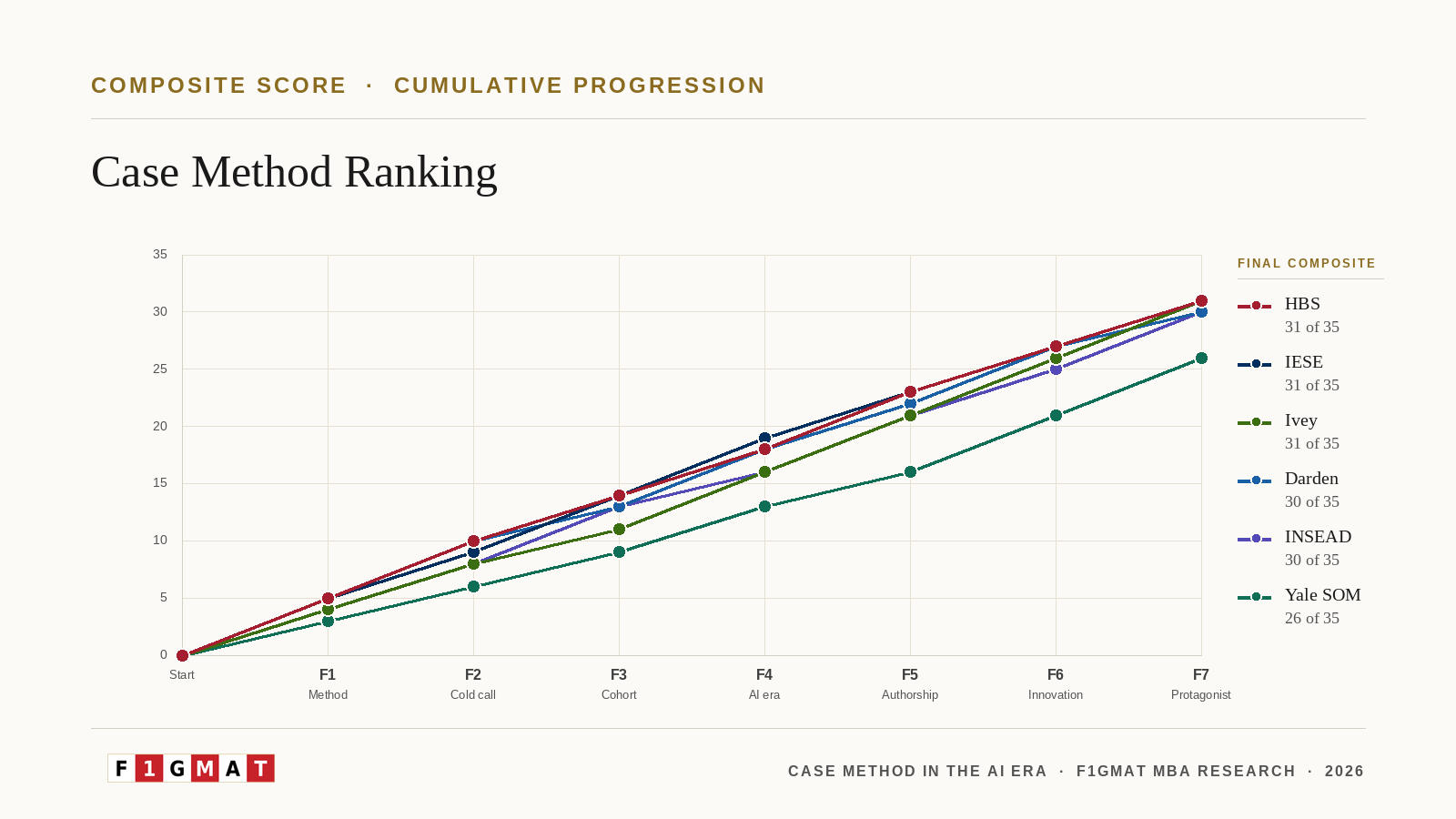
| Composite (out of 35) | 31 | 30 | 30 | 26 | 31 | 31 |
The composite ranking
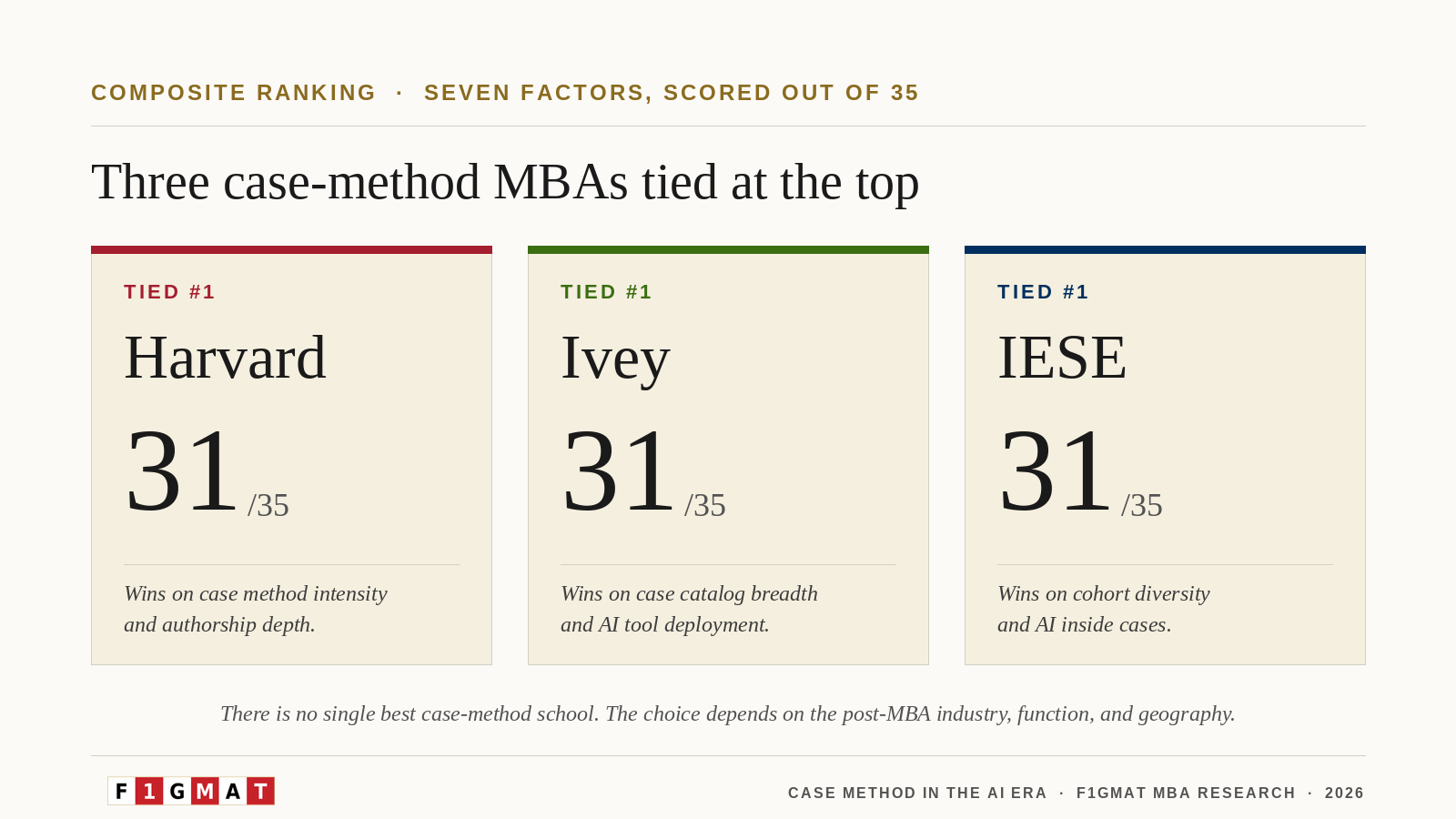
- Harvard, Ivey, IESE (tied at 31): Each scores at or above 4 on every factor. Harvard wins on case method intensity and authorship depth, Ivey wins on case catalog breadth (7,500+ cases) and AI tool deployment, IESE wins on cohort diversity and the September 2026 AI-inside-the-case redesign.
- Darden, INSEAD (tied at 30): Darden scores at the top on case method intensity, cold call pressure, and AI integration, but the case catalog and protagonist diversity are below the leaderboard score. INSEAD scores high on cohort diversity, authorship depth, and protagonist diversity, but lower on AI-era adaptation.
- Yale SOM (26): Wins on method innovation through raw cases and on protagonist diversity. The school scores lower on case method intensity and cold call pressure, as raw cases by design take more than two sessions each.
Which MBA program has the best case method?
Considering all seven factors, three programs tie at the top in 2026: Harvard, Ivey, and IESE.
Each scores 31 of 35 possible points, but earns the score by different routes.
Harvard wins on intensity and authorship.
Ivey wins on case catalog breadth and AI tool deployment.
IESE wins on cohort diversity and AI embedding inside cases.
Is Harvard or Darden better for the case method?
Both schools rank at the top of the case method intensity factor, with sections of 70 to 90 students, cold call culture, and participation grades around 50% of the course total.
Harvard wins on case authorship depth and the broadest AI tool suite[3]
Darden wins on daily case load (two to three cases per day vs HBS's typical one to two) and on AI integration inside the case classroom (required GenAI in core Strategy since Fall 2025)[5]
References
- The Case Method (program page) · HBS ↩ ↩
- Case Method 100 Years (history, first case) · HBS ↩
- HBS Expands AI Integration Across MBA Curriculum (April 2026) · The Harvard Crimson ↩ ↩
- Nitin Nohria, “What the Case Study Method Really Teaches” (December 2021) · HBR
- Goes ‘All-In’ on GenAI in Core Strategy Course (November 2025) · Darden News ↩ ↩ ↩
- Why Darden Is Moving AI Into the Core MBA Experience (May 2026) · Darden News ↩
- Darden Ranks #3 for Case Impact (November 2025) · Darden News ↩ ↩
- Impact Focus on Artificial Intelligence · INSEAD ↩ ↩
- 13 INSEAD Cases in Case Centre Best-sellers 2025 · INSEAD Publishing ↩ ↩
- Unilever in Brazil (1997-2007), case ref INS615 (Chandon & Guimaraes) · The Case Centre
- The ‘Raw’ Case Approach · Yale SOM ↩ ↩ ↩ ↩
- The ‘Raw’ and the ‘Cooked’ · Yale SOM ↩
- New AI-Focused Required Course (Spring 2026) · Yale SOM ↩
- SELCO case (vol10 case page) · Yale SOM CRDT
- The Case Method at Ivey · Ivey ↩ ↩
- AIBEL Wins Learning Design Award (January 2026) · Ivey ↩ ↩
- MBA Class of 2027 Profile (PDF) · Ivey ↩ ↩
- Redesigns MBA for the Age of AI (May 2026) · IESE ↩
- MBA Program (curriculum and class size) · IESE ↩ ↩
- Case Method and Generative AI Survey Results (2024) · The Case Centre
- Bridgman, Cummings, McLaughlin (2016), “Restating the Case” · AMLE 15(4)
- SELCO Case Study Synopsis & Teaching Objectives (25 pages, 13,000 words, 25 videos, 60+ documents) · Design Observer ↩ ↩ ↩
- The Section Experience (90-person sections, class diversity) · HBS ↩ ↩
- nebulaONE Launch (February 2026) · Ivey ↩ ↩
- Unilever in Brazil 1997-2007, ref 5188 (Chandon & Guimaraes), official case page · INSEAD Publishing ↩
- SELCO 2009: Determining a Path Forward, Case 09-033 (Sheldon & Elias), ISBN 9781526407351 · Yale SOM CRDT ↩
- How to Consume a Raw Case (overview of website-based case structure) · Yale SOM ↩
- Representation Matters: Building Case Studies that Empower Women Leaders (Ammerman & Groysberg) · HBS Working Knowledge ↩
- Lesley Symons, “Only 11% of Top Business School Case Studies Have a Female Protagonist” (March 2016) · HBR ↩
