The Columbia MBA 2027 Entering Class or the 2024-25 admissions cycle produced new school record at CBS. Women's representation reached 46%, up from 44% in each of the prior three cycles. U.S. minority share rose to 48% from 44%. The average GMAT 10th Edition score climbed to 734, while admits submitting the new GMAT Focus Edition averaged 690. International enrollment moved the other direction, falling to 41% from 46%, the lowest share at CBS in the past three years. Financial Services held at 30% of pre-MBA industries, reflecting Columbia's strength in placing students to Wall Street firms.
TL;DR
- The Columbia MBA Class of 2027 enrolled 982 students from 7,477 applications, 10 fewer than the 7,487 record set the prior cycle
- 758 entered in August 2025 and 224 in the January 2026 J-Term
- Three school records this cycle: women at 46%, U.S. minorities at 48%, and the average GMAT 10th Edition at 734
- International enrollment fell to 41%, down from 46% in 2026 and 51% in 2025, the lowest share at CBS in recent year
- Financial Services held at 30% of pre-MBA industries, and Consulting moderated to 23% from 25%, while STEM undergraduate majors continued their three-year rise to 31%
- Acceptance rate is approximately 21% (CBS does not publish an official figure)
Contents
Columbia MBA Class of 2027 Profile: Key Highlights and Volume Trends
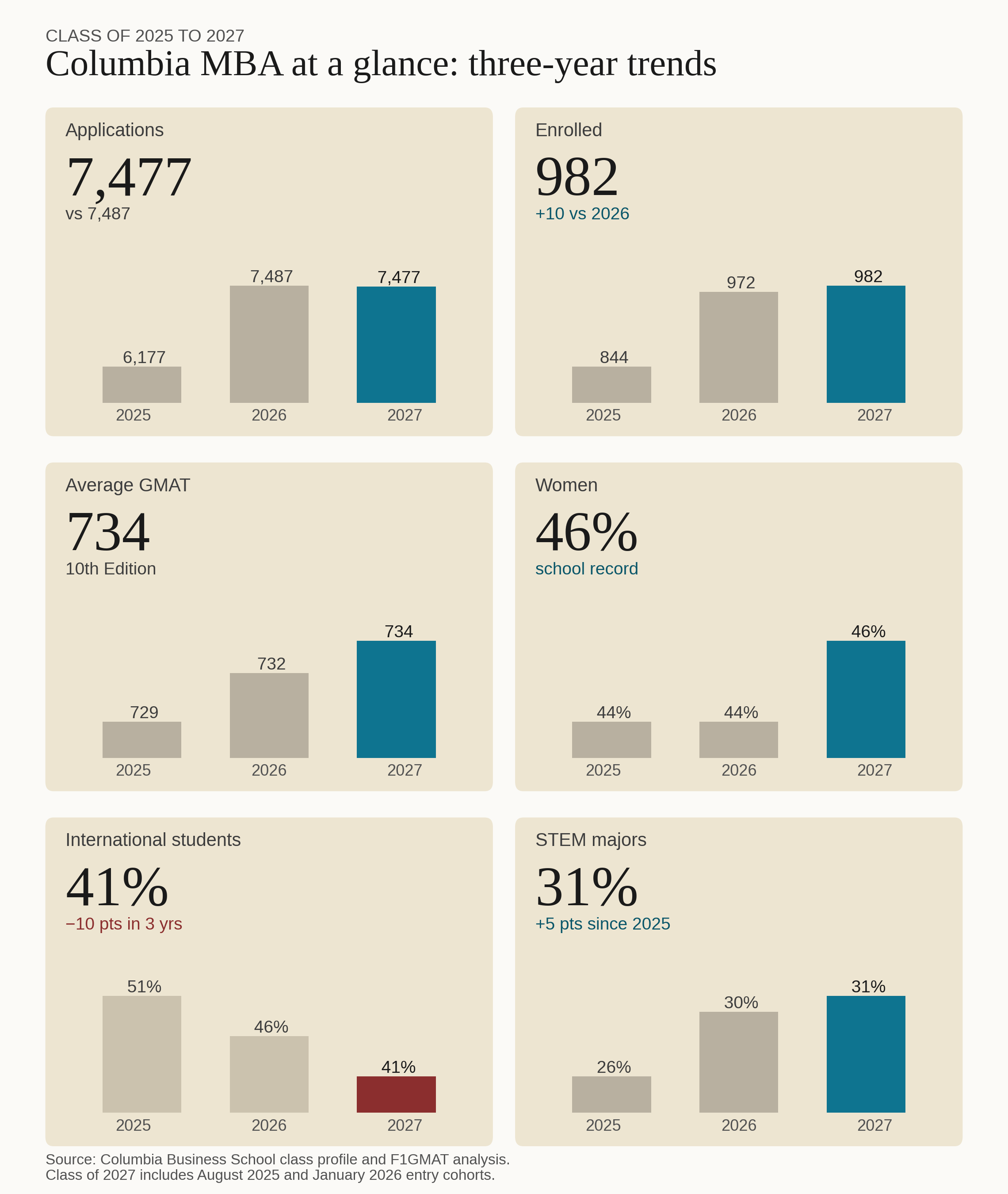
From the 7,477 applications[7], the school enrolled 982 students, slightly above 972 in 2026 and 844 in 2025, suggesting that yield management improved and that Columbia has maintained a larger class size since its campus expansion[1] plans that will take effect by 2030.
The Average work experience remained steady at 5 years, the years when Consultants and IB candidates go back to school to upgrade themselves.
| Columbia MBA Class of 2027 at a Glance | Metrics | Notes |
| Applications Received | 7,477 | |
| Enrolled Class Size | 982 | |
| Enrollment Rate (approx) | 13.1% | |
| Acceptance Rate (approx.) | 21% | Estimated |
| Yield Rate (approx.) | 63% | |
| Average Undergraduate GPA | 3.6 | |
| Average GMAT (Classic) | 734 | Increased by 5 points in 3 years |
| Average GMAT Focus | 690 | New format |
| Average GRE | 163 Quant / 163 Verbal| | Increased by 1 point each |
| Average Work Experience | 5 years | Consistent |
| Women | 46% | Increase of 2% |
| International Students | 41% | Down 3% from 2026 Class |
| Countries Represented | NA | Not available |
| U.S. Students | 59% | Inferred |
| U.S Minority | 48% | 4% increase |
Gen Z vs. Millennial GMAT Scores at CBS
Gen Z GMAT Score Increased at Columbia MBA, but Marginally Lower than Millennial Applicants
The academic profile strengthened slightly. The median GMAT rose to 734, up from 732 in 2026 and 729 in 2025.
GenZ Applicants submitting the GMAT Focus Edition averaged 690, 6 points lower than the scores submitted by Millennial applicants [2], even after considering the Focus to old format conversion.
Columbia MBA Average GPA Held Steady at 3.6
Average GPA at Columbia MBA remained consistent at 3.6, which is now considered a cut-off score for US applicants targeting M7 and Top MBA programs.
GRE Scores at CBS Rose to 163/163
GRE scores averaged 163/163, marginally higher than the prior year's 162/162, adding to the stability.
Women Reached 46% of the 2027 Cohort
Women comprise 46% of the class, up from 44% in both 2026 and 2025, marking one of Columbia's strongest gender representation levels to date.
Columbia MBA Despite New York's multiculturalism suffered in international MBA class representation. International students decreased to 41%, down from 46% in 2026 and 51% in 2025. This decline mirrors broader national trends: data across U.S. graduate programs has shown slower international enrolment in 2024–2025 due to visa-processing delays, increased scrutiny, and longer approval timelines for applicants from key sending regions.
Columbia's international share still remains high relative to peer programs, but the three-year downward movement suggests a real impact from the US MBA Visa Rules and the crackdown on H1B visas.
| Class Profile | Class of 2025 | Class of 2026 | Class of 2027 |
|---|---|---|---|
| Applications Received | 6177 | 7487 | 7,477 |
| Enrolled | 844 | 972 | 982 |
| Work Experience (Average) | 5 years | 5 years | 5 years |
| GMAT Score (Median/Average) | 729 | 732 | 734 (GMAT Focus Edition: 690) |
| GPA (Median/Average) | 3.6 | 3.6 | 3.6 |
| GRE (V/Q) | NA | 162/162 | 163/163 |
| % Women | 44% | 44% | 46% |
| % International Students | 51% | 46% | 41% |
Columbia MBA Class of 2027: Applications, Enrollment & Acceptance Rate Trends
Acceptance Rate vs. Yield Rate vs. Enrollment Rate
Before you infer the Columbia MBA Class acceptance rate trend, you must understand three terminologies: acceptance rate, enrolment rate and yield rate.
Acceptance Rate: From the 7,477 applications, Columbia sent admissions letter to approx 1,570 students (21%).
Yield Rate: From the 21% or the approx. 1,570 students, 63% accepted the offer (Columbia does not publicly disclose this data. We are making inference based on the recent trends and based on a reasonable sample size)
Enrollment Rate: From the 63% of the 1,570 students, who accepted the offer, 13.1% finally enrolled to the program.
When you see enrollment rate of 13.1%, do note that the number is different from the acceptance rate and yield rate.
Yield Rate is the strongest signal of whether a school is accepted by more or less M7 caliber candidates.
For the novice applicant, Columbia MBA has far more takers than Wharton MBA despite a lower application volume than Wharton MBA, but Wharton might be competing with Harvard and Stanford instead of Columbia. And that could be the reason for the lower enrollment rate.
Categorize your target schools into peer schools. That is the first step for your research.
| Metric | Wharton MBA 2027 | Columbia MBA 2027 |
|---|---|---|
| Applications | 7,613 | 7,477 |
| Admits (est.) | ~1,600 | ~1,570 |
| Enrolled | 888 | 982 |
| Acceptance Rate | ~21% | ~21% |
| Yield Rate (est.) | 55–65% | 55–65% (implied ~63%) |
| Enrollment Rate | 11.7% | 13.1% |
Columbia MBA Class of 2027: Undergraduate Degree
The undergraduate composition of the Class of 2027 reflects strong Business and Economics major representation.
Business and Economics Majors: 49% of the CBS MBA Incoming Class
Business and economics majors account for 49%, similar to 48% in 2026 but below the 53% seen in 2025.
Students with commercial backgrounds continue to choose Columbia because the school offers one of the strongest placements into investment banking, asset management, and corporate finance roles in the U.S., supported by its location in Manhattan and longstanding relationships with financial institutions in New York City.
STEM Majors at CBS Rose to 31%
STEM students form 31% of the class, higher than 30% in 2026 and 26% in 2025. This steady rise is driven by two factors. One, engineers, computer scientists, and data-oriented applicants are pivoting aggressively to careers in product management and consulting. Second, consulting engagement post-AI needs a strong technical foundation [3]
Humanities and Social Science Majors Held at 19%
Humanities and social-science backgrounds make up 19%, identical to 2026 and slightly above 18% in 2025. The steadiness in this segment reflects Columbia's consistent belief that Humanities and Social Science candidates from top universities can be oriented towards Consulting, Finance, and even Technology, depending on the client-facing and holistic thinking expected out of the role. The strong nonprofit, media, and marketing ecosystem in New York also contributed to the uptick in the cohort.
| Undergraduate Degree | Class of 2025 | Class of 2026 | Class of 2027 |
|---|---|---|---|
| Business/ Economics | 53% | 48% | 49% |
| Humanities/Social Science | 18% | 19% | 19% |
| STEM | 26% | 30% | 31% |
Columbia MBA Class of 2027: Pre-MBA Industry
Financial services remains the dominant pre-MBA industry at 30%, matching 2026 and slightly above 29% in 2025. This consistency will remain as long as Investment Banking remains New York's #1 high-paying function.
Why Financial Services Hiring at CBS Held Strong in 2024–2025
New York experienced growth in Private equity deployments, asset management, and certain banking M&A showed resilience, with NYSE member firms reporting ~40% pre-tax profit increase from Q3 2024–2025, driven by trading, IB, and asset management [4]. The comeback encouraged finance professionals to pursue career advancement through an MBA at Columbia.
Consulting Representation at CBS: AI and Consulting Correction
Consulting stands at 23%, down from 25% in 2026 but above 22% in 2025. During 2024–2025 as firms adjusted staffing as AI-driven implementation projects were in high demand and the demand for strategy and corporate-transformation engagements plateued . For consultants who did apply, Columbia continues to offer strong transition pathways into finance, corporate strategy, and leadership rotations in major corporations headquartered in New York.
Technology at CBS Held at 12%
Technology accounts for 12% of the Columbia MBA Class of 2027, slightly lower than 13% in 2026 but higher than 9% in 2025.
Despite volatility in technology hiring during 2023–2024, New York's technology and fintech sectors expanded reaching 203,000–211,000+ by mid-2025, up significantly from 161,000 in 2019[6]. The industry aslo drove 41% of net new private-sector jobs post-pandemic and accounted for 14% of all citywide employment growth over the past decade. An MBA became a natural extension to gain cross-functional expertise before returning to the industry as product experts in AI.
Columbia's appeal for technology applicants is also tied to its proximity to the city's fintech ecosystem and the school's curriculum in analytics, entrepreneurship, and digital transformation.
Marketing, Media, and Entertainment Still Above 10% CBS MBA Class Representation
Marketing, media, and entertainment remained steady at 10% for the 2027 CBS MBA Class, matching 2026 and slightly lower than 11% in 2025. Given the large consolidation of streaming platforms and dominance of Google and Facebook, the steady demand shows that even for revolutionary technology like AI, professionals capable of building PR and Digital Campaigns and manage the portfolio of product features is still in high demand.
Healthcare Hires at Columbia MBA Up and Reached 6%
Healthcare rose to 6%, up from 5% in the previous cycle, consistent with sector growth in biotech, health-tech, and pharmaceutical firms where M&A was selective. Key drivers in 2024 included innovative therapies (especially weight-loss drugs), physician-backed ambulatory surgery centers (ASCs), and digital health solutions, which drove candidates from the industry to pursue CBS MBA as a pivoting platform to learn about M&A and gain a strong management foundation.
Government and Non-Profit Recovered to 7%: 2023 Government Hiring Boom
The Government Hiring Boom in 2023 [5] with total government hiring rising by 709,000 jobs, a sharp acceleration from +299,000 in 2022 and +392,000 in 2022, spiked intake of Government and nonprofit backgrounds, which rose to 7% after dipping to 6% in 2026.
CBS MBA Energy Candidates: Oil and Gas to CleanTech
Energy remained constant at 2%, reflecting the small but steady flow of applicants from oil, gas, utilities, and renewable-energy sectors, who use an MBA to pivot to a different industry or switch functions to management roles.
Military Representation Returned to 4%
Military representation reappeared at 4% after an unreported figure in 2026, which is a hint that the representation fell below 1%.
| Pre-MBA Industry | Class of 2025 | Class of 2026 | Class of 2027 |
|---|---|---|---|
| Financial Services | 29% | 30% | 30% |
| Consulting | 22% | 25% | 23% |
| Marketing/Media/Entertainment | 11% | 10% | 10% |
| Technology | 9% | 13% | 12% |
| Government/Non-Profit | 9% | 6% | 7% |
| Healthcare | 5% | 5% | 6% |
| CPG/Retail/E-commerce | NA | 3% | NA |
| Energy | 2% | 2% | 2% |
| Military | 5% | NA | 4% |
Final Take - Columbia MBA Class of 2027
Overall, Columbia's Class of 2027 mirrors the economic conditions of 2024–2025: stable finance activity, moderated consulting demand, selective tech growth, and predictable hiring in public and healthcare sectors.
