The Stanford MBA deadlines for the 2027 entering class (Class of 2029) follow a single schedule of three rounds.
Round 1 closes September 9, 2026, Round 2 closes January 6, 2027, and Round 3 closes April 7, 2027.
Every round closes at 4:00 p.m. Pacific Time, and you may submit only one application to Stanford GSB per application year. The completed application includes both letters of recommendation and the paid application fee.
However, there are key structural differences and timelines.
TL;DR
- Only three rounds exist - September 9, 2026, January 6, 2027 and April 7, 2027
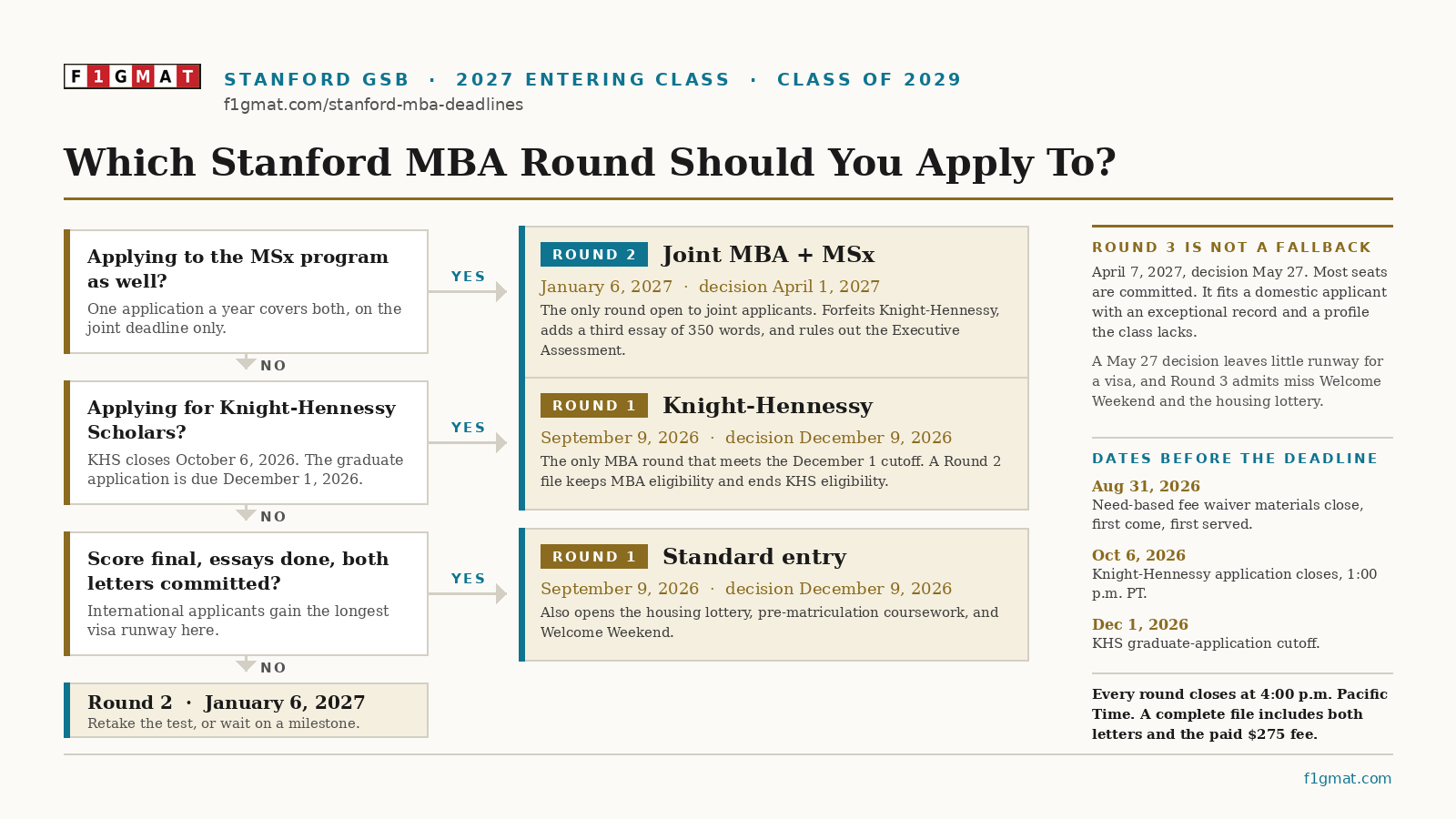
- Knight-Hennessy Scholars applicants must use Round 1,as the later MBA rounds doesn't meet the December 1, 2026 cutoff of the fund
- Joint MBA and MSx applicants must use the Round 2 joint deadline
- Application fee $275 has been reduced to $100 for defer-eligible applicants and waived for US military service members and veterans
- Need-based fee waiver materials will close on August 31, 2026, which are awarded on a first come, first served basis
Open Upcoming Closed
R1 Open Sept 9, 2026 4:00 PM PT Decision: Dec 9, 2026
R2 Upcoming Jan 6, 2027 4:00 PM PT Decision: Apr 1, 2027
R3 Upcoming Apr 7, 2027 4:00 PM PT Decision: May 27, 2027
Contents
- Stanford MBA Deadlines at a Glance
- 2027 Entry Deadlines (Three Rounds)
- What 4:00 p.m. Pacific Means in Your Time Zone
- Priority Application Deadline Window
- MSx Joint Entry Deadline (Round 2 Only)
- Stanford MBA vs. Stanford MSx Entry
- Round-Based Admissions at Stanford: What It Means
- Round Strategy: When to Apply
- Interview Invitation Timeline
- Application Components and What is Due by the Deadline
- Decision Day, Waitlist, and Deferral Policy
- Reapplicants: Eligibility and Process
- Application Fee and Fee Waivers
- Deferred Enrollment Deadlines
- Generative AI Policy for Applications
- Frequently Asked Questions
- Key Takeaways
Stanford MBA Deadlines at a Glance
All deadlines close by 4:00 p.m. Pacific Time (not midnight, and not 11:59 p.m.) on the deadline date for the round in which you apply [1].
Stanford states that it cannot guarantee review of information that is submitted after the deadline.
| Round | Application Deadline (4:00 PM PT) | Final Decision Released | Interview Window |
|---|---|---|---|
| Round 1 | September 9, 2026 | December 9, 2026 | Mid-September to mid-November 2026 |
| Round 2 | January 6, 2027 | April 1, 2027 | Mid-January to mid-March 2027 |
| Round 3 | April 7, 2027 | May 27, 2027 | Mid-April to mid-May 2027 |
2027 Entry Deadlines (Three Rounds)
Stanford runs one entry per year, the traditional two-year MBA with a summer internship between the first and second years.
Every full-time MBA applicant competes on the same three-round calendar for a 434 class size.
You submit your essays and completed application by the round deadline.
The admissions committee reviews only after the round closes.
Once the applications are reviewed, the AdCom invites a subset to interview inside a published window.
The AdCom also releases every decision for that round on one date.
What 4:00 p.m. Pacific Means in Your Time Zone
The cutoff falls in the middle of the American working day.
For most international applicants, it would be late at night or the following morning.
We advise applicants to schedule the upload at least two days before the deadline.
Round 2 closes under Pacific Standard Time while Rounds 1 and 3 close under Pacific Daylight Time.
The offset shifts by an hour between rounds.
Plan for the submission for the day before your local conversion.
Conversions calculated from the 4:00 p.m. Pacific cutoff published by Stanford GSB Admissions [1].
| Your city | Round 1 closes | Round 2 closes | Round 3 closes |
|---|---|---|---|
| San Francisco | 4:00 PM, Sept 9 | 4:00 PM, Jan 6 | 4:00 PM, Apr 7 |
| New York | 7:00 PM, Sept 9 | 7:00 PM, Jan 6 | 7:00 PM, Apr 7 |
| London | 12:00 AM, Sept 10 | 12:00 AM, Jan 7 | 12:00 AM, Apr 8 |
| Lagos | 12:00 AM, Sept 10 | 1:00 AM, Jan 7 | 12:00 AM, Apr 8 |
| Paris, Berlin | 1:00 AM, Sept 10 | 1:00 AM, Jan 7 | 1:00 AM, Apr 8 |
| Dubai | 3:00 AM, Sept 10 | 4:00 AM, Jan 7 | 3:00 AM, Apr 8 |
| Mumbai, Delhi | 4:30 AM, Sept 10 | 5:30 AM, Jan 7 | 4:30 AM, Apr 8 |
| Singapore, Beijing | 7:00 AM, Sept 10 | 8:00 AM, Jan 7 | 7:00 AM, Apr 8 |
| Tokyo, Seoul | 8:00 AM, Sept 10 | 9:00 AM, Jan 7 | 8:00 AM, Apr 8 |
| Sydney | 9:00 AM, Sept 10 | 11:00 AM, Jan 7 | 9:00 AM, Apr 8 |
Priority Application Deadline Window
The priority application window at Stanford works differently from schools that reserve fellowship money by round. Stanford publishes no fellowship-priority round and admits on a need-blind basis, so the priority argument rests on two other things: an external scholarship with an earlier calendar, and a fee waiver that closes before Round 1.
Priority Funding
The Knight-Hennessy Scholars application for the 2027 cohort closes on October 6, 2026 at 1:00 p.m. Pacific Time.
Every KHS applicant must also submit a Stanford graduate degree application by the earlier of the program deadline or December 1, 2026. Stanford states plainly that only the Round 1 MBA deadline aligns with the KHS admission timeline [8]. Round 2 falls on January 6, 2027, five weeks past that cutoff, so a Round 2 submission preserves MBA eligibility and forfeits KHS eligibility entirely.
Knight-Hennessy covers tuition and a living stipend against a first-year cost of attendance that reached $140,940 for a single student and $168,825 for a married student in 2026-27, built on tuition of $89,187 [13]. Institutional aid at Stanford is separate and need-based, and the average GSB fellowship for the Class of 2026 was approximately $50,000 a year.
The second dated item is the need-based application fee waiver. All waiver materials are due by August 31, 2026, nine days ahead of the Round 1 deadline, and Stanford will not consider requests after that date. Waivers are offered first come, first served [3].
Priority Decision
Stanford strongly encourages partnered applicants applying in the same year to apply in the same round, so that each knows whether the other has been admitted before either has to accept or decline an offer [1].
MSx Joint Entry Deadline (Round 2 Only)
The Stanford MSx Program is the school's one-year master's degree for experienced leaders, and it is the only other full-time degree that shares the MBA application portal. It matters to a deadline page because you may start and submit only one application to Stanford GSB per year.
To be considered for both programs, you must apply through the joint application deadline in Round 2 [9][14]. Applying to one program alone leaves all three rounds of that program open.
| Applying for | Submit your application by | Notification date |
|---|---|---|
| MBA only | Sept 9, 2026 / Jan 6, 2027 / Apr 7, 2027 | Dec 9, 2026 / Apr 1, 2027 / May 27, 2027 |
| MSx only | Oct 8, 2026 / Jan 6, 2027 / Feb 11, 2027 | Dec 9, 2026 / Apr 1, 2027 / Apr 1, 2027 |
| MBA and MSx jointly | January 6, 2027 (Round 2 only) | April 1, 2027 |
The joint route costs you the September and April MBA rounds.
A candidate weighing both programs gives up the Knight-Hennessy-eligible Round 1 by definition.
A joint application is reviewed independently by each admissions office [14].
Two rules catch joint applicants.
The MBA Program does not accept the Executive Assessment, so a joint applicant must submit a valid GMAT, GMAT Focus, or GRE score even though MSx alone would accept the EA.
Joint applicants also write a third essay of up to 350 words on how they will enhance the MSx community, in addition to the two required MBA essays [2].
Stanford MBA vs. Stanford MSx Entry
There is no compromise on quality between the two programs. Both are taught by the same faculty on the same campus, and MSx students take GSB electives alongside MBA students.
The primary difference is in the years of experience each program expects and the absence of a summer internship in the twelve-month MSx calendar.
| Dimension | Stanford MBA | Stanford MSx |
|---|---|---|
| Program length | 24 months | 12 months |
| Number of rounds | 3: Sept 9, 2026 / Jan 6, 2027 / Apr 7, 2027 | 3: Oct 8, 2026 / Jan 6, 2027 / Feb 11, 2027 |
| Joint application | Round 2 only, January 6, 2027 | Round 2 only, January 6, 2027 |
| Application fee | $275 | $275 |
| Work experience | Class of 2027 averaged 5.3 years | Minimum 8 years required |
| Summer internship | Yes, between years | No, program runs straight through |
| Accepted tests | GMAT, GMAT Focus, or GRE | GMAT, GMAT Focus, GRE, or Executive Assessment |
| Essays | Two required | Third 350-word essay added for joint applicants |
| Round timing advice | Round 1 or Round 2 preferred by the committee | No advantage to any particular round |
| Deferral policy | Enroll in the year admitted, unless you meet the deferred enrollment criteria | Enroll in the year admitted. No deferred enrollment route exists |
If you are unsure which program to target, the deciding question is years of experience. The MSx minimum of eight years sits well above the MBA average of 5.3 years, and a candidate below that line has one route rather than two.
Round-Based Admissions at Stanford: What It Means
Stanford does not use rolling admissions in any part of the MBA process.
Every round is closed-deadline, where a committee reviews the application after the round closes.
Timeline of Application Review
There are no preference for applicants who submit the application on day one of the round vs. a person who submit the application an hour before the deadline.
Late submissions has a risk of portal failure. Worse, payment declines or recommenders not able to complete the deliverable.
One application per year
You may apply once per application year in one of the three rounds. There is no mechanism to move a file into a later round, and no second application inside the same cycle.
Tracking recommenders
Applicants can track the online status to see if the recommenders submitted their letters through Stanford's online form. [4].
Round Strategy: When to Apply
| What works in a Stanford GSB application | What does not work |
|---|---|
| Round 1 for Knight-Hennessy candidates, the only round that qualifies | Having another person or tool write any essay, which can void an offer |
| Round 1 or Round 2 for international applicants who need visa lead time | Drafting or editing your own recommendation letter, which breaks the terms |
| Requesting the need-based fee waiver well before August 31, 2026 | Submitting a rushed Round 1 file when Round 2 would produce a stronger one |
| Reporting your single strongest sitting, since Stanford does not superscore | Treating Round 3 as a fallback when funding or a visa is required |
Round 1 (deadline September 9, 2026)
Round 1 suits three kinds of applicants.
The first is any Knight-Hennessy candidate, for whom Round 1 is the only qualifying round.
The second is an international applicant, who needs the longest possible runway for visa processing before the program starts.
The third is anyone whose essays are finished by Labor Day weekend and whose two recommenders have already committed.
Stanford also lists the on-campus housing lottery, recommended pre-matriculation coursework, and Welcome Weekend among the reasons to apply in the first two rounds, and there is no Welcome Weekend for Round 3 admits.
Avoid if: your GMAT or GRE score is not yet competitive. The Class of 2027 averaged 738 on the 10th edition GMAT, 689 on the GMAT Focus Edition, and 164 on both GRE sections, with an average GPA of 3.76, out of 7,259 applications for 434 seats.
Stanford sets no minimum score, but a September submission built on a score you plan to replace in October wastes your one application for the year.
Round 2 (deadline January 6, 2027)
Round 2 is ideal for applicants whose current score undersells them. Retake GMAT/GRE and if you are waiting for a promotion or a project outcome that would changes your profile, choose Round 2. It is also the mandatory round for anyone applying jointly to the MBA and MSx programs.
Note: Round 2 forfeits Knight-Hennessy eligibility, since the January 6 deadline falls after the December 1, 2026 cutoff.
Round 3 (deadline April 7, 2027)
Best for: A domestic applicant with an exceptionally strong record and a profile the class is missing. Round 3 is the most competitive round at any top program because most seats are already committed, and Stanford admitted roughly 6% of applicants overall for the Class of 2027.
Avoid if: You are an international applicant who needs a long visa timeline, since a May 27 decision deadline will little time for visa processing that takes anywhere from 1.5 to 3 months. Round 3 admits also miss the Welcome Weekend and the housing lottery, which could affect the total COA.
Interview Invitation Timeline
You cannot request an interview on campus through networking. The AdCom sends the interview invites after the review.
When invitations go out
Stanford publishes no date by which all interview decisions are released. It publishes interview windows instead: mid-September to mid-November for Round 1, mid-January to mid-March for Round 2, and mid-April to mid-May for Round 3 [5]. An invitation can arrive at any point inside that window, so silence in week two of a window carries no signal.
An interview will not be granted without valid test scores submitted to Stanford. Every admitted candidate interviews first, and Stanford generally interviews two to three candidates per available seat, so an invitation is a positive signal that still leaves most invited candidates outside the class.
Format
A trained member of the global alumni community or a member of the admissions team conducts the interview. It is a structured behavioral interview focused on what you have done and how you did it, built on past actions instead of hypothetical situations, and it invites you to discuss meaningful professional or community experiences from the past few years. Interviews take place remotely or in person, and Stanford states that the location and date do not affect your candidacy. Business attire is recommended.
After the interview
The interviewer reports back to the admissions committee, and every decision for the round is released on the published decision date.
Application Components and What is Due by the Deadline
| Component | Deadline Behavior |
|---|---|
| Online application form | Submitted by 4:00 p.m. Pacific Time on the round deadline. No changes accepted after submission. |
| Application fee ($275) | Paid by the deadline. Stanford releases a decision only after the fee is paid or waived. Reduced and waived tiers apply, see Reapplicants and Fees below. |
| Letters of recommendation (2) | One from a current direct supervisor or the next best alternative, one from someone else who has supervised you. Both submitted through the online form by the deadline. No family members and no current or former direct reports. |
| Resume | One page, standard letter or A4. Uploaded with the application. A template is offered but not required. |
| Transcripts | Unofficial copies uploaded with the application from every university attended. Official copies requested only if you are admitted. |
| GMAT, GMAT Focus, or GRE score | Entered at submission from a single sitting. Stanford does not superscore. If your score expires before June 1, 2027, send official scores through the reporting center at submission, and they may arrive after the deadline. |
| English proficiency test | TOEFL, IELTS, or PTE required if any undergraduate course outside foreign language study was taught in a language other than English, unless you later completed a graduate degree taught exclusively in English. |
| Essays | Two essays inside the application, up to 650 words and up to 350 words. A third 350-word essay applies to joint MBA and MSx applicants. |
| Additional Information | Optional. For extenuating circumstances, unlisted academic experience, or why a current supervisor is not a recommender. Not a second essay. |
| Interview | By invitation only after file review. Not a deadline item. |
Decision Day, Waitlist, and Deferral Policy
Decision release
Stanford posts your decision to your application account on the notification date for your round and emails the address used to create the profile. It does not release decisions before the published date and does not accommodate requests for an early decision or for a decision by phone or in person [1].
Waitlist
Stanford publishes no waitlist size, no waitlist release schedule, and no waitlist communication policy on any admission page. Having said that here is the ideal waitlist communication strategy as a starting point.
Deposits and deferral
Stanford publishes no deposit schedule by round on its admission pages. What it does publish is a deferral policy that functions as the constraint most applicants overlook: if you are offered admission, you are expected to enroll in the year for which you are admitted unless you meet the deferred enrollment criteria. If you do not meet those criteria, Stanford does not allow you to defer to a later year and asks you to reapply instead. Exceptions are considered only under rare and extraordinary circumstances, such as compulsory military service [1].
Reapplicants: Eligibility and Process
Stanford has no reapplicant category, no reapplicant essay, and no twelve-month window. [12].
What a reapplication requires
- A complete new application, because the application changes each year. Some biographical information carries over, and every field remains editable.
- The standard $275 application fee, unless you qualify for a reduction or a waiver.
- Valid GMAT, GMAT Focus, GRE, and English proficiency scores. Scores still valid for the round need no retake and no resend from the test center. Expired scores require a retake.
- A current letter from each recommender. Choosing the same two recommenders is permitted, and Stanford asks that they submit a fresh letter.
- The same round deadlines as first-time applicants. There is no separate reapplicant deadline.
- Stanford evaluates the new application without seeing your previous application, though the office retains access and may choose to review it before a final decision. Stanford does not provide feedback on denied applications.
Application Fee and Fee Waivers
The application fee is $275 and nonrefundable.
Stanford accepts American Express, Discover, Mastercard, and Visa.
The fee must be received by 4:00 p.m. Pacific Time on the round deadline, and the office evaluates the application and releases a decision only after payment [3].
| Tier | Who qualifies | What to do |
|---|---|---|
| Standard, $275 | Every applicant not covered below | Pay inside the application by the round deadline |
| Reduced, $100 | Final-year bachelor's or joint bachelor/graduate students whose degree is conferred between October 1, 2026 and September 30, 2027, and current graduate students who began immediately after an undergraduate program | Applies automatically to defer-eligible applicants |
| Waived | Active-duty US service members, honorably discharged US veterans, and US military reservists | Upload proof of service when prompted: a proof-of-service letter dated within 45 days, an enlistment contract dated within 365 days, a Tuition Assistance form showing separation date, or recent leave and earnings statements |
| Need-based waiver | Applicants for whom the fee poses extreme financial hardship | Complete the listed application steps, then email [email protected] for the additional form. All materials due August 31, 2026, first come, first served |
Deferred Enrollment Deadlines
Deferred enrollment is for college seniors and final-year graduate students who want a seat secured before they have full-time work experience, then spend one to four years working before enrolling.
There is no separate deferred enrollment deadline. Stanford states that an applicant interested in deferred enrollment may apply in any of the three rounds, on the same dates as every other applicant [1]. That is the single largest structural difference from peer programs, which run deferred admissions on a separate spring calendar.
Who is eligible
| Route | Requirement |
|---|---|
| College senior | In the final year of a bachelor's degree or a joint bachelor/graduate program, with the degree conferred between October 1, 2026 and September 30, 2027 |
| Graduate student | Began a master's, PhD, law, or medical degree in the academic year immediately following an undergraduate or undergraduate/graduate program, did not work full time beforehand other than internships or co-ops, and the degree is conferred between October 1, 2026 and September 30, 2027 |
| December graduation | Eligible to apply in any of the three rounds during the year of eligibility, even when the degree is conferred before a round deadline |
| Gap year taken | Not eligible for deferred enrollment if you took a gap year between undergraduate study and graduate school |
| Job offer | Not required. A full-time offer in hand is not a condition of admission |
College senior In the final year of a bachelor's degree or a joint bachelor/graduate program, with the degree conferred between October 1, 2026 and September 30, 2027
Graduate student Began a master's, PhD, law, or medical degree in the academic year immediately following an undergraduate or undergraduate/graduate program, did not work full time beforehand other than internships or co-ops, and the degree is conferred between October 1, 2026 and September 30, 2027
December graduation Eligible to apply in any of the three rounds during the year of eligibility, even when the degree is conferred before a round deadline
Gap year taken Not eligible for deferred enrollment if you took a gap year between undergraduate study and graduate school
Job offer Not required. A full-time offer in hand is not a condition of admission
Graduate students should apply in the final year of the graduate program. Defer-eligible applicants pay the reduced $100 application fee, and Stanford encourages full-time students to select recommenders who supervised internships, co-ops, part-time work, or extracurricular activity [3][4][6].
Generative AI Policy for Applications
Stanford draws one of the hardest lines among top programs. It states that having another person or tool write your essays is improper and a violation of the terms of the application process, and that such behavior may result in denial of your application or revocation of your admission [2].
The distinction Stanford draws is between feedback and coaching. Appropriate feedback happens when others review your completed application once or twice and point out omissions, errors, or inaccuracies that you then correct yourself, leaving your thoughts, voice, and style intact. When you allow others to write any part of the application, your self-presentation is no longer authentic. The line is crossed when any part of the application other than the letters of recommendation stops being exclusively yours in thought or word.
The same standard covers recommendation letters, and Stanford states it more strictly than most schools. Your recommenders must be the sole authors of their letters. Drafting, writing, translating, editing, or submitting your own recommendation violates the application terms, even when your recommender asks you to do it, and outside parties may not review or edit a letter either. Recommenders may not submit from your personal or work computer, laptop, or other device. Stanford makes the applicant responsible for informing recommenders of this policy [4].
Where a letter is written in another language, the recommender should have it translated by a paid translation service or a colleague, upload both versions, and provide contact information for the translator. The applicant does not touch the translation.
Frequently Asked Questions
When is the Stanford MBA Round 1 deadline for the 2026-2027 cycle?
Round 1 closes September 9, 2026 at 4:00 p.m. Pacific Time equivalent to 7:00 p.m. Eastern. Decisions are released December 9, 2026.
When is the Stanford MBA Round 2 deadline?
Round 2 closes January 6, 2027 at 4:00 p.m. Pacific Time while decisions are released April 1, 2027. This is also the joint deadline for applicants seeking consideration by both the MBA and MSx programs.
When is the Stanford MBA Round 3 deadline?
Round 3 closes April 7, 2027 at 4:00 p.m. Pacific Time. Decisions are released May 27, 2027. It is the final round of the 2026-2027 cycle.
Is the Stanford deadline midnight or 4:00 p.m.?
It is 4:00 p.m. Pacific Time. Plan for the early afternoon of the deadline date in California, which is the evening in New York and after midnight across Europe, Africa, and Asia.
Does Stanford have rolling admissions?
No. All three rounds are closed-deadline, and review begins after the round closes. Submitting on the first day of a round does not produce an earlier read.
Can I apply more than once in the same year?
No. You may apply once per application year in one of the three rounds, and you may start and submit only one application to Stanford GSB per year.
Should I apply in Round 1 or Round 2?
Round 1 if you are a Knight-Hennessy candidate, since no later round qualifies, or if you are an international applicant who wants maximum visa lead time. Round 2 if your test score needs a retake or a professional milestone lands in the autumn. A strong Round 2 file beats a rushed Round 1 file, but a Round 2 file forfeits Knight-Hennessy.
Is Round 3 worth applying to at Stanford?
Round 3 is the most competitive round at the most selective MBA program in the world, which admitted roughly 6% of 7,259 applicants for the Class of 2027. It works for a domestic candidate with an exceptional record and a profile the class lacks. It is a poor choice for an international candidate who needs visa lead time, and Round 3 admits miss both Welcome Weekend and the housing lottery.
What is the Stanford MBA application fee?
The fee is $275 and nonrefundable.
Defer-eligible applicants pay a reduced fee of $100.
Active-duty US service members, honorably discharged veterans, and reservists pay no fee on approval.
A need-based waiver also exists for applicants facing extreme financial hardship.
When is the fee waiver deadline?
All need-based fee waiver materials are due August 31, 2026. Stanford will not consider requests after that date, and waivers are granted first come, first served. The military waiver is requested inside the application by uploading proof of service.
Do my test scores need to reach Stanford by the deadline?
Report one score from GMAT, GMAT Focus, or GRE score, since Stanford does not superscore. The one exception to the deadline - if your score expires before June 1, 2027, send official scores through the reporting center at submission.
How many letters of recommendation does Stanford require?
Two. One from your current direct supervisor or the next best alternative, and one from someone else who has supervised your work. Family members and current or former direct reports are not permitted. Both letters must reach Stanford through the online form by the round deadline.
When does Stanford send interview invitations?
Stanford publishes no invitation release date. It publishes interview windows: mid-September to mid-November for Round 1, mid-January to mid-March for Round 2, and mid-April to mid-May for Round 3. Interviews are not granted without valid test scores on file.
What are my odds after an interview invitation?
Stanford generally interviews two to three candidates per accepted seat.
Can I interview on campus?
No. Stanford doesn't accept requests to interview on campus. Interviews take place remotely or in person with a trained alumni interviewer or an admissions staff member, and the location and date do not affect your candidacy.
Is the reapplicant deadline different?
No. Reapplicants apply in the same deadlines and file a complete new application.
Are there separate essays for reapplicants?
There is no reapplicant essay for Stanford MBA and no twelve-month reapplicant window. Valid test scores need no retake or resend, and each recommender must submit a current letter.
When is the deferred enrollment deadline?
There is no separate one. Deferred enrollment applicants use the same three rounds as everyone else and pay a reduced $100 application fee.
Can I defer my admission if I am admitted?
Only through the deferred enrollment criteria. Stanford expects admits to enroll in the year for which they were admitted and asks everyone else to reapply, considering exceptions only under rare and extraordinary circumstances such as compulsory military service.
Can I apply to both the MBA and the MSx program?
Yes, through the Round 2 joint application deadline only, which is January 6, 2027 with notification on April 1, 2027. Joint applicants write a third essay of up to 350 words on enhancing the MSx community, and the MBA program does not accept the Executive Assessment, so a valid GMAT, GMAT Focus, or GRE score is required.
Can I use AI to write my Stanford essays?
No. Stanford states that having another person or tool write your essays violates the terms of the application process and may result in denial or revocation of admission. Feedback on a completed draft is permitted. Anything that leaves the work no longer exclusively yours in thought or word is not.
Key Takeaways
- Knight-Hennessy Scholars should target Round 1 as The KHS application closes October 6, 2026.
- The Round 1 deadline is 4:00 p.m. Pacific, which is after midnight the same night for Europe, Africa, and Asia. Round 2 shifts an hour later in most of those cities because it closes under Pacific Standard Time instead of Pacific Daylight Time.
- Stanford does not superscore and reads one score from one sitting, so a candidate holding a strong quant section from one attempt and a strong verbal section from another gains nothing by reporting both.
- Stanford interviews two to three candidates per available seat, conducts a structured behavioral interview on past actions, and will not interview anyone without valid test scores already submitted.
- Admission is for one year only. An admit who cannot enroll and does not meet the deferred enrollment criteria reapplies from scratch. Stanford grants deferrals only in rare circumstances such as compulsory military service.
References
- Stanford GSB: Deadlines for Applying to the MBA Program ↩ ↩ ↩ ↩ ↩ ↩
- Stanford GSB: MBA Application Essentials and Essays ↩ ↩
- Stanford GSB: Application Fee ↩ ↩ ↩
- Stanford GSB: Letters of Recommendation ↩ ↩ ↩
- Stanford GSB: Interviews ↩
- Stanford GSB: Deferred Enrollment ↩
- Stanford GSB: MBA Entering Class Profile
- Knight-Hennessy Scholars: Application Deadlines ↩
- Stanford GSB: Admission to the Stanford MSx Program ↩
- Stanford GSB: Joint and Dual Degrees
- Stanford GSB: MPP/MBA Joint Degree
- Stanford GSB: Reapplication ↩
- Stanford GSB: Cost of Attendance ↩
- Stanford GSB: Deadlines for Applying to the MSx Program
↩ ↩