2026-27 Update | F1GMAT Admissions Consulting
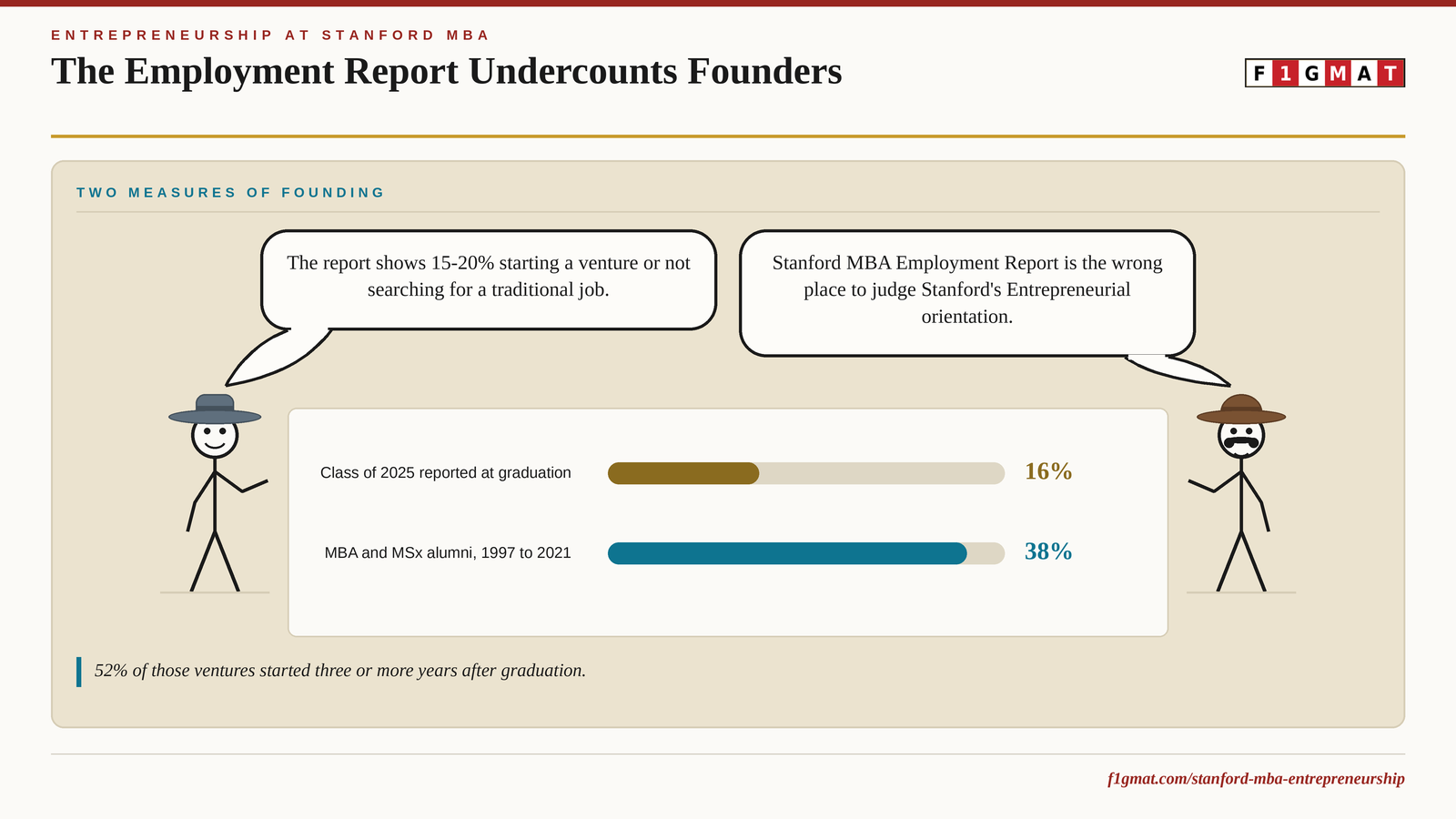
Stanford MBA Employment Report is the wrong place to judge Stanford's Entrepreneurial orientation. The report shows 15-20% starting a venture or not searching for a traditional job.
The school's own longitudinal research across MBA and MSx classes from 1997 to 2021 shows that 38% of alumni founded a company and 52% of those ventures started three or more years after graduation[3], against the 16%, or 70 graduates, the Class of 2025 reported at graduation[1][2].
Search funds, vehicles in which a searcher raises capital to buy and run an existing company, took 18% of that founding cohort, behind technology at 42% and ahead of healthcare at 10% and consumer products at 8%[1]
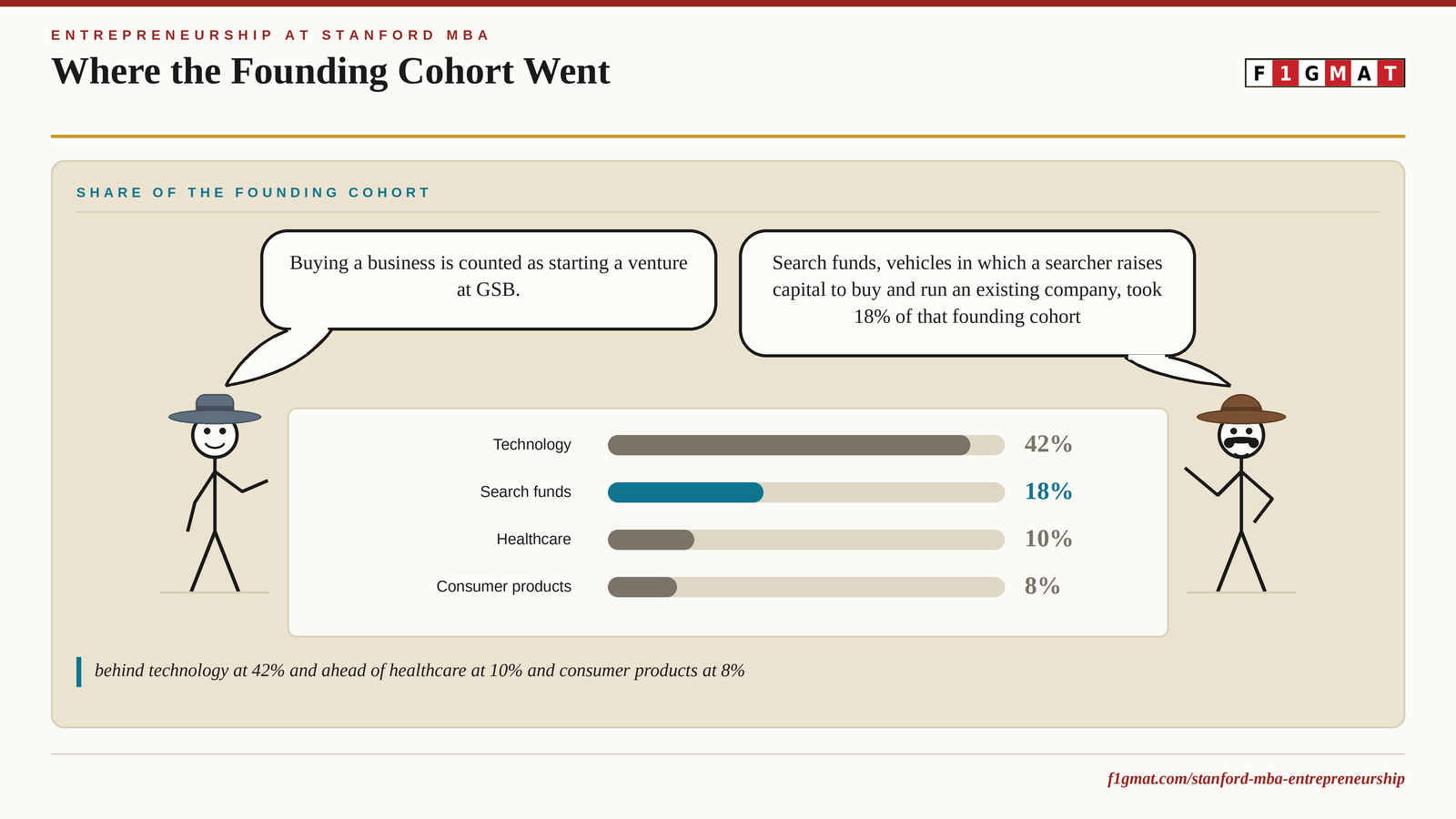
Buying a business is counted as starting a venture at GSB.
From an MBA Application and Why Stanford MBA perspective, convert the GSB ecosystem to a specific value statement.
Here are 8 Stanford GSB Entrepreneurial ecosystems worth quoting in your GSB MBA Application essays:
Contents
- Grousbeck-Holloway Center for Entrepreneurial Studies
- Startup Garage
- Stanford Venture Studio
- Botha-Chan Innovation Program and the Entrepreneurial Summer Internship Program
- Stanford Entrepreneurship Network
- StartX
- STVP, the Stanford Engineering Entrepreneurship Center
- Business Association of Stanford Entrepreneurial Students (BASES)
- How to Use This in a Stanford Application
- References
- Related F1GMAT Resources
Grousbeck-Holloway Center for Entrepreneurial Studies
The Center for Entrepreneurial Studies became the Grousbeck-Holloway Center for Entrepreneurial Studies in June 2026, at its 30th anniversary celebration, after more than 100 alumni and friends contributed to a naming gift honoring its two founders.
H. Irving Grousbeck and Charles A. Holloway created the center in 1996, at a point when Stanford GSB offered three entrepreneurship courses and had published almost no research on the subject.
Stefanos Zenios is the faculty director, and Deb Whitman is the director.
The center now runs more than 50 courses on entrepreneurship and innovation, publishes 40 to 50 case studies a year, and funds research on startups, venture funding, and entrepreneurial ecosystems.
Its teaching methodology is based on teaming up a tenure-line researcher with a practicing founder or investor in the same classroom.
Over a hundred alumni return each year as mentors, case protagonists, lecturers, or competition judges.
Recent additions to the curriculum include Understanding AI Technologies for Business Problems, Research-Driven Inspiration, in which students interview domain experts before committing to an industry, and Ecopreneurship Foundations, an entry-level course on climate-focused venture building.
If you plan to write a Why Stanford essay around entrepreneurship, this is the center that owns most of what you will cite.
Startup Garage
Startup Garage is the school's flagship entrepreneurship course, taught over two quarters.
and structured by Zenios, professor of operations, information, and technology.
Students work in teams to find a real problem, test it against users, and build a business model around a proposed solution, with weekly deliverables and mentoring from industry partners and Startup Garage Fellows.
Teams present to a panel of investors and entrepreneurs at the end.
Zenios is explicit that launching a company is not the objective.
The course teaches a repeatable method for turning an observed problem into a tested opportunity, which is why he describes entrepreneurs as behaving like scientists who observe, hypothesize, test, and iterate.
The output speaks for the method anyway: DoorDash, Zum, and Gold Leaf Farming all began in Startup Garage, and companies started by course alumni have raised more than $3 billion in venture funding.
Lean Launchpad, taught through the engineering school, plays a similar role for students who want a second run at the same discipline.
Stanford Venture Studio
Stanford Venture Studio is the co-working space and residency program that the entrepreneurship center runs for Stanford graduate students across the university.
An MBA team can pick up an engineer, a lawyer, or a medical student without leaving the building.
Membership gives you round-the-clock desk space, weekly advising sessions with founders and venture capitalists, workshops, and a member community.
The studio takes no equity and charges no fees, because its purpose is educational.
Students can test an idea and abandon it without consequence, which is a different proposition from an accelerator that needs its portfolio to return capital.
Botha-Chan Innovation Program and the Entrepreneurial Summer Internship Program
Stanford GSB funds two distinct ways to spend the summer between first and second year on a venture instead of at an employer.
The Botha-Chan Innovation Program, funded by a gift from Roelof Botha, MBA '00, and Huifen Chan, MBA '00, gives Stanford graduate students eight weeks to dissect an idea and evaluate if it is a feasible for-profit idea.
The Entrepreneurial Summer Internship Program instead places students inside early-stage startups, which suits candidates coming from consulting or a large corporate employer who want to test whether they actually enjoy the disorder of an eight-person company.
A third option, EcoSprint, applies the eight-week sprint format to climate and sustainability problems.
Stanford Entrepreneurship Network
The Stanford Entrepreneurship Network (SEN) is the federation that connects entrepreneurship organizations across the university, including groups inside Engineering, Medicine, Law, and the GSB, alongside the Office of Technology Licensing and the Office of Corporate Relations.
SEN[8]runs an annual Entrepreneurship Week, hosts educational and networking events, and operates Coaches-on-Call office hours where students meet industry professionals.
Its most practical resource for a first-year MBA is the Team Formation Hub, which helps students find co-founders across schools, lists the experiential entrepreneurship courses open to them, and publishes guidance on forming and keeping a founding team.
SEN also indexes the accelerators an MBA can join, including Cardinal Ventures, the on-campus accelerator that graduates two cohorts a year with a small grant plus recruiting, technical, and legal support.
StartX
StartX is the independent non-profit accelerator and founder community for Stanford students, faculty, and alumni[6]. It began as SSE Labs in 2009 and was incorporated in its current form in 2011, and it marked 15 years in September 2025. It takes no equity and charges no fees, and it was built with more than $7 million in grant funding from Stanford University and Stanford Health Care, with roughly $200 million deployed by the two institutions to keep the organization self-sufficient.
StartX reports a community of more than 3,000 founders, a combined portfolio valuation of $200 billion, an average of $44 million raised per company, 144 companies valued above $100 million, and 29 valued above $1 billion, with more than 85 tenured Stanford professors involved.
Companies raising from professional investors can also apply to the Stanford-StartX Fund.
In September 2025, StartX announced that it will be the anchor tenant of The Link, a purpose-built innovation hub in Stanford Research Park opening in early 2027.
At least one team member must have a Stanford affiliation, which an admitted MBA satisfies on arrival.
STVP, the Stanford Engineering Entrepreneurship Center
STVP, founded in 1996 by Tom Byers, is the entrepreneurship center inside the School of Engineering, hosted by the Department of Management Science and Engineering[7]. It runs fellows programs that GSB students can apply to, including the Mayfield Fellows Program and the Xfund Ethics Fellows, previously the PEAK Fellows. Its research arm now includes the Stanford Initiative for Entrepreneurs' Resilience and Well-Being, a joint effort with the Stanford Mussallem Center for Biodesign that studies founder burnout.
STVP's best-known output is eCorner, its free library of videos, podcasts, and articles, which more than 500 schools use each year to teach entrepreneurship.
The Entrepreneurial Thought Leaders seminar, the long-running speaker series that feeds most of the eCorner catalog, is popular with GSB students and open to the campus.
Business Association of Stanford Entrepreneurial Students (BASES)
BASES is a student-run entrepreneurship organization[8]. Founded in 1996 by five Stanford engineers, the organization is now one of the largest of its kind anywhere.
BASES is undergraduate-heavy in participation but open to graduate students.
Operating as the connective tissue between the campus and Silicon Valley investors and law firms, its flagship event is the BASES $100K Startup Challenge, Stanford's oldest and largest startup competition, which draws more than 200 companies a year and puts them in front of venture capitalists and industry judges across several rounds.
The competition awards over $100,000 in non-dilutive funding across categories spanning technology, design, and social innovation.
BASES also runs the Entrepreneurial Thought Leaders' Seminar, a Startup Career Fair that introduces students to early-stage employers, the Women in Entrepreneurship Summit, Social Impact Week, and the Hackspace product-building program.
The organization states that its alumni have founded companies worth more than $50 billion.
How to Use This in a Stanford Application
Listing entrepreneurial programs in a Why Stanford essay is not useful.
The program that you cite should mention specific mechanisms and explain why your venture requires it.
A candidate whose idea depends on a partner from a different industry or function has a reason to mention the Venture Studio's cross-school membership.
A candidate who has never worked in a company under 500 people has a reason to want the Entrepreneurial Summer Internship Program.
A candidate who intends to buy a business rather than starting one should be writing about the search fund track, given that 18% of the entrepreneurial share of the Class of 2025 took that route.
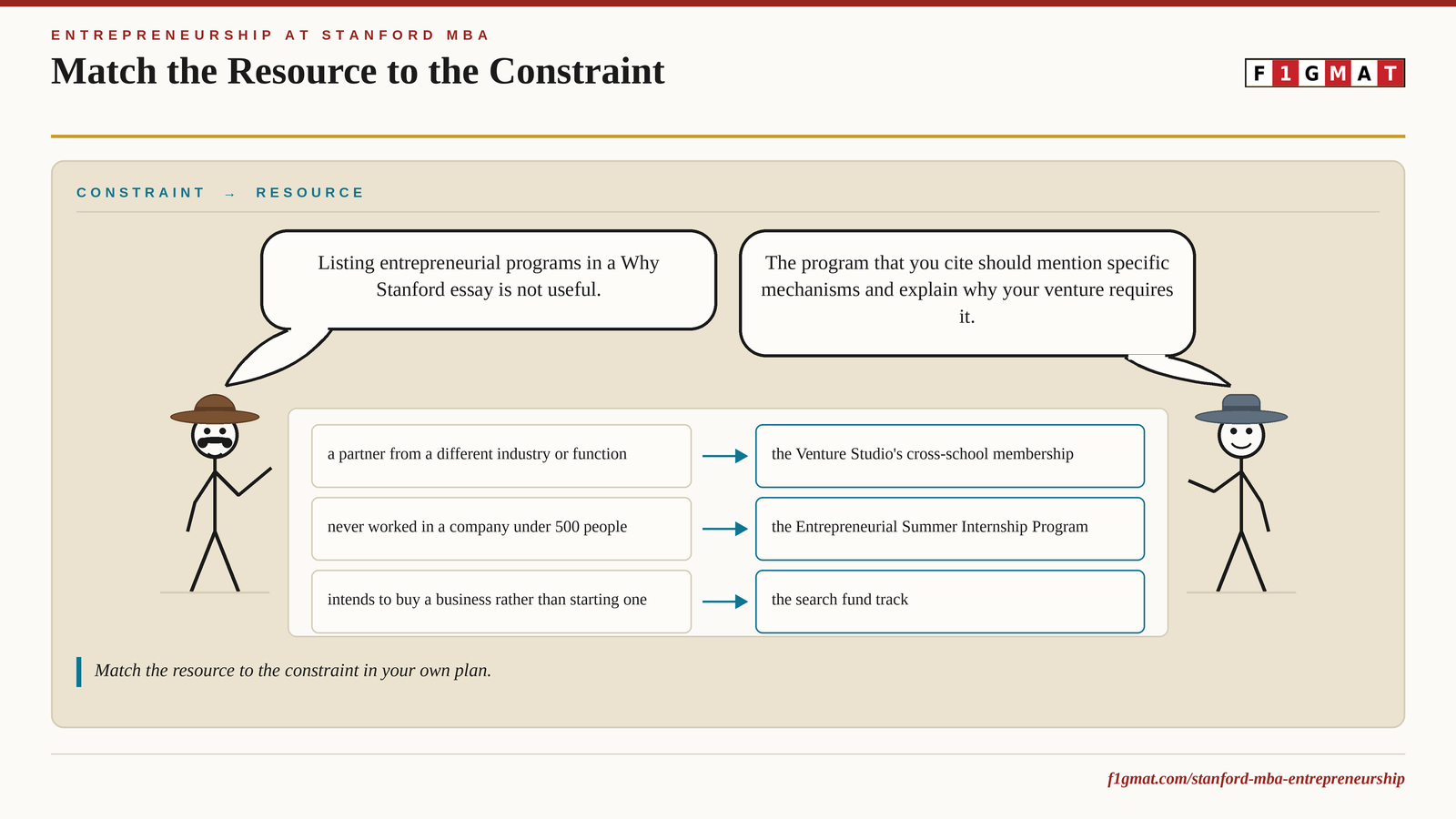
Match the resource to the constraint in your own plan.
For help. Subscribe to F1GMAT's Essay Editing Service.
References
- F1GMAT, Entrepreneurship at Stanford MBA: 2025 (Analysis) ↩ ↩
- Stanford GSB, MBA Employment Outcomes, Class of 2025. ↩
- Stanford GSB, GSB Alumni Entrepreneurs 2025 Report, and Quantifying Stanford GSB's Founder Effect, December 2025. ↩
- Stanford Report, Stanford GSB unveils new name for entrepreneurial studies center, June 2026.
- Stanford School of Engineering, Study Reports Stanford Alumni Create Nearly $3 Trillion in Economic Impact, 2012.
- StartX ↩
- STVP, the Stanford Engineering Entrepreneurship Center ↩
- Stanford Entrepreneurship Network and BASES Challenge. ↩ ↩
Related F1GMAT Resources
- Stanford MBA Essay Tips: What Matters Most and Why Stanford, analyzed prompt by prompt.
- Stanford MBA Curriculum Analysis: Core, electives, and the entrepreneurial studies track.
- Stanford MBA Salary and Placements 2025 Where the 84% who did not start a business went instead.
- Stanford MBA Total Cost and Funding Tips What two years cost before any venture income
- Harvard vs Stanford MBA Cost, class profile, and ranking side by side
- F1GMAT's Stanford MBA Essay Guide : 24+ sample essays and 300+ pages of essay writing wisdom

