F1GMAT · https://www.f1gmat.com/stanford-sample-mba-essays/why-stanford-mba/responsible-pe-deals ·
 Add F1GMAT as a preferred source on Google, opens Google in a new tab
 See more of F1GMAT's MBA admissions research in Google's Top Stories by making us a preferred source on Google.
This is a Stanford MBA sample essay from a private equity applicant, an M&A accounting specialist pivoting into private equity to replace cost restructuring with a people-first investment framework, written for the Why Stanford essay prompt.
Essay: Why Stanford?
Profile: Mr. SK
Profile (Background): Mr. SK, an accounting specialist in M&A, finds himself frustrated with contributing meaningfully to acquisitions and investment decisions. Although his accounting role is limited to due diligence, he witnessed deals that were driven by flawed beliefs of the founder/entrepreneur.
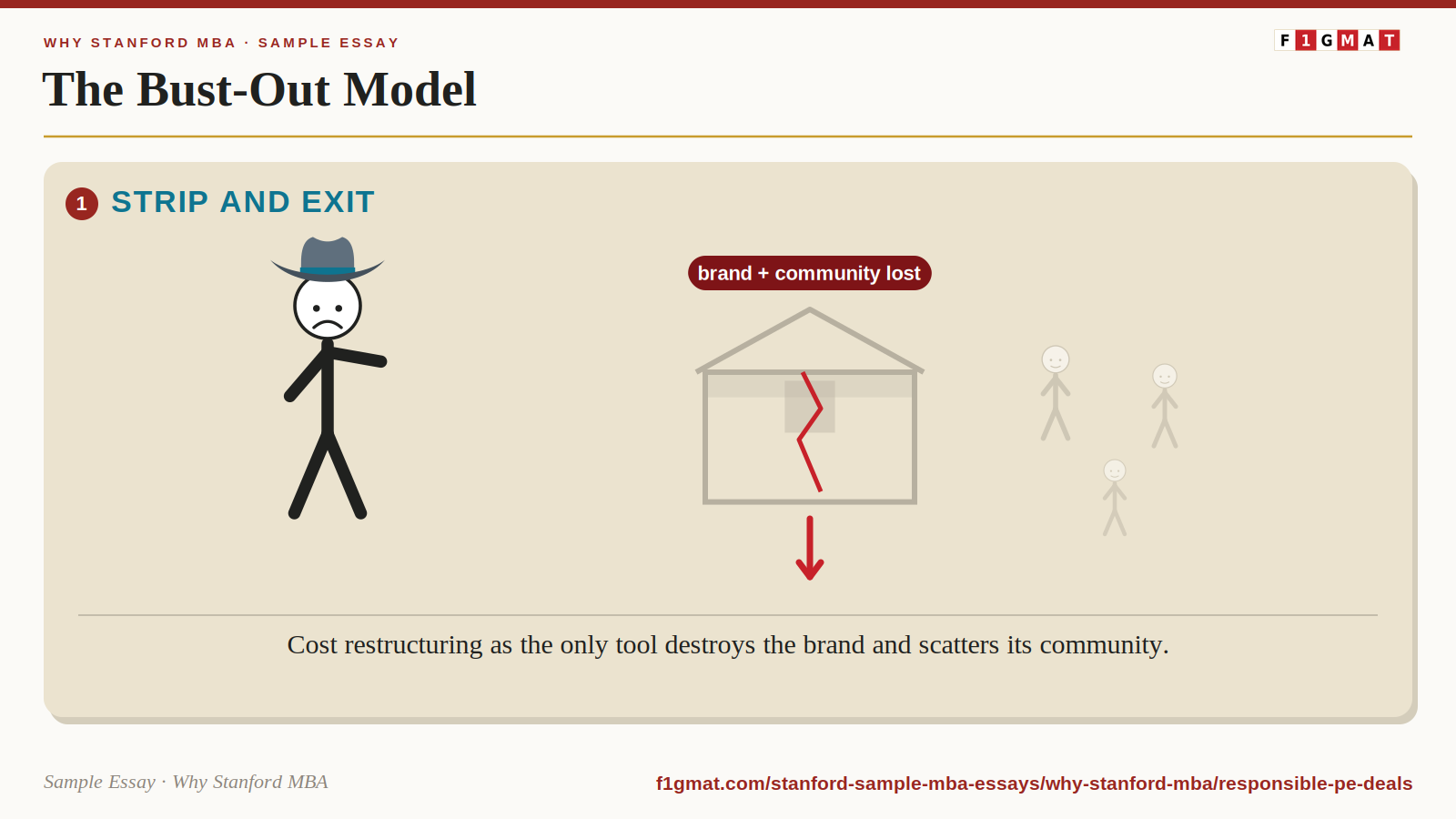
With a Pivot to PE, Mr. SK wants to bring people-first principles to the PE industry.
Essay Approach: “Why Stanford?”
The biggest reason for Mr. SK to choose Stanford is to work with Professor Graham Weaver and understand the people-first principles he applied in his venture. Through the Managing Growing Enterprise course, he will learn the framework to successfully nurture and develop talent – a fundamental factor that influences the culture of a PE firm.
Note: Complete Core, Electives and Experiential Learning Courses are Quoted and narrated in F1GMAT's Why Stanford MBA Sample Essay as part of F1GMAT's Stanford MBA Essay Guide
Essay Planning
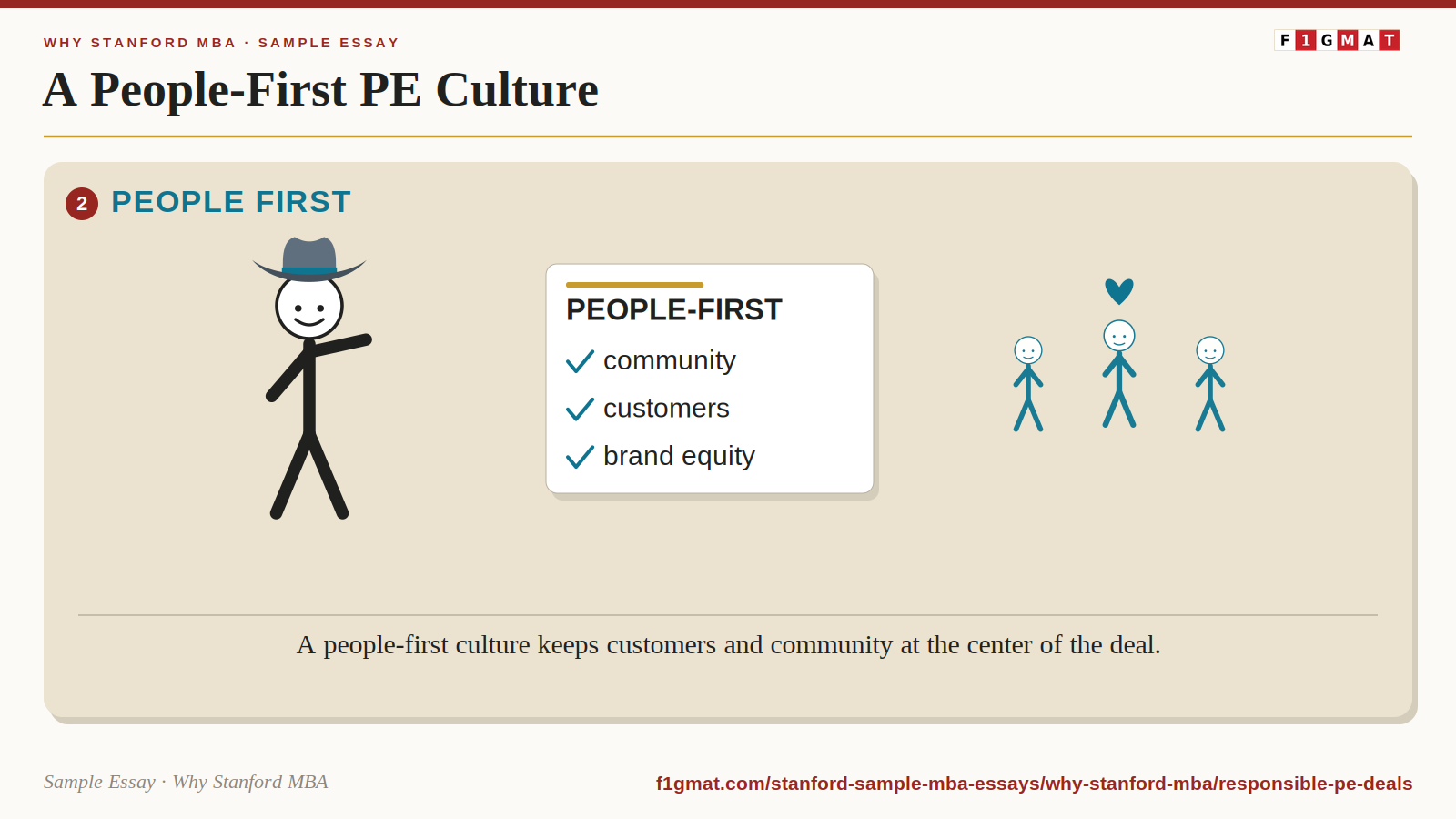
Problem: Cost Restructuring as the standard fix in Private Equity
Problem (Explained): Often, cost restructuring is the first step in Private Equity, but the short-sightedness has destroyed brands, optimized businesses for short-term returns while ignoring the unique brand position, and the communities outside the customer base that propagate the brand's visibility.
Feasible Goals: Develop an alternative framework on productivity, brand positioning, and sensible cost restructuring that doesn't affect the portfolio company's unique position in the market
Short-term Goal: Understand how to create a people-first culture in the PE industry
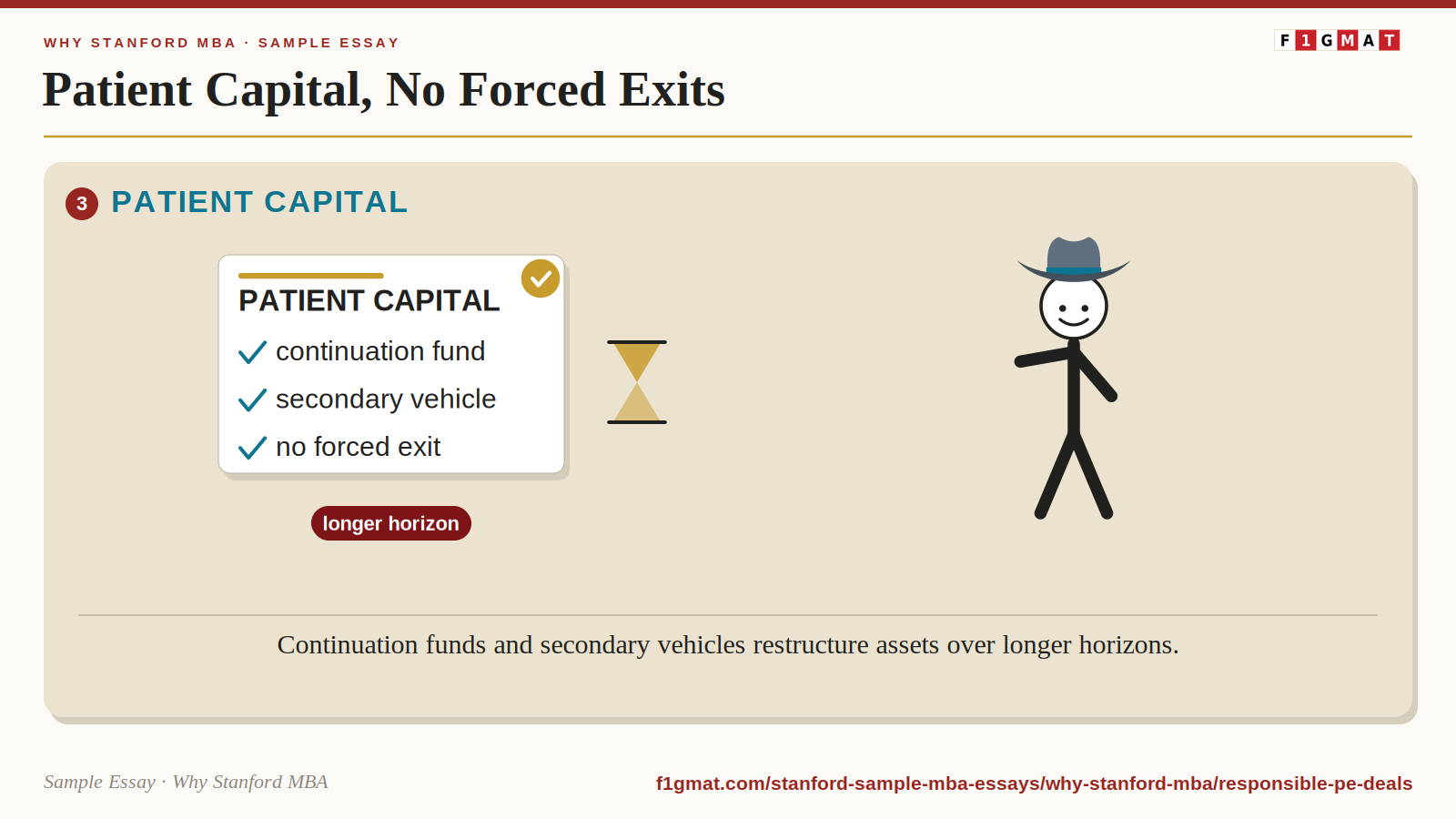
Long-Term Goal: Bring a broader repertoire of interventions and strategies instead of turning PE into a bust-out operation with cost restructuring as the only modus operandi.
Stanford’s Strength: Stanford’s support of empowering candidates with extreme ambitions
Opener: I wanted to hint at the applicant's functional expertise, and quote two CEOs he collaborated with to contrast two styles of leadership - one leading to a bankruptcy and the second, although impressive, also turning into a short-term win.
Strategy: To present the need for reform in the PE industry, I have captured experiences with 2 CEOs and 1 incident where the applicant's suggestion to keep certain costs was ignored. Through citing the applicant's experiences, I am personalizing the essay to a vision where PE is beyond a cost restructuring vehicle, but a value add to any investment ecosystem.
Why Stanford MBA Essay: Accounting to Private Equity (Expand PE’s Toolkit from Cost Restructuring) (350 Words)
By correlating expenses to market trends, I helped one media-savvy CEO, <x>, acquire a high-value brand. For another CEO,<y>, I built a framework that priced algorithmic staying power, an innovation that helped us save $100m in marketing costs. The first CEO declared bankruptcy with another risky acquisition. The second became the top telecom operator in his market.
Confident, I began thinking out loud around strategy. A PE manager reprimanded me, saying, "Why is he still in the room?" With a Stanford MBA, I want to enter that room and redefine PE’s reputation from a bust-out operation to a people-first function.
Download the Complete Essay with F1GMAT's Stanford MBA Essay Guide (Reimagine PE Deals)