F1GMAT · https://www.f1gmat.com/stanford-mba-application-tips-using-placement-data ·
 Add F1GMAT as a preferred source on Google, opens Google in a new tab
 See more of F1GMAT's MBA admissions research in Google's Top Stories by making us a preferred source on Google.
If you're applying to Stanford GSB in the 2026-27 cycle, the Class of 2025 placement data tells you which narratives the admissions team still rewards and which ones it has stopped rewarding.
In a copycat AI-crowded market, Stanford's expertise was valued across General Management, Marketing, and Business Development functions.
Finance candidates were pulled into PE, where the capital concentration was pronounced.
General Management talent was most in demand across roles where operator-led transformation was a priority.
Unlike Harvard's industry-balanced placement profile[6], even with a higher percentage than before reaching the Bay Area, Stanford was clearly placing the majority of its Class in the region.
The trends below decodes the MBA Application Strategy you must adopt for 2026-27.
TL;DR
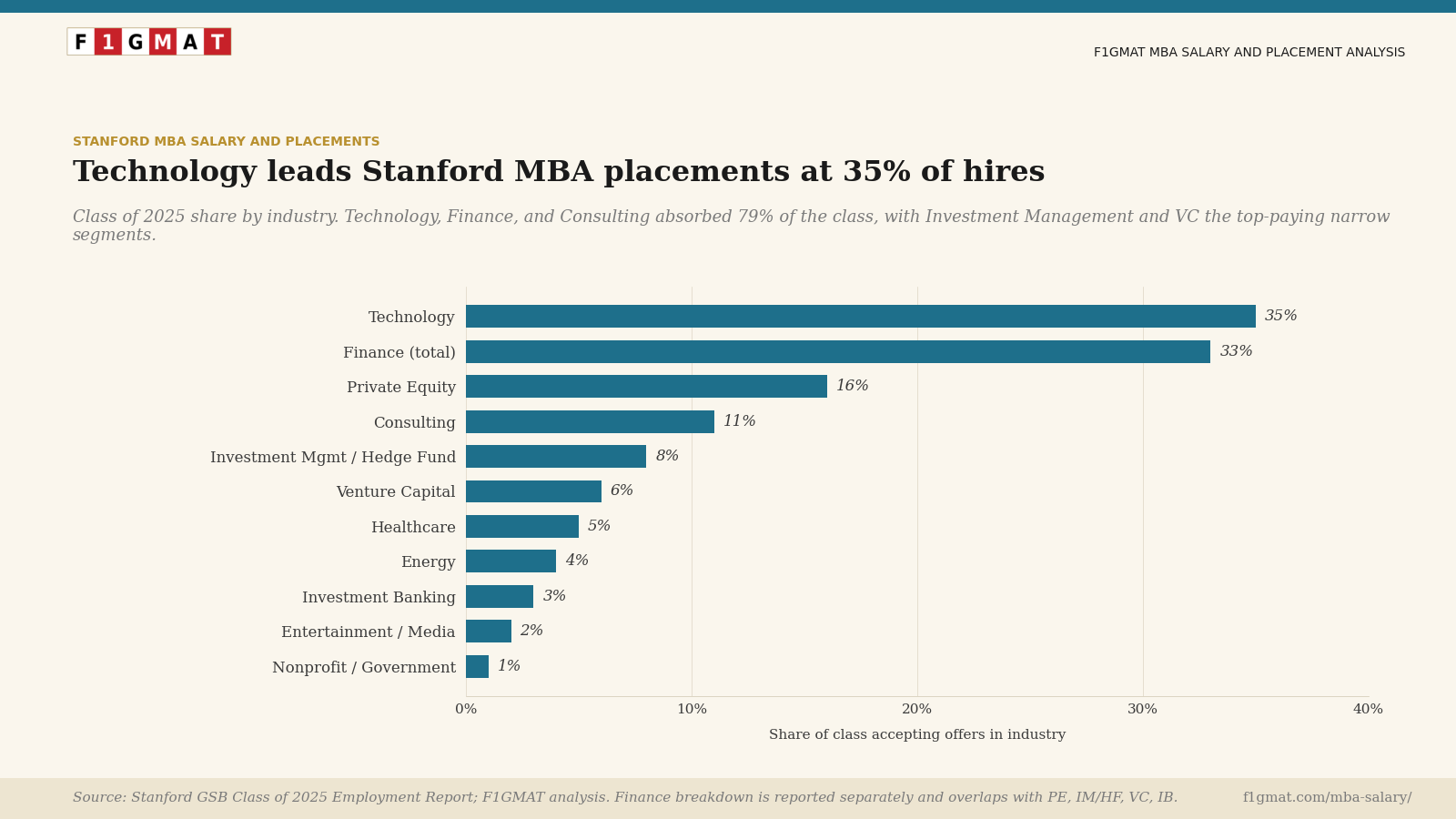
- Technology absorbed 35% of Stanford MBA hires at $210,000 total compensation, the largest single-industry share at the school.
- Finance mix was clearly favoring PE as the industry trends shows 33% of placements in Finance, where 16% were in PE, 8% in Investment Management and Hedge Funds, 6% VC, and 3% in Investment Banking.
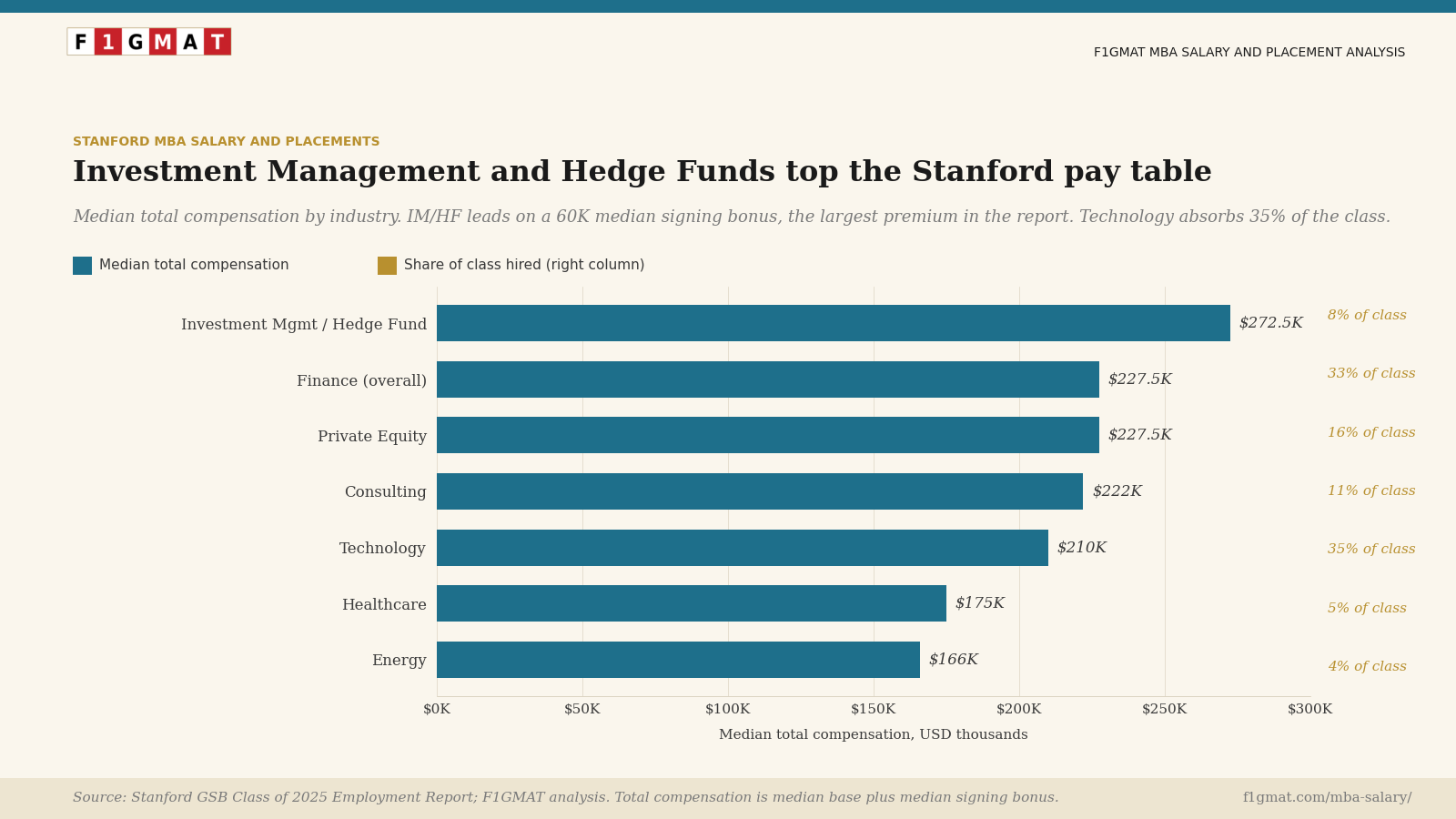
- Investment Management and Hedge Funds like the compensation at Harvard led Stanford's top pay at $272,500 median total compensation, driven by a $60,000 median signing bonus.
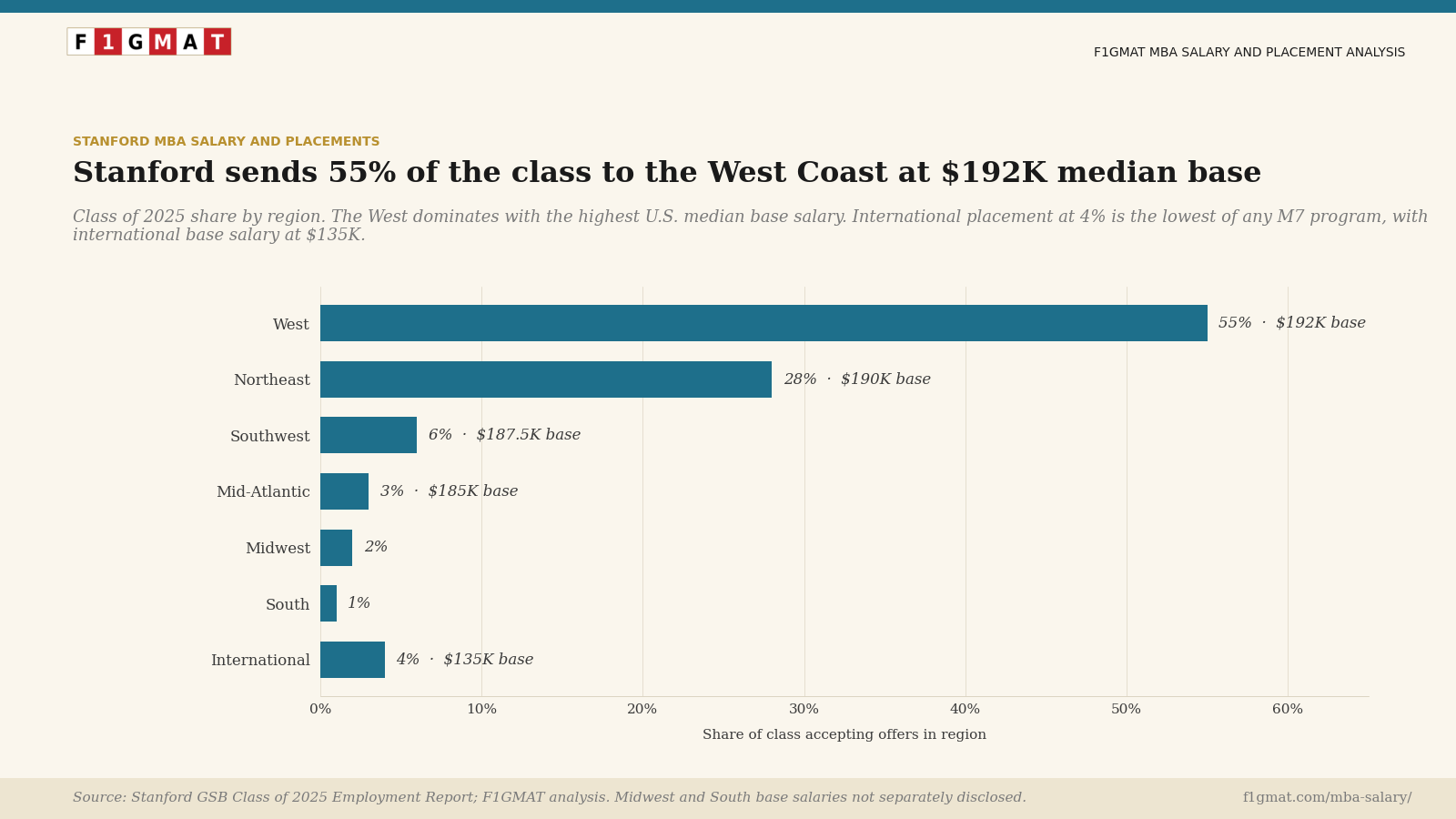
- The West Coast was Stanford's clear strength. 55% of the Class earned a $192,000 median base salary, the highest among US regions. International placement, which has an inverse correlation to US placement trends, was at 4%, the strongest for an M7 program.
- General Management, a dying niche, has emerged as the strongest Function at Stanford, overtaking Finance functions with 32% of the total hires
- 16% of the Class pursued entrepreneurship, a 7-point drop from two years earlier, with 70 graduates launching companies and 18% choosing search funds.
Contents
- Trend #1: Technology Dominates at 35% of Stanford Hires
- Application Tips for Stanford MBA Technology Applicants
- Trend #2: Finance Holds at 33%, But the Internal Mix Shifts to Ownership
- Application Tips for Stanford MBA Finance Applicants
- Trend #3: Private Equity Hires 16% with $227,500 Total Compensation
- Application Tips for Stanford MBA PE Applicants
- Trend #4: Investment Management and Hedge Funds Crack $272,500 Total Comp
- Application Tips for Stanford MBA Investment Management Applicants
- Trend #5: General Management Becomes the Largest Functional Destination
- Stanford MBA Application Tips for General Management
- Trend #6: Consulting Fell to 11% Demand Shifts to Implementation Specialists
- Stanford MBA Application Tips for Consultants
- Trend #7: The West Coast Absorbed 55% of the Class at $192,000 Median Base
- MBA Application Tips for Candidates Targeting the West Coast
- Trend #8: Marketing and Sales Expand to 20% as AI Commercialization Reshapes Go-To-Market
- Application Tip for Sales and Marketing Applicants
- Trend #9: International Placement at 4% Is the Lowest in the M7
- Application Tips for International Stanford MBA Applicants
- Trend #10: 16% of the Class Chose Entrepreneurship, Down 7 Points From the Post-Pandemic Peak
- Application Tips for Entrepreneurial Applicants
MBA Application Tips Based on 10 Stanford MBA Placement Trends
Trend #1: Technology Dominates at 35% of Stanford Hires
Technology absorbed 35% of Stanford MBA hires in the Class of 2025[1], with a median base salary of $185,000, a $25,000 signing bonus, and $210,000 total compensation. This is a clear step-up from Stanford's 2021-2024 range, where Technology placements sat in the mid-to-high 20% band.
Unlike earlier technology cycles, where a digital-first mandate driven by consumers was leading the investments, this cycle was defined by enterprise AI deployment and infrastructure investments in data centers.
Cloud providers, AI platform companies, and large enterprise software firms increased spending on go-to-market teams, AI product strategy, internal operations, and customer integration functions, roles that explicitly require business leadership over mastery of engineering.
Because Stanford's curriculum offers early access to electives in technology strategy, AI for business problems, and product-market fit, and because Stanford had a proximity advantage to AI infrastructure and foundational model companies, more than half of the Class was placed in the West.
Application Tips for Stanford MBA Technology Applicants
For Stanford Applicants planning to enter the Technology Industry as Marketing, Business Development, and General Management professionals, the big shift in enterprises is the pivot away from 'features' to 'speed' and 'cost' messaging.
For Marketing applicants, if your pre-MBA story involves repackaging a product suite to the new demand of enterprise to measure everything from 'tokens' to 'usage by hour', break it down in one of the essays. Share how you positioned a product to the realities of new work constraints and found product-market fit.
For Business Development professionals, the skills are in thinking holistically to position the service in such a way that the complementing solutions are equally important as the product you were selling. This is because no one product fits all the criteria of an enterprise's complex workflow. Demonstrating an encyclopedic awareness of the products and services and orchestration frameworks available in the market is a key 'narrative' strength.
For Product Managers, the transition to a BD or Marketing role is a tough sell unless you can convince with a narrative why the skill requirements are closer to a product manager's role than a traditional marketing or business development role. Predicting model evolution and the specific challenges and opportunities each AI product evolution brings should be captured with limited engineering jargon.
For General Management applicants, the Stanford GSB MBA Essay narratives should be purely around the operational challenges of scaling, upskilling, and integrating AI into the workflow. The complexity of data privacy rules across jurisdictions and their impact on data intelligence is another challenge you can build a story around.
Trend #2: Finance Holds at 33%, But the Internal Mix Shifts to Ownership
Finance attracted 33% of the class. The choice was driven by a competitive compensation, median base salary increasing to $200,000, and total compensation reaching $227,500[2].
Compared to Stanford's 2021-2024 data, the representation in Investment Banking declined by 3-4 percentage points to just 3% of hires. The influx in Finance has been mostly into Private Equity (16%). The secondary niches were in Investment Management and Hedge Funds (8%), although the latter was in no way a niche when it came to compensation.
Between Q3 2024 and Q2 2025, sell-side activity driven by AI investments surged around PE, Private Credit, and Hedge funds. The influx of private credit and PE funds into healthcare services and energy transition, with renewed interest in nuclear and data-center driven demand, also drove the trend. The slowdown in the IPO market affected the demand for IB professionals at Stanford, which historically has not been a feeder school for Investment Banking.
Application Tips for Stanford MBA Finance Applicants
The buy-side experience is most valued at Stanford. If you are coming from IB to PE, sharing the motivation for the pivot, with a couple of stories to support the case, is essential, but you don't have to spend too many words on the pivot. The admissions person will accept the argument that IB to PE is a common pivot path.
If you are a career switcher from Operations, Consulting, or Technology, entering Finance, you need a different strategy altogether.
A judgment-driven example over technical proficiency is one way to improve the feasibility of this goal.
Another angle for career switchers outside Finance is the use of long-term value creation.
Even for Finance applicants, the technical brilliance of the due diligence models has faded away after the arrival of AI. Finding the intersecting motivation of the client and shareholders is an expected skill.
Investment Banking as a primary post-MBA goal is now a hard sell at Stanford, even for current IB professionals.
Trend #3: Private Equity Hires 16% with $227,500 Total Compensation
Private Equity captured 16% of Stanford MBA placements at $227,500 total compensation, with a $200,000 median base salary and a $27,500 signing bonus. This makes PE the largest sub-segment within Finance and one of Stanford's most enduring strengths.
Application Tips for Stanford MBA PE Applicants
PE at Stanford is more accessible than PE at Harvard.
With 16% of the Class entering PE (vs 14% at Harvard), the school expects you to show an ownership mindset.
The fall in IB representation shows that the GSB curriculum is not tuned for a bank-centric career. The curriculum foundation is around an ownership mindset, both as an entrepreneur and as an investor.
Demonstrating this 'owner' mindset, where your interest doesn't end with the deal dynamics, is one way to stand out in the Stanford MBA Application.
Curriculum elements like Entrepreneurial Acquisition and Investment Management courses show how long-term value creation is an implied learning goal at GSB.
Trend #4: Investment Management and Hedge Funds Crack $272,500 Total Comp
8% of GSB MBA candidates entered Investment Management and Hedge Funds with the highest median base salary - $212,500. The signing bonus of $60,000 drove the total upto $272,500.
IM and Hedge Funds have now entered the pre-2023 norm.
Funds expanding AI-driven trading, alternative data strategies, and private credit platforms hired a few MBAs, but when they did, they paid a premium for candidates capable of independent judgment early in role tenure.
Application Tips for Stanford MBA Investment Management Applicants
This niche is the only post-MBA placement where quant and data modeling skills are valued over general management skills.
What has changed now in heavy analytical work in IM and Hedge Funds is that routine work like financial modeling, trade reconciliations, security research, portfolio compliance checks, earnings transcripts/10-K analysis, and basic performance attribution is done by AI.
The dataset has expanded to satellite imagery, credit card transactions, geolocation, web traffic, and social sentiments.
The core skills in interpreting data have remained the same, but now IM and Hedge Fund managers are expected to have strong judgment over narrow, grind work around data.
Essays should clearly capture this differentiation. The diversity of the dataset will not impress the admissions team to make a decision in your favor.
The reasoning as to why you pursued the diverse data source shows your judgment.
Trend #5: General Management Becomes the Largest Functional Destination
The evidence that the General Management surge is driven by AI is from the 2021-24 Stanford MBA Employment data. At that period, General Management sat at mid-20% representation. Now, the representation has hit 32% with a $170,000 median base salary and a $25,000 signing bonus, the highest for a GM function[3].
Between Q3 2024 and Q2 2025, technology firms, healthcare organizations, and private-capital-backed portfolio companies prioritized leaders with operational expertise. Beyond traditional operational roles, Stanford nurtures cross-functional experts who can work under uncertainty and find optimization paths within existing business models.
Stanford offers early exposure to strategy, operations, leadership, and organizational behavior courses. The four act as the foundational to think like a Generalist with an owner mindset. The Leadership orientation through Managing Growing Enterprises, Leadership Laboratory, Strategic Management, and Systems Leadership courses, limits the scope to managerial thinking without stretching to the entrepreneurial path that close to 20% of their peers pursue.
Figure 2. Median total compensation by industry, Stanford MBA Class of 2025.
Stanford MBA Application Tips for General Management
From the many narrative options available, owning a P&L is the best strategy to 'stand out' in the crowded general management applicant pool.
In GSB MBA essays, include managing teams, integrating solutions, and making decisions under uncertainty.
Avoid the trap of trying to position yourself as a specialist when your real strength is integrative leadership.
Bring specialized expertise only when the story demands it.
Trend #6: Consulting Fell to 11% Demand Shifts to Implementation Specialists
Consulting hired 11% of Stanford MBAs with a median base salary of $192,000 and $222,000 total compensation. Compensation remained strong, but the share of hires declined compared to Stanford's early-2020s peak, when Consulting regularly accounted for the mid-to-high teens in representation.
Between Q4 2024 and Q2 2025, Consulting work shifted decisively toward AI implementation. The consulting engagement also demanded specialists deep into Data Science who know the operational and technical aspects of data infrastructure integration. Another niche specialist in operational cost transformation also emerged.
Stanford MBA Application Tips for Consultants
The Strategy Roles are at high risk.
The path is exclusively for those already in the specialization.
For everyone else, entering Consulting in Technology and AI, deployment experience, operational transformation, and data infrastructure integration are three examples worth developing for the essays.
Trend #7: The West Coast Absorbed 55% of the Class at $192,000 Median Base
Stanford is known to place candidate to the West Coast. 2025 placements accelerated the trend with a record median base salary ($192,000) and 55% getting placed in the region[4].
The dual industry trend of AI advancing from experimentation to implementation and Private Equity & Private Credit filling the VC funding gap drove the demand.
Even within the placements in Technology, Silicon Valley served as the epicenter for opportunities in advancing frontier models and adding value to cloud platform providers. Seattle strengthened the Enterprise AI and Cloud market.
The dual industry trend also drove the rest of the supporting functions - VC, Consulting (implementation), and Strategy roles to the West.
MBA Application Tips for Candidates Targeting the West Coast
Like NYU Stern is for New York placements, McCombs is for Texas placements, Stanford is the most geographically concentrated M7 program. This is not obvious because applicants assume M7 has the pull for offers in any region.
Stanford does a self-selection mechanism where only applicants with strong motivation to settle on the West Coast are accepted.
The PE and Finance candidates have a strong history on the East Coast.
If you don't have a strong East Coast legacy, it is better to orient your goals to opportunities on the West Coast.
Trend #8: Marketing and Sales Expand to 20% as AI Commercialization Reshapes Go-To-Market
Like the spike in General Management roles, the 20% entering Marketing and Sales functions is also a side-effect of the AI boom. The surprising factor was the strong base salary - $180,000, a historic high for Stanford MBA graduates. The levels reverse the pre-2023 trend when Finance and Consulting were leading the compensation charts.
Talent capable of selling, positioning, and integrating AI into customer workflows was valued over pure engineering talent or product prodigies that were valued in the 2021-23 era. This elevated the importance of product marketing, enterprise sales strategy, customer acquisition, and lifecycle monetization, which was driven by Stanford's multi-decade expertise in orienting students through Customer Acquisition for New Ventures, Building and Managing Sales Organizations, and Strategic Communication courses.
Application Tip for Sales and Marketing Applicants
Personalize the sales and marketing stories.
When the admissions team expects high-impact sales stories, choose a volunteering experience.
Show your sales and marketing experience in other aspects of your life.
Show that your strong channel partnerships or product positioning are not an isolated professional quirk.
You are born to see product position in the market, customer needs, and changing market dynamics in any market.
Trend #9: International Placement at 4% Is the Lowest in the M7
International placements were 4%. The lower the international placements, the stronger the job placement trends in the US. Despite the debate on visa rules in the US and how it will affect yield, 4% is good news for Stanford MBA graduates. Most found opportunities in the US. The low $135,000 salary in Asia, Australia, Latin America, Europe, and Africa is another reason for the shift.
The highest concentration of private credit and M&A with low regulation is a deciding factor for the opportunities.
For Stanford graduates, many targeting frontier technology, private equity, venture capital, and growth-stage leadership roles, the US offered higher compensation, greater scope, faster responsibility, and stronger capital backing.
Application Tips for International Stanford MBA Applicants
Stanford is highly selective when it comes to choosing a 'true' international applicant.
Anyone with no connection with the US, your story should scream 'Stanford'.
Entrepreneurial thinking, High EQ, and a sense of agency to accomplish complex, high-impact goals should be evident in the essays.
Don't pick low-value goals.
Don't hype up mediocre accomplishments.
Understand where you stand in the uniqueness scale. It is tough to find out without an independent eye.
Prioritize Round 1.
If your goal is to return to your native country post-Stanford, don't apply.
Don't use entrepreneurial dreams or creating a venture ecosystem like Silicon Valley in your native country.
All such narratives have failed.
Keep your essay US-centric.
Trend #10: 16% of the Class Chose Entrepreneurship, Down 7 Points From the Post-Pandemic Peak
For the Stanford MBA Class of 2025, entrepreneurship has been a choice for 15-20% of the class since 2009.
16% of the Class pursuing entrepreneurship either by starting a venture or acquiring one, and 70 graduates are launching their own businesses[5], which is a 7-point drop from the peak in 2023.
With venture capital funds not able to compete against massive AI-driven private credit and PE funds, the fall is understandable. Startups rebounded in AI, but structural support for early-stage founders strengthened only around AI and AI-enabled business models.
A unique trend in Stanford's Entrepreneurial ecosystem is search funds. 18% of entrepreneurs chose this path.
In simple terms, Search Funds stands between the scale of PE funds and VC funds. They target firms which has proven in the market but are not under the radar for PE funds or too old for VCs to show any interest. But according to recent Stanford papers, they generate 25% return on average[7], higher than VC or PE-funded ventures.
Enterprise Software where most of the AI fund has been deployed, attracted 19% of the entrepreneurs with FinTech (6%), Healthcare (10%), and Consumer Products (8%), completing the top 4 niches for entrepreneurship.
Application Tips for Entrepreneurial Applicants
Stanford has a well-established entrepreneurial ecosystem.
Study and map every single resource available to your skills, exposure, or mentoring gaps.
The admissions person must be convinced that the problem you are solving needs the 'specific' advisory and supportive ecosystem that GSB offers.
Show commitment to the vision.
Think beyond financial sacrifices.
Give a timeline on what it takes to achieve all your entrepreneurial goals.
Make the beneficiary 'the focus' of the venture.
Stanford accepts a high percentage of high EQ applicants.
Merge competence with strong social responsibility in your essay.
Key Takeaways for 2026-27 M7 and HSW Applicants
Applicants targeting Stanford GSB, Harvard, and Wharton in the 2026-27 cycle should internalize these five takeaways from the Class of 2025 placement data:
1. Stanford is geographically concentrated by design
55% of the Class places West and 4% places internationally.
Stanford's network advantage is closely tied to Silicon Valley.
For applicants who do not plan to settle in the West, framing 'why Stanford MBA' needs careful positioning.
2. Technology means commercial and Enterprise AI
The influx of private credit has been mostly in Enterprises.
35% of the Class entering technology are mostly in Enterprise software, with functional focus remaining in Marketing, Business Development, and General Management, while Product Management remains a distant outcome.
The stories in your Stanford MBA essays should match this expectation. Don't complicate with engineering-heavy stories.
3. Finance at Stanford is buy-side and ownership-driven
33% of placements went to Finance, but only 3% to Investment Banking. PE (16%), VC (6%), and Investment Management and Hedge Funds (8%) absorbed the rest.
Position Finance goals around capital allocation, valuation, and ownership.
Banking as a primary post-MBA goal is now a hard sell at Stanford.
4. General Management is the easiest functional fit if you have the resume for it
32% of the Class entered General Management where their leadership under uncertainty and ownership of P&L had the most influence on their placements.
In your Stanford essays, avoid trying to position yourself as a specialist when your real strength lies in integrative leadership.
5. Entrepreneurship is mainstream, with search funds as the less explored path
16% of the Class chose entrepreneurship. Even though not the peak we saw in 2023, the entrepreneurial DNA of the class was intact. An interesting development is the 18% who choose search funds.
Stanford is the strongest M7 platform for search funds and finding acquisition targets that PE funds or VC funds are not searching for.
Focus on the customer, the system, and the outcome.
If search funds match your operator profile, name them as a serious alternative path in your application over consumer technology that is facing a funding drought.
References
- Stanford GSB, Employment Reports ↩
- Stanford MBA Salary: By Industry (2025) · F1GMAT ↩
- Stanford MBA Salary: By Function (2025) · F1GMAT ↩
- Stanford MBA Salary: By Job Location (2025) · F1GMAT ↩
- Entrepreneurship at Stanford MBA: 2025 · F1GMAT ↩
- Harvard MBA Placement Trends: A 2026-27 Applicant's Guide ↩
- Search Funds - 25% ROI ↩

