F1GMAT · https://www.f1gmat.com/m7-mba-essay-secret-high-reflection-high-empathy ·
 Add F1GMAT as a preferred source on Google, opens Google in a new tab
 See more of F1GMAT's MBA admissions research in Google's Top Stories by making us a preferred source on Google.
In this deep dive into MBA Essay Writing, I explain why the STAR framework is insufficient for M7 and Top MBA Essays and why High Reflection High Empathy MBA essays are the secret to an M7 Admit.
Contents
Overview of the STAR Framework – For Essay Writing
STAR framework was built for behavioral interviews.
An interviewer asks questions to measure your past behavior.
The candidate chooses a situation, converts it into tasks, and then maps them to the right actions.
The actions they took are now evidence of how they will behave in the future.
The results are the baseline of their IMPACT.
M7 MBA Essay Writing
Consultants adopt the framework meant for interviews to MBA admissions where the peers are other consultants with similar career growth and similar exposure to the STAR framework.
They use it for case interviews and yearly reviews.
The AdCom will struggle to find why you are unique.
My Experience with STAR Writing Technique – A Client Story
A few years ago, I worked with a client. A smart consultant who had streamlined the proposal creation for a large technology company.
She had bought into the idea that every paragraph needs a STAR framework
When she sent me the first draft, I could see the pattern everywhere.
Situation. Task. Action. Result repeated across the paragraphs with token empathy lines.
She was applying to an MBA program where historically the women applicants were low.
Schools stereotype male and female applicants for their innate behaviors.
High Agency High Risk Taking for Men.
High Agency, High Empathy for Women.
This doesn’t mean that there aren’t women who are high risk takers or there aren’t men who are high in Empathy.
On average, the Admissions Committee looks for these traits in each gender.
When I read the client’s essay, the writing was competent.
The grammar was good.
The achievements were real, but when I read the essay in one sitting, it felt like watching someone performing an autopsy on their own life with no empathy, clinically evaluating a situation, inserting herself into the narrative as a variable instead of showing her humanity and then underlining what she had achieved.
Where STAR actually comes from
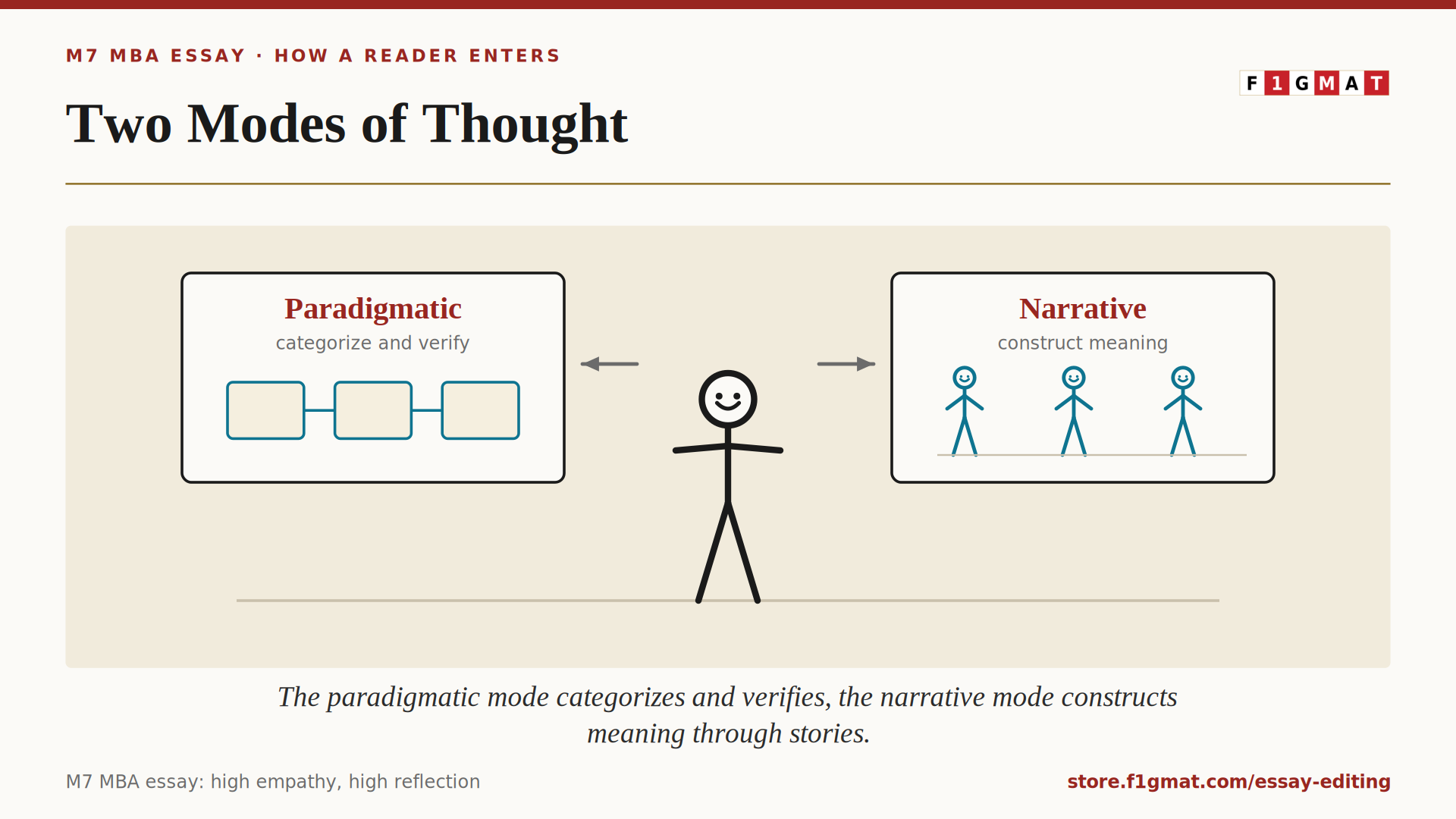
Jerome Bruner argued in Actual Minds, Possible Worlds[1] that human thought runs in two modes – paradigmatic and narrative.
Paradigmatic is what we use for categorizing, verifying, and logically connecting events.
The narrative mode constructs meaning through stories, where we dissect human intention, dramatize events, and explore possibilities.
Neither should be the core framework for MBA essay writing.
A logically structured essay doesn’t make a great MBA essay.
An emotional story with no logical connections also doesn’t make a great MBA essay.
Empathy is the Solution
Van Laer and colleagues[2] elaborated the role of Empathy through their transportation theory in 2014, where a good story is all about transporting the reader to feel what the writer is expressing.
They have to enter your world.
The world of the supporting characters you have written about.
The constraints, the challenges, and setbacks should feel their own.
Now start writing your essay.
Will I feel what you were feeling when you were writing the essay?
Empathy is not a sprinkle on your logically structured essay.
Empathy is the foundation.
The High Reflection High Empathy MBA Essay Wins
Empathy can be overdone too.
The instinct to replace STAR is to go high on Empathy.
Resist it, because the problem was never that you couldn’t add an empathetic line to a STAR framework.
The problem is a lack of balance between reflection and Empathy.
Reflection points inward.
What did I learn about myself at the end of a setback?
Did anything I believed turn out to be true?
Did I hold the values that I live by during a challenging part of my life?
Empathy points outward.
What was it like for the other person?
What are their constraints?
Did I take them seriously?
Did I help them?
Did I guide them?
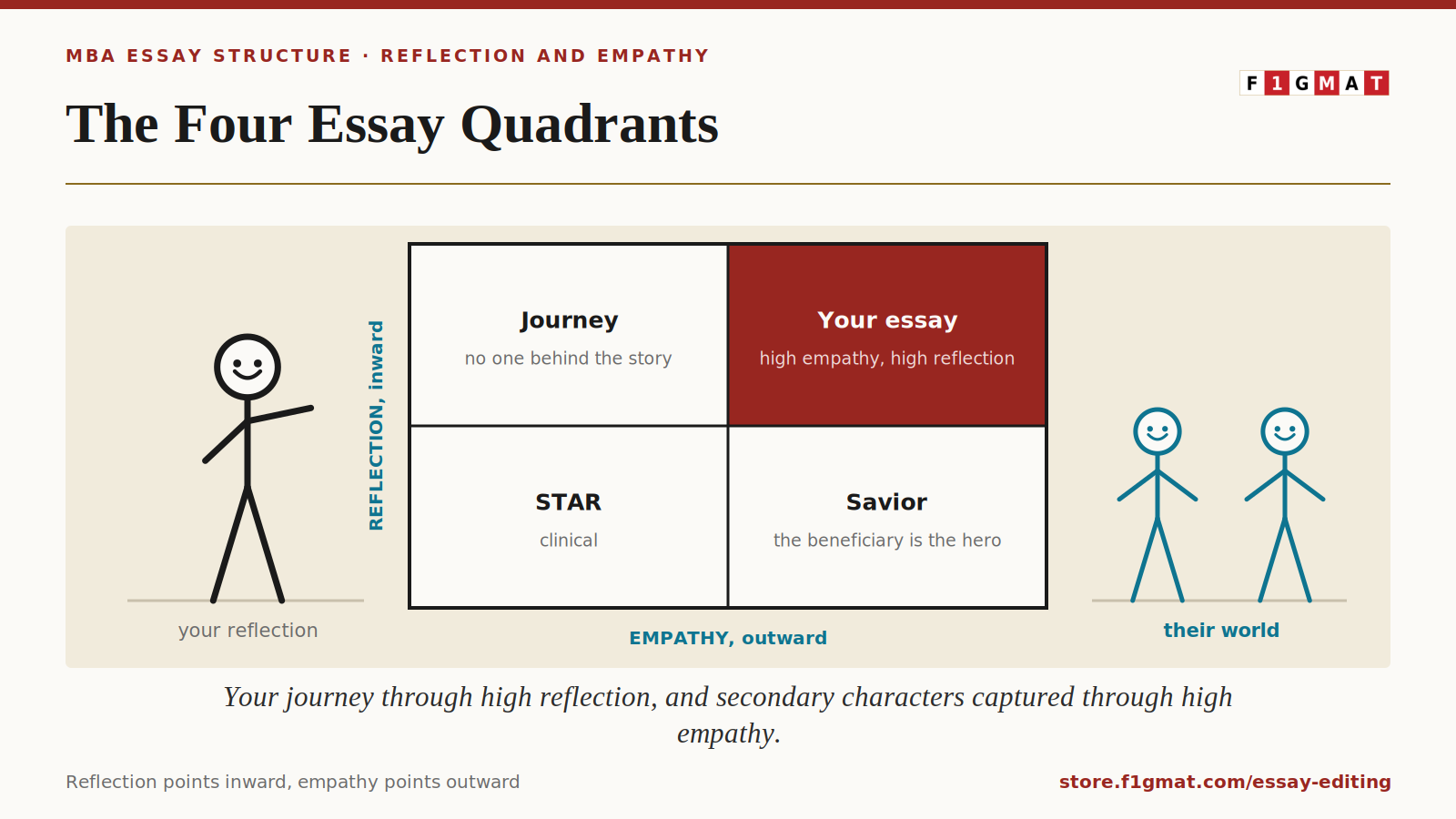
Reflection and Empathy are separate checkboxes.
High Reflection High Empathy Quadrant
| Low empathy | High empathy | What the reader concludes | |
|---|---|---|---|
| High reflection | The journey essay | The working essay | Row two is the only one that survives |
| Low reflection | STAR | The savior narrative | Nothing happened to this person |
STAR is the low empathy, low reflection essay. It is clinical, but you will not understand what the applicant was going through, or the applicant has not empathized with the beneficiary or the supporting characters in an authentic way.
The Low Empathy High Reflection is the Journey Essay. The applicant is obsessed with the hero’s journey, reflecting on their life most likely chronologically, but when you read the essay, there is no one behind the story. It feels mechanical.
The other end of the spectrum is the High Empathy Low Reflection essays. This is called the Savior narrative. It is all about the beneficiary. You make the beneficiary the hero. You are minimally captured. In an MBA Admissions essay, you are the hero. You have to bring the story back to you.
That leaves us with the High Empathy High Reflection Quadrant[3].
This is the quadrant you aspire to be in.
Your essay should have the right balance between your journey through high reflection and the beneficiaries or secondary characters captured through high Empathy.
If you need my help in balancing high Empathy with high reflection, subscribe to F1GMAT’s Essay Editing Service