F1GMAT · https://www.f1gmat.com/nyu-stern-professional-aspirations-essay-sports-injury-healthcare-consulting ·
 Add F1GMAT as a preferred source on Google, opens Google in a new tab
See more of F1GMAT's MBA admissions research in Google's Top Stories by making us a preferred source on Google.
The NYU Stern MBA goals essay example captures the journey of a former college football player whose career ended after an injury and a delayed rehabilitation. He turned the frustration of a three-month recovery into an online forum that helps lower-income families plan injury treatment within their Medicaid coverage.
The hard part of the NYU Stern Professional Aspirations essay for this applicant is keeping the story of a lost career from turning into a complaint against insurers. He wants to join the healthcare practice of a management consulting firm on the payers-and-providers side and advise insurers and hospital systems, along with state Medicaid agencies, on benefit design and access to care.
This Stern MBA goals essay example keeps the essay on one event, the delayed rehabilitation and the forum it led to, and cites Healthcare Markets and Professor Michael Dickstein's research on health insurance as the economics behind the delays he saw.
Contents
TL;DR - What This Page Covers
- The essay's one event: a delayed rehabilitation that ended his college football career and led to a forum for families on Medicaid
- Feasibility: consulting took 32.8% of NYU Stern Class of 2025 hires at a median base salary of $175,000
- Why Stern: Healthcare Markets for the incentives behind delays and cost shifts, with Professor Michael Dickstein's research on health insurance
- The opener: a blackout on the stretcher, used as the first minute of the delay that cost him his career
The Prompt: NYU Stern Essay 1, Professional Aspirations
What are your short-term career goals? Why is the Stern MBA the necessary next chapter in your professional story? Please be specific.
Applicant Snapshot
| Background | A former college football player whose career ended after a delayed rehabilitation started an online forum that helps lower-income families plan injury treatment within their Medicaid coverage. |
|---|---|
| Themes | Policy Change, Healthcare, Entrepreneurship |
| Traits | Resilience, Systems Thinking |
| Pre-MBA role | Founder, Online Rehabilitation-Access Forum (former college football player) |
| Short-term goal | Join the healthcare practice of a management consulting firm on the payers-and-providers side, advising insurers and hospital systems, along with state Medicaid agencies, on benefit design and access to care. |
| Long-term goal | Found a company that partners a direct-access rehabilitation network with installment-based patient financing, so middle- and low-income patients can begin treatment the week of an injury. |
Why the Healthcare Consulting Goal Is Feasible
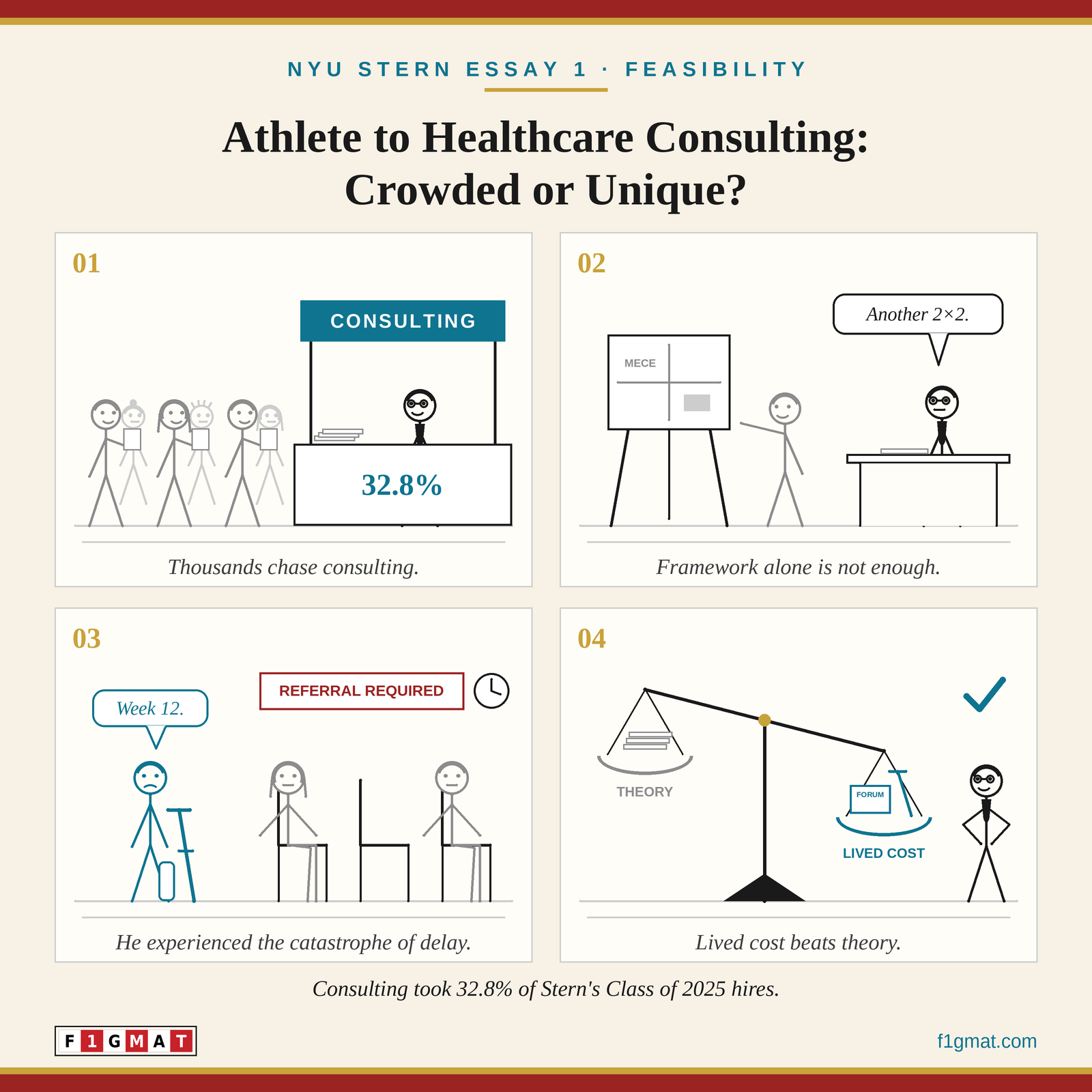
Consulting is one of the two largest destinations for the NYU Stern full-time MBA class. In F1GMAT's analysis of the NYU Stern Class of 2025 employment data, consulting accounted for 32.8% of hires, second to Financial Services at 36.6%, with a median base salary of $175,000 and an average signing bonus of $29,231.
Healthcare, pharmaceutical and biotech employers took 3.4% of the same class at a median base salary of $138,500. For this applicant, the healthcare practice of a consulting firm is the wider entry into the sector.
The applicant's challenge is the switch from athlete and forum founder to payer-and-provider consultant. His forum already does a version of that work. It explains coverage rules to families who would otherwise delay treatment, such as the Medicaid plan that would not pay for a therapist until a physician wrote a referral.
The referral rule is benefit design seen from the patient's side. This is the example that will convince the admissions committee that he is prepared to advise the insurers and Medicaid agencies who write those rules.
Consulting outcomes for the NYU Stern Class of 2025
Essay Planning
One Injury
Personalizing the essay is a quick way to stand out in a competitive applicant pool. Although the applicant is not from a typical profile - consulting, technology, or Finance, the post-MBA goal to enter Healthcare consulting, which is a common goal for applicants from the healthcare industry and even technologists who have worked in the industry.
My strategy was to pivot quickly into the motivation behind creating an online forum - the community, which taught him the problems they face when seeking support for rehabilitation. It was not just about injured sportsperson. This was a larger american issue.
Work on care delivery and health law alone will not change the system, which is why the applicant is entering consulting: to work on the economics and incentives behind insurers' decisions.
Once the anecdote establishes credibility, the rest of the 500 words go to the specific value the applicant can gain from Stern. Along with the course narrative, the essay cites a Stern professor whose research changes how we calculate healthcare ROI.
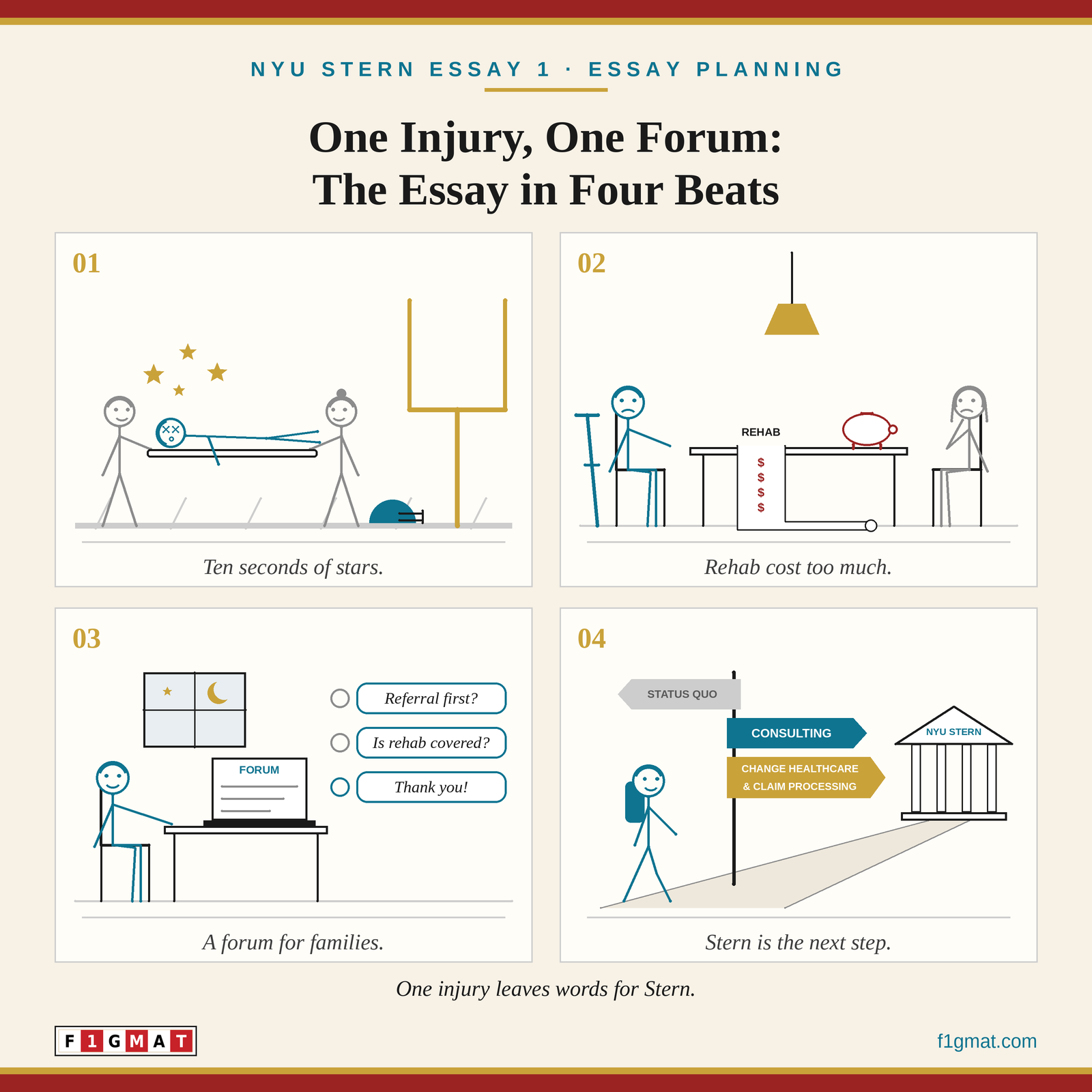
I saw stars for ten seconds and blacked out on the stretcher.
Medicare mandates 20% of the total cost of rehabilitation as a co-payment – a cost that was too steep for my family. Early intervention would have saved my football career. The frustrating 3-month rehabilitation became <_z.com> - a forum I created for offering affordable treatment options after injuries.
Full Essay Continues in F1GMAT's NYU Stern MBA Essay Guide
store.f1gmat.com
The Goal
NYU Stern MBA's short-term goal for this applicant is a role in the healthcare practice of a management consulting firm on the payers-and-providers side, advising insurers and hospital systems, along with state Medicaid agencies, on benefit design and access to care. The admissions reader will ask why a former athlete would succeed in a client-facing role with insurers.
The forum answers that question.
Like other injured players, he started with the frustration of a delayed recovery. Unlike them, he built a forum that walks families through what their coverage pays for and what it requires before treatment begins.
The long-term goal is not stated in isolation either. He plans to found a company that partners a direct-access rehabilitation network with installment-based patient financing, so that middle- and low-income patients can begin treatment the week of an injury. The goal returns to the essay's first line, the treatment he could not start on time.
Why Stern
Healthcare Markets
Healthcare Markets (ECON-GB.2374) teaches how medical care gets produced and paid for in the United States, across both private insurers and public programs. Professor Michael Dickstein, Director of Stern's Healthcare Initiative, teaches the course and uses topics such as cost-effectiveness analysis to show how government regulation of healthcare markets affects business strategy.
The course treats the delays and cost shifts in the system as products of its incentives, which is the lens the applicant needs as a payer-and-provider consultant. Healthcare Markets is also part of Stern's Healthcare specialization, whose course roadmap includes a Payers/Providers track.
Professor Michael Dickstein's Research on Health Insurance
Professor Dickstein studies healthcare markets with the tools of industrial organization, the economics of how firms compete. His research asks how patient prices affect the uptake of prescription drugs and how redefining the boundaries of a health insurance pool can raise enrollment among sicker households. His paper Market Segmentation and Competition in Health Insurance, written with Kate Ho and Nathaniel Mark, appeared in the Journal of Political Economy in January 2024.
For an applicant whose career ended over the cost of rehabilitation, research on how out-of-pocket prices change patient behavior gives the essay an economic case for early treatment. It is also the case he will make to insurers as a consultant.
Why Healthcare Consulting and Stern Work
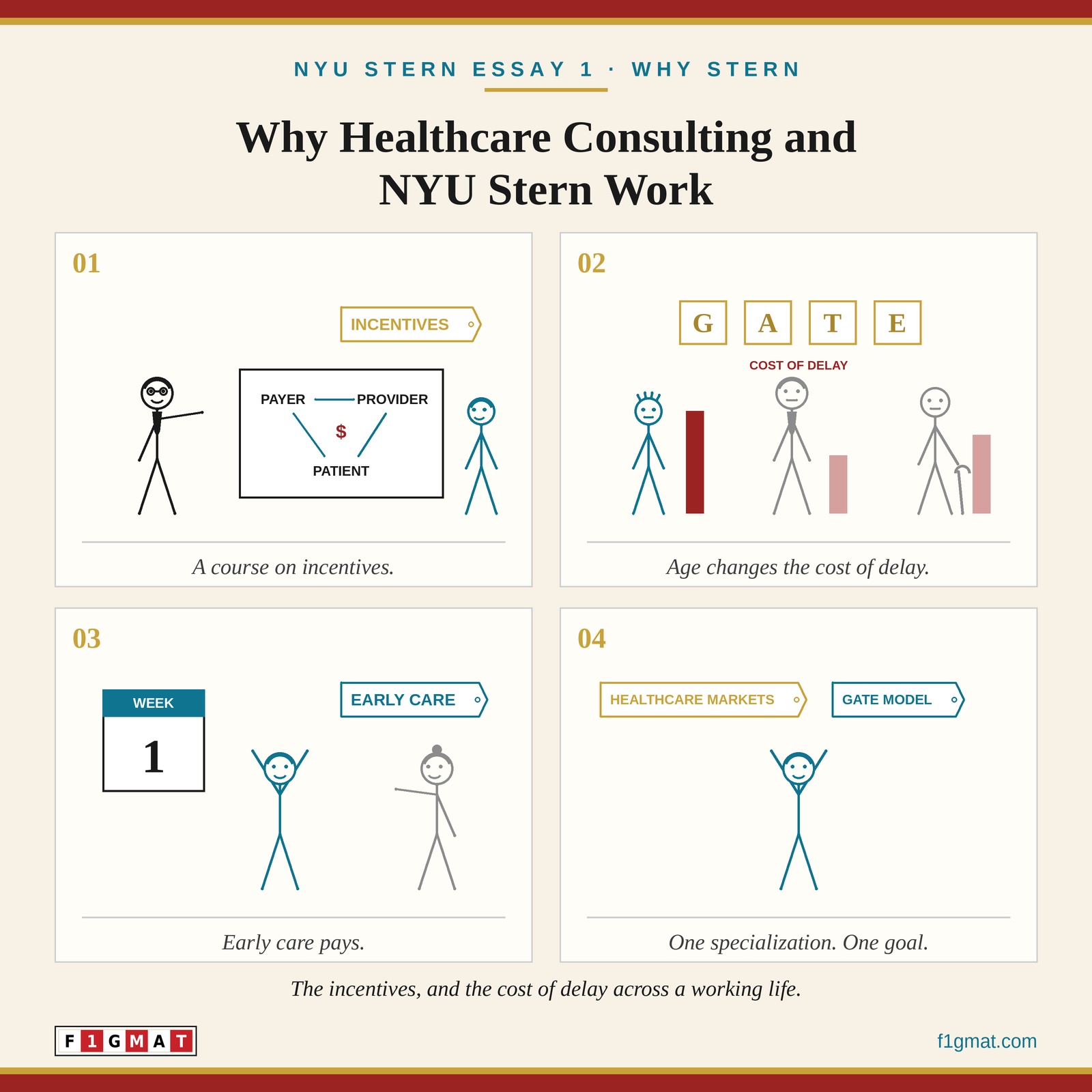
Both resources are part of the Stern's Healthcare Initiative. Although the applicant has experience with care, the exposure to Healthcare Markets will give him exposure to the incentive framework a payer-side practice expects. To that goal, Professor Michael North's GATE model will help him devise an alternative model for evaluating the ROI of healthcare customers.
I have added the Full Course Mapping and reasoning in F1GMAT's NYU Stern MBA Essay Guide
The Essay Opener
Opening with a dramatic line is a deliberate strategy.
The line also sets up the essay's argument that anyone can face debilitating injury. Care should be accessible to everyone and more than access, timely access is the sign of a robust healthcare system.
The delay began on the stretcher, and each week after it cost him his career.
I saw stars for ten seconds and blacked out on the stretcher.
NYU Stern Essay 1 · Opening Line
How the Guide Maps This Goal to Stern
The guide maps this applicant's goal to Stern's Healthcare specialization, starting with Healthcare Markets and Professor Michael Dickstein's research on health insurance, and connects the forum for Medicaid families to the benefit-design work of a payer-and-provider practice. The full course mapping and narrative are in F1GMAT's NYU Stern MBA Essay Guide.
F1GMAT Guide
You've seen the reasoning. Here is the finished essay.
Get the finished NYU Stern essay for this profile
- The complete 486-word essay, from the blackout on the stretcher to the closing, built around the delayed rehabilitation and the forum
- The Healthcare Markets course mapping and Professor Michael North's GATE model that support the switch into healthcare consulting are included in the Guide.
- The injury and the forum are developed in the first half of the essay, and the consulting goal and the Stern fit in the second half
By Atul Jose, Founding Consultant at F1GMAT · 15 years guiding applicants into top-10 MBA programs.