Self-learning & Entrepreneurship: LBS MBA What Makes you Unique Essay Sample
LBS MBA Essay: What makes you unique? (200 words)
Background Information: An entrepreneurial applicant narrates the circumstances that led to his education without any structure.
The confidence to learn anything and tackle problems became a behavior that led him to entrepreneurship.
Theme: Entrepreneurship, Resilience
Theme (Explained): Self-learning and Resilience as a prerequisite to entrepreneurship is not a theme that many applicants cover.
Sports Injury to Media Startup: NYU Stern MBA Change Essay Example
NYU Stern MBA Essay 1: Change: _________ it (350 word maximum, double-spaced, 12-point font)
In today’s global business environment, the only constant is change. Using NYU Stern’s brand call to action, we want to know how you view change. Change: _____ it. Fill in the blank with a word of your choice. Why does this word resonate with you? How will you embrace your own personal tagline while at Stern? Examples:
Entrepreneurial MBA Applicant - Haas Kellogg Ross or INSEAD?
Q) As the son of a diplomat, I did my schooling in four countries. My Engineering degree is from a tier-2 college in North India with a mediocre 61%. I was fascinated with the power of technology and ventured on my own in 2016, creating a FinTech product that was adopted by leading banks in India. The company was acquired by India’s leading payment service. As of now, I am in charge of the company’s growth strategy. I want to continue in Strategy or pivot into Consulting. Which school - Haas, Kellogg, Ross, or INSEAD is better suited for my profile?
Where should I immigrate for Entrepreneurial success?

Q) I am from India. Given the poor Entrepreneurial Ecosystem (bureaucracy, corruption, and societal pressure); I would like to immigrate to a country where I can pursue my Entrepreneurial dream. I also want to be in a country where I have the option of doing an MBA if things don’t work out.
First, you have to define what Entrepreneurship is for you. Once you have defined clearly what your start-up would be like, brainstorm, and find out whether you will go it alone or you will have a partner.
Read: Immigrate for Entrepreneurial success
2014 - Top 5 MBA in Entrepreneurship

Entrepreneurship is not something that can be taught in a classroom; however, what most Entrepreneurial MBA students want is to learn how to start, run and grow a business. MBA programs with focus on Entrepreneurship provide a wealth of knowledge that will help students understand how different parts of a business work and come together.
While many MBA students seek a steady job immediately after graduation, there is a rare but growing breed of aspirants who are choosing the entrepreneurial route. Find out the top 5 MBA Programs for Entrepreneurs + Bonus MBA Program Exclusively Designed for Entrepreneurs.
Why Software Engineers Make Good Entrepreneurs

Software Engineers are an interesting breed. As Marc Anderson had famously said in a NY Times article, “When you’re dealing with machines or anything that you build, it either works or it doesn’t, no matter how good of a salesman you are.” Tech Engineers deal with machine more than they do with people. Machines don’t lie. A regular honest interaction with machines forces Engineers to focus on the solution rather than presentation.
Here is why Software Engineers Make Better Entrepreneurs
Low Number of Entrepreneurs from Business Schools? Increase Perceived Capability & Address Fear of Failure

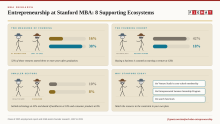
Over the past five years, the MBA curriculum in Business Schools has been customized to include Entrepreneurship as a specialization and in some cases an integral part of the learning process. But if you have read the latest MBA Employment trends, in top Entrepreneurial Business Schools like Stanford (13%) and MIT (8.2%), only a small section of the class actively pursued Entrepreneurship after MBA.
Find out why Fear of Failure is the biggest Deterrent
Before Joining an MBA Program for Entrepreneurship: What is your definition of Entrepreneurship?

Business Schools have done an excellent job in integrating Entrepreneurship Centers with the MBA program. However, the question remains – do Entrepreneurs need an MBA? Unlike other specialization, Entrepreneurship has a broad definition.
Ask the following questions to define Entrepreneurship
Entrepreneurship: 5 Reasons Why MBA is not necessary, ROI is just one factor...Bigger Issues Still Exist

The need for an MBA program or knowledge of management best practices are not mandatory qualities for Entrepreneurs.
In this article, we will evaluate five factors that have turned the tide against MBA Students pursuing Entrepreneurship.
Earned a Patent, Deeply influenced by the book Emotional Intelligence & Now Joining MIT Sloan MBA Program

MIT Sloan MBA Program is known to attract Entrepreneurial and talented Engineering Students. Although Stanford has a better record of students starting their own company post MBA, 18% against Sloan’s 8.2%, MIT often attracts students that have started Entrepreneurial ventures, before the MBA program. We had the chance to interview Pawan Gupta, MIT Sloan Class of 2015 student, and asked him about his Entrepreneurial experience.
Is it a good Idea to start a Business while doing an MBA?

If you had realized that the objective of joining an MBA program is to learn the management fundamentals that are required to start and build a business, then list out Business Schools that has the ecosystem, and support for Entrepreneurship, and pick the best. So what are the pros and cons of starting a Business while doing an MBA. Find out!
Canada launches Startup Visa for Immigrants

The latest program that the Canadian government has added to encourage Entrepreneurs is the ‘Startup Visa’ program. Canadian government owned Bank – BDC is inviting applications from Immigrant Entrepreneurs for Financing and consulting services
The selection process is rigorous, and BDC Venture Capital reviews over 1000 Business plans every year. Find out the criteria for selection.
IE MBA Entrepreneurship: Curriculum, Venture Lab, Venture Days and Spain Startup Co-Investment Fund
When you consider the Top Entrepreneurial MBA Programs in Europe, IE Business School is consistently featured among them. The Entrepreneurial eco-system and curriculum have helped MBA students transform Business Ideas to new ventures, and raise capital for their initiative. Find out how IE Business School supports Entrepreneurship.
Entrepreneurship at Texas MBA: Compete in $135,000 Venture Lab Investment Competition
The University of Texas at Austin McCombs School of Business was ranked #5 in the Top 25 Graduate Entrepreneurial Colleges.
Entrepreneurship at BYU MBA: Ranked 3rd in Princeton Review & Win $145,000 in cash with Miller New Venture Challenge

BYU’s MBA program provides the option to choose Entrepreneurship as a Major or a Minor/Certificate program. Students who are serious about starting or growing a new venture is advised to opt for the Major in Entrepreneurship. The Courses, Projects, Internships, Externships and Activities will be aligned towards starting a new venture or enabling intrapreneurship in a large organization.
Entrepreneurship at Ross MBA: Ranked 2nd in Princeton Review, Integrated in Curriculum & $3 Million Wolverine Venture Fund
Although Ross School of Business does not immediately come to our mind when we think of MBA programs with Entrepreneurial focus, it is ranked 2nd in the Top 25 Graduate Entrepreneurial Colleges for 2012 in Entrepreneur and Princeton Review annual rankings.
Samuel Zell & Robert H. Lurie Institute for Entrepreneurial Studies – Ross School of Business
Haas Entrepreneurship: $50,000 in bplan Competition, Entrepreneurs Forum, Skydeck Accelerator, Best Practices Series & More
The San Francisco Bay Area or Silicon Valley has been a driving force in global entrepreneurship, and Berkeley-Haas is among the leading players for the education and launch of successful Entrepreneurs. The MBA program offers an ecosystem that nurtures young enterprises while also preparing students for careers as Venture Capitalists.
MIT $100K Competition for Entrepreneurs: Launched 160+ companies, Exit value of $2.5 billion with $15 billion Market Cap
The MIT 100K Competition is among the world’s oldest competitions for entrepreneurs, and has now completed 22 years. In 1990, the MIT Entrepreneurs Club in collaboration with the Sloan New Ventures Association held the first competition that had 54 participating teams. The winner won $10K, with $3K and $2K for the 2 runners up. In 1996 it became the $50K, and in 2006 the competition evolved into the MIT $100K Entrepreneurship Competition.
Today, it is one of the worlds most anticipated competition. It is aimed at fostering the entrepreneurial spirit among MIT students and researchers, encouraging them to express their ideas, and providing the support required to bring them to fruition. The competition is a yearlong process that ropes in VCs, mentors and media, culminating in a giveaway of $350,000 in cash and prizes. The most prestigious of all is the $100k prize for the launch competition.
$10,000 for MBAs - Arthur Rock Center for Entrepreneurship, Award Based on Business Plan
The Arthur Rock Center for Entrepreneurship has announced a one-time award of $10,000 to each of the 2013 graduating MBA student who is committed in starting an entrepreneurial venture. This is a need-based award and is aimed at for-profit startup ventures. The winner will be decided by the Rock Center. In addition to the award, the student will be eligible for regular MBA Financial Aid.
Babson Entrepreneurship: Curriculum, Tracks, Accelerators, Labs, Fundraising & Global Entrepreneurship Monitor (GEM)

Babson introduced entrepreneurship as a distinct discipline almost half a century ago. It is an intrinsic part of the Babson culture. As a result, among the class of 2012, 17% started their own business, while 7% went back to their family business. This is an extremely high rate of entrepreneurial commitment at a Business School, even beating Stanford's 16%.
Learn More about Entrepreneurship at Babson
Wharton MBA - 7.15% Self-Employed or Starting their own Business
Wharton is among the pioneers in entrepreneurial education, formulating the world’s first completely integrated curriculum for entrepreneurial studies all the way back in 1973. As a result, its trademark entrepreneurial support environment - Wharton Entrepreneurship is one of the top-rated Business schools for Entrepreneurs.
At Wharton, entrepreneurship is considered so important; it is one of 4 scholarship sub-fields under the ‘management’ discipline. Learn more about Entrepreneurship at Wharton.
MIT Sloan: 2nd Best Entrepreneurial Ecosystem, $100K Competition & Best Entrepreneurship Clubs
MIT Sloan’s offers arguably the world’s 2nd best entrepreneur ecosystem after Stanford’s GSB. And just as GSB benefits from the Stanford University’s environment, the Sloan gains from being next door to MIT.
MIT nurtures 200+ companies every year. Students, alumni and faculty have founded 25,000+ firms that employ 3.3 million people. They include HP, Intel and Bose. Recent ventures include A123 Systems, Dropbox and Zipcar. The impact of entrepreneurs from this environment is said to be almost $2 trillion a year in revenues. MIT fosters cross-school collaboration with a wide range of courses, a varied class profile and team projects, all supported by some of the best infrastructure and support systems in the world.
Martin Trust Center for MIT Entrepreneurship
The Martin Trust Center for MIT Entrepreneurship was founded in 1958 and is one of 12 entrepreneurship centers. It provides immense support for budding entrepreneurs. Besides research support by faculty, here are some of the center’s features.
Entrepreneurs in Residence
4 Billionaire Entrepreneurs with MBA
MBA or no MBA, Entrepreneurs have innate qualities that you cannot miss. They are confident, persistent, creative problem solvers and don’t do well with authority. They also have a strong work ethic and are good at selling their idea to customers, partners and team members. We have created a list of top four Billionaire Entrepreneurs with an MBA.
Read More about these Billionaire Entrepreneurs>>>
Top Five Business Incubators for MBA Students
Business incubators exist to help bring business ideas to life. Just as a baby requires maximum care just after it is born, startup ideas too need careful nurturing in the stages before and just after the launch. The best schools now provide specific facilities to encourage entrepreneurship on campus. It includes the required physical infrastructure to help launch a business, as well as the resources and intellectual capital required to gain traction.
While researching B-School incubators, there are a few factors that aspiring Entrepreneurs need to consider. The physical infrastructure is obviously important. But more important are the resources and support offered. Interaction with successful entrepreneurs and industry leaders is a must. Dedicated faculty support and student groups are necessary. Funding possibilities are critical. And exposure to a wide student body, as well as markets completes the list.
We have picked our top five Business Incubators or Innovation Lab for you.
Harvard Innovation Lab