In 2016, GMAC collaborated with six prominent global business schools to create the Executive Assessment, a tailored assessment specifically developed to suit the admissions objectives of executive MBA programs globally. From a tool for evaluating Executive MBA candidate, the assessment has now been started accepting as an alternative to GMAT test for full-time MBA candidates as well.
Admissions officers have long relied on GMAT test statistics to estimate application trends. The Pandemic strained that relationship, partly due to advancements made by GRE.
Setting 700+ performance goal for your GMAT exam is essential. However, studies by Gary P. Latham, Gerard Seijts and Dan Crim on The Effects of Learning Goal Difficulty Level and Cognitive Ability on Performance show that when the participants are focused on higher learning goals than higher performance goals the potential to reach their goals is higher. This is true only in the initial stages of the learning process.
When you are in the initial stages of GMAT prep, setting higher GMAT score goals will motivate you to start the process, but that does not guarantee a higher performance.
Bob Bjork, who studies interleaving, demonstrated this with an experiment where he used art to demonstrate our ability to remember and connect the dots. One group of participants were shown a set of painting from the same artists in consecutive sessions with each session marking the transition from one artist to the other while for the other...
Motivation is the key to sustain GMAT preparation for 3-months to 5 months. The standards that you set for goals influence motivation. Jessica M. Nicklin & Kevin J. Williams have covered the correlation between goal setting and motivation in their paper: Self-Regulation of Goals and Performance: Effects of Discrepancy Feedback, Regulatory Focus, and Self-Efficacy.
You might argue that when you are in the zone, no distraction - external or internal would derail your GMAT preparation. For such lengthy span of attention, taking breaks would be the last thing on your mind. But for other daily GMAT Study sessions, 20 minutes sessions would be helpful, and produce the best results.
After getting Business School research right, the next important step for an MBA Aspirant is GMAT Preparation. For 1-Month, 3-Month, or 2-Week GMAT study plan, practice sessions are an integral part of the preparation. But most aspirants are driven by two motivations: mastery or 700+ score.
Q) I have been preparing for the GMAT for the past 2 and half months. To be honest, my preparation would have been better but it is just 3 weeks to go and from three diagnostic tests, I am scoring in the 550-570 range. My target is 700+. Should I re-schedule?
F1GMAT: Since you have indicated that the preparation would have been better, it makes us curious as to what happened during the 2.5 months. Why do you think that the preparation would have been better? Even if you postpone the test, and adopt the old method of preparation, which has been proven ineffective, the scores won’t improve. Here is what you have to do!
Veritas Prep – the leading MBA Admissions Consulting and GMAT Test Prep Company is offering free 7-Day Trial with Veritas Prep GMAT on Demand Course. The course is delivered on high-definition streaming video. The same course materials and the curriculum in Veritas Prep Full GMAT Course are delivered with the On Demand Course.
Starting your GMAT test with Integrating Reasoning section can affect your stamina. For the first year, Business Schools like Stanford has revealed that they will not give high priority to IR section, instead evaluate Verbal, Quant, and AWA along with the total score.
Even without using a GMAT prep Book, you can still strengthen your GMAT Critical Reasoning and Reading Comprehension skills. Here are some useful tips on improving your GMAT RC and CR Skills. Learn how to Improve your GMAT Test taking skills
The ideal time quoted by most GMAT Prep Companies and experts is 3 Months. More importantly it is not the time but the plan that you have during the 3-Month that will help you reach the 700+ target.
Louis Dudley scored a 750 on his GMAT (Quant: 48, Verbal: 44, AWA: 6.0). He shares his secrets, strategies and detailed preparation plan with F1GMAT’s readers.
I originally purchased the study materials for the GMAT nearly a year ago. Since they were changing the test, I decided that I needed to take it before the changes to make use of my materials. I started studying about 7 weeks before my test. I spent 6 of the 7 weekends studying for the exam (some more productive than others), 16 days after work studying for several hours, 12 days during lunch studying for an hour, and took 5 days off from work prior to the test just to review.
11 GMAT Preparation Tips from Louis Dudley, who Scored 750 on his GMAT. He completed his undergrad major in Computer Engineering from San Diego University with 3.8 GPA. Here are some excerpts of the tips: "Do save some questions in the OGs until after you have reviewed all topics unless you are still really not comprehending the material". Read the rest of the GMAT 750 Tips
You can plan to spend about 3 months on your GMAT preparation. Plan to secure 700 and beyond for the top 10 schools and Grockit definitely becomes very useful in achieving your goal with the other Official material. So when do you really take the GMAT?
What’s the best way to get at it? Well there are different strategies and people figure out what works for them and what does not. But always remember this- If you were good in Math at one point of time, you are still good in Math. You have not lost your Quant and so do not loose faith…. Have confidence. It’s just a matter of days before you can catch on to it and then GMAT Quant is fun and you will enjoy it. The best way to work the Quant preparation is to get to the Official Guide notes and go through them. Try to not only read them but also try to derive..
Everyone learns in different ways and at a different pace. But when it comes to preparing for the GMAT and gaining a score reasonably reflective of your abilities – there are some general rules of thumb that can help you get the score you want.
RSM's MBA Marketing & Admissions Director Maryke Luijendijk-Steenkamp has been helping prospective students through the MBA application process for years. Here she shares her observations on preparing for the GMAT in a way that can help ensure a successful application to an RSM MBA programme.
First up – make sure you DO prepare
It's not uncommon for people to go into the GMAT blindly and then have an unpleasant surprise when they achieve a score different to what they expected. Even people who are very confident in their cognitive abilities need to prepare. We have seen financial consultants and accountants with scores of 10%. Doing well in the GMAT is not just dependant on ability, but being familiar with the sorts of questions that are asked, how they are phrased and so on. Everyone needs to prepare.
Familiarise yourself with the language and test environment
You might have started preparing for the GMAT. Before you start, identify your personality type. What happens during the GMAT prep process is that many test takers blindly follow a few top contributors in GMAT forums. This can be detrimental in reaching your goal – “Getting into a top Business School”.
Most applicants I speak to spend a fair amount of time studying for the GMAT because they know it plays an important role in the admissions process. However, often applicants overestimate or underestimate the importance of the GMAT and the role it plays in the admissions process.
Collecting and Interpreting Facts: GMAT Reading Comprehension
Effective Note-taking for GMAT Reading Comprehension
5 Questions to Speed up Summary Creation
Mastering GMAT Reading Comprehension: 3 Best Practices
How to Remember Information
How to improve comprehension by Questioning the Author
How to Read Faster
How to Answer GMAT Reading Comprehension Title question
How to Answer GMAT Reading Comprehension Main Idea Question
How to Answer GMAT Reading comprehension inference question
How to Answer GMAT Reading Comprehension Purpose Question
How to Answer GMAT Reading Comprehension Detail Question
How to Answer the GMAT organization of passage Question
How to Improve GMAT Reading Comprehension Score?
Passage #1: Protein-Rich Diet Passage #2: Pregnant Women and Stress Management Passage #3: F Losing Momentum Passage #4: Conservatives and Automation Passage #5: Collaboration, Team size and Performance Passage #6: Effective Altruism Passage #7: Loneliness Epidemic Passage #8: Space Exploration Passage #9: Lab-Grown Meat Passage #10: Minimum Wage in the US Passage #11: AI and Creativity Passage #12: Bias Against Healthcare in Developing Economies Passage #13: Legacy Admissions Passage #14: Plastic Ban and alternatives Passage #15: Underestimating Homo Sapiens Passage #16: Conspiracy Theories Passage #17: Relative Poverty Passage #18: Why Paintings are expensive Passage #19: US Obesity Epidemics Passage #20: The Future of Advertising Passage #21: Breaking Large Companies Passage #22: Helicopter Parenting Passage #23: Future of Democracy Passage #24: Technology and Global Citizenship
Chapters 1) Introduction 2) 6 Step Strategy to solve GMAT Critical Reasoning Questions 3) How to overcome flawed thinking in GMAT Critical Reasoning? 4) 4 GMAT Critical Reasoning Fallacies 5) Generalization in GMAT Critical Reasoning 6) Inconsistencies in Arguments 7) Eliminate Out of Scope answer choices using Necessary and Sufficient Conditions 8) Ad Hominem in GMAT Critical Reasoning 9) Slippery Slope in GMAT Critical Reasoning 10) Affirming the Consequent – GMAT Critical Reasoning 11) How to Paraphrase GMAT Critical Reasoning Question 12) How to Answer Assumption Question Type 13) How to Answer Conclusion Question Type 14) How to Answer Inference Question Type 15) How to Answer Strengthen Question Type 16) How to Answer Weaken Question Type 17) How to Answer bold-faced and Summary Question Types 18) How to Answer Parallel Reasoning Questions 19) How to Answer the Fill in the Blanks Question Question Bank Question 1: 5G Technology (Inference) Question 2: Water Purifier vs. Minerals (Fill in the Blanks) Question 3: Opioid Abuse (Strengthens) Question 4: Abe and Japan’s Economy (Inference) Question 5: Indians and Pulse Import (Weakens) Question 6: Retail Chains in Latin America (Assumption) Question 7: American Tax Rates – Republican vs. Democrats (Inference) Question 8: AI – China vs the US (Weakens) Question 9: Phone Snooping (Strengthens) Question 10: Traditional Lawns (Assumption) Question 11: Appraisal-Tendency Framework (Inference) Question 12: Meta-Analysis of Diet Trials (Weakens) Question 13: Biases in AI (Strengthens) Question 14: Stock Price and Effectiveness of Leadership (Inference) Question 15: US Border Wall (Weakens) Question 16: Driverless Car and Pollution (Assumption) Question 17: Climate Change (Inference) Question 18: Rent a Furniture (Weakens) Question 19: Marathon Performance and Customized Shoes (Weakens) Question 20: Guaranteed Basic Income (Assumption) Question 21: Brexit (Infer) Question 22: AB vs Traditional Hotels (Assumption) Question 23: Tax Incentive and Job Creation (Weakens) Question 24: Obesity and Sleeve Gastrectomy (Inference) Question 25: Recruiting Executives (Weaken)
Read the Essay Guides and see how we write & edit MBA essays
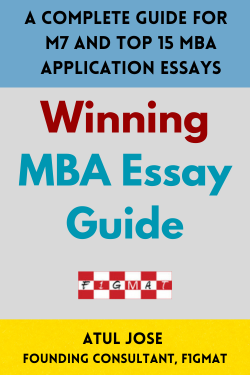
Winning MBA Essay Guide - A Complete Guide for M7 and Top 15 MBA Application Essays
F1GMAT's Winning MBA Essay guide will teach you how to transform your essay into a life journey with trials and tribulations that will move the admission team.
+ Top 15 MBA Programs (Harvard, Stanford, Wharton, Columbia, Booth, MIT, Kellogg, Yale, Haas, Darden, INSEAD, LBS, NYU Stern, Tuck, Duke Fuqua, Ross)
+ The Art of Storytelling + Leadership Narratives + Review Tips + Persuasion Strategies + The Secret to "unleashing" your unique voice + How to prepare and present for the Video Essay + How to write about your Strengths + How to write about your Weaknesses







 Q) I have been preparing for the GMAT for the past 2 and half months. To be honest, my preparation would have been better but it is just 3 weeks to go and from three diagnostic tests, I am scoring in the 550-570 range. My target is 700+. Should I re-schedule?
 Veritas Prep – the leading MBA Admissions Consulting and GMAT Test Prep Company is offering free 7-Day Trial with Veritas Prep GMAT on Demand Course. The course is delivered on high-definition streaming video. The same course materials and the curriculum in Veritas Prep Full GMAT Course are delivered with the On Demand Course.


 Everyone learns in different ways and at a different pace. But when it comes to preparing for the GMAT and gaining a score reasonably reflective of your abilities – there are some general rules of thumb that can help you get the score you want.