Week 1: Take a diagnostic practice test to see where you stand overall. Learn the basic parameters of each section including scoring and question types.
Weeks 2 – 4: Do as many practice problems as possible for each section and read explanations for any wrong answers. The goal is not just to see whether you are better at Verbal or Quant, but specifically which sections (Critical Reasoning, Sentence Correction) and which question types (strengthening arguments, usage of idioms) are the most difficult for you.
Ideally you should spend 3 months for your GMAT Prep(Read How to prepare for the GMAT in 3 months?). If you have one month, here is a focused way to plan your studies:
Week 1: Diagnosis and Practice
Take a practice test and carefully go over your wrong answers. Look for patterns. You want to see if there is one particular section or problem type that is hurting you more than all others. Do additional practice problems if the practice test yields inconclusive information. Read explanations for wrong answers and map out three to five consistent weaknesses. You will focus on these in the next week.
Week 2: Focused Study
Now is the time to deal with your weaknesses. Depending on how many you identified, you will want to spend 1 – 2 days focusing on each. If strengthening arguments questions are your Kryptonite, put a night or two of studying into that. If data sufficiency algebra is killing you, spend an afternoon reading strategies and explanations related to it. You should spend this week doing a combination of practice problems and content coursework about math and English. Take super-concise notes that you can review later.
The goal during this period is work only on things that have a high probability of improving your score.
Day 1 – Diagnosis: Take a practice test. This will likely be your one and only assessment. If you score evenly on both sections, then you will need a more comprehensive study plan. If you ace verbal but bomb the quant, then you know to focus your attention there. Get the GMAT 2-Week Study Plan
If GMAT practice test scores easily affect you, then the last day GMAT practice test can hamper your confidence. Most top GMAT Prep companies have recommended against taking a GMAT test the day before the actual test but GMAT test takers who have score over 750 have recommended taking a Full Practice GMAT test.
English, like all living languages, is complex and constantly-changing; what is acceptable in spoken English is not always accepted in Standard (written) English. The key to improving your English reading, processing, and writing skills for the GMAT is consistent high-quality practice.
A large majority of students aim for the September intakes, when the majority of B-school admissions occur. The spring admissions have been considered to be fewer in number and financial support harder to get during that period.
Some schools have one batch starting in September and another starting in Jan/March.
Collecting and Interpreting Facts: GMAT Reading Comprehension
Effective Note-taking for GMAT Reading Comprehension
5 Questions to Speed up Summary Creation
Mastering GMAT Reading Comprehension: 3 Best Practices
How to Remember Information
How to improve comprehension by Questioning the Author
How to Read Faster
How to Answer GMAT Reading Comprehension Title question
How to Answer GMAT Reading Comprehension Main Idea Question
How to Answer GMAT Reading comprehension inference question
How to Answer GMAT Reading Comprehension Purpose Question
How to Answer GMAT Reading Comprehension Detail Question
How to Answer the GMAT organization of passage Question
How to Improve GMAT Reading Comprehension Score?
Passage #1: Protein-Rich Diet Passage #2: Pregnant Women and Stress Management Passage #3: F Losing Momentum Passage #4: Conservatives and Automation Passage #5: Collaboration, Team size and Performance Passage #6: Effective Altruism Passage #7: Loneliness Epidemic Passage #8: Space Exploration Passage #9: Lab-Grown Meat Passage #10: Minimum Wage in the US Passage #11: AI and Creativity Passage #12: Bias Against Healthcare in Developing Economies Passage #13: Legacy Admissions Passage #14: Plastic Ban and alternatives Passage #15: Underestimating Homo Sapiens Passage #16: Conspiracy Theories Passage #17: Relative Poverty Passage #18: Why Paintings are expensive Passage #19: US Obesity Epidemics Passage #20: The Future of Advertising Passage #21: Breaking Large Companies Passage #22: Helicopter Parenting Passage #23: Future of Democracy Passage #24: Technology and Global Citizenship
Chapters 1) Introduction 2) 6 Step Strategy to solve GMAT Critical Reasoning Questions 3) How to overcome flawed thinking in GMAT Critical Reasoning? 4) 4 GMAT Critical Reasoning Fallacies 5) Generalization in GMAT Critical Reasoning 6) Inconsistencies in Arguments 7) Eliminate Out of Scope answer choices using Necessary and Sufficient Conditions 8) Ad Hominem in GMAT Critical Reasoning 9) Slippery Slope in GMAT Critical Reasoning 10) Affirming the Consequent – GMAT Critical Reasoning 11) How to Paraphrase GMAT Critical Reasoning Question 12) How to Answer Assumption Question Type 13) How to Answer Conclusion Question Type 14) How to Answer Inference Question Type 15) How to Answer Strengthen Question Type 16) How to Answer Weaken Question Type 17) How to Answer bold-faced and Summary Question Types 18) How to Answer Parallel Reasoning Questions 19) How to Answer the Fill in the Blanks Question Question Bank Question 1: 5G Technology (Inference) Question 2: Water Purifier vs. Minerals (Fill in the Blanks) Question 3: Opioid Abuse (Strengthens) Question 4: Abe and Japan’s Economy (Inference) Question 5: Indians and Pulse Import (Weakens) Question 6: Retail Chains in Latin America (Assumption) Question 7: American Tax Rates – Republican vs. Democrats (Inference) Question 8: AI – China vs the US (Weakens) Question 9: Phone Snooping (Strengthens) Question 10: Traditional Lawns (Assumption) Question 11: Appraisal-Tendency Framework (Inference) Question 12: Meta-Analysis of Diet Trials (Weakens) Question 13: Biases in AI (Strengthens) Question 14: Stock Price and Effectiveness of Leadership (Inference) Question 15: US Border Wall (Weakens) Question 16: Driverless Car and Pollution (Assumption) Question 17: Climate Change (Inference) Question 18: Rent a Furniture (Weakens) Question 19: Marathon Performance and Customized Shoes (Weakens) Question 20: Guaranteed Basic Income (Assumption) Question 21: Brexit (Infer) Question 22: AB vs Traditional Hotels (Assumption) Question 23: Tax Incentive and Job Creation (Weakens) Question 24: Obesity and Sleeve Gastrectomy (Inference) Question 25: Recruiting Executives (Weaken)
Read the Essay Guides and see how we write & edit MBA essays
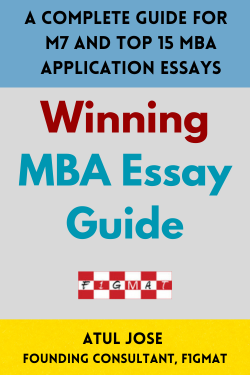
Winning MBA Essay Guide - A Complete Guide for M7 and Top 15 MBA Application Essays
F1GMAT's Winning MBA Essay guide will teach you how to transform your essay into a life journey with trials and tribulations that will move the admission team.
+ Top 15 MBA Programs (Harvard, Stanford, Wharton, Columbia, Booth, MIT, Kellogg, Yale, Haas, Darden, INSEAD, LBS, NYU Stern, Tuck, Duke Fuqua, Ross)
+ The Art of Storytelling + Leadership Narratives + Review Tips + Persuasion Strategies + The Secret to "unleashing" your unique voice + How to prepare and present for the Video Essay + How to write about your Strengths + How to write about your Weaknesses



 English, like all living languages, is complex and constantly-changing; what is acceptable in spoken English is not always accepted in Standard (written) English. The key to improving your English reading, processing, and writing skills for the GMAT is consistent high-quality practice.
  A large majority of students aim for the September intakes, when the majority of B-school admissions occur. The spring admissions have been considered to be fewer in number and financial support harder to get during that period.