F1GMAT · https://www.f1gmat.com/post-mba-goals-research-tips ·
 Add F1GMAT as a preferred source on Google, opens Google in a new tab
 See more of F1GMAT's MBA admissions research in Google's Top Stories by making us a preferred source on Google.
An AI model can collect data and create a plausible post-MBA career arc based on the school's public pages and employment reports, but to create a believable goals essay, you must think like a journalist and reach out to real people.
The intelligence gathering must answer three questions – are the post-MBA goals feasible for ROI?
Have enough candidates from your background achieved the post-MBA goals you are quoting?
Are you in an over-represented applicant pool that is already crowded in a post-MBA job market?
Although M7 MBA programs don't talk openly about the goals in their essays, Cambridge Judge asks what research the applicant did into how the target industry recruits and how confident they feel.
Several programs moved the goal into timed video to measure the authenticity of the applicant's motivation. [1]
In this deep dive, I share how to think like a journalist, reach out to real people and how you should research beyond AI and Search for the MBA Goals Essay:
Contents
- High-ROI Goals: The School's Perspective
- The Top 15 MBA Class Profile as Core Intelligence for Your MBA Goals Essay
- Position your post-MBA Goal for an AI-first World.
- Primary-Source Research for Your MBA Goals Essay
- LinkedIn Research for Your MBA Goals Essay
- Researching Clubs for Your MBA Goals Essay: The Active-versus-Namesake Clubs
- Verifying How Employers Recruit for Your MBA Goals Essay
- Events and Experiences – An Important Part of the Goals Narrative
- MBA Goals Essay Questions Checklist
- References
High-ROI Goals: The School's Perspective
The first change in perspective you must gain in the research process is how schools think about your goals.
They are not thinking about your values alone.
They are also thinking about whether the goals are achievable with or without the MBA.
If you can achieve them without the MBA, you are a risk.
You will quit midway.
You won't be a happy Alumnus.
You won't bring in a new demographic that is needed to reduce the risk of demographic concentration.
Political Risk – Future Trumps
Look at what happens during the years when hostile governments take over.
The international percentage drops, and schools are scrambling across DC, San Francisco, and New York to find strong local candidates or international students with strong local experience.
They don't want to risk another frantic search for talent when the government changes in the future.
The wider the international applicant pool beyond India and China, the stronger the chance that the school can manage a political risk.
The Sponsored Students – Risk Management with Guaranteed Tuition
Another group the school prefers is sponsored students.
The employer is showing confidence in the applicant's long-term value.
The tuition is guaranteed, and access to these prestigious employers is maintained through the candidate.
Look at the 2025 numbers.
Wharton's Class of 2025 posted a record median base of $185,000 with a median signing bonus of $33,750, and Stanford led the field at $187,504. [17] But the market was bifurcated. Pay rose while placement softened, with only 91% of Wharton's job-seekers receiving an offer within three months, down from 97% for the Class of 2023, and just 69% of the class seeking employment at all as sponsored students, founders, and investors grew as a share. [17]
The Economic Downward Trend and Entrepreneurship
When the job search extends from three months to six months, a pattern of starting a venture as an alternative career path becomes prevalent even in M7 MBA programs.
At Stanford, 23% of the Class of 2024 went into entrepreneurship (98 founders), easing to 16% for the Class of 2025 off a record 25% two years earlier.
The fall in startup pursuit is from the level playing field AI has created in the SaaS market.
There aren't enough customers demanding Apps when they can create their own Apps in a few hours.
At Harvard, where the startup market were broader, the trend was reverse - 14% of the Class of 2024 launched a startup (138 founders), and the Class of 2025 set a record with 17% planning to start a business, up from 13% in 2023 and 8% in 2021, while 35% of the class chose not to seek a traditional job at all.
Even in an economic downward trend, schools behave differently.
You must be aware of such trends when you cite post-MBA goals in entrepreneurship.
Why a definite high-ROI goal helps admissions
Top MBA programs live and die by ranking. Applicants still value reputable publications' rankings.
Outside increase in salary and starting post-MBA base salary, along with the reputation of the professors in preparing students for their long-term goals, rankings for M7 and Top 15 MBA programs have not changed drastically enough that any one of them went out of these top lists.
Schools optimize their ranking based on post-MBA salary. That is why schools are eager to attract consulting, banking, and technology employers.
They are the industries with the highest-paying jobs.
The ROI is clear.
The difference between the highest-paying job function even within the highest-paying industry and the lowest-paying job function is close to $70,000 (see our Harvard MBA ROI).
Applicants who arrive undecided or apply broadly across unrelated sectors place slower [17] – a risk factor M7 can absorb because of their steady placements of sponsored applicants to Consulting and Finance, but for schools outside M7, such risk-taking is looked down on.
Case Study: Bain Consultant (Goals for Booth and Kellogg)
A Bain consultant choosing Booth and Kellogg with the goal of entering MBB is a low-risk admit as the roughly $192,000 base salary clears her debt and shortens the ROI [4]. But if she decides to quote starting a venture in the short-term – a tradition Booth and Kellogg don't have, her risk of rejection increases dramatically.
A Social IMPACT applicant who moved from Teach for America to a social-impact role in a corporate-funded organization is a lower risk than an applicant moving from Teach for America to start a think tank serving the underprivileged in the short-term.
With over 90% failure rate – startups in any form without the support of a strong funding network – family or professional network is a risk for the school.
Avoid them in your short-term goals narrative unless you are applying for Harvard or Stanford.
The two schools treat entrepreneurship differently.
The Top 15 MBA Class Profile as Core Intelligence for Your MBA Goals Essay
Representation Challenges
Where your demographic is highly represented, differentiate or change schools.
Take Consulting where 35% of the MIT Sloan class arrived from, 34% at INSEAD, 33% at Yale, and 32% at Kellogg, but only 9% at UCLA Anderson, 13% at Darden, and 15% at NYU Stern. [5]
Consultants do change industries and functions, but our latest research shows that they are a net positive industry, which means more career switchers enter the industry and the function.
Now, if you are a career switcher and plan to enter consulting, feasibility is not the problem.
You are inside the most over-represented post-MBA goals group.
The Uniqueness lies in how you stitch your motivation and the specificity of your post-MBA role.
A consultant applying to MIT or Kellogg is in a competitive applicant pool for a consulting goal and must differentiate on a specific post-consulting destination.
The same consultant applying to Anderson or Stern is on a winning path and can lean on that scarcity to bring their unique insights to the class.
When you are underrepresented, Own the Scarcity as your Uniqueness
Applicants who are aware of such scarcity go into a defensive state. I am writing this advice not to discourage you but to help you build a strategy.
For example, if you are a veteran, know that 15% of the class at Ross and 12% at Darden are from your background, but only 3% at Harvard are from the military.
The effort to stand out from other veterans at Ross and Darden, and the effort to stand out as a potential 'minority' veteran at Harvard, is way different.
The skills and stories that you must highlight to complement the goals essay should be informed by the post-MBA placement trends.
One challenge at Harvard, for instance, is the high concentration of Finance and Consulting roles and fewer operations roles, where veterans fit naturally.
It doesn't mean that as a veteran you can't pick up the best practices in your target industries and transition to a General Management role where your military experience could come in handy.
The stories in your non-post-MBA goals essays – especially the business-minded and curiosity essays- must align. This is where most military applicants fail – not from a failure in their motivation or incentive, but because they work in a defined culture like the military where the Chain of Command is structured for fewer surprises.
How can a Veteran own the scarcity of the skill to work in a structured Chain of Command for a chaotic business environment?
Maybe the chaos of the startup or a culture where the scope changes frequently (technology) needs the eyes of a Veteran who can bring structure to chaos.
It all depends on how you define the skills in the essay.
Your post-MBA goal should own this scarcity, and not shy away and artifically merge into the skills peers from Consulting, Finance, and Technology can quote.
Position your post-MBA Goal for an AI-first World.
GMAC's 2026 survey of recruiters found that one in three employers globally will replace at least some entry-level roles with AI, 40% in technology, 36% in manufacturing, and 25% in consulting, with coding, data entry, and customer service the first to go. [11]
The same survey found that the durable human skills employers cannot automate are the ones they rate graduates as least prepared to demonstrate, and that adaptability and initiative have risen above project management and teamwork in what recruiters weigh. [11]
The goals essay should be based on the new demand from recruiters in roles where non-AI skills could be demonstrated.
Choose examples that tick the traits below.
| Trait | What is Valued in an AI-First Market | A Good Example |
| Problem Framing | Recruiters' top current skill; AI answers the question but does not decide which question matters, so building the expertise to question AI is the human value | A moment you redefined the real problem before solving it, such as turning a "cut costs" brief into a pricing decision |
| Adaptability and initiative | Adapting to changing market demands and initiative to take action are the fastest-rising traits in the 2025-26 surveys, now ranked above project management and teamwork. | A time you acted proactively, anticipating the change in market or scope of the project. |
| AI as a multiplier | AI-tool fluency tops the five-year forecast in skills, yet fewer than half of employers find graduates prepared to use AI as a multiplier for productivity and reach A case where you used an AI or automation tool to shorten the days of work into hours, and what you did with the time it freed. | The second half of the question is the important part of your 'strategic thinking' |
| Communication and synthesis | As analysis commoditizes, turning data or disagreement into a decision people act on is what separates the best from the rest. | A time you united a divided room, or a wall of numbers, to a clear insight or a decision others followed is a good example to validate your post-MBA goals. |
| Emotional intelligence and managing people | EQ cannot be automated, and employers share that they are the toughest to find. | A moment you read a person or a team correctly and changed the outcome |
| Grit and accountability | The bar is low when it comes to owning the outcome of a project, as employers quote that professionalism fell to 52% from 61% in the 2026 GMAC Corporate Recruiters Survey. | A failure you owned, learned from, and applied as lessons for future challenges shows you can be trusted when the work goes wrong. |
Source: GMAC Corporate Recruiters Survey 2026 [11]; skill rankings and AI-replacement figures as reported.
Primary-Source Research for Your MBA Goals Essay
The primary source research is the part of the application that AI cannot do for you, which is why it is the part that decides whether the goal is believable.
A model can assemble a plausible career arc from a school's public pages without the applicant speaking to a single person.
The goals essay is the theme that fits most easily. [1]
The tells are a lack of specific, checkable detail and a disconnect between the essay, the resume, and the recommendation letter.
Schools have answered by moving the goal into timed video and by inferring your interest by seeking lines where the applicant quotes a current student or an Alumnus.
A believable goal is built by talking to people who have lived the MBA experience.
The Golden Rule of Journalism
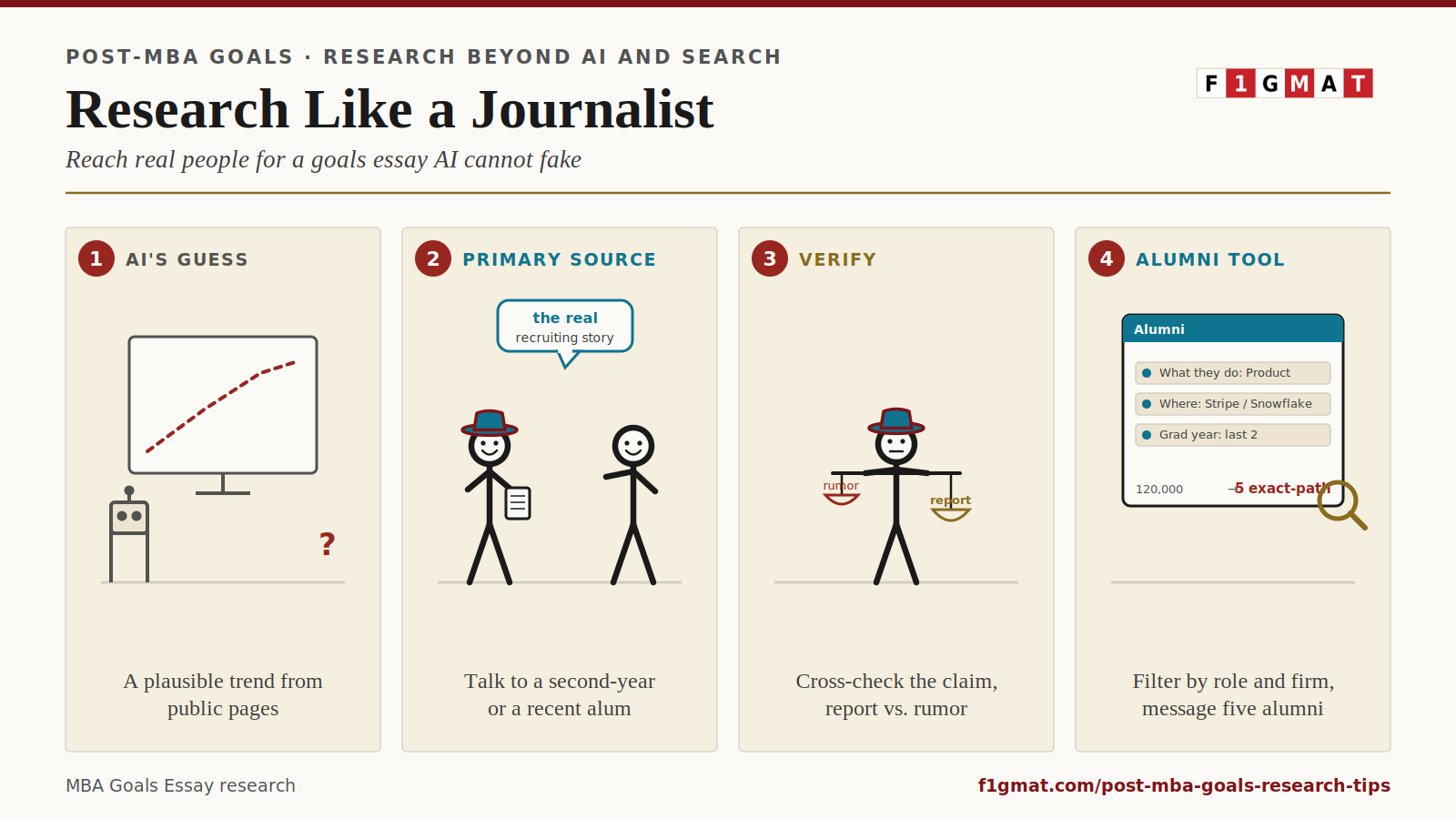
You must choose these three golden rules from the newsroom: "Seek Truth and Report It." [12]
Rule 1. Go to the primary source
The journalistic code tells reporters to use original sources whenever possible. [12]
A school's site, the featured students in third-party publications, class profile, and club pages are the pages every applicant reads.
A goal built from them produces the essay every applicant writes.
The primary source is the person who has lived it - a second-year in the club or an alum two years into the role you want.
The detail they give you is published nowhere, and they are closer to the current job market and market reality than an alumnus 5 years into their post-MBA role.
Rule 2. Verify before you Narrate
The same code tells reporters to test information across sources and to seek alternatives before relying on one source [12]
One Alum's enthusiasm is not evidence that a program fits your goal.
Cross-check the claim with a current student and then with an alum already in the target role. Maybe the enthusiastic Alum had a narrow goal which she achieved. Ask her about the goal and then infer the reasons for the high satisfaction score, before you build the goal around the narrative.
Numbers and What They Really Mean
If a source says half the class enters consulting, but the employment report says 28%, verify before repeating your interest in the goal.
The class profile and the employment report are the documents that confirm or contradict what a source says.
The sources might not be as invested as you are in these numbers. They might forget too.
Correct them, but be polite.
Ask how they know
"I got my offer through the trek" is clear evidence
"I hear people get offers through the trek" is a rumor.
Push every claim back to its source or origin.
Firsthand accounts from someone in the target role should carry more weight than secondhand ones.
Read the silence
Reporters notice omissions.
When an applicant asked three student ambassadors about a club everyone lists, and when all three changed the subject, the gap is obvious.
A question the sources dodge is itself good information.
Rule 3. Know who is talking and why
The journalistic code tells reporters to identify sources clearly and to weigh their reliability and motives. [12] A student ambassador is there to sell the school.
A mid-career alum with nothing at stake gives you an honest answer on the value of an MBA.
An alum 2-years post-MBA will offer the most realistic answers.
Ask open-ended questions, such as "how was a normal week like at Harvard" or "what would you change at Harvard," then push past the adjective to the specific experience, the course details, or the exact way a firm recruits on that campus.
LinkedIn Research for Your MBA Goals Essay
LinkedIn is the fastest way to reach the primary sources, and alumni answer far more often than when reaching out anonymously without a profile. [13]
How to Research Using LinkedIn's Interface
The school's Alumni tool, the "Alumni" tab on its LinkedIn page, sorts every graduate into filters that plain search and even AI-assisted research cannot reach.
You can find where the alumni live, where they work, what they do, and what they studied – all in one interface.
Stacking two of them, "what they do" plus "where they work," turns a list of 120,000 alumni into the most realistic outline of who walked the exact path you are researching.
The keyword box accepts Boolean.
So ("private equity" OR buyout) AND NOT intern narrows to the roles you mean to enter.
The graduation-year slider, dragged to the last two years, shortlists recent graduates who know the current recruiting reality.
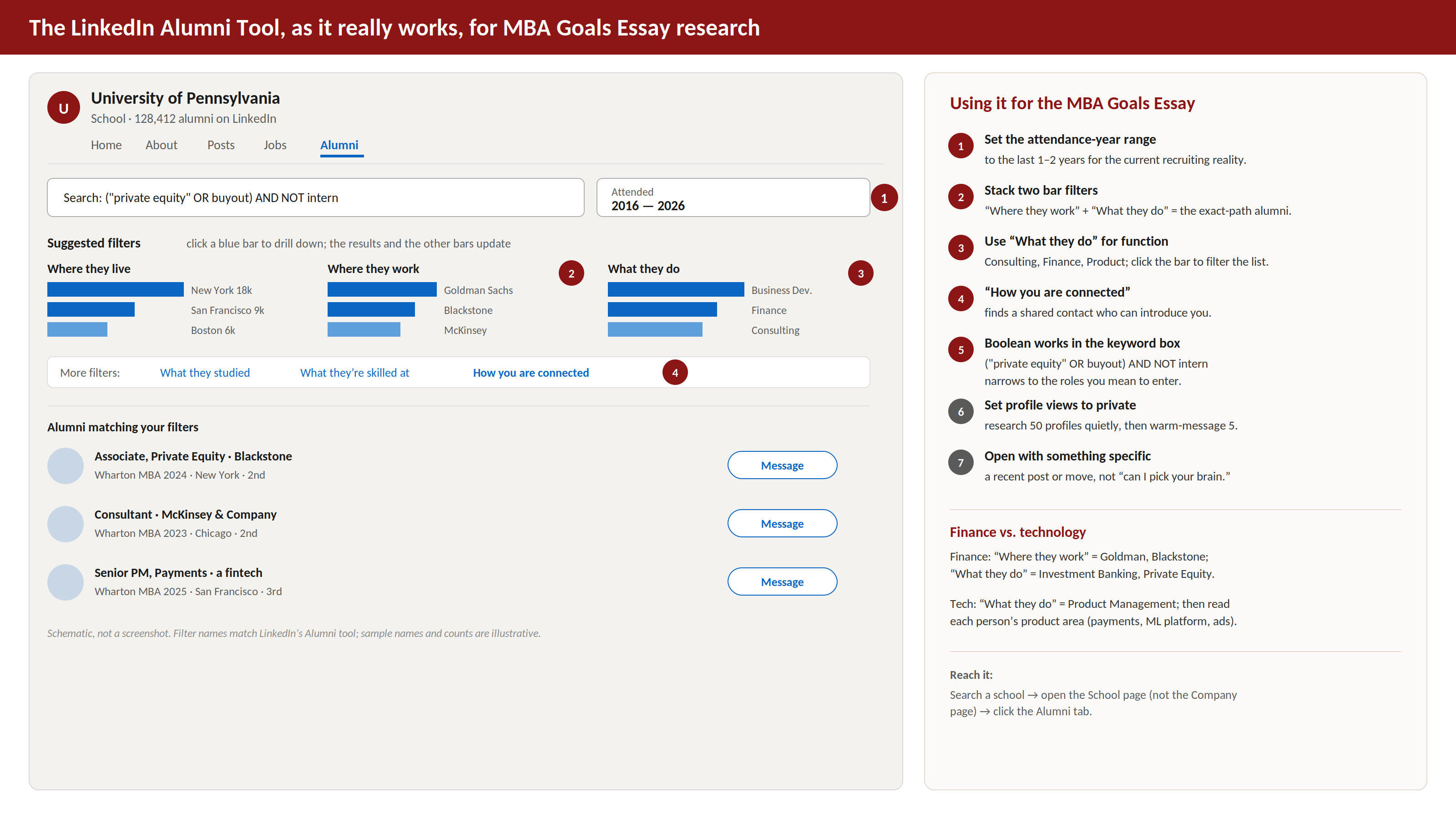
Step 1: Open the school's LinkedIn page and click the Alumni tab.
Step 2: Set "What they do" to your function and "Where they work" to your target employers.
Step 3: In the keyword box, use Boolean to narrow, for example ("private equity" OR buyout) AND NOT intern.
Step 4: Drag the graduation-year slider to the last two years to reach recent graduates who know the current market.
Step 5: Switch your own profile to private mode, then scan the filtered profiles.
Step 6: Read each person's desk or product area from their experience and recent posts, and shortlist five exact-path alumni.
Step 7: Message those five with a short note that references one specific thing from their profile.
LinkedIn Research for Post-MBA Goals – Finance Applicant
Search by firm and desk, without using the word 'Finance' in the keyword box.
For example - use "M&A associate in healthcare investment banking at Evercore," "private-equity associate at a middle-market buyout fund like Audax," or "growth-equity associate at General Atlantic."
You get the pattern.
Role at type_of_fund like/at employer_name
Set "where they work" to the specific banks or funds and "what they do" to investment banking or private equity, then reach the analysts and associates one to three years out who still remember how recruiting worked, not the managing directors who do not.
The questions that matter are around timing and structure - on-cycle versus off-cycle, which desks recruit on your campus, and how early the process starts.
Finance recruiting is early and structured.
For an applicant aiming at a New York buy-side seat, they should name the sub-sector and a few real funds, say healthcare-focused buyouts at a fund like Welsh, Carson, Anderson & Stowe, and talk to second-year associates at exactly those funds.
LinkedIn Research for Post-MBA Goals – Technology Applicant
Target by product specialization because a "product manager" at two firms can mean two different responsibilites.
Name the domain and the employer inside it - "Senior PM for payments at Stripe," "group PM for cloud data products at Snowflake," or "principal PM for ML infrastructure at Databricks."
On the tool, set "what they do" to product management, then list each person's actual product specialization, whether payments, developer tools, ads measurement, marketplace, or ML platform.
Evaluate their experience and recent posts before reaching out, and prioritize the managers who pivoted from a pre-MBA background like yours.
Find out which employers actually hire MBAs, whether the summer internship converts to a full-time offer, and whether the role is a real product job or a rotational program.
LinkedIn Research for Post-MBA Goals – Consulting Applicant
First Target by firm size and practice area (private-equity due diligence, healthcare, operations).
Set "where they work" to McKinsey, Bain, and BCG, or your targets, and "what they do" – are they in consulting or strategy?
Then, reach the post-MBA associates one to two years into the new role and the sponsored consultants who returned, since they have seen both sides of the recruitment cycle.
Ask them which office and practice recruit from your campus, how the case-interview timeline runs, and whether the firm sponsors if you are also from the same firm.
Consulting recruiting is early, structured, and case-driven.
Figure out the timeline and the changes happening in mid-tier roles with the expansion of AI.
Researching Clubs for Your MBA Goals Essay: The Active-versus-Namesake Clubs
Clubs are the hardest thing on a campus to research and the easiest to get wrong, because the published blogs about the club and the activity might not match.
A refined page might be the effort of an officer two years ago.
A Stale blog might mean there wasn't anyone leading the blogging effort.
The first rule, then, is not to judge a club by its website but by what current students say it does.
Naming a namesake club is a missed opportunity to quote a genuinely active club. [1]
Ask about placement Facilitation
The one question that settles the value of a club is its role in placement.
Ask the recently graduated Alum about the clubs they were in and its role in networking.
Find the hidden active club
Current students mention them unprompted and describe their experience instead of ROI. Strong word of mouth about a club is a sign that you must include it if it is relevant to your post-MBA goal.
Follow the treks and the money
Funded treks take real budget and organization. Look for news releases and blogs where the trek was organized by a club.
Quote that club.
It is a sign that the club can get things done.
Network with the officer in that club.
Ask non-featured students
A technique that can help you find negative feedback about the school experience is to randomly list 3 current students and reach out to them.
They should not have any official role.
Ask them about the experiences they didn't like. That is the hint of clubs and experiences you must not quote in your goals or potential contribution essay.[18]
Verifying How Employers Recruit for Your MBA Goals Essay
A goal that names Google, or any employer, as the post-MBA target is only credible if that employer actually recruits from the target school for that role.
It is the most checkable claim in the essay, and the one applicants most often skip.
Here is how to verify it:
Start with the employment report's employer list
Most schools publish the firms that hired two or more graduates.
If Google appears with real numbers, it recruits there, and if it is absent from a program that lists Amazon and Microsoft, that is a clear trend that Google is not hiring from the school. Validate the data for the past 3 years.
Count recent hires on LinkedIn
Search using a key phrase that concatenates the school plus the employer plus the last two graduation years and filters them by role. An active search hit shows several recent product-manager hires, while zero recent hires means the path is not on-campus, whatever the brochure might say.
Check the company's target-school list
Google recruits its MBA product and rotational programs from a defined set of schools. If the target school is not on it, on-campus recruiting will not happen, and the applicant has to plan an off-campus route. Ideally, don't mention employers candidates pursued off-campus.
Ask the technology club and a recent hire
The club knows which firms come to campus versus the ones that require cold networking. An alum now at Google can say in one line whether they recruited on-campus or networked in.
Find why the company may have paused or cut campus MBA hiring that year, as several technology firms did between 2023 and 2025 with the priority shifting to CAPEX and AI integration.
The role in Technology may not be MBA-recruitable at all, since many Google product roles hire from the industry rather than an MBA program. [17]
For an applicant whose MBA goal names a FAANG product role, this verification is a necessity.
If the employment report and LinkedIn both show Google hiring product managers from the school, the goal should be confirmed.
Events and Experiences – An Important Part of the Goals Narrative
Beyond clubs and recruiting, two more parts of the lived experience never fully get captured in the school blogs.
Most are 3 years to a decade old.
Recruiting versus social
The events calendar mixes recruitment and social events.
A coffee chat with a visiting firm or a club trek to meet an employer is a recruiting event.
Many receptions are social.
The most valuable experiences and what to skip
Alumni two or three years out can name the experiences that mattered and the ones they would drop because they just fulfilled a social norm.
MBA Goals Essay Questions Checklist
Ask only what is not published.
Clubs: Active versus namesake
- Which clubs did you actually spend time in, and which turned out to be valuable for your post-MBA experience?
- If I want [target role], which one club is non-negotiable, and which are optional?
- Which club actually placed people into [firm or role] last recruitment cycle?
Events and Treks
- Which event or trek led directly to an offer or a lasting relationship?
- Which events are recruiting-relevant, and which are mostly social?
- What happens at [event] that the school page does not say?
Recruiting reality for the target role
- Would you please share how you actually got into [role or firm] and the networking strategies you used?.
- Which firms recruit on campus for [role], and which make you network cold?
- How many people in your class targeted [role], and how many got it?
- What did the people who got [role] do in their first term that the people who missed did not?
Questions for Career Pivoters
- Did anyone make my exact move, from [current field] to [target field]? What did it really take?
- What part of the pivot does the school's marketing understate?
- What would you tell someone attempting it now that you wish you had known?
Most valuable experiences
- Looking back, what two or three experiences mattered most?
- What did you spend time on that you would skip if you did it again?
- What is the one resource here that is underused?
Fit Questions
- What kind of person thrives here, and what kind struggles?
- What surprised you once you arrived?
The answers to these questions are what an AI model cannot produce.
Either publications get paid to feature student ambassadors, or you hear a sanitized version in MBA tours and campus visits. The incentives are mismatched.
For an honest evaluation of your target schools and shortlisting feasible & believable post-MBA goals, Sign Up for F1GMAT's Essay Editing Service or reach out to me.
References
- F1GMAT, MBA Essay Questions of the M7 and Global Top 50 (2026-27) ↩ ↩ ↩
- Harvard Business School, MBA Cost of Attendance and Financial Aid
- School financial-aid and employment disclosures (Harvard Business School, The Wharton School, Yale SOM)
- Consulting compensation for MBA hires, 2025, from Top 15 employment reports and consulting-firm disclosures ↩
- F1GMAT, Top 15 MBA Class Profile, Class of 2027 ↩
- INSEAD MBA cost (August 2025 intake, approx. €103,500, one-year program)
- One Big Beautiful Bill Act (Pub. L. 119-21), effective July 1, 2026
- Employer MBA sponsorship, 2026 (consulting-firm policies)
- Companies that pay for an MBA (GMAC/mba.com)
- Nonprofit sector funding cuts 2025-26: EO 14222 and DOGE grant terminations
- GMAC Corporate Recruiters Survey 2026 (conducted Jan-May 2026) ↩ ↩ ↩
- Society of Professional Journalists, Code of Ethics, “Seek Truth and Report It” ↩ ↩ ↩ ↩
- LinkedIn Alumni Tool and informational-interview best practices, university career-services guidance 2025-26 ↩
- Barrick, M. R., & Mount, M. K. (1991). The Big Five Personality Dimensions and Job Performance
- International MBA private lending, 2026
- International student work authorization, 2026
- MBA placement and salary, Class of 2025 (Wharton MBA Career Report and school employment reports) ↩ ↩ ↩ ↩
- F1GMAT, MBA Salary and Placement Analysis by job location, Class of 2025 (Harvard, Stanford, Wharton)
↩
