The HBS MBA cost for the 2026-27 academic year is $130,318 per year for a single student, based on Harvard Business School's nine-month student budget. From the Cost of Attendance, HBS MBA tuition fees account for $84,760 of that figure. The remaining $45,558 covers health fees, housing, food, transportation, and other living expenses.
A single student must budget roughly $273,524 and a married student $337,922, before scholarships.
TL;DR (At a Glance)
- HBS MBA tuition fees (2026-27): $84,760 per year. Harvard Business School raised tuition 7.7% from $78,700.
- Total HBS MBA cost, single student: $130,318 per year. The two-year budget reaches $273,524.
- Total HBS MBA cost, married student: $159,592 per year. The two-year budget reaches $337,922.
- Year-over-year increase: 3.0% overall. Tuition (+7.7%) and the health insurance plan (+15.0%) drove the increase.
- Required fees: Student Health Fee $1,944. Student Health Insurance Plan $4,954.
- Scholarships: Harvard Business School gives need-based aid to about half of each class. The average award reaches roughly $100,000 over two years. HBS awards no merit aid.
- 9-to-12 month gap: A single student who lives off-campus or stays for the summer adds about $12,888.
F1GMAT's Harvard MBA Cost guide breaks down HBS MBA tuition fees, the full cost of attendance, the 2026-27 increase, the scholarships that lower it, and how the cost measures against the return.
Contents
- Harvard MBA Tuition Fees (2026-27)
- Harvard MBA Cost: Two-Year Total of Attendance
- Harvard MBA Cost: Two-Year Total Cost of Attendance
- HBS MBA Cost Increase: 2026-27 vs 2025-26
- How to Lower Your Harvard MBA Cost: Build Your Own Budget Plan
- The Harvard MBA Housing Lottery and Your Real Cost
- Harvard MBA Scholarships and Financial Aid (Summary)
- Harvard MBA Cost vs ROI: Is It Worth It?
- Key Takeaways - Harvard MBA Cost
- Methodology and Sources
Harvard MBA Tuition Fees (2026-27)
The HBS MBA tuition fee for the 2026-27 academic year is $84,760[1]. Harvard Business School raised tuition 7.7% over the 2025-26 figure of $78,700, the steepest annual increase in recent years[2]. Prior cycles moved 2 to 3% per year.
How HBS MBA Tuition Fees Have Changed Year Over Year
Tuition has climbed every year, from $73,440 in 2022-23 to $84,760 in 2026-27. The first three increases stayed near 2 to 3%. The 2026-27 jump of 7.7% breaks that pattern and is the largest single-year increase in the five-year window. F1GMAT Premium tracks the full component-by-component trend in the Harvard MBA Cost Increase Trends analysis.
Harvard MBA Cost: Two-Year Total of Attendance
The COA at Harvard Business School is based on a nine-month academic year schedule with the assumption that the student will live a moderate student lifestyle. Based on this assumption, the single-student budget comes to $130,318. The most consequential component of the COA is the Household size. Even if the tuition fee increases by 5-8% every year, housing, living costs, and dependent coverage add to the total cost.
| Household | One-Year Cost of Attendance (2026-27) |
|---|---|
| Single student | $130,318 |
| Married (spouse) | $159,592 |
| Married with one child | $179,402 |
| Married with two children | $186,312 |
Required Fees: Student Health Fee (SHF) and Health Insurance (SHIP)
Two health charges as part of the required fees influence the total cost.
The Student Health Fee is mandatory for everyone but the Student Health Insurance Plan can be waived if you already hold comparable coverage. The waived SHIP can save $4,954 out of your budget.
For dependents, the SHIP needs different planning. The Harvard University Student Health Program costs are added when a married student enrolls a spouse or children to the program.
| Required Health Charge | Annual Cost | Waivable? |
|---|---|---|
| HUHS Student Health Fee (SHF) | $1,944 | No, mandatory for all students |
| Student Health Insurance Plan (SHIP) | $4,954 | Yes, with comparable outside coverage |
| Harvard University Student Health Program (dependents) | $11,716 | Only if enrolling a spouse or children |
Living Expenses: Housing, Food, and Transportation
Living costs are the flexible part of the budget. The lifestyle part students can suppress for 2 years, but the housing cost has multiple tiers and each tier require compromising on privacy or luxury.
Harvard Business School pegs the housing allowance to the average area market rate for a shared apartment. Spend below that rate or above it, and your housing line moves more than any other cost component in the budget.
The added housing requirements for a married couple is higher on every metric.
| Living Expense (9 months) | Single | Married |
|---|---|---|
| Housing | $18,600 | $29,500 |
| Food, transportation, and other | $20,060 | $26,718 |
The Nine-to-Twelve-Month Difference
The published budget covers only the nine-month academic year. Stay through the summer or sign a twelve-month off-campus lease, and you pick up roughly $12,888 in extra living costs as a single student, or $18,738 with a family.
One cost component falls outside the published total entirely - the computer expense.
Harvard Business School lists a computer as a variable $1,500 that it does not fold into the figures above.
Harvard MBA Cost: Two-Year Total Cost of Attendance
The two-year HBS MBA cost is not simply double the annual figure.
Harvard Business School doubles the nine-month budget and then adds the nine-to-twelve-month difference for the first year, since most students live in Boston through that first summer.
A single student reaches $273,524, a married student $337,922.
| Household | Two-Year Total (before scholarships) |
|---|---|
| Single student | $273,524 |
| Married student | $337,922 |
HBS MBA Cost Increase: 2026-27 vs 2025-26
The total HBS MBA cost of attendance for single students rose from $126,536 in 2025-26 to $130,318 in 2026-27, a 3.0% increase.
HBS MBA Tuition Fees Inflation: 7.7% Increase
Harvard Business School raised tuition from $78,700 to $84,760. The 7.7% increase is the steepest single-year tuition jump in recent cycles.
Health Insurance and Fee Inflation: 12.9% Increase
The HUHS Student Health Fee rose 8.0%, from $1,800 to $1,944. The Student Health Insurance Plan rose 15.0%, from $4,308 to $4,954. The two health lines together rose 12.9%.
Housing, Food, and Transportation Changes
Harvard's projected housing allowance in the COA has come down by 1.6% from $18,900 to $18,600. It is the transportation estimate that fell remarkably by 21.2%, contributed mostly by the percentage of on-campus housing. The food budget followed inflationary trends rising by 3.3% from $9,100 to $9,400.
What Drove the 2026-27 HBS MBA Cost Increase
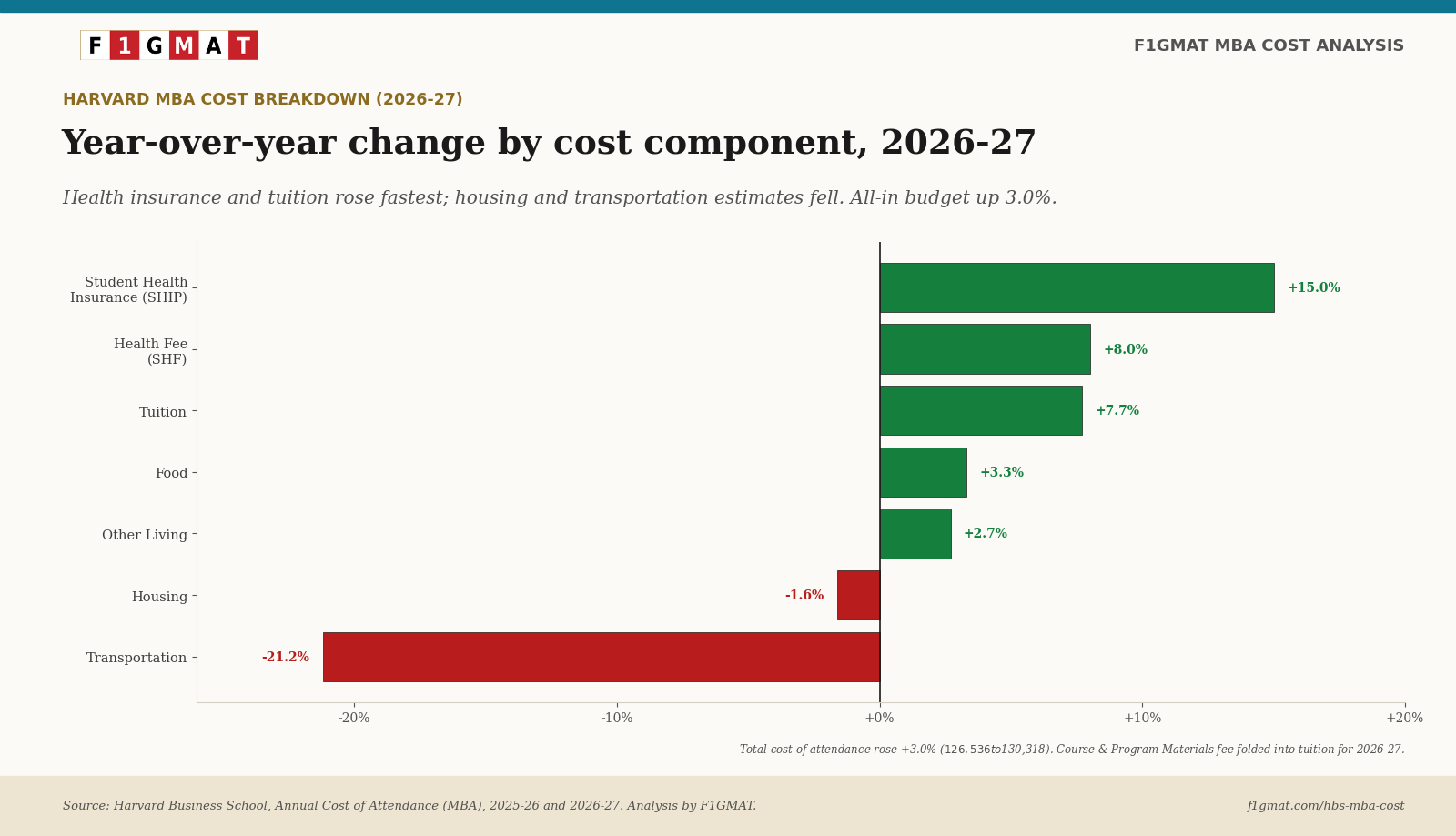
Tuition Fees and Student Health Insurance Plan are cost components that Harvard has limited control over. The school began managing the housing allowance and the correlated transportation estimate to keep the total cost increase to a manageabel level in a year where students have been hyper-sensitive to ROI in a down job market. The total cost increase of 3% for single students is the result of this careful calibration.
The 2026-27 HBS MBA cost increase was not spread evenly across the budget. The Student Health Insurance Plan rose the most in percentage terms, climbing 15.0% from $4,308 to $4,954. The Student Health Fee followed at 8.0%, and HBS MBA tuition fees at 7.7%. Food rose a modest 3.3% and other living expenses 2.7%.
Two cost lines moved the other way.
Harvard Business School cut the housing allowance 1.6% and dropped the transportation estimate 21.2%. Tuition is by far the largest component. Its 7.7% increase produced most of the total increase. The housing and transportation cuts then held the all-in single-student budget to a 3.0% gain.
| Harvard (Expenses) | Cost For Single Students (2025-26) | Cost For Single Students (2026-27) |
|---|---|---|
| Tuition | $78,700 | $84,760 |
| HUHS Student Health Fee (SHF) | $1,800 | $1,944 |
| Student Health Insurance Plan (SHIP) | $4,308 | $4,954 |
| Course & Program Materials Fee | $2,800 | Added into tuition |
| Housing (9 months) | $18,900 | $18,600 |
| Food (9 months) | $9,100 | $9,400 |
| Transportation (9 months) | $2,360 | $1,860 |
| Other Living Expenses (9 months) | $8,568 | $8,800 |
| Total | $126,536 | $130,318 |
HBS MBA Cost for Married Students and Students with Children
A married student pays the same HBS MBA tuition fees and required health fees as a single student.
The gap between the two budgets comes from living costs and dependent coverage.
Tuition holds at $84,760 and the combined health fee and insurance at $6,898 for both.
Three cost components create the difference.
For 2026-27, the dependent health coverage through the Harvard University Student Health Program increased to $11,716, the housing allowance rose from $18,600 to $29,500 and living expenses climbed from $20,060 to $26,718.
Together these three cost component increased the annual HBS MBA cost from $130,318 for a single student to $159,592 for a married couple, where the marital status created a difference of $29,274 per year.
Single vs married single-student budget for 2026-27
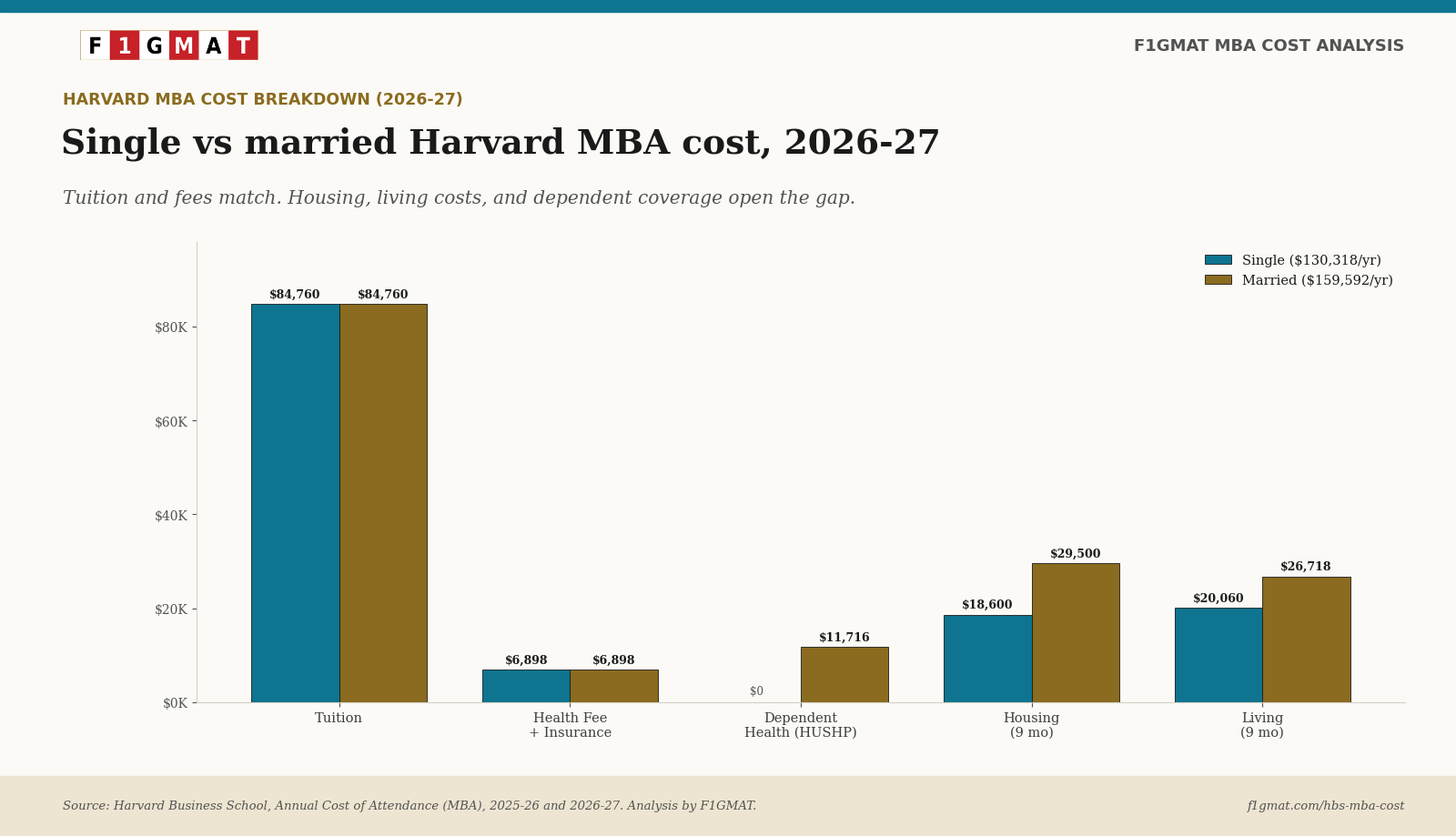
Tuition and health fees matches for single and married students.
The HBS MBA cost increases with household size.
A single student budgets $130,318 a year.
A married couple budgets $159,592.
A married student with one child budgets $179,402, and a married student with two children $186,312.
A first child adds another $19,810.
A second child adds just $6,910.
Harvard Business School holds tuition and required fees fixed regardless of the household size. Each additional dependent raises only the housing and living allowances.
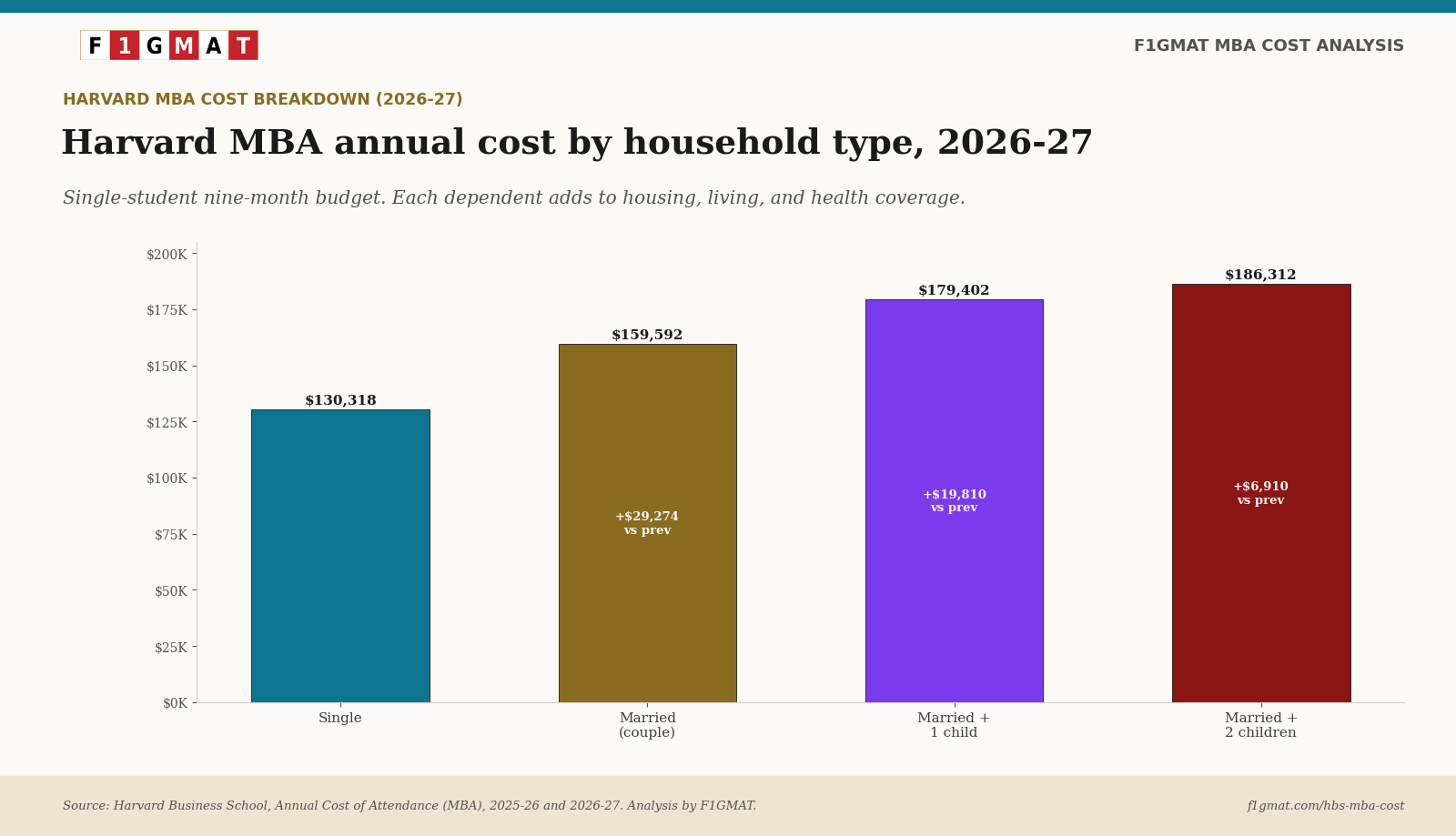
Marriage adds $29,274 as housing, living costs, and dependent health coverage all increase at once.
How to Lower Your Harvard MBA Cost: Build Your Own Budget Plan
The published budget describes a single student who spends exactly to the allowance, which almost nobody does. What you actually pay turns on three things the published figure cannot know.
Your scholarship award is the largest of them.
Where and how you live is the next, and whether you carry your own health insurance is the third.
The four steps below build a personal estimate for 2026-27 from those variables.
start with tuition and required fees
Tuition is $84,760, the Student Health Fee is $1,944, and the Student Health Insurance Plan is $4,954. These three sit largely fixed at $91,658 for a single student. A student who carries comparable outside insurance can waive SHIP and remove $4,954.
add your living costs
The on-budget allowance runs $18,600 for housing, $9,400 for food, $1,860 for transportation, and $8,800 for other expenses, a nine-month total of $38,660. Housing is the line you can move most, and the on-campus lottery decides much of it. The section below on the HBS housing lottery covers how a dorm room, an on-campus apartment, or an off-campus rental changes this figure.
account for the summer
The academic budget covers nine months. A student who lives off-campus or stays for the summer adds about $12,888 for the year.
subtract your scholarship
The academic budget covers nine months. A student who lives off-campus or stays for the summer adds about $12,888 for the year. Take a single student who receives the average scholarship and lives on-budget and you see the two-year figure falling from $273,524 to about $173,524 before loans.
Note: Waiving SHIP and drawing a residence-hall room in the housing lottery removes several thousand dollars more from each year.
The Harvard MBA Housing Lottery and Your Real Cost
Housing is the largest living-cost line in the HBS MBA budget, and where you live moves the number more than any other choice you control.
Harvard Business School reports that 65% of MBA students live on campus[4].
The published budget assumes $18,600 for housing across the nine-month year as Harvard Business School assigns on-campus housing through a lottery.
The amount you actually pay depends on which lottery you enter and what it offers you.
Two Separate Lotteries
Two separate lotteries determine on-campus housing.
The first lottery covers the HBS residence halls and the on-campus dorms. Both determine admits for single students only.
HBS counts you as single for housing if you will live alone, regardless of your marital status.
The second lottery covers the Harvard University Housing apartments, including Soldiers Field Park and One Western Avenue on campus. These apartments are open to everyone. Priority residence is offered for applicants with one or more children.
An incoming single student can enter both lotteries to widen the odds.
An applicant arriving with a partner or children applies only for the apartments.
How the Lottery Affects What You Pay
A residence-hall dorm room is the lower-cost on-campus option.
A student who draws one can come in under the $18,600 housing allowance.
The single dorm room with a shared bath trades space for the lower rent.
The Harvard University Housing apartments cost more.
A Soldiers Field Park unit starts around $2,772 per month with utilities included[5]. Over a full lease that rent runs above the nine-month housing allowance.
A student who places low in both lotteries typically explore the off-campus Cambridge and Allston market, where a one-bedroom typically runs above the on-campus budget.
What This Means for Your Budget
A residence-hall room housing is the single biggest factor to your HBS MBA total cost.
The allocation brings down the housing allowance below the $18,600 level each year.
Even on-campus apartment or an off-campus rental cannot bring down the housing cost below the allowance, but on-campus obviously brings down the transportation cost.
Harvard MBA Scholarships and Financial Aid (Summary)
Harvard Business School awards need-based scholarships only and gives no merit aid.
About half of each MBA class receives a scholarship, and the award is a gift that no student repays.
Harvard Business School reports individual awards from $2,000 to $87,000 per year, an average scholarship of roughly $100,000 over two years, and full-tuition scholarships for the 10% of students with the greatest financial need[3].
Harvard Business School also funds complementary fellowships.
The Goldsmith fellowship supports nonprofit-bound students, and the Forward fellowship backs students from lower-income backgrounds.
The RISE fellowship adds support for students serving under-resourced communities.
The Summer Fellows program pays up to $650 per week for internships between the first and second year.
Domestic and international students can both apply for federal and private loans.
Each admitted student completes the HBS financial aid application after acceptance to determine the award.
For the full breakdown of HBS MBA scholarships, fellowships, loan programs, and aid for international students, see our HBS MBA Scholarships and Financial Aid guide.
Harvard MBA Cost vs ROI: Is It Worth It?
The HBS MBA cost only makes sense against what the degree returns.
The two-year program cost is $253,072. Add the salary a student forgoes, and the full investment runs from roughly $433,000 to $663,000, depending on the pre-MBA industry.
The Class of 2025 earned a median base salary of $184,500. Consulting and private equity placements earned the strongest base salary of $190,000.
When we used a net present value model, the investment turned positive within Year 3 for most pre-MBA industries under realistic pre-MBA salary range. Even for candidates with pre-MBA salary in the higher range, which increases the opportunity cost, Year 4 gave Harvard MBA candidates a positive ROI.
Candidates from venture capital recovered the cost the fastest.
Because pre-MBA salary is among the lowest for the entertainment and media field, they also earned the title of the industries with the fastest cost recovery.
Consulting purely from a post-MBA salary perspective was a close 2nd in terms of ROI.
Non-profit and government roles took the longest to break even.
Opportunity cost, the salary a student gives up, outweighs tuition in the payback period for many candidates.
For the full break-even analysis by industry, both salary cases (higher pre-MBA salary and average pre-MBA salary), and the year-by-year NPV tables, see F1GMAT's Harvard MBA ROI analysis.
Key Takeaways - Harvard MBA Cost
1. Tuition is the largest cost component
Tuition fee ($84,760) alone is about two-thirds of the total cost that a single-student should budget for Harvard MBA. With a 7.7% increase for 2026-27 budget, tuition fee increased the steepest in five years. Because every other cost line is small relative to tuition fees, a tuition increase of that size moves the total more than any other single change could.
2. Housing and Transportation Cost Drop Attempt at Managing Tuition Fee Increase
A 3.0% all-in increase sounds mild against tuition up 7.7% and health insurance up 15.0%. Harvard Business School managed the lower total cost increase by bring down the housing allowance by 1.6% and transportation allowance by 21.2%.
3. Family status Costs More than Lifestyle
The cost addition to married students is $29,274 a year, driven by larger housing and living allowance needs of the dependents.
4. Need-Based Scholarships Saves $100,000
Harvard Business School has no merit scholarships in the traditional sense although there are credible external funds that chooses scholarships based on merit. The need-based scholarship of $100,000 over two years is the single largest relief for HBS MBA Applicants.
5. Pre-MBA and Post-MBA Industry
Opportunity cost determined by the pre-MBA to post-MBA compensation change, adjust for PPP or without, determines the ROI for Harvard MBA.
Our ROI analysis answers that question with break-even year for 11 industries[6]
Methodology and Sources
Every cost figure we have used for the guide comes from Harvard Business School's published Annual Cost of Attendance.
We have used a single student's , nine-month budget unless stated otherwise.
Note: Harvard Business School removed the Course and Program Materials Fee as a separate cost component and added it to the tuition for 2026-27. The comparison table lists that fee at $2,800 under 2025-26 to keep both columns matching their published totals of $126,536 and $130,318.
References
- Annual Cost of Attendance, Harvard Business School MBA ↩
- Harvard MBA Cost Increase Trends, F1GMAT Premium ↩
- Merit-Based Admissions, Need-Based Aid, Harvard Business School MBA ↩
- Campus Experience (65% of MBA students live on campus), Harvard Business School ↩
- Harvard University Housing, Soldiers Field Park rents ↩
- Harvard MBA ROI ↩