F1GMAT · https://www.f1gmat.com/mba-essay-archetypes/hero-origin-story ·
 Add F1GMAT as a preferred source on Google, opens Google in a new tab
 See more of F1GMAT's MBA admissions research in Google's Top Stories by making us a preferred source on Google.
The strangest thing about writing essays for MBA applications is that you inherently understand the 'Hero's Origin Story' even if you have never written an essay in your life.
We reinterpret our hero's values through the origin story.
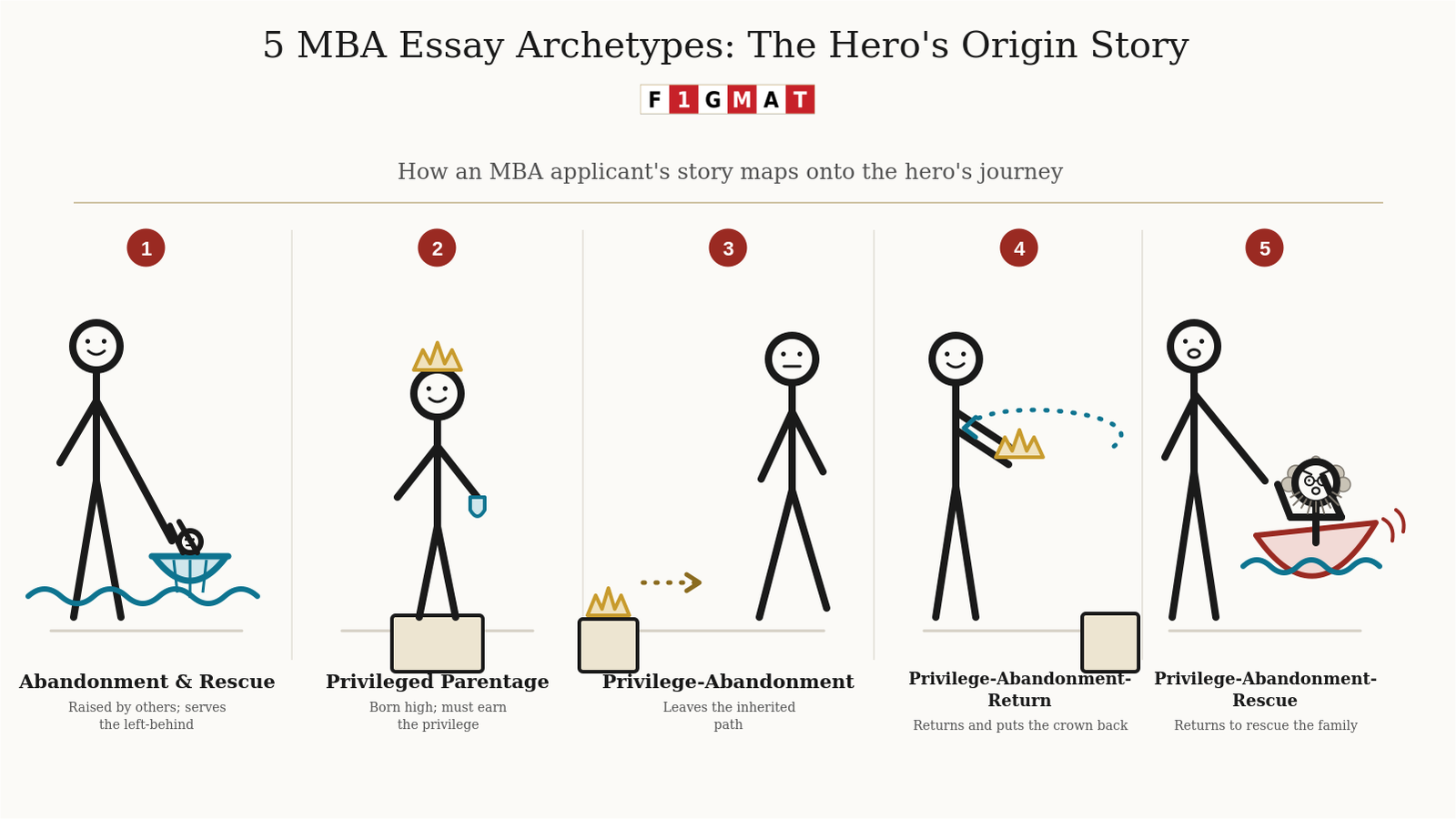
Regardless of where you have built up the templates for the 'Hero's Origin Story', there are a few common attributes that you must cover when you map your story to an Archetype.
Contents
- MBA Essay Hero's Origin Archetype #1: The Abandonment-and-Rescue Archetype
- MBA Essay Hero's Origin Archetype #2: Privileged Parentage Archetype
- MBA Essay Hero's Origin Archetype #3: Privilege-Abandonment Archetype
- MBA Essay Hero's Origin Archetype #4: Privilege-Abandonment-Return Archetype
- MBA Essay Hero's Origin Archetype #5: Privilege-Abandonment-Rescue Archetype
- How to Choose the Right Hero's Origin Archetype
- Frequently Asked Questions
- References
MBA Essay Hero's Origin Archetype #1: The Abandonment-and-Rescue Archetype
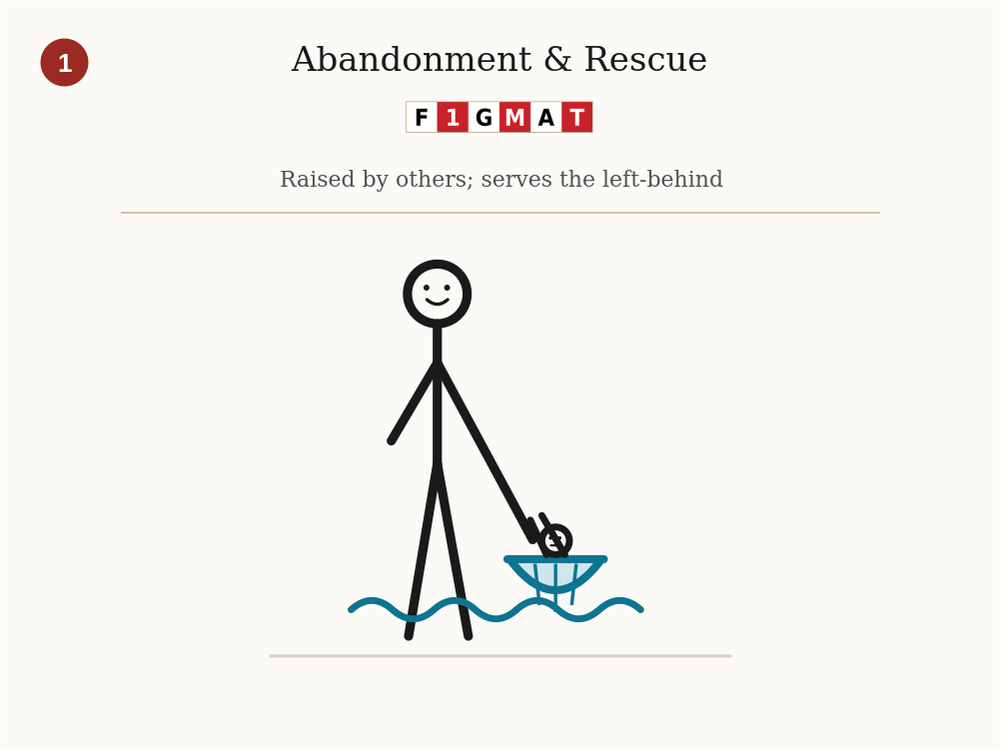
When I read essays, I closely watch this Archetype where the applicant's true sense of self was not built by the birth mother or the father, who was supposed to raise them.
The stronger influences came first in early childhood through an Uncle, Aunt, Grandparent, and later during the teenage years through a mentor, who took it upon themselves to pass on values that continue to drive the applicant's worldview.
This psychological pattern is embedded throughout mythology and continues to shape the motivations behind many of an applicant's long-term goals[4]
Sargon, Karna and Oedipus - The Thread of Abandonment
Sargon of Akkad, a historical king whose birth legend survives in Neo-Assyrian literature, faced danger at birth. His priestess mother bore him in secret and set him on the river in a reed basket sealed with tar, from which Akki the water-drawer lifted him out and raised him as an adopted son and gardener[1]
Karna, his unwed mother Kunti, having borne him to the sun god Surya, placed the infant in a basket and set him adrift on a river, where the charioteer Adhiratha and his wife Radha found him and raised him as their son[2]
Oedipus, his father Laius, warned by prophecy that his son would kill him, had the infant's feet pinned and left him exposed on Mount Cithaeron, where a shepherd took pity and passed him to the king and queen of Corinth, who raised him as their own[3].
None of these heroic figures continued in their original family.
The abandonment influenced their core values.
From Myth to MBA Essay
For MBA applicants, the rescue gave them the core value to serve those who are abandoned by society, the capital structure, or technology.
A single-parent household where grandparents raised the applicant while the mother worked multiple shifts. Now, the applicant wants to scale the after-school program that could rescue children from the bad influences in the neighborhood.
A foster family upbringing where the applicant found new opportunities. Now, the applicant wants to offer a young leaders' program to build foster children's identity through leadership.
A war that killed the applicant's parents and a new life in America or Europe that offered new opportunities. Now, the applicant wants to build a global consensus on the ills of perpetual wars and American interventionism.
MBA Essay Hero's Origin Archetype #2: Privileged Parentage Archetype
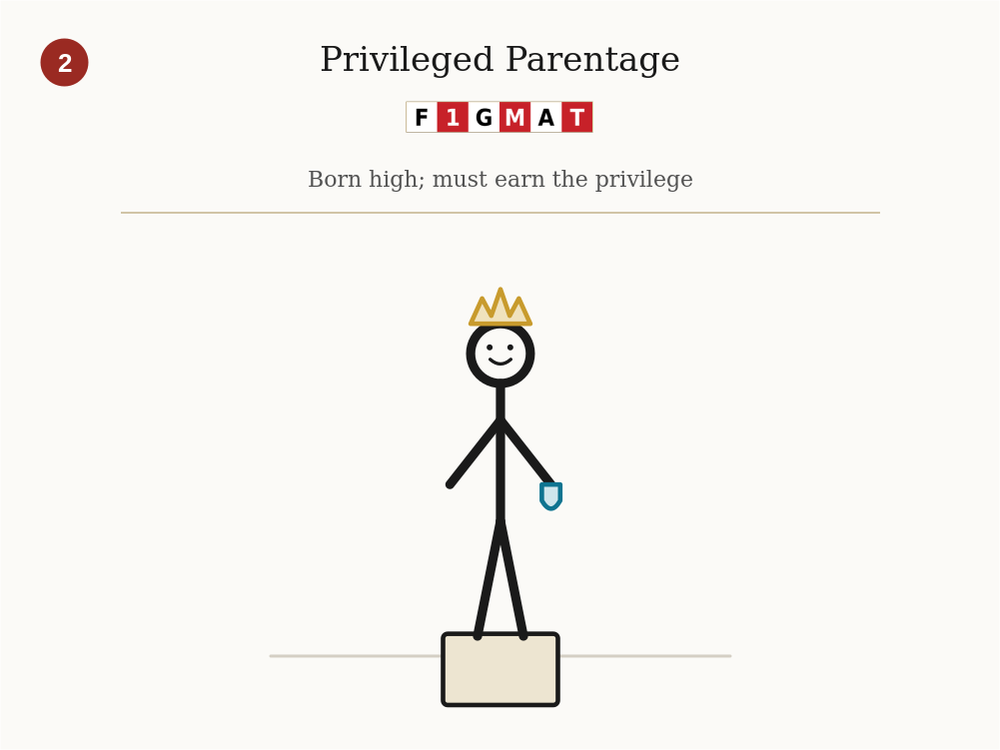
The privileged parentage, which most of you have received seem like the least influential story structure for a school essay, but they are great openers for essay structures where the applicant changes their values in the middle of the essay.
Serving the underprivileged through one's realization of privilege is a strong myth that societies across cultures have embraced.
In the chivalric tradition, emerging in 11th and 12th-century Europe, to earn and sustain knighthood, one must defend those who could not defend themselves (Widows and orphans). The knights could use force only in a just cause; they must grant mercy even to enemies and give aid to ladies and gentlewomen[5].
Why Privilege Needs Internal Conflict: Memorable MBA Essays
The struggle with incorporating the 'good' values passed on to the applicant through privileged parentage is that there is no inherent conflict.
The conflict is external.
When the conflict is within 'the family,' the admissions person will engage sooner.
All our earlier memories of conflicts are with parents, siblings, and close friends. It brings a strong 'relatedness' in your story.
When you write about a privileged upbringing with parents shown only in a good light, you are robbing the reader of the conflicts that they know too well.
Lack of 'connection' to your story is the most common way to create disengaged readers.
Disengaged readers will not complete reading your essays.
MBA Essay Hero's Origin Archetype #3: Privilege-Abandonment Archetype
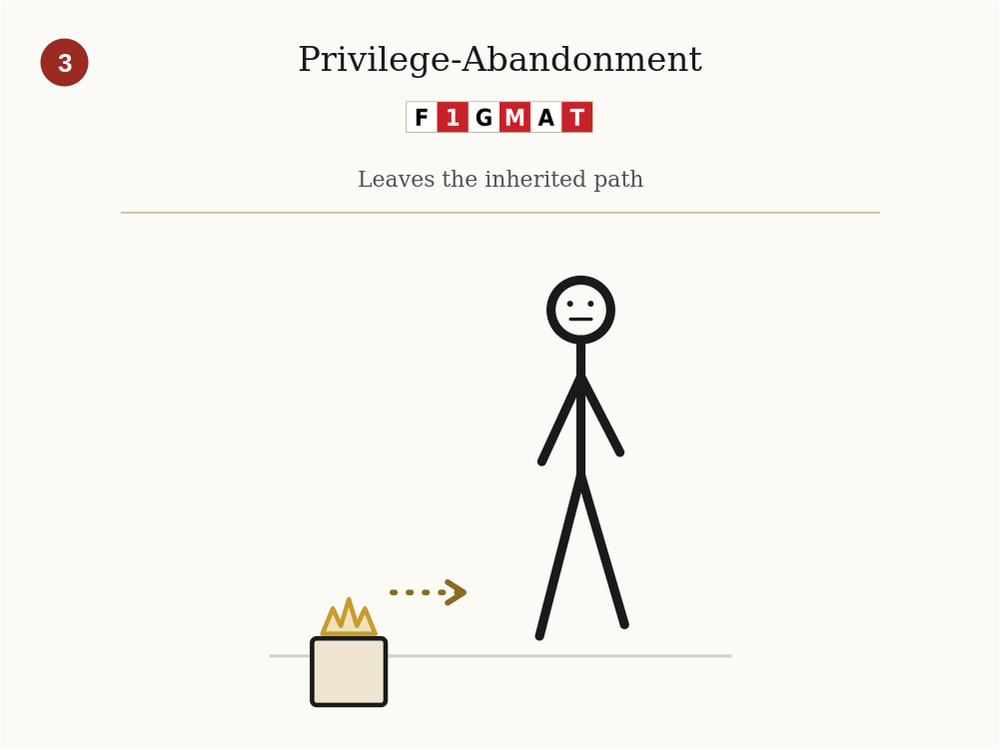
The stories that have stayed strongest in my mind are of applicants who follow the Privilege-Abandonment story archetype.
The most direct mythical structure came to our culture from the Buddha.
Siddhartha Gautama and the Great Departure
Born as Siddhartha Gautama, Buddha was a prince. His father, King Suddhodana, engineered a life so pleasant that he built separate palaces for the hot season, the cold season, and the rainy season. The prince never sat in weather he disliked. The encounter with the aged, the sick, and the outcast broke the manufactured contentment[6].
The Great Departure, when he left the palace, the throne, his wife Yasodhara, and his newborn son Rahula to seek the meaning of life, is the beginning of the enlightenment journey.
I have read applicants embracing the Privilege-Abandonment Archetype through two variations: the abandonment of career paths chosen by parents and finding one's own journey in entrepreneurship outside family business.
The abandonment of the career path chosen by parents when presented in a subtle narrative reads well over literal 'lines' that paint parents as the antagonists.
Renouncing the Family Career Path
The subtlety is evident in applicants from Military family where brothers, sisters, father, and grandparents were all in the military. The choice of 'breaking' the tradition is the variation of the 'privilege-abandonment' archetype.
The privilege came from the early orientation to a career in the military. No such orientation exists for a family where the father and mother are lost in the daily pursuit of survival. Recognizing the 'privilege' through the 'They Don't Have What I had' contrasting lines is the first paragraph that applicants must draft to avoid turning this archetype into a caricature.
The more impactful MBA essays are around 'independence' from parental support.
Independence from Parental Support: An MBA Essay Narrative True to the Privilege-Abandonment Archetype
One German applicant wrote about the struggles of working in movie production, taking care of the logistics of lighting, schedules of the actors, and building the set, while his father led a Fortune 500 company to a new milestone.
The contrast of the two lives in consecutive sentences painted the Privilege-Abandonment Archetype in just two lines.
His rise in the media business from the ground up in a country where his father had limited influence, and the applicant taking over 7 years to establish himself, validates the story.
I have also read manufactured stories of 'Privilege-Abandonment Archetype' where the 'privilege' was clearly visible in the latest role the applicant has taken on, either in the family-run foundation or with companies in the parents' inner networks.
MBA Essay Hero's Origin Archetype #4: Privilege-Abandonment-Return Archetype
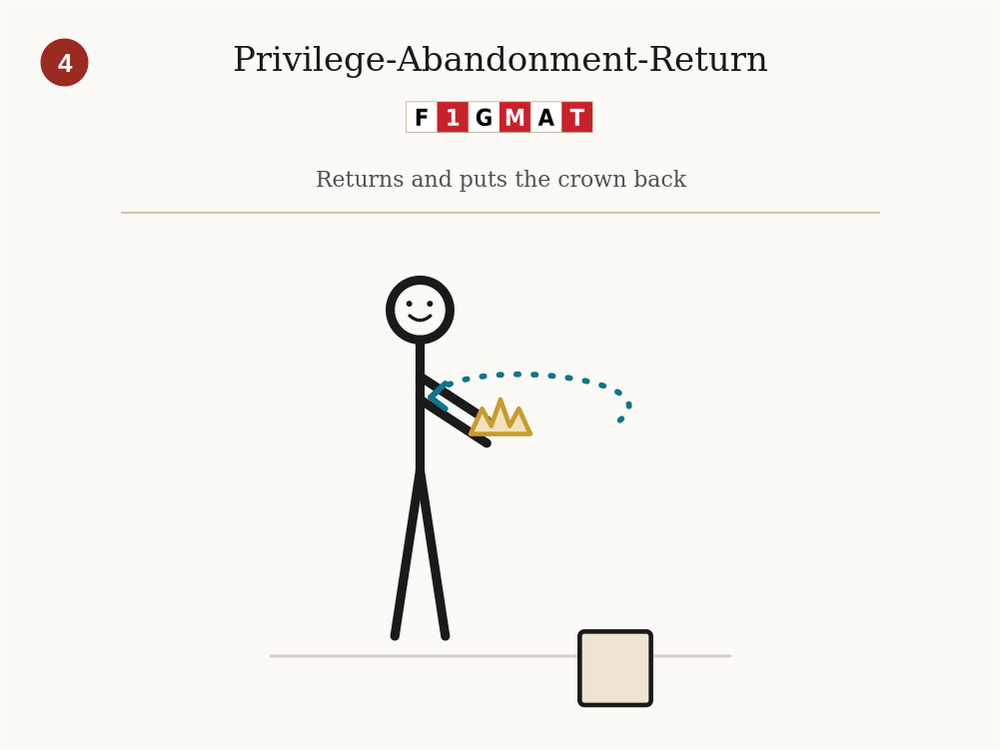
A subtle variation of the Privilege-Abandonment story is the Privilege-Abandonment-Return Archetype.
Unlike the prodigal son returns story Archetype where the son squanders his inheritance and chooses the lowest work in society (feeding pigs), and returns home expecting to be a servant, only to be restored to the father's business[7], the Privilege-Abandonment-Return Archetype in modern school essays has some 'I recognize why my parents insisted on certain values' reflection.
The conflicting values, first written in black and white terms, emerge as a much more subtle lesson and show the reader the challenges of upholding values in modern society.
Case Study: From UN Fieldwork to Market Realism
For one MBA applicant I covered for F1GMAT's essay on privilege, she believed that engineered market making is the primary reason for society's inequalities. She worked with the UN serving the displaced persons from war and famine. Only after trying to bring commerce to this war affected regions, she recognized the pressure on public funding when there are no businesses willing to serve this market. She is subtly agreeing that her capitalistic father was right. Without markets, poverty multiplies, and crime spreads.
The return to her father is through the oscillation back to the middle of the value scale (not fully free market, nor fully engineered market).
Such subtlety, if built up with the right argument and narrative, can show how you think.
MBA Essay Hero's Origin Archetype #5: Privilege-Abandonment-Rescue Archetype
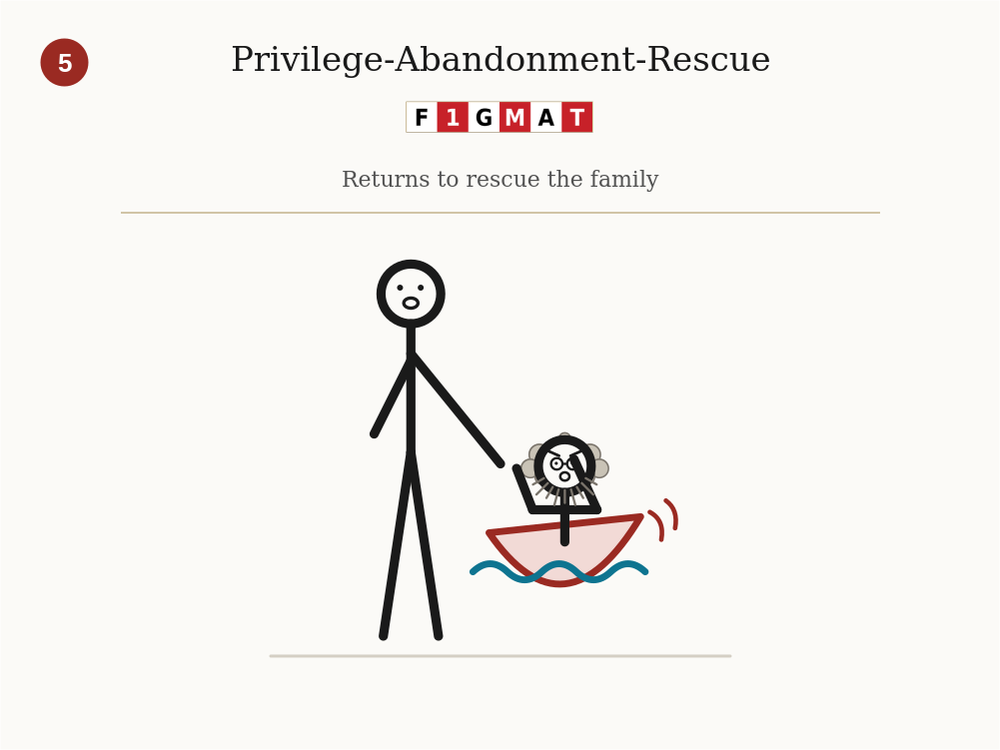
Another rare but impactful hero's journey is through the Privilege-Abandonment-Rescue Archetype, where the MBA applicant had to return to the family business or to replace a family member who was ill.
Unlike the 'Return with the Wisdom' Archetype that completes a strong essay and is often used in the' lessons learned' part of school essays, the Privilege-Abandonment-Rescue is a midway abandonment of the hero's journey.
The hero has not completed the ordeal. The ordeal is in rescuing the family from the downward spiral.
Case Study: Leaving a Startup to Save the Family Firm
One Applicant found his own entrepreneurial path through a product that improved students' reading habits and concentration through a non-screen gaming product that integrated reading with problem-solving.
In the year the applicant found scale, his father called on him to rescue the family business. Excessive borrowing and a fall in quality standards had put the family's automotive parts business under deep distress.
The return and building up the business with new ideals is the hero's journey for the essay.
For help dissecting your story into the right Hero's Origin Story Archetype, subscribe to F1GMAT's Essay Editing Service.
How to Choose the Right Hero's Origin Archetype
Match Your Story to an Archetype
Break down your story.
First breakdown your life story to plot points with main actors, supporting actors, and goals all mapped to the story.
Find which Archetype
If the people who shaped you were not the parents who were supposed to take care of you and mentor you, but an uncle, a grandparent, a teacher who arrived at the right moment, you are working in the Abandonment-and-Rescue archetype.
If you were handed an early advantage through mentorship and you lived in a stable home with no financial or social disruption, your story belongs to privilege archetypes.
If you walked away from the inherited path, your story archetype is in Privilege-Abandonment.
If you walked away, succeeded, and then came back victorious with new respect for the values you rejected, your Archetype is in Privilege-Abandonment-Return.
If you left, found your own footing, and were then called home to rescue a family in distress, your Archetype is in Privilege-Abandonment-Rescue.
Don't pick Archetype that sounds most impressive on paper
Pick the Archetype by the authenticity of the turning points. The admissions team can feel the disconnect a mile away
Common Mistakes That Flatten the Essay Narrative
The most common failure in archetypes are seen in the privileged archetype where there are no internal conflict.
The second mistake I see is when the applicant manufactures abandonment, where the hardship the applicant experienced can be easily debunked. The obvious data is the extra-curricular and volunteering and the association with parent's network, or worse participation in family foundation or business.
The third is portraying parents as antagonists.
The fourth is skipping the recognition, the moment of reflection where you show what the ordeal taught you, which is what separates a Privilege-Abandonment-Return essay from a simple account of leaving and coming back.
Across all five archetypes, the admissions person should tell the difference between a person changed by the journey and a person who merely traveled.
Frequently Asked Questions
What is an MBA essay archetype?
An MBA essay archetype is a recurring story structure that an applicant's life maps onto, drawn from the hero's origin stories found across mythology and literature. The psychiatrist Carl Jung used the term archetype for patterns the mind recognizes across cultures[9].
In an MBA essay, naming your Archetype, such as Abandonment-and-Rescue or Privilege-Abandonment, gives your narrative a shape the admissions reader already understands.
The recognition of these archetypes is cultural and not just an intellectual exercise. Using such a mapping technique saves you time in connecting with the admissions person as a writer. You can instead focus on the prose after the first iteration with archetypes.
Is the hero's journey a good structure for an MBA essay?
Joseph Campbell's hero's journey, the departure, the trial, and the return, is the backbone of most origin stories[8], and admissions person has seen this a hundred times through movies, TV series, and books.
The risk is using it as a template that flattens your specific experiences into a generic outline.
Regardless of the Archetype you use or decide not to use, you should build the story with details that only you can write.
What is the abandonment-and-rescue story?
The abandonment-and-rescue story is the pattern in which a child is separated from the birth parents and raised by others, then grows up shaped by the rescuer's values. The psychoanalyst Otto Rank cataloged it in the birth legends of Sargon, Moses, Oedipus, and Karna[4].
In an MBA essay, it appears whenever a grandparent, an aunt or uncle, a foster family, or a mentor built the applicant's worldview. The worldview was critical for the applicant to escape from inter-generational poverty, bad influences in the neighborhood, or earn the respect of the communities he served.
References
- Sargon of Akkad, birth legend. "The Legend of Sargon of Akkad," World History Encyclopedia. Scholarly translation: J.B. Pritchard, Ancient Near Eastern Texts Relating to the Old Testament (ANET), p. 119. The surviving text is preserved in first-millennium-BCE (Neo-Assyrian and Neo-Babylonian) copies. ↩
- Karna, birth and setting adrift. Vyasa, Mahabharata, Adi Parva, trans. Kisari Mohan Ganguli ↩
- Oedipus, exposure on Mount Cithaeron. Apollodorus, Library 3.5.7, Perseus Digital Library. ↩
- The abandonment-and-rescue birth pattern. Otto Rank, The Myth of the Birth of the Hero (1909; English translation 1914), ↩ ↩
- Chivalric duty to the weak: Maurice Keen, Chivalry (Yale University Press, 1984) ↩
- The Buddha's sheltered youth and Great Departure. Ashvaghosha, Buddhacarita, trans. E.B. Cowell, sacred-texts; The seasonal-palace detail is in the Sukhumala Sutta (AN 3.39), Access to Insight ↩
- The Prodigal Son. Luke 15:11–32, Bible Gateway ↩
- Joseph Campbell, The Hero with a Thousand Faces (1949) ↩
- Carl Jung, The Archetypes and the Collective Unconscious (1959) ↩