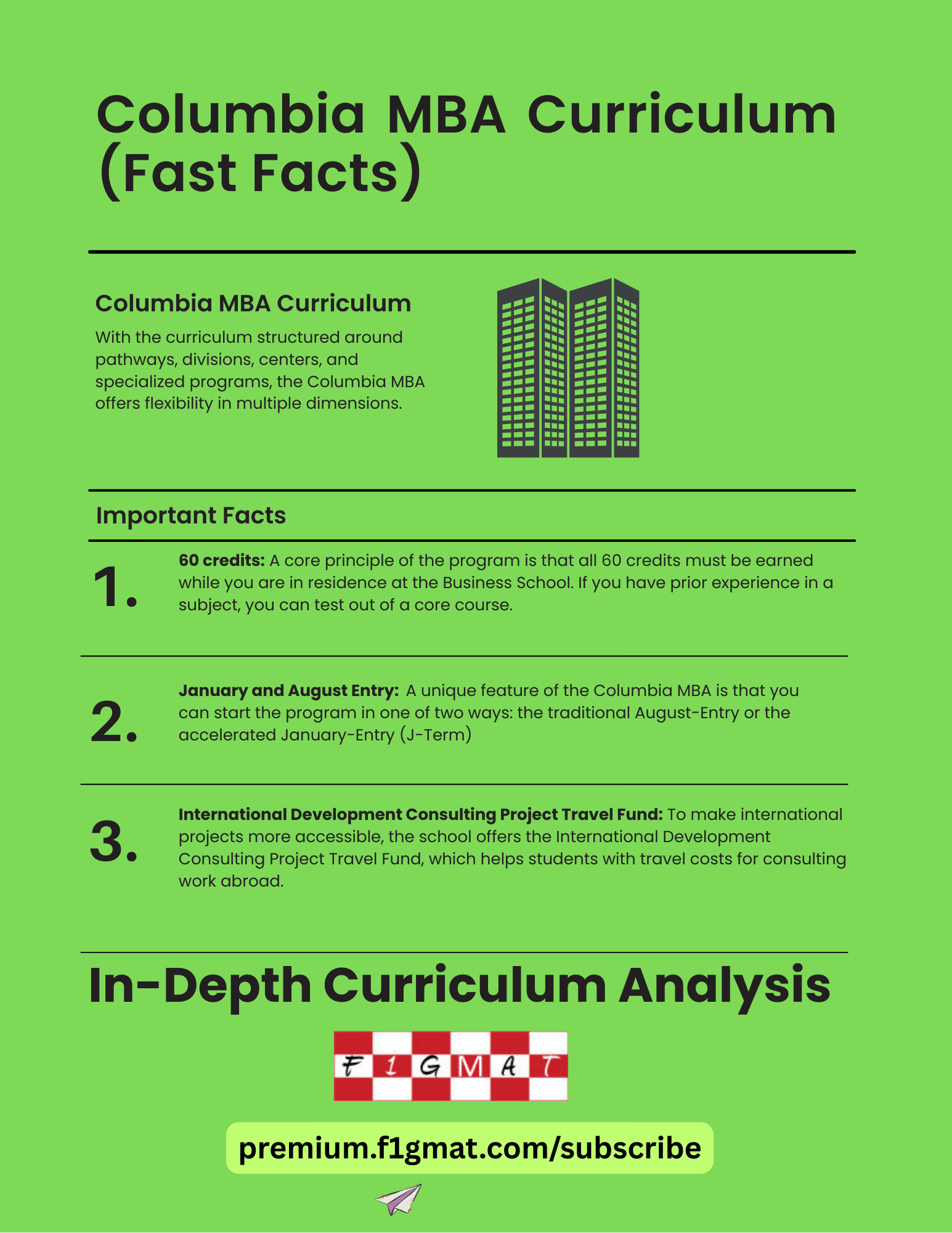
 The Columbia MBA is a two-year, full-time program that requires completing 60 graduate-level credits, broken down into 18 credits of required core coursework and a minimum of 42 credits of electives.
We at F1GMAT have analyzed the curriculum of the Columbia Full-time MBA program.
In this analysis, we cover:
- 60 Credit Rule
- Two Paths: August and January Entry
- Cores and Electives
- Pathways, Academics, Centres, and Programs
- Academic Divisions, Centers, and Programs
- Experiential Learning
- Global Learning Opportunities
- Dual Degree Programs
60 Credit Rule
A core principle of the program is that all 60 credits must be earned while you are in residence at the Business School. If you have prior experience in a subject, you can test out of a core course. However, you will still need to take an elective to replace those credits and meet the total requirement.
Two Paths: August and January Entry
A unique feature of the Columbia MBA is that you can start the program in one of two ways: the traditional August-Entry or the accelerated January-Entry (J-Term). Both paths lead to the same degree, are taught by the same faculty, and offer the same resources, but they follow different timelines.
• The August-Entry: The Traditional 20-Month Journey This is the standard path for most students. The program begins in late August with a mandatory orientation period. You will be placed in a "cluster" of around 65 peers, and this group will take all of your core classes together. The first year is focused on building foundational knowledge through the core curriculum, while the summer is typically reserved for an internship. This path is ideal if you're looking to switch careers or gain experience in a new industry before your second year.
• The January-Entry: A Focused 16-Month Path The J-Term is a faster option, designed for students who do not need a summer internship. It's a popular choice for entrepreneurs, sponsored students, or those who plan to stay in their pre-MBA industry. J-Term students begin in January and complete their core curriculum over the spring and summer. They don't have a summer internship break. By the fall of their second year, they merge with the August-Entry class, and from that point, their academic experience is identical.
Columbia MBA Curriculum: Cores and Electives
The curriculum is built on two main pillars: a core curriculum that provides a shared foundation and a wide array of electives that allow for deep specialization.
The Core Curriculum
Every student starts with the core curriculum, a set of two full-term and eight half-term courses that cover fundamental business disciplines.
For Columbia deferred MBA applicants, the core curriculum should be primary focus while quoting in essays as electives change frequently.
For electives, phrase around themes instead of the specifics.
Columbia Business School Deferred Enrollment Program Essay Tips
For experienced applicants, finding believable reasons to mention a particular core, as a means to going back to the basics must be precisely phrased.
Exemption Exam
Students can test out of certain core courses through an exemption exam. If you pass, you can replace that core class with an elective, allowing you to move directly into more advanced or specialized subjects from your first year.
Electives: 300 and Counting
After completing the core, you can choose from over 300 electives across seven areas: Accounting, Decision, Risk and Operations, Economics, Entrepreneurship, Finance, Management, and Marketing. This extensive catalog allows you to design a personalized academic experience that aligns with your specific career goals.
• Marketing: This area includes classes on digital strategy, branding, and product management, such as Growth Hacking and the Digital Product Management Lab.
• Decision, Risk, and Operations: Electives here focus on data and technology, from foundational courses like Python for MBAs to advanced topics like Generative AI for Business.
• Economics: You'll find a blend of traditional economic theory and modern challenges, with courses covering topics like global macroeconomic investing and Climate Policy.
• Management: This area offers a mix of leadership development, organizational strategy, and entrepreneurship. Electives range from Managerial Negotiations to Launch Your Startup and Entrepreneurship Through Acquisition.
• Finance: This is one of the most extensive areas, with courses on private equity, venture capital, real estate, and sustainable finance. Standout electives include Value Investing with Legends and the Private Equity Field Study.
 Download F1GMAT's Columbia MBA Essay Guide
Short Answer Question 1: What is your immediate post-MBA professional goal? (50 characters maximum)
Short Answer Question 2: How do you plan to spend the summer after the first year of the MBA? If in an internship, please include target industry(ies) and/or function(s). If you plan to work on your own venture, please indicate a focus of business. (50 characters maximum)
Essay 1: Through your resume and recommendation, we have a clear sense of your professional path to date. What are your career goals over the next three to five years and what is your long-term dream job? (500 words)
Essay 2: Please share a specific example of how you made a team more collaborative, more inclusive or fostered a greater sense of community within an organization. (250 words)
Essay 3: We believe Columbia Business School is a special place with a collaborative learning environment in which students feel a sense of belonging, agency, and partnership--academically, culturally, and professionally.
How would you co-create your optimal MBA experience at CBS? Please be specific. (250 words)
Related Download: F1GMAT's Columbia MBA Essay Guide
Cores | Area of Electives |
| Financial Accounting | Marketing |
| Lead: People, Teams, Organizations | Management |
| Foundations of Valuation | Accounting |
| Managerial Statistics | Business |
| Strategy Formulation | Decision, Risk and Operations |
| Managerial Economics | Finance |
| Corporate Finance | Economics |
| Business Analytics | |
| Marketing | |
| Global Economic Environment | |
| Operations Management |
Pathways, Academics, Centres, and Programs
Beyond the core and electives, the school is organized around specific academic divisions, centers, and formal programs that offer distinct areas of expertise.
Pathways: Curated Roadmaps for Expertise
Pathways are like curated roadmaps, not rigid requirements. They don’t appear on your final transcript, giving you the freedom to explore while still providing a clear structure.
There are 17 pathways in total.
For example, you can find a pathway for Venture Capital or Private Equity that guides you through the finance electives needed for a career in PE or VC. There are also pathways for Climate and Data Analytics and AI that show you how to build skills in sustainability or generative AI. Such a balance in the curriculum gives students the option to choose a traditional and a cutting-edge course as part of the curriculum.
 Essay Editing - Consult with Atul Jose (Essay Specialist, F1GMAT)
The skills that a writer/editor brings to the table are different from what a former admissions officer or a consultant who has limited writing skills brings
Review Skills # Writing Skills
Movie Critics # Movie Directors
For any questions about the service, email me, Atul Jose, at [email protected]
As F1GMAT’s Lead Consultant and Essay Specialist, I will help you structure the essay by:
1) Incorporating your Personal Brand
I will help you find unique life experiences that would differentiate you from the highly competitive Columbia MBA application pool.
2) Including Storytelling elements
I have developed a keen sense of storytelling from over a decade and a half of editing essays and writing essay examples for F1GMAT’s Essay Guides.
The skills that a writer/editor brings to the table are different from what a former admissions officer or a consultant who has limited writing skills brings
Review Skills # Writing Skills
Movie Critics # Movie Directors
It is easy to comment, but it is tough to structure the essay from the perspective of the applicant and turn the essay into a winning application essay.
3) Aligning with the Culture of the School
A big part of editing and guiding applicants is in educating them about the culture of the school
Some schools have very ‘specific’ traits that they are looking for in an applicant.
If you don’t highlight them and lean towards general leadership or cultural narratives, the essay won’t work.
I will guide you through the writing process.
I will also iteratively edit the essays without losing your original voice.
Academic Divisions, Centers, and Programs
The Academic Divisions are the traditional departments of the school, such as Finance, Marketing, and Management, which offer the bulk of the core and elective courses.
The Centers are where research meets practice, acting as hubs for collaboration, like the Tamer Institute for Social Enterprise and Climate Change or the Heilbrunn Center for Value Investing.
Finally, Programs provide focused opportunities to specialize in a particular field, like the Private Equity Program or the Healthcare and Pharmaceutical Management Program.
• Academic Divisions: These are the foundational departments that oversee the curriculum, including Accounting, Economics, and Decision, Risk, and Operations.
• Centers: These centers provide a home for students with specific interests and often host events and research initiatives. Key examples include the Eugene Lang Entrepreneurship Center, the Paul Milstein Center for Real Estate, and the Bernstein Center for Leadership and Ethics.
• Programs: These formal programs offer a structured, deep dive into a specific industry. For example, the Media and Technology Program and the Healthcare and Pharmaceutical Management Program offer tailored curricula and professional development for students interested in these fields.
Pathways | Pathways | Academic Divisions | Centers | Programs |
| Asset and Wealth Management | Healthcare | Accounting | Entrepreneurship | Global Family Enterprise |
| Climate | Innovation | Decision, Risk, and Operations | Leadership and Ethics | Healthcare and Pharmaceutical Management |
| Customer Insights | Leadership | Economics | Real Estate | Media and Technology |
| Data Analytics and AI | Media | Finance | Social Enterprise and Climate Change | Private Equity |
| Economic Analysis | Private Equity | Management | Value Investing | |
| Entrepreneurship | Product Management | Marketing | ||
| Family Enterprise | Real Estate | |||
| Fundamental Analysis | Strategy | |||
| Venture Capital |
Experiential Learning at Columbia MBA
At Columbia Business School, experiential learning is a key component of the MBA experience, pushing students to sharpen skills in consulting, social impact, and leadership by working directly with businesses, non-profits, and startups.
Pangea Advisors
Through programs like Pangea Advisors, students can engage in pro-bono international consulting projects, helping social enterprises in developing countries overcome resource and technology constraints.
Nonprofit Board Leadership Program
For those interested in governance and social impact, the year-long Nonprofit Board Leadership Program pairs students with nonprofit boards, offering hands-on strategic consulting and a rare look at how boards operate.
International Development Consulting Project Travel Fund
To make international projects more accessible, the school offers the International Development Consulting Project Travel Fund, which helps students with travel costs for consulting work abroad.
Opportunity | Relevant Sectors | Short Description |
| Pangea Advisors | Social Enterprise, Consulting, International Development | Students work on pro-bono consulting projects for social enterprises in developing countries, gaining experience in a wide range of global business challenges. |
| Nonprofit Board Leadership Program | Social Impact, Nonprofit Management, Leadership | A year-long program that pairs MBA students with nonprofit organizations, providing hands-on experience in both strategic consulting and board governance. |
| International Development Consulting Project Travel Fund | International Business, Consulting | A fund that helps offset the travel costs for student teams working on consulting assignments for NGOs, nonprofits, or public-sector organizations overseas. |
Global Learning Opportunities at Columbia MBA
The global economy is at the heart of the Columbia MBA. The school’s curriculum offers numerous opportunities to gain a global perspective.
The Chazen Institute for Global Business is the hub for these programs, which blend classroom learning with on-the-ground exposure.
For a full academic immersion, the Chazen MBA Exchange Program lets you spend a full semester at one of nearly two dozen partner business schools around the world, from HEC Paris to the University of Cape Town.
For shorter, more focused trips, Chazen Global Study Tours are student-led excursions that provide access to executives and businesses in a host country. The Global Immersion Programs combine a half-term of on-campus preparation with a week of in-country travel, allowing you to study a topic like "Innovation in India" or "Tech in Africa".
Opportunity | Relevant Sectors/Locations | Short Description |
| Chazen Global Immersion Programs | Varies by Topic (e.g., Tech, VC, Climate, Entrepreneurship) | A short-term, intensive elective that combines a half-term of on-campus preparation with a week-long, in-country travel experience to a global business hub. |
| Chazen MBA Exchange Program | Varies by Region (Europe, Asia, Africa, Australia, etc.) | Spend a full semester at one of nearly two dozen partner business schools around the world, fully immersing yourself in a new academic and cultural setting. |
| Chazen Global Study Tours | Varies by Topic (e.g., Luxury, Real Estate, Finance) | Student-organized, short-term trips that provide access to executives, policymakers, and businesses in a host country. |
Dual Degree Program offered with Columbia Full-time MBA
Columbia’s dual degree programs give MBA students the chance to combine business training with expertise in law, public health, medicine, engineering, and journalism.
Spanning ten formal options, these programs shorten the time it would normally take to earn two separate degrees while still tackling admission to both schools.
Each track has its own structure, some alternating semesters, others condensing business terms into intensive blocks, but all follow a shared model where tuition, aid, and requirements align with the school of registration.
Columbia Dual Degree | Degrees Conferred |
| Architecture | MBA and MS in Urban Planning |
| Dental and Oral Surgery | DDS and MBA |
| Engineering and Applied Science | MBA and Executive MS |
| International and Public Affairs | MBA and MIA |
| Journalism | MBA and MS |
| Law | JD and MBA |
| Physicians and Surgeon | MD and MBA |
| Public Health | MBA and MPH |
| Social Work | MBA and MS in Social Work |
| Teachers College | MBA and MA in Private School Leadership |
Reference