Updated for Applicants entering the Class of 2029 | F1GMAT Admissions Consulting
The Stanford MBA is a 24-month program at Stanford Graduate School of Business in Palo Alto, California, with a summer between the two years for an internship or a venture project.
With the smallest class size for an M7 MBA, Stanford accepts only 6% of applicants. The updated profile covers class profile, cost, curriculum structure and placement outcomes.
Stanford MBA Class Profile
Main Article: Stanford MBA Class Profile: Class of 2027
From 7,259 applications, the Stanford MBA Class of 2027 enrolled 434 students. Stanford keeps the class small on purpose, and the small cohort explains most of the difference between Stanford and its peers on every selectivity measure.
The average GMAT (10th Edition) held at 738, the second-highest figure in the top 15 after Yale at 740 and eight points above Harvard. The GMAT Focus average of 689 is the highest in the group.
Stanford and Harvard are the only two schools in the top 15 that report the same GRE average in both sections, at 164 Quant and 164 Verbal. The undergraduate GPA held at 3.76.
The average work experience rose to 5.3 years, the highest among the top 15 MBA programs. With the job market uncertainity, more candidates waited an extra year before applying, which matched a hiring market where promotions and pay reviews slipped through 2023 and 2024.
Stanford MBA Women and International Representation
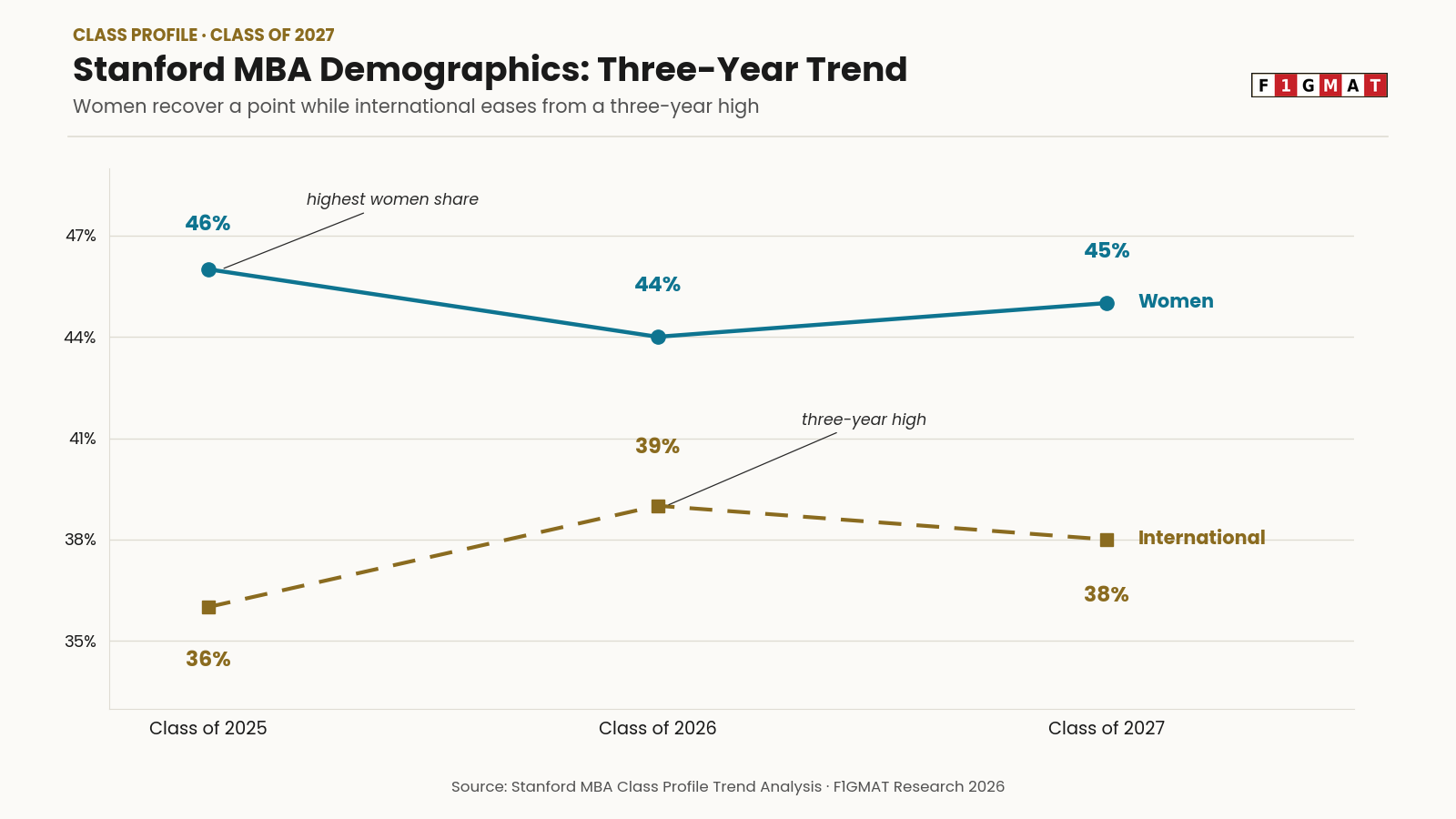
Women made up 45% of the Class of 2027, level with NYU Stern and behind MIT Sloan at 47% and UCLA Anderson at 46%.
International students made up 38%, one point below the previous class. The one-point move is within the year-to-year variation for a class of 434 students, and Stanford held its international share while Wharton lost five points and UCLA Anderson lost six.
Stanford MBA Professional Experience
Consulting was the largest pre-MBA industry at 20%.
Investment management, private equity, and venture capital together accounted for 17%, the highest buy-side intake in the top 15.
Technology held at 15%, and government, education, and non-profit accounted for 9%.
Consumer products and services and healthcare each accounted for 7%.
The 9% public-sector intake is the number applicants should study.
Stanford placed 1% of its class into non-profit and government roles on the way out.
Candidates from government, education, and non-profit backgrounds enter Stanford in numbers, and almost all of them exit into another industry.
Stanford MBA Undergraduate Degrees
Business and economics majors accounted for 42% of the class, STEM majors 41%, and humanities and social science majors 17%.
The 41% STEM share puts Stanford level with Kellogg and behind MIT Sloan at 47% and Harvard at 43%.
The 17% humanities share is low for a school that places graduates into general management, marketing, and business development. Those roles at Stanford are in AI products and platform companies, and a technical foundation matters in them even when the job title says sales or operations.
The business and economics intake at Stanford does not convert into a finance and consulting placement profile the way it does at Booth. The same foundation supports operator and go-to-market roles at Stanford.
| Class of 2027 metric | Stanford | Harvard | Wharton |
|---|---|---|---|
| GMAT (10th Edition) | 738 (Focus 689) | 730 (Focus 685) | 735 (Focus 676) |
| GRE (Quant / Verbal) | 164 / 164 | 164 / 164 | 163 / 162 |
| International | 38% | 37% | 26% |
| Women | 45% | 44% | 44% |
| STEM majors | 41% | 43% | 32% |
| Business / Economics | 42% | 41% | 32% |
| Humanities / Social Sciences | 17% | 16% | 36% |
Stanford MBA Cost
Main Article: Stanford MBA: Cost and Funding Tips
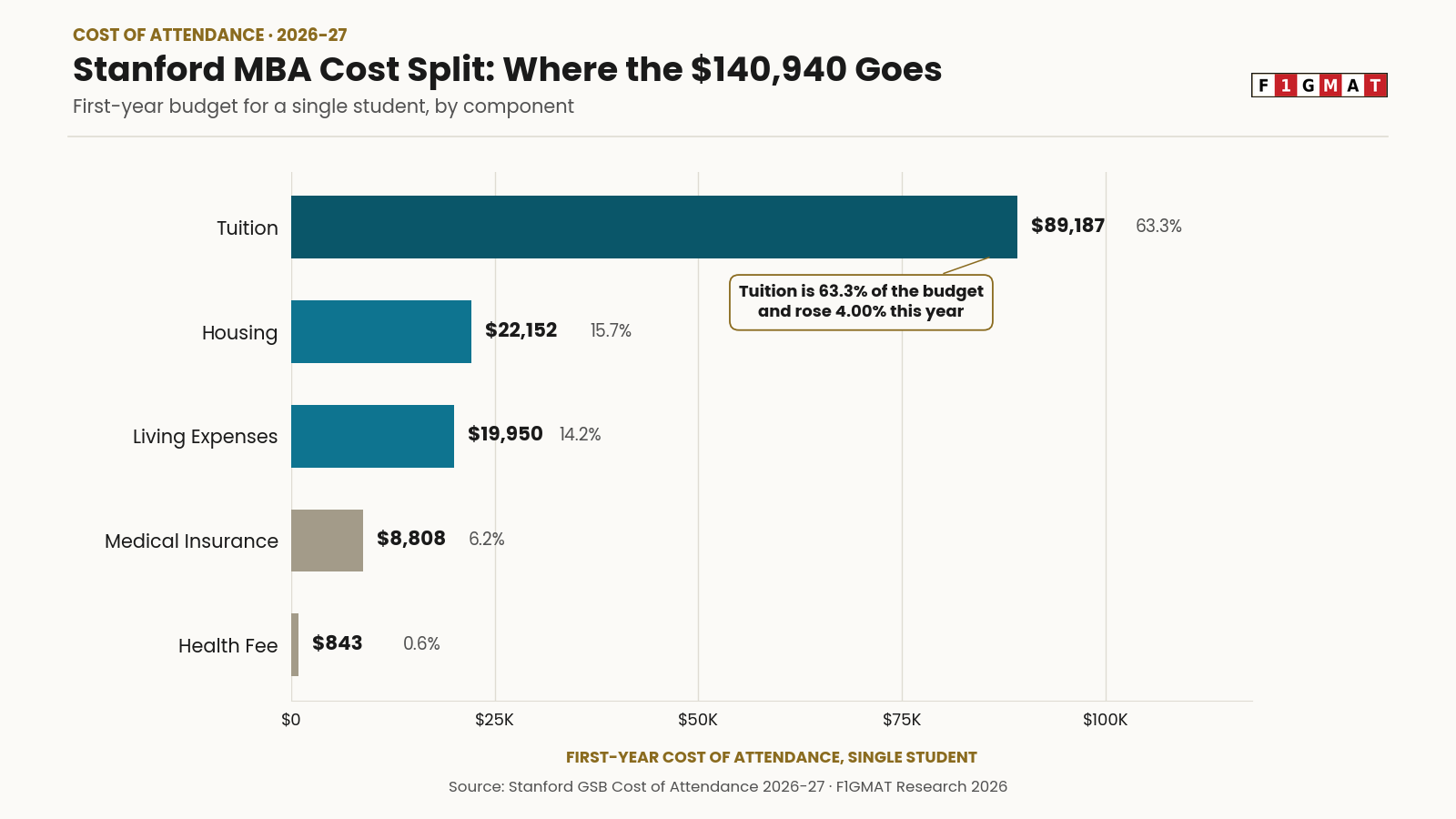
For the 2026-27 academic year, Stanford MBA tuition increased 4.00% to $89,187 for single and married students. Stanford is among the costliest MBA programs in the world on a two-year basis.
The first-year cost of attendance for a single student comes to $140,940. That figure includes tuition ($89,187), living expenses ($19,950), housing ($22,152), medical insurance ($8,808), and the campus health fee ($843). For a married student, living expenses rise to $36,972 and housing to $33,015, which takes the first-year total to $168,825.
The total rose $5,169 for a single student and $5,898 for a married student against 2025-26. Tuition accounts for $3,432 of the single-student increase. Medical insurance recorded the sharpest percentage move, up 7.00% from $8,232 to $8,808. Housing rose 3.00% and living expenses 2.50%.
Stanford does not publish a second-year budget for an incoming class. Doubling the first year gives $281,880 for a single student and $337,650 for a married student. The global experience requirement adds $4,000 to $6,000 and is not part of the standard budget, so a single student should plan on $286,000 to $288,000 across two years before any second-year increase.
Tuition has risen every year since 2022-23, from $76,950 to $89,187. That is an increase of $12,237, or 15.9%, over four years.
One rule catches married applicants.
For a married U.S. citizen or permanent resident, the cost of attendance on the award letter and the loan eligibility are calculated on the single-student budget. Fellowship eligibility is calculated on the married-student budget.
Two cost adjustments are worth knowing before an applicant builds a budget.
Global Study Trips and the Stanford Tsinghua Exchange Program can be added to the cost of attendance, which makes them eligible for fellowship and loan funding. The Global Management Immersion Experience and self-directed global experiences cannot be added.
Stanford also allows two round-trip flights home each academic year.
| Cost (2026-27) | Single student | Married student |
|---|---|---|
| Tuition | $89,187 | $89,187 |
| Living expenses | $19,950 | $36,972 |
| Housing | $22,152 | $33,015 |
| Medical insurance | $8,808 | $8,808 |
| Health fee | $843 | $843 |
| First-year total | $140,940 | $168,825 |
| Two-year estimate (first year doubled) | $281,880 | $337,650 |
Source: Stanford GSB Cost of Attendance, First-Year MBA 2026-27. The global experience requirement of $4,000 to $6,000 is not included.
| Cost line (single) | 2025-26 | 2026-27 | Change | % change |
|---|---|---|---|---|
| Tuition | $85,755 | $89,187 | +$3,432 | 4.00% |
| Living expenses | $19,464 | $19,950 | +$486 | 2.50% |
| Housing | $21,507 | $22,152 | +$645 | 3.00% |
| Medical insurance | $8,232 | $8,808 | +$576 | 7.00% |
| Health fee | $813 | $843 | +$30 | 3.69% |
| Total | $135,771 | $140,940 | +$5,169 | 3.81% |
Stanford MBA Funding
Main Article: Stanford MBA: Scholarships, Fellowships and Loan
Stanford GSB awards need-based fellowships that do not require repayment, and MBA admission is need-blind.
The average fellowship for the Class of 2026 was about $50,000 a year, or $100,000 across the two years.
A combination of fellowships and loans covers the gap between the expected student contribution and the cost of attendance.
See how to fund an M7 MBA for the full funding sequence.
The BOLD Fellows fund supports candidates from low-income families and from families facing socioeconomic disadvantage, at about $15,000 a year, or $30,000 over the two-year program.
The Knight-Hennessy Scholars program selects 100 students across Stanford University each year and funds up to three years of graduate study.
Military veterans are covered through the Yellow Ribbon Program.
Recipients of need-based fellowships may receive additional grant funding of up to 40% of approved expenses for one qualifying global experience trip.
Stanford lists 24 external scholarships for U.S. citizens and permanent residents and 54 external scholarships for international candidates. An external award below $40,000 does not reduce the Stanford fellowship. An award above $40,000 does reduce it.
Summer Stipends – Entrepreneurial and Social IMPACT
The Entrepreneurial Summer Program supports internships at companies with 5 to 50 full-time employees, and about 10% of the class takes part.
The Social Management Immersion Fund pays students working with NGOs, government bodies, and social ventures at a level near the private-sector median summer salary.
The Stanford Impact Founder Fellowship awards a $110,000 grant for founders with high-impact ventures. In addition to for finalist receiving a $20,000 prize, the GSB entrepreneurial eco-system supports graduates with advisory service.
For applicants working in non-profits and earnign less than $95,000, the Social Impact Loan Forgiveness Program forgives GSB loan repayments in full, with prorated support above that income.
Stanford MBA Curriculum
Main Article: Stanford MBA - Curriculum Analysis
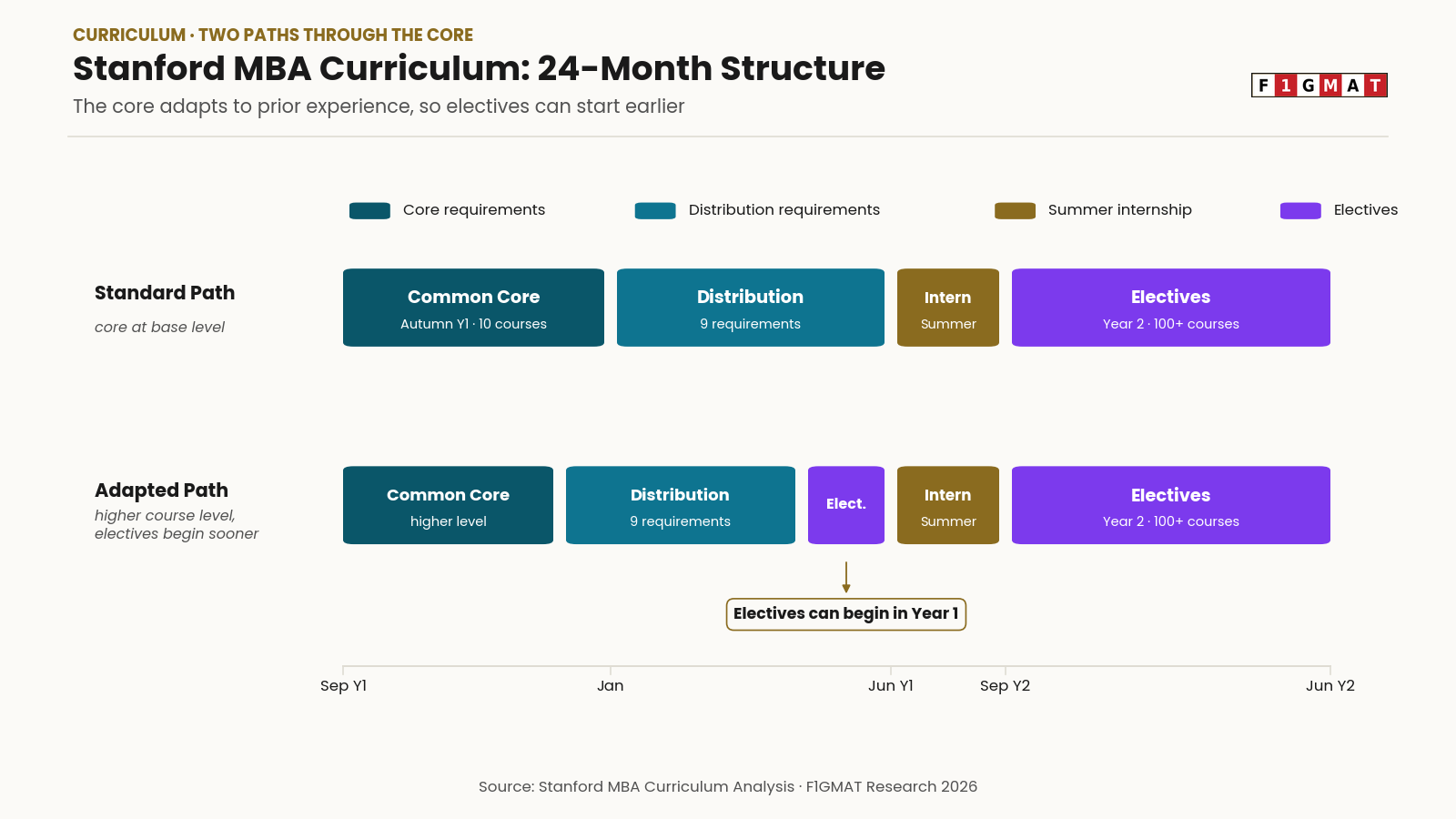
The Stanford MBA runs 24 months.
The first year covers core requirements and distribution requirements, with room for one or two electives.
The second year is almost entirely elective.
What separates Stanford from its peers is that the core adapts to the student.
A candidate with a finance background takes a higher level of the same core course and starts electives earlier, which matters for anyone recruiting into private equity, venture capital, or product management.
Stanford MBA First-Year Core
The autumn quarter is common to everyone.
Data & Decisions covers analysis for decision-making, and Global Management Foundations covers cross-border leadership and cultural dynamics.
Leading with Values handles ethical judgment through practical dilemmas.
Finance I and Financial Accounting cover valuation and financial analysis.
The Leadership Laboratory and Managing Groups and Teams put students in front of live team dynamics.
Distribution requirements follow the core and cover Finance II, Human Resource Management, Information Management, Macroeconomics, Managerial Accounting, Marketing, Operations, Strategy, and Strategy Beyond Markets.
Finance II is where investment-bound students choose between corporate finance and global markets.
Stanford MBA Second-Year Electives
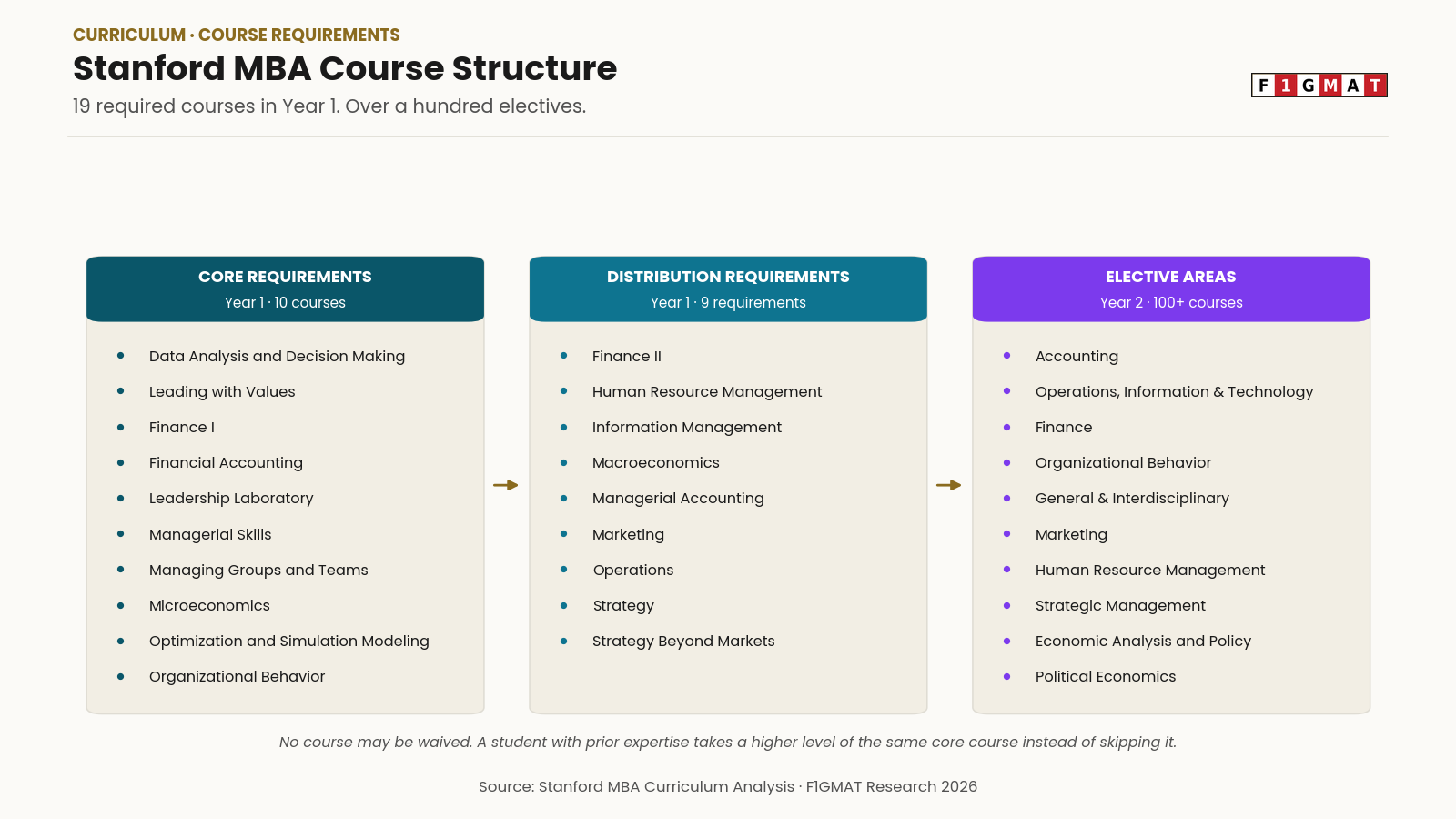
The second year offers more than a hundred electives across accounting, finance, marketing, operations, organizational behavior, strategic management, entrepreneurship, political economics, and economic analysis.
The finance curriculum is ownership-oriented.
Private Equity: An Overview of the Industry, Economics of the Private Equity Industry, Entrepreneurial Acquisition, and Investment Management and Entrepreneurial Finance teach capital deployment and long-term value creation instead of transaction execution alone. That design matches where Stanford graduates are hired.
The technology and product curriculum includes Understanding AI Technology for Business Problems, Strategies of Effective Product Management, Product/Market Fit, Competitive Strategy for Technology Markets, and The AI-powered Org.
These courses feed the operating roles at platform and foundation-model companies that hired the Class of 2025.
Stanford MBA Global and Experiential Learning
The Global Management Immersion Experience is a four-week summer project abroad. Global Study Trips are 10-day trips built around a business problem in one country.
The Stanford-Tsinghua Exchange Program pairs GSB students with Tsinghua University in China for joint projects.
Stanford MBA Entrepreneurship and Social Innovation
Stanford offers more than 50 courses covering venture creation, industry-specific innovation, social impact, and business growth.
The Center for Entrepreneurial Studies supports research and community connections, and the Stanford Venture Studio gives students space to test startup ideas.
The Center for Social Innovation runs programs and fellowships for students entering impact careers.
Stanford MBA Dual and Joint Degrees
About 20% of GSB students take a joint or dual degree. They combine the MBA program with law, education, public policy, engineering, or medicine, either within Stanford or with partner institutions including Harvard and Yale.
Stanford MBA Industry Clubs
Student-led clubs map to the main recruiting paths.
Finance candidates use the Finance Club, the Investment Management Club, and the FinTech Club.
Buy-side candidates use the Private Equity Club, the Venture Capital Club, and the Search Fund Club.
Consulting candidates use the Management Consulting Club and the General Management Club.
Technology candidates use the Tech Club and the Product Management Club.
Founders use the Entrepreneur Club, the Startup Garage Alumni Club, and the Social Entrepreneurs Club.
Stanford MBA Salary and Placements
Stanford MBA Salary By Industry
Main Article: Stanford MBA Salary: By Industry (2025)
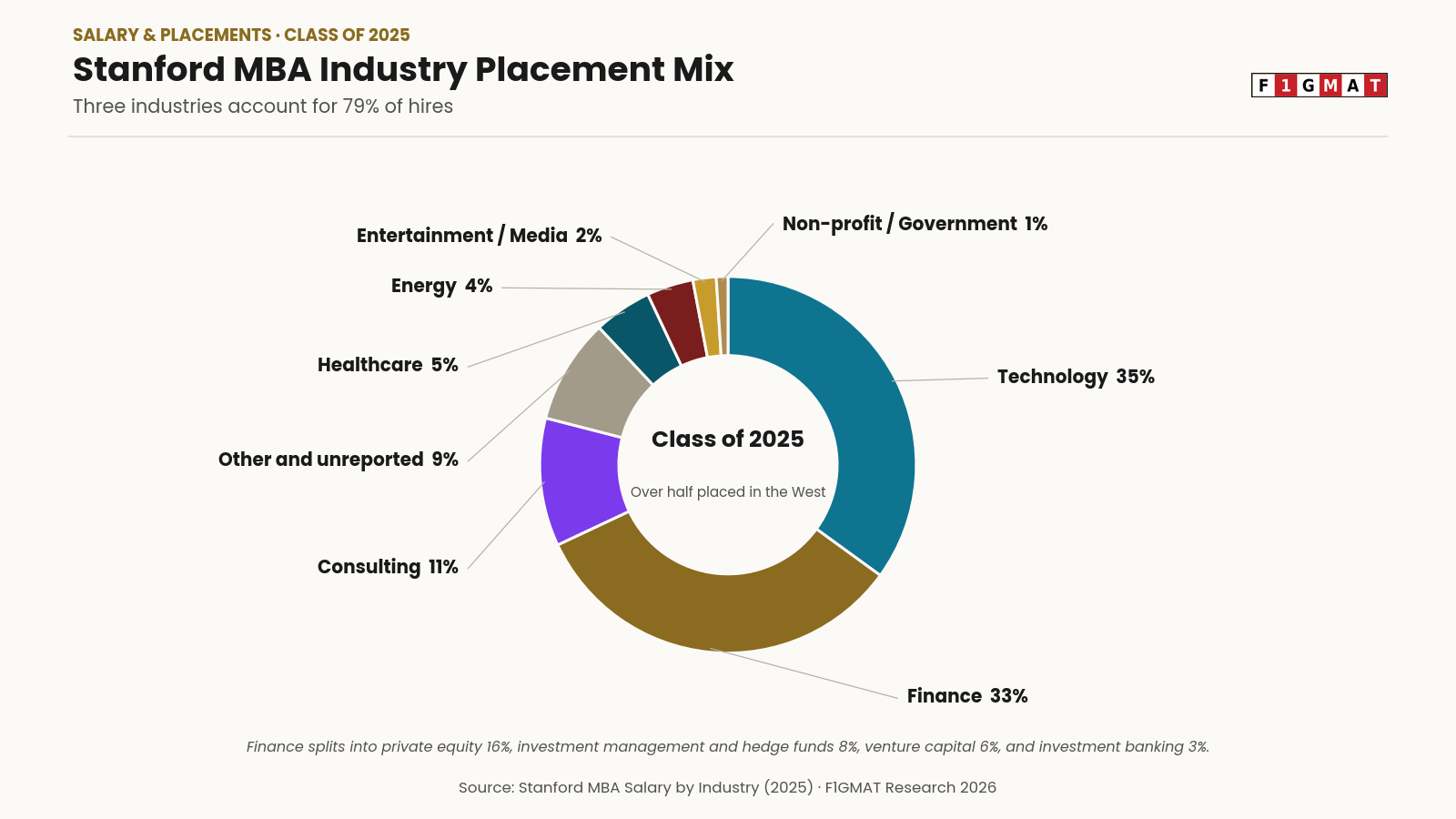
Technology absorbed 35% of Stanford MBA hires in the Class of 2025, with a median base salary of $185,000, a $25,000 signing bonus, and $210,000 in total compensation. That share is a step up from the mid-to-high 20% range Stanford reported between 2021 and 2023.
The cycle between Q3 2024 and Q2 2025 was built on enterprise AI deployment and infrastructure build-out.
Cloud providers, AI platform companies, and enterprise software firms hired for go-to-market, AI product strategy, and customer integration work.
Over half of Stanford graduates are placed in the West, near the foundation-model companies and cloud platforms, and the school captured the hiring.
Finance accounted for 33% of placements, with a $200,000 median base salary and $227,500 in total compensation.
The mix inside that number moved sharply.
Investment banking fell to 3% of hires, a decline of roughly 3 to 4 percentage points against the 2021 to 2024 data. Private equity took 16% and investment management and hedge funds took 8%.
Investment management and hedge funds paid the highest compensation in the report, at a $212,500 median base salary and a $60,000 median signing bonus, for $272,500 in total compensation.
Funds hired few MBAs and paid a premium for candidates who could exercise independent judgment early.
Consulting hired 11% of the class at a $192,000 median base salary and $222,000 in total compensation. The share fell from the mid-to-high teens of the early 2020s.
Consulting demand moved toward AI implementation and data infrastructure work, and Stanford candidates who once chose consulting moved into technology strategy, internal strategy, and venture-adjacent roles.
Healthcare took 5% at a $175,000 median base salary, and energy took 4% at $166,000. Both are small shares attached to long-cycle investment themes.
| Industry | % Hired | Median base | Median sign-on | Total salary |
|---|---|---|---|---|
| Technology | 35% | $185,000 | $25,000 | $210,000 |
| Finance | 33% | $200,000 | $27,500 | $227,500 |
| Private Equity | 16% | $200,000 | $27,500 | $227,500 |
| Consulting | 11% | $192,000 | $30,000 | $222,000 |
| Investment Mgmt / Hedge Fund | 8% | $212,500 | $60,000 | $272,500 |
| Venture Capital | 6% | $212,500 | NA | NA |
| Healthcare | 5% | $175,000 | NA | NA |
| Energy | 4% | $166,000 | NA | NA |
| Investment Banking | 3% | NA | NA | NA |
| Entertainment / Media | 2% | NA | NA | NA |
| Non-profit / Government | 1% | NA | NA | NA |
Private equity and venture capital are reported inside the finance total. All figures are on an industry basis.
Stanford MBA Salary By Job Function
Main Article: Stanford MBA Salary: By Function (2025)
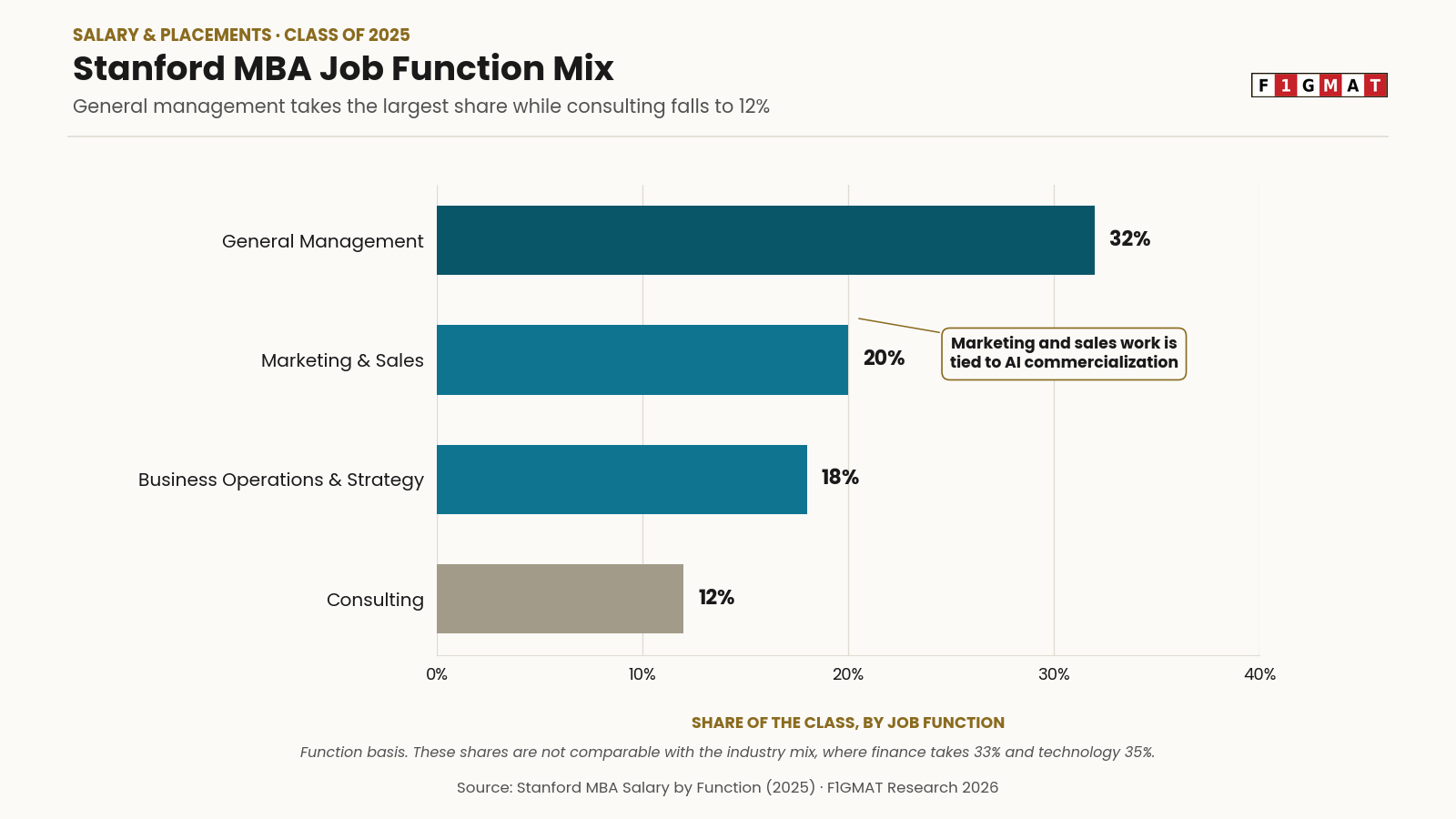
General management took the single-largest functional share of the Class of 2025 at 32%.
Marketing and sales took 20%, much of it attached to AI commercialization work.
Business operations and strategy took 18%.
Consulting as a function fell to 12%.
These are function figures and are not comparable with the industry figures above.
A graduate hired into a product role at a cloud provider counts under technology on the industry basis and under general management or business operations on the function basis.
The functional spread is the point.
Stanford does not concentrate a third of the class into one advisory function the way Wharton and Yale do with consulting.
The class distributes across operator roles, and that pattern holds across the last three years.
Stanford MBA Salary By Job Location
More than half of the class accepted roles in the West.
The concentration follows the employers, since AI infrastructure, foundation-model companies, and platform ecosystems are within an hour of campus.
Stanford leads the total salary comparison across the top 30 U.S. MBA programs at $215,000, ahead of Harvard, Columbia, NYU Stern, Darden, Tuck, and Wharton, which each report $205,000.
Salary growth across M7 programs was flat in the most recent cycle, with no school posting an increase above 1%.
Stanford MBA Deadlines
The 2026-27 Stanford MBA application runs over three rounds. The dates below are for applicants targeting the Class of 2029.
| Round | Application due | Notes |
|---|---|---|
| Round 1 | Wednesday, 9 September 2026 | Same day as Columbia, Harvard, and Kellogg |
| Round 2 | Wednesday, 6 January 2027 | Same day as Kellogg, UCLA Anderson, and Yale |
| Round 3 | Wednesday, 7 April 2027 | Same day as UCLA Anderson and Yale |
| Deferred (GSB Deferred Enrollment) | April 2027 | For final-year undergraduate and master’s students |
Stanford Round 1 falls one day after Wharton and on the same day as Columbia, Harvard, and Kellogg.
September 2026 has 19 deadlines and January 2027 has 24.
Those two months have more than half the deadlines.
For the full set of rounds across programs, see M7 and Top 50 MBA Application Deadlines.
Stanford MBA Essay Tips
Main Article: Stanford MBA Essay Tips 2026-27: Strategies & Analysis
Stanford asks two essays and one optional short-answer set.
Essay A in 650 words asks what matters most to you and why.
Essay B in 350 words asks why Stanford.
The optional question asks for up to three examples of positive impact, at up to 1,200 characters, or about 200 words, for each example.
Essay A measures emotional intelligence through behavioral cues and word cues.
The admissions team reads for perspective-taking, self-awareness followed by corrective action, and resilience with the failure context intact.
Applicants who use AI to describe emotion fail on balance, because the negative and positive emotions in the writing do not match how people actually write about their own lives.
Essay B is forward-looking and measures alignment. It asks what change you want to make, why that change matters to you, and which parts of the Stanford program equip you to make it.
Citing Startup Garage, the d.school, the Executive Challenge, or the Arbuckle Leadership Fellows Program only works when each one closes a stated gap in your skills.
The Prompts
Essay A (650 words): What matters most to you, and why?
Essay B (350 words): Why Stanford?
Optional (up to 1,200 characters per example): Think about a time in the last five years when you have created a positive impact, whether in professional, extracurricular, civic, or academic settings. What was the situation, what did you do, and what was the impact?
How to Approach Each Essay
Start Essay A with a pivotal moment
The moment should open up the essay to a question that has shaped your life choice. The What matters Stanford MBA essay question is a values question. It is never a line from your resume.
Give the reader the tension: A story with no conflict is hard to believe. Describe a time you were tested to adhere to the value. Share the cost of adhering to the value – losing a client, a promotion or a deal. Show that the value defines you.
End Essay A with Commitment: End the essay with a poignant moment that shows your commitment to the value.
Make Essay B specific to the gap: State the problem you want to solve, then cite the course, lab, or program that gives you the skill you do not have. Check the post-MBA role you mentioned against the Class of 2025 placement data before you commit to it.
Show how you would give back: Describe where you have contributed before, and translate how that behavior will be useful for a Stanford club or initiative.
Keep the optional answers focused: Pick one decision inside a project, share your role in it, and demonstrate the impact of your decision and behavior on that result. One story with depth beats three summaries.
What to Avoid
Any trauma that sounds manufactured reads poorly.
Themes that conflict with each other also negates the personal brand.
For example, an applicant writing extensively about the importance of offering minimum wages in Essay A, when talks of plan to creatively destruct an industry where minimum wage is a norm, is a theme violation.
Resume and What Matters Essay Mismatch: College extra-curricular and volunteering examples quoted in the resume should not look trivial compared to your personal brand built carefully with the What Matters Essay.
Harsh criticism of another person costs more than self-criticism.
High Agency and Negative Tone: A negative tone about the future works against a school like GSB that selects you for high agency.
Sample essay contexts: Stanford MBA Essay Examples and Sample Stanford MBA Essays - the List of Sample Essays.
Read F1GMAT's Stanford MBA Essay Guide for the Full Version of the Sample Essays.
Related Resources
- Stanford MBA: Essay Tips, Analysis, and Strategies
- Stanford MBA Application Tips Using Placement Data
- Stanford MBA Scholarships, Loans and Financial Aid
- Stanford MBA Events
- Stanford MBA Salary Trends (F1GMAT Premium)
- Harvard vs Stanford vs Wharton Class of 2027
- Harvard MBA vs Stanford MBA - How MBA ROI Should Be Calculated
- Top 70 MBA Programs - GMAT and GPA Scores (2026)
- 14 Factors to Consider Before Choosing an MBA
- How to Fund M7 and T20 MBA - A Complete Guide
- F1GMAT's Stanford MBA Essay Guide
- F1GMAT's Career Planning Service
- F1GMAT's Winning MBA Essay Guide (245+ Sample Essays)
- Essay Editing Service
- Mock Interview Service
