GMAT RC inference questions are one of the toughest question types. You can’t skim the content, and infer.
When you see the question framed as: "It can be inferred from the passage that" or “Author's which statement do you agree to..” or “What do you mean by the word or phrase”
They are variations of the Inference question type.
Welcome to F1GMAT’s #AskAtulJose series. I am Atul Jose. Today’s question is a little different from the usual ones I get about MBA application and school selection. The question is:
With GMAT Main Idea question, the test makers wants to understand how good you are in getting to the gist of the passage.The most common mistake GMAT test takers make is taking the time to read the entire passage in detail and trying to understand every miniscule fact mentioned in the passage.
Strategies to tackle GMAT Reading comprehension title questions are similar to handling GMAT Main idea questions. But they are not entirely the same. The best strategies to follow are: Don't get lost in details, Summarize each paragraph, Find the central theme and finally Eliminate and select. Learn to solve GMAT RC Title Questions
GMAT Reading Comprehension primary purpose questions are seeking your ability to find structure in a passage, except that the test creators want to see how you interpret the author’s intent.
In early 1990, Isabel Beck and Margaret McKeown pioneered a new reading comprehension technique - questioning the author. The technique involved critical questioning of the author, and his intentions. By focusing on the thought process and motivation behind the articles, readers were better equipped to recognize biases, and how the author manipulates facts while forming an opinion.
Although we recommend that test takers go back to the passage for facts or questions related to “quotes,” memory serves the crucial role of understanding the author’s point of view. Skim the passage when the questions are about “the main idea,” “tone,” “passage structure,” and “author’s stand,” but without comprehending the author’s point of view, reading in record time becomes a wasteful exercise.
You cannot improve your memory with a 3-month GMAT preparation, but you can improve with these four focus areas:
Staying still and reading 600 to 1000-word passages seem a daunting task for most. In regular reading, we skim the content, look for titles & sub-titles, and try to pick the gist of the passage. This process cannot be followed in GMAT Reading comprehension passages where answering the question requires paying close attention to keywords, tone of the author, and other details embedded in the passage.
For GMAT Reading Comprehension, summarizing the passage or the paragraph is an essential skill that test takers have to develop during the preparation stage. Some of us have developed the instinct to find keywords, theme, and the intent of the author by reading 3-5 lines. Even for instinctive readers, performance in GMAT reading comprehension can be improved if they ask the 5 questions in sequential order.
A piece of common advice given to GMAT test takers is to ignore facts and focus on the main idea and the intent of the author. Before you do that, understand the difference between relevant and irrelevant facts. The relevant ones come together to create the foundation for the main idea, therefore, instead of writing all of them, find patterns in facts and learn to discern the facts that convey the main idea from the ones that offer a context.
In GMAT Verbal section, you have to answer 41 questions in 75 minutes, which means, you will get 1 minute and 82 seconds to answer each question. On an average, you will get 12-14 reading comprehension questions in GMAT. If you are planning to cross the 700 mark, focus on 100% accuracy in GMAT RC. Here are some exercises that will improve your reading comprehension.
It was not until late 1950s, when Evelyn Wood coined the term speed reading. A researcher and a school teacher, Mrs. Wood was fascinated by the difference in reading speed of equally qualified professionals. In an act of desperately finishing a book, she used the sweeping motion of her hand to read chunks of sentences. This technique later became the basis for “Evelyn Wood Speed Reading Dynamics”.
Timing is everything in GMAT. Computer Adaptive Tests (CATs) have additional constraints apart from limited time: You cannot return to previous questions, you can't skip a question and you are penalized more for unanswered questions than for wrong answers.
For many GMAT test takers, the ticking clock on the top right corner of the screen is a constant source of worry. "How much time should I spend on this question?". "Should I guess and move on?". These questions will force even the coolest test takers to make irrational decisions.
GMAT Reading Comprehension passages are complicated and boring texts that will test your concentration and stamina. Most GMAT test takers will start to zone out at this stage and will just stare at the screen, re-reading the same sentence again and again.
One GMAT Reading Comprehension question type that you will rarely encounter is the style or tone/attitude question. By style, the test creators are not asking you to compare the style of the prose to the works of some of the renowned authors. It’s another term used to describe the tone/attitude of the author.
GMAT Reading comprehension detail questions are the easiest to crack. The best strategies to follow are: Identify the question type, Identify the location and use Process of Elimination.
One question type you are bound to encounter on the GMAT Reading Comprehension is a style or tone question. Style and tone questions are particularly rare because most of the passages will be informational articles with neutral tones.
The tone of any given passage is the author’s emotion or feeling, usually towards his subject. An author’s style is the particular way he uses language to reflect his unique authorial voice. Most style or tone questions will include the words “attitude,” “tone,” “style,” and “feeling”.
To crack GMAT Reading comprehension questions you have to understand the important GMAT Reading comprehension question types that would be tested.There are 6 most
GMAT Reading comprehension assumption question is another RC Question type that is tough to crack.The assumption questions normally mentions - According to the passage the assumption that " ....." . Here the assumption might be a term or a phrase,which can be crystalized by reading the entire passage or just one or two paragraphs.
Collecting and Interpreting Facts: GMAT Reading Comprehension
Effective Note-taking for GMAT Reading Comprehension
5 Questions to Speed up Summary Creation
Mastering GMAT Reading Comprehension: 3 Best Practices
How to Remember Information
How to improve comprehension by Questioning the Author
How to Read Faster
How to Answer GMAT Reading Comprehension Title question
How to Answer GMAT Reading Comprehension Main Idea Question
How to Answer GMAT Reading comprehension inference question
How to Answer GMAT Reading Comprehension Purpose Question
How to Answer GMAT Reading Comprehension Detail Question
How to Answer the GMAT organization of passage Question
How to Improve GMAT Reading Comprehension Score?
Passage #1: Protein-Rich Diet Passage #2: Pregnant Women and Stress Management Passage #3: F Losing Momentum Passage #4: Conservatives and Automation Passage #5: Collaboration, Team size and Performance Passage #6: Effective Altruism Passage #7: Loneliness Epidemic Passage #8: Space Exploration Passage #9: Lab-Grown Meat Passage #10: Minimum Wage in the US Passage #11: AI and Creativity Passage #12: Bias Against Healthcare in Developing Economies Passage #13: Legacy Admissions Passage #14: Plastic Ban and alternatives Passage #15: Underestimating Homo Sapiens Passage #16: Conspiracy Theories Passage #17: Relative Poverty Passage #18: Why Paintings are expensive Passage #19: US Obesity Epidemics Passage #20: The Future of Advertising Passage #21: Breaking Large Companies Passage #22: Helicopter Parenting Passage #23: Future of Democracy Passage #24: Technology and Global Citizenship
Chapters 1) Introduction 2) 6 Step Strategy to solve GMAT Critical Reasoning Questions 3) How to overcome flawed thinking in GMAT Critical Reasoning? 4) 4 GMAT Critical Reasoning Fallacies 5) Generalization in GMAT Critical Reasoning 6) Inconsistencies in Arguments 7) Eliminate Out of Scope answer choices using Necessary and Sufficient Conditions 8) Ad Hominem in GMAT Critical Reasoning 9) Slippery Slope in GMAT Critical Reasoning 10) Affirming the Consequent – GMAT Critical Reasoning 11) How to Paraphrase GMAT Critical Reasoning Question 12) How to Answer Assumption Question Type 13) How to Answer Conclusion Question Type 14) How to Answer Inference Question Type 15) How to Answer Strengthen Question Type 16) How to Answer Weaken Question Type 17) How to Answer bold-faced and Summary Question Types 18) How to Answer Parallel Reasoning Questions 19) How to Answer the Fill in the Blanks Question Question Bank Question 1: 5G Technology (Inference) Question 2: Water Purifier vs. Minerals (Fill in the Blanks) Question 3: Opioid Abuse (Strengthens) Question 4: Abe and Japan’s Economy (Inference) Question 5: Indians and Pulse Import (Weakens) Question 6: Retail Chains in Latin America (Assumption) Question 7: American Tax Rates – Republican vs. Democrats (Inference) Question 8: AI – China vs the US (Weakens) Question 9: Phone Snooping (Strengthens) Question 10: Traditional Lawns (Assumption) Question 11: Appraisal-Tendency Framework (Inference) Question 12: Meta-Analysis of Diet Trials (Weakens) Question 13: Biases in AI (Strengthens) Question 14: Stock Price and Effectiveness of Leadership (Inference) Question 15: US Border Wall (Weakens) Question 16: Driverless Car and Pollution (Assumption) Question 17: Climate Change (Inference) Question 18: Rent a Furniture (Weakens) Question 19: Marathon Performance and Customized Shoes (Weakens) Question 20: Guaranteed Basic Income (Assumption) Question 21: Brexit (Infer) Question 22: AB vs Traditional Hotels (Assumption) Question 23: Tax Incentive and Job Creation (Weakens) Question 24: Obesity and Sleeve Gastrectomy (Inference) Question 25: Recruiting Executives (Weaken)
Read the Essay Guides and see how we write & edit MBA essays
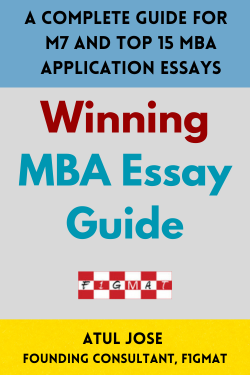
Winning MBA Essay Guide - A Complete Guide for M7 and Top 15 MBA Application Essays
F1GMAT's Winning MBA Essay guide will teach you how to transform your essay into a life journey with trials and tribulations that will move the admission team.
+ Top 15 MBA Programs (Harvard, Stanford, Wharton, Columbia, Booth, MIT, Kellogg, Yale, Haas, Darden, INSEAD, LBS, NYU Stern, Tuck, Duke Fuqua, Ross)
+ The Art of Storytelling + Leadership Narratives + Review Tips + Persuasion Strategies + The Secret to "unleashing" your unique voice + How to prepare and present for the Video Essay + How to write about your Strengths + How to write about your Weaknesses
 GMAT RC inference questions are one of the toughest question types. You can’t skim the content, and infer.


 Timing is everything in GMAT. Computer Adaptive Tests (CATs) have additional constraints apart from limited time: You cannot return to previous questions, you can't skip a question and you are penalized more for unanswered questions than for wrong answers.