 One question type you are bound to encounter on the GMAT Reading Comprehension is a style or tone question. Style and tone questions are particularly rare because most of the passages will be informational articles with neutral tones. For example, it would not be very challenging if you were asked to identify the tone of a passage about the many types of metamorphic rock - such a passage would surely be neutral.
The tone of any given passage is the author’s emotion or feeling, usually towards his subject. An author’s style is the particular way he uses language to reflect his unique authorial voice. Most style or tone questions will include the words “attitude,” “tone,” “style,” “feeling,” etc. A typical question of this type might look like this:
• The author’s attitude toward global warming might best be described as which of the following?
• Which of the following best describes the tone of the passage?
• Based on the statements in lines 43-46, which of the following could be inferred about the author’s attitude toward socialism?
The best way to identify the tone of a passage is to examine certain words with positive or negative connotations. If I were writing a passage about global warming, and one sentence read “fortunately, these brilliant scientists were able to combine their wits and begin formulating promising solutions,” you should identify my tone as positive, optimistic, or reverent. I respect and honor the scientists, and I consider their research valuable and intelligent. Of course, we can imagine that an author adopt a negative tone toward the same subject. Another author might say that “the irresponsible scientists pooled together their half-baked theories to create the most egregious scare tactic of the 21st century.” Notice that positively or negatively charged word in italics - they are the keys to identifying tone.
Of course, my examples are extreme; most of the passages on the GMAT will be more neutral in tone. Most of the answer choices will be moderate. It’s usually best to avoid the extreme answer choices. If you notice that the author is slightly skeptical about her topic, don’t choose the answer choice that says she is “vehemently opposed” to her topic.
Here is an example of a tone question. The following paragraphs are exercepted from a passage about the Iguacu Falls:
Iguacu Falls, which sit on the border between Argentina and Brazil, are said to make Niagara look like a leaky faucet. The great cataracts stretch for two and a half miles across lushly foliaged rocky outcroppings before plunging a staggering two hundred and thirty feet into the river below.
The falls region is densely forested, and is home to a wide variety of plants and animals, including a number of endangered ones. It is a paradise where parrots dive and swoop through the spray, butterflies cavort among the tropical plants and coatis, and giant otters and anteaters amble through the trees. The foliage itself varies between tropical and deciduous with orchids blushing in the shade of pines and ferns nodding gracefully in the shadow of fruit trees.
The author's attitude toward Iguacu Falls can best be described as which of the following?
A. Overweening pride.
B. Positive appreciation.
C. Mild acceptance.
D. Apathetic objectivity.
E. Cautious optimism.
Even though I’ve only included two paragraphs from the passage, we can still answer the question about the author’s tone. First, try to identify words with positive or negative connotations, or identify phrases that reveal the author’s attitude toward the falls. The first sentence reveals the author’s reverence for the falls; if the Iguacu Falls make Niagara look like a ‘leaky faucet,’ they must be pretty impressive. Further, notice the adjectives “great,” “lush,” and “graceful,” the positive noun “paradise,” and the verbs “swoop,” “amble,” and “cavort,” which evoke an Edenic portrait of the natural landscape.
The author’s attitude, in short, is purely positive. Thus, we can quickly eliminate C, D, and E. We can also eliminate A for a different reason. It would be wrong to say that the author is “proud” of Iguacu Falls; after all, he doesn’t take credit for its beauty. B is the best answer.
Remember, don’t try to project a positive or negative tone where one does not exist. If the tone is completely neutral, make sure you answer accordingly.
 About the Author
I am Atul Jose, Founding Consultant of F1GMAT, an MBA admissions consultancy that has worked with applicants since 2009.
For the past 15 years I have edited the application files of admits to the M7 programs: Harvard Business School, Stanford Graduate School of Business, the Wharton School, MIT Sloan, Chicago Booth, Kellogg School of Management, and Columbia Business School, together with admits to Berkeley Haas, Yale School of Management, NYU Stern, Michigan Ross, Duke Fuqua, Darden, Tuck, IMD, London Business School, INSEAD, SDA Bocconi, IESE Business School, HEC Paris, McCombs, and Tepper, plus other programs inside the global top 30.
My work covers the full MBA application deliverable: career planning and profile evaluation, application essay editing, recommendation letter editing, mock interviews and interview preparation, scholarship and fellowship essay editing, and cover letter editing for funding applications. Full bio with credentials and admit history is here.
I am the author of the Winning MBA Essay Guide, the best-selling essay guide covering M7 MBA programs. I have written and updated the guide annually since 2013, which makes the 2026 edition the thirteenth.
The reason I still write and edit essays every cycle: a good MBA essay carries a real applicant's voice. Writing essays for F1GMAT's Books and Editing essays weekly is how I stay calibrated to what current admissions committees respond to.
Contact me for school selection, career planning, essay strategy, narrative development, essay editing, interview preparation, scholarship essay editing, or guidance documents for recommendation letters.
Essential GMAT Reading Comprehension Guide (2023 Edition)

Collecting and Interpreting Facts: GMAT Reading Comprehension
Effective Note-taking for GMAT Reading Comprehension
5 Questions to Speed up Summary Creation
Mastering GMAT Reading Comprehension: 3 Best Practices
How to Remember Information
How to improve comprehension by Questioning the Author
How to Read Faster
How to Answer GMAT Reading Comprehension Title question
How to Answer GMAT Reading Comprehension Main Idea Question
How to Answer GMAT Reading comprehension inference question
How to Answer GMAT Reading Comprehension Purpose Question
How to Answer GMAT Reading Comprehension Detail Question
How to Answer the GMAT organization of passage Question
How to Improve GMAT Reading Comprehension Score?
Passage #1: Protein-Rich Diet Passage #2: Pregnant Women and Stress Management
Passage #3: F Losing Momentum
Passage #4: Conservatives and Automation
Passage #5: Collaboration, Team size and Performance
Passage #6: Effective Altruism
Passage #7: Loneliness Epidemic
Passage #8: Space Exploration
Passage #9: Lab-Grown Meat
Passage #10: Minimum Wage in the US
Passage #11: AI and Creativity
Passage #12: Bias Against Healthcare in Developing Economies
Passage #13: Legacy Admissions
Passage #14: Plastic Ban and alternatives
Passage #15: Underestimating Homo Sapiens
Passage #16: Conspiracy Theories
Passage #17: Relative Poverty
Passage #18: Why Paintings are expensive
Passage #19: US Obesity Epidemics
Passage #20: The Future of Advertising
Passage #21: Breaking Large Companies
Passage #22: Helicopter Parenting
Passage #23: Future of Democracy
Passage #24: Technology and Global Citizenship
Passage #25: Morality and Investment
Answers: 157 to 294
Pages: 295
Questions: 100+
Download F1GMAT's Essential GMAT Reading Comprehension Guide (2023 Edition)
Mastering GMAT Critical Reasoning (2023 Edition)

1) Introduction
2) 6 Step Strategy to solve GMAT Critical Reasoning Questions
3) How to overcome flawed thinking in GMAT Critical Reasoning?
4) 4 GMAT Critical Reasoning Fallacies
5) Generalization in GMAT Critical Reasoning
6) Inconsistencies in Arguments
7) Eliminate Out of Scope answer choices using Necessary and Sufficient Conditions
8) Ad Hominem in GMAT Critical Reasoning
9) Slippery Slope in GMAT Critical Reasoning
10) Affirming the Consequent – GMAT Critical Reasoning
11) How to Paraphrase GMAT Critical Reasoning Question
12) How to Answer Assumption Question Type
13) How to Answer Conclusion Question Type
14) How to Answer Inference Question Type
15) How to Answer Strengthen Question Type
16) How to Answer Weaken Question Type
17) How to Answer bold-faced and Summary Question Types
18) How to Answer Parallel Reasoning Questions
19) How to Answer the Fill in the Blanks Question
Question Bank
Question 1: 5G Technology (Inference)
Question 2: Water Purifier vs. Minerals (Fill in the Blanks)
Question 3: Opioid Abuse (Strengthens)
Question 4: Abe and Japan’s Economy (Inference)
Question 5: Indians and Pulse Import (Weakens)
Question 6: Retail Chains in Latin America (Assumption)
Question 7: American Tax Rates – Republican vs. Democrats (Inference)
Question 8: AI – China vs the US (Weakens)
Question 9: Phone Snooping (Strengthens)
Question 10: Traditional Lawns (Assumption)
Question 11: Appraisal-Tendency Framework (Inference)
Question 12: Meta-Analysis of Diet Trials (Weakens)
Question 13: Biases in AI (Strengthens)
Question 14: Stock Price and Effectiveness of Leadership (Inference)
Question 15: US Border Wall (Weakens)
Question 16: Driverless Car and Pollution (Assumption)
Question 17: Climate Change (Inference)
Question 18: Rent a Furniture (Weakens)
Question 19: Marathon Performance and Customized Shoes (Weakens)
Question 20: Guaranteed Basic Income (Assumption)
Question 21: Brexit (Infer)
Question 22: AB vs Traditional Hotels (Assumption)
Question 23: Tax Incentive and Job Creation (Weakens)
Question 24: Obesity and Sleeve Gastrectomy (Inference)
Question 25: Recruiting Executives (Weaken)
Answers with Detailed Explanation
Do you want to work with the expert consultant who has consistently guided applicants to M7 and T20 MBA programs? Sign up now!
F1GMAT's Services
- MBA Application Review (Essay Editing + Resume Editing + Recommendation Letters + All Application Questions)
- Essay Editing (Essays and All Application Questions)
- One Essay Editing (One Essay/One Cover Letter)
- Career Planning and Detailed Profile Evaluation (Find career goals and courses/schools to match your aspirations)
- One School Recommendation Letter Editing Service
- One Supervisor Recommendation Letter Editing Service
Read the Essay Guides and see how we write & edit MBA essays
Winning MBA Essay Guide - A Complete Guide for M7 and Top 15 MBA Application Essays
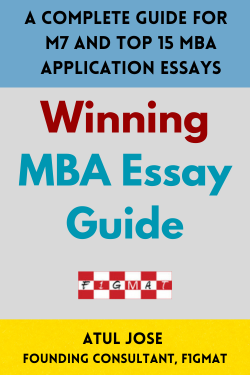
F1GMAT's Winning MBA Essay guide will teach you how to transform your essay into a life journey with trials and tribulations that will move the admission team.
+ Over 245 Sample Essays (Read Previews of F1GMAT's Winning MBA Essay Guide Sample Essays here)
+ Top 15 MBA Programs (Harvard, Stanford, Wharton, Columbia, Booth, MIT, Kellogg, Yale, Haas, Darden, INSEAD, LBS, NYU Stern, Tuck, Duke Fuqua, Ross)
+ The Art of Storytelling
+ Leadership Narratives
+ Review Tips
+ Persuasion Strategies
+ The Secret to "unleashing" your unique voice
+ How to prepare and present for the Video Essay
+ How to write about your Strengths
+ How to write about your Weaknesses
+ Leadership Narratives
+ Review Tips
+ Persuasion Strategies
+ The Secret to "unleashing" your unique voice
+ How to prepare and present for the Video Essay
+ How to write about your Strengths
+ How to write about your Weaknesses
Want to try the individual school Essay Guides before upgrading to the Winning MBA Essay Guide? Try below.
F1GMAT's Essay Guides
- Harvard MBA Essay Guide (20 Sample Essays)
- Stanford MBA Essay Guide (24 Sample Essays)
- Columbia MBA Essay Guide (21 Sample Essays)
- Wharton MBA Essay Guide (15 Sample Essays)
- INSEAD MBA Essay Guide (19 Sample Essays)
- Darden MBA Essay Guide (21 Sample Essays)
- Yale SOM MBA Essay Guide (15 Sample Essays)
- Tuck MBA Essay Guide (15 Sample Essays)
- Haas MBA Essay Guide (18 Sample Essays)
- NYU Stern MBA Essay Guide (15 Sample Essays + 6 Examples - Visual Essay)
- LBS MBA Essay Guide (6 Sample Essays)
- MIT Sloan MBA Essay Guide (6 Sample Cover Letters + 3 Sample Video Statement Scripts + 3 Sample Optional Essays)
- Kellogg MBA Essay Guide (11 Sample Essays)
- Chicago Booth MBA Essay Guide (12 Sample Essays)
- Ross MBA Essay Guide (31 Sample Essays)
- Duke Fuqua MBA Essay Guide (10 Sample Essays + Two 25 Random Things Samples)
- Cambridge MBA Essay Guide (12 Sample Essays)
Want to read the Essay Examples before purchasing the Essay Guides?
Get Exclusive Events, Advice and Trends in your Inbox
Not sure if an MBA Program is right for you? See our Premium Research.
F1GMAT Premium