In 2016, GMAC collaborated with six prominent global business schools to create the Executive Assessment, a tailored assessment specifically developed to suit the admissions objectives of executive MBA programs globally. From a tool for evaluating Executive MBA candidate, the assessment has now been started accepting as an alternative to GMAT test for full-time MBA candidates as well.
GMAT Reading Comprehension passages are complicated and boring texts that will test your concentration and stamina. Most GMAT test takers will start to zone out at this stage and will just stare at the screen, re-reading the same sentence again and again.
Ever heard of a Math problem that you actually don't have to solve. If you have just started your GMAT prep, then this can be confusing. Don't worry! With some practice, your mind will be trained to think like a DS Wizard. Follow these 10 tips and you will be on your way to mastering GMAT Data Sufficiency.
1. Familiarize with the Answer Choices
No excuses: On Data Sufficiency, they’re always the same! Know in the blink of an eye what choice C is. On test day, if you find that Statement 1 is insufficient, be able to cross out choices A and D without hesitation.
Successfully answering GMAT questions is a function of concentration. There are no magic pills to improve concentration, but most test takers have improved their performance by sitting through dense and boring passages, GMAT 800 problems, tricky GMAT Sentence correction questions, and confusing critical reasoning section.
1) Does external noise – both loud and routine, easily distract you? 2) Do random thoughts take your focus away from the text on the screen? 3) Does the timer in the GMAT test screen distract you?
Test takers might be familiar with the feeling of uneasiness when they make a careless mistake. Studies show that as test takers what influence their ability to make a comeback from careless mistakes & conceptual errors depends a lot on their test taking personality.
The Problem Solving (PS) section of the GMAT may not be as quirky as the Data Sufficiency section of the test – but that doesn’t mean you don’t need to study for it! PS questions require more “straight math” than Data Sufficiency questions. Find out the 10 Tips to Solve GMAT Problem Solving Questions
First, you will find that you are spending a lot of time looking between the screen in front of you and your dry erase board. USE YOUR PEN AND DRY ERASE BOARD but do not waste valuable time writing needless things down. CAT environment, especially GMAT CAT environment is different from your traditional paper based exams.
The most important things you can do to prepare for the GMAT is to understand all the concepts tested and to be familiar with all the question types.There is no magic formula–the best strategy is to spend a lot of time beforehand practicing and familiarizing yourself with the various concepts and question formats. Find out the remaining 9 Time Saving Tips for the GMAT Exam.
The GMAT finds much of its competitive advantage in its ability to wear down its unsuspecting challengers, who perform unnecessary calculations on the quantitative side and reading and analyzing unnecessary verbiage on the verbal side, while all the while the GMAT packs its "knockout punch" in the form of a subtle uniqueness in the line of questioning that a tired examinee is unlikely to notice.
Your performance on the GMAT, like all peak performances tend to come in a familiar three-step pattern: ready, set, go; bump, set spike; game plan, warm up, perform. All signs point to I came, I saw, I conquered. Learn how to perform at your peak.
A common belief is that the first ten questions “count” the most in each section of the GMAT, and that in light of this “fact,” you should spend more time on these early questions than you do on the rest of the test. Unfortunately, this belief is false, and its implied course of action could actually be detrimental to your score.
Some people continue to believe this legend, despite all the evidence to the contrary.
A large majority of students aim for the September intakes, when the majority of B-school admissions occur. The spring admissions have been considered to be fewer in number and financial support harder to get during that period.
Some schools have one batch starting in September and another starting in Jan/March.
Collecting and Interpreting Facts: GMAT Reading Comprehension
Effective Note-taking for GMAT Reading Comprehension
5 Questions to Speed up Summary Creation
Mastering GMAT Reading Comprehension: 3 Best Practices
How to Remember Information
How to improve comprehension by Questioning the Author
How to Read Faster
How to Answer GMAT Reading Comprehension Title question
How to Answer GMAT Reading Comprehension Main Idea Question
How to Answer GMAT Reading comprehension inference question
How to Answer GMAT Reading Comprehension Purpose Question
How to Answer GMAT Reading Comprehension Detail Question
How to Answer the GMAT organization of passage Question
How to Improve GMAT Reading Comprehension Score?
Passage #1: Protein-Rich Diet Passage #2: Pregnant Women and Stress Management Passage #3: F Losing Momentum Passage #4: Conservatives and Automation Passage #5: Collaboration, Team size and Performance Passage #6: Effective Altruism Passage #7: Loneliness Epidemic Passage #8: Space Exploration Passage #9: Lab-Grown Meat Passage #10: Minimum Wage in the US Passage #11: AI and Creativity Passage #12: Bias Against Healthcare in Developing Economies Passage #13: Legacy Admissions Passage #14: Plastic Ban and alternatives Passage #15: Underestimating Homo Sapiens Passage #16: Conspiracy Theories Passage #17: Relative Poverty Passage #18: Why Paintings are expensive Passage #19: US Obesity Epidemics Passage #20: The Future of Advertising Passage #21: Breaking Large Companies Passage #22: Helicopter Parenting Passage #23: Future of Democracy Passage #24: Technology and Global Citizenship
Chapters 1) Introduction 2) 6 Step Strategy to solve GMAT Critical Reasoning Questions 3) How to overcome flawed thinking in GMAT Critical Reasoning? 4) 4 GMAT Critical Reasoning Fallacies 5) Generalization in GMAT Critical Reasoning 6) Inconsistencies in Arguments 7) Eliminate Out of Scope answer choices using Necessary and Sufficient Conditions 8) Ad Hominem in GMAT Critical Reasoning 9) Slippery Slope in GMAT Critical Reasoning 10) Affirming the Consequent – GMAT Critical Reasoning 11) How to Paraphrase GMAT Critical Reasoning Question 12) How to Answer Assumption Question Type 13) How to Answer Conclusion Question Type 14) How to Answer Inference Question Type 15) How to Answer Strengthen Question Type 16) How to Answer Weaken Question Type 17) How to Answer bold-faced and Summary Question Types 18) How to Answer Parallel Reasoning Questions 19) How to Answer the Fill in the Blanks Question Question Bank Question 1: 5G Technology (Inference) Question 2: Water Purifier vs. Minerals (Fill in the Blanks) Question 3: Opioid Abuse (Strengthens) Question 4: Abe and Japan’s Economy (Inference) Question 5: Indians and Pulse Import (Weakens) Question 6: Retail Chains in Latin America (Assumption) Question 7: American Tax Rates – Republican vs. Democrats (Inference) Question 8: AI – China vs the US (Weakens) Question 9: Phone Snooping (Strengthens) Question 10: Traditional Lawns (Assumption) Question 11: Appraisal-Tendency Framework (Inference) Question 12: Meta-Analysis of Diet Trials (Weakens) Question 13: Biases in AI (Strengthens) Question 14: Stock Price and Effectiveness of Leadership (Inference) Question 15: US Border Wall (Weakens) Question 16: Driverless Car and Pollution (Assumption) Question 17: Climate Change (Inference) Question 18: Rent a Furniture (Weakens) Question 19: Marathon Performance and Customized Shoes (Weakens) Question 20: Guaranteed Basic Income (Assumption) Question 21: Brexit (Infer) Question 22: AB vs Traditional Hotels (Assumption) Question 23: Tax Incentive and Job Creation (Weakens) Question 24: Obesity and Sleeve Gastrectomy (Inference) Question 25: Recruiting Executives (Weaken)
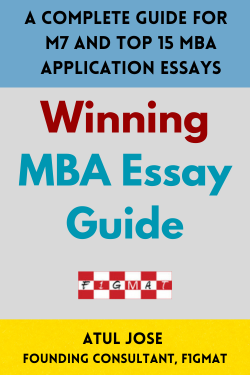
Read the Essay Guides and see how we write & edit MBA essays
Winning MBA Essay Guide - A Complete Guide for M7 and Top 15 MBA Application Essays
F1GMAT's Winning MBA Essay guide will teach you how to transform your essay into a life journey with trials and tribulations that will move the admission team.
+ Top 15 MBA Programs (Harvard, Stanford, Wharton, Columbia, Booth, MIT, Kellogg, Yale, Haas, Darden, INSEAD, LBS, NYU Stern, Tuck, Duke Fuqua, Ross)
+ The Art of Storytelling + Leadership Narratives + Review Tips + Persuasion Strategies + The Secret to "unleashing" your unique voice + How to prepare and present for the Video Essay + How to write about your Strengths + How to write about your Weaknesses

 Ever heard of a Math problem that you actually don't have to solve. If you have just started your GMAT prep, then this can be confusing. Don't worry! With some practice, your mind will be trained to think like a DS Wizard. Follow these 10 tips and you will be on your way to mastering GMAT Data Sufficiency.


 A large majority of students aim for the September intakes, when the majority of B-school admissions occur. The spring admissions have been considered to be fewer in number and financial support harder to get during that period.