 With world war II, 9-5 jobs emerged. Documentation became an integral part of an office job. Reading through hundreds of documents, and filtering the must have from the routine was one skill that Employers treasured. That is when in late 1950s, Evelyn Wood coined the term "speed reading". A researcher and a schoolteacher, Mrs. Wood was fascinated by the difference in reading speed of equally qualified professionals. In an act of desperately finishing a book, she used the sweeping motion of her hand to read chunks of sentences. This technique later became the basis for “Evelyn Wood Speed Reading Dynamics.”
While preparing for GMAT, Students are apprehensive about using speed-reading courses citing lack of evidence in comprehension. The worry is qualified as aggressive reading in place of speed-reading can decrease comprehension. Skimming Techniques help you answer ‘title of the passage’ question but is ineffective in details question and inference questions in some cases. A combination of speed-reading and comprehensive reading is the solution.
Before you start adopting a technique:
1) Pick dense reading material
GMAT reading comprehension passages are about ecology, historical events, policy decisions or one of the latest research papers from Scientific Journal. Test creators ensures that you have limited or no knowledge of the reading material. This forces you to depend on the passage for information.
2) Measure your performance
After you have picked up a dense reading material, it is time to measure your reading speed. The most common metric is words per minute, but that limits your ability to measure when you are slowing down. A better approach would be to divide the passage into paragraphs, and measure the reading speed of each paragraph. The traditional words per minute metric can be used for each paragraph.
3) Set Baseline
After you have set a baseline for your reading speed, note down the metric for each context.
Words per Minute – Introduction
Words per Minute – Details
Words per Minute – Full Passage
Words per Minute – Type of Passage (Science, Astronomy, Social Science, Politics, History)
Once you are aware where you are slowing down, improvements can be made by systematically reading and attempting denser subject matters in the same weaker topics.
GMAT Speed Reading Techniques
Stop Sub-vocalization
If you are reading the words in your mind or whispering the passage as you read, speed and comprehension are likely to go down. Changing a learned behavior takes time. With just 2-3 months for GMAT preparation, breaking this pattern requires drastic changes. A common technique to break this habit is repeating an unrelated sentence loudly as you read the passage. Let’s use “I will master GMAT RC”. This repetition serves two purposes. It acts as an affirmative command, and blocks our sub-conscious from reading the words in our mind. Initially, the speed will be low but our goal is changing sub-vocalization. With 3-10 passages, the behavior will alter.
Z-Method
Reading line by line limits your speed reading capacity. You will not lose any comprehension if you follow a z-pattern. Initially, the Z-style reading would seem confusing but with just 3-5 passages, the new style will become second nature. What Z-Style reading does is combining three lines and taking the gist of the “word chunk.” Instead of sequentially tracing the flow of ideas line by line, this sweeping motion captures more than what traditional eye scan can.
Regress if Necessary
Although speed reading experts have discouraged readers from reading words and sentences already read, research by Elizabeth R. Schotter, Randy Tran, and Keith Rayner from UCSD Department of Psychology has proved that regressing improves comprehension. By knowing that speed-reading allows for regression, pressure to retain the meaning of each sentence decreases, and focus is shifted on understanding context, intent of the author, and evidence presented for formulating an opinion.
Skimming
Don’t use skimming while reading the passage for the first time. Use them when the question is about finding a detail embedded in a paragraph or what the author means by the “sentence” or a line number.
Scanning
Scanning like skimming results in reduced comprehension. Use it for questions about main idea, author’s biases, assumptions, and paragraph structure. No matter which speed reading technique you use, not all of them will work for you. Choose techniques and practice on easier to tougher reading comprehension passages before shortlisting the ones for your final GMAT exam.
....
.......
......
The above post is an Excerpt from Essential GMAT Reading Comprehension Guide. Download it here
 About the Author
I am Atul Jose, Founding Consultant of F1GMAT, an MBA admissions consultancy that has worked with applicants since 2009.
For the past 15 years I have edited the application files of admits to the M7 programs: Harvard Business School, Stanford Graduate School of Business, the Wharton School, MIT Sloan, Chicago Booth, Kellogg School of Management, and Columbia Business School, together with admits to Berkeley Haas, Yale School of Management, NYU Stern, Michigan Ross, Duke Fuqua, Darden, Tuck, IMD, London Business School, INSEAD, SDA Bocconi, IESE Business School, HEC Paris, McCombs, and Tepper, plus other programs inside the global top 30.
My work covers the full MBA application deliverable: career planning and profile evaluation, application essay editing, recommendation letter editing, mock interviews and interview preparation, scholarship and fellowship essay editing, and cover letter editing for funding applications. Full bio with credentials and admit history is here.
I am the author of the Winning MBA Essay Guide, the best-selling essay guide covering M7 MBA programs. I have written and updated the guide annually since 2013, which makes the 2026 edition the thirteenth.
The reason I still write and edit essays every cycle: a good MBA essay carries a real applicant's voice. Writing essays for F1GMAT's Books and Editing essays weekly is how I stay calibrated to what current admissions committees respond to.
Contact me for school selection, career planning, essay strategy, narrative development, essay editing, interview preparation, scholarship essay editing, or guidance documents for recommendation letters.
Essential GMAT Reading Comprehension Guide (2023 Edition)

Collecting and Interpreting Facts: GMAT Reading Comprehension
Effective Note-taking for GMAT Reading Comprehension
5 Questions to Speed up Summary Creation
Mastering GMAT Reading Comprehension: 3 Best Practices
How to Remember Information
How to improve comprehension by Questioning the Author
How to Read Faster
How to Answer GMAT Reading Comprehension Title question
How to Answer GMAT Reading Comprehension Main Idea Question
How to Answer GMAT Reading comprehension inference question
How to Answer GMAT Reading Comprehension Purpose Question
How to Answer GMAT Reading Comprehension Detail Question
How to Answer the GMAT organization of passage Question
How to Improve GMAT Reading Comprehension Score?
Passage #1: Protein-Rich Diet Passage #2: Pregnant Women and Stress Management
Passage #3: F Losing Momentum
Passage #4: Conservatives and Automation
Passage #5: Collaboration, Team size and Performance
Passage #6: Effective Altruism
Passage #7: Loneliness Epidemic
Passage #8: Space Exploration
Passage #9: Lab-Grown Meat
Passage #10: Minimum Wage in the US
Passage #11: AI and Creativity
Passage #12: Bias Against Healthcare in Developing Economies
Passage #13: Legacy Admissions
Passage #14: Plastic Ban and alternatives
Passage #15: Underestimating Homo Sapiens
Passage #16: Conspiracy Theories
Passage #17: Relative Poverty
Passage #18: Why Paintings are expensive
Passage #19: US Obesity Epidemics
Passage #20: The Future of Advertising
Passage #21: Breaking Large Companies
Passage #22: Helicopter Parenting
Passage #23: Future of Democracy
Passage #24: Technology and Global Citizenship
Passage #25: Morality and Investment
Answers: 157 to 294
Pages: 295
Questions: 100+
Download F1GMAT's Essential GMAT Reading Comprehension Guide (2023 Edition)
Mastering GMAT Critical Reasoning (2023 Edition)

1) Introduction
2) 6 Step Strategy to solve GMAT Critical Reasoning Questions
3) How to overcome flawed thinking in GMAT Critical Reasoning?
4) 4 GMAT Critical Reasoning Fallacies
5) Generalization in GMAT Critical Reasoning
6) Inconsistencies in Arguments
7) Eliminate Out of Scope answer choices using Necessary and Sufficient Conditions
8) Ad Hominem in GMAT Critical Reasoning
9) Slippery Slope in GMAT Critical Reasoning
10) Affirming the Consequent – GMAT Critical Reasoning
11) How to Paraphrase GMAT Critical Reasoning Question
12) How to Answer Assumption Question Type
13) How to Answer Conclusion Question Type
14) How to Answer Inference Question Type
15) How to Answer Strengthen Question Type
16) How to Answer Weaken Question Type
17) How to Answer bold-faced and Summary Question Types
18) How to Answer Parallel Reasoning Questions
19) How to Answer the Fill in the Blanks Question
Question Bank
Question 1: 5G Technology (Inference)
Question 2: Water Purifier vs. Minerals (Fill in the Blanks)
Question 3: Opioid Abuse (Strengthens)
Question 4: Abe and Japan’s Economy (Inference)
Question 5: Indians and Pulse Import (Weakens)
Question 6: Retail Chains in Latin America (Assumption)
Question 7: American Tax Rates – Republican vs. Democrats (Inference)
Question 8: AI – China vs the US (Weakens)
Question 9: Phone Snooping (Strengthens)
Question 10: Traditional Lawns (Assumption)
Question 11: Appraisal-Tendency Framework (Inference)
Question 12: Meta-Analysis of Diet Trials (Weakens)
Question 13: Biases in AI (Strengthens)
Question 14: Stock Price and Effectiveness of Leadership (Inference)
Question 15: US Border Wall (Weakens)
Question 16: Driverless Car and Pollution (Assumption)
Question 17: Climate Change (Inference)
Question 18: Rent a Furniture (Weakens)
Question 19: Marathon Performance and Customized Shoes (Weakens)
Question 20: Guaranteed Basic Income (Assumption)
Question 21: Brexit (Infer)
Question 22: AB vs Traditional Hotels (Assumption)
Question 23: Tax Incentive and Job Creation (Weakens)
Question 24: Obesity and Sleeve Gastrectomy (Inference)
Question 25: Recruiting Executives (Weaken)
Answers with Detailed Explanation
Do you want to work with the expert consultant who has consistently guided applicants to M7 and T20 MBA programs? Sign up now!
F1GMAT's Services
- MBA Application Review (Essay Editing + Resume Editing + Recommendation Letters + All Application Questions)
- Essay Editing (Essays and All Application Questions)
- One Essay Editing (One Essay/One Cover Letter)
- Career Planning and Detailed Profile Evaluation (Find career goals and courses/schools to match your aspirations)
- One School Recommendation Letter Editing Service
- One Supervisor Recommendation Letter Editing Service
Read the Essay Guides and see how we write & edit MBA essays
Winning MBA Essay Guide - A Complete Guide for M7 and Top 15 MBA Application Essays
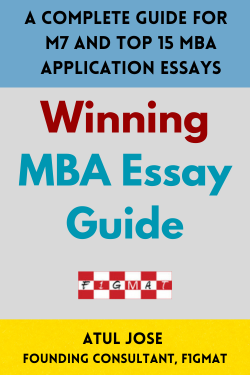
F1GMAT's Winning MBA Essay guide will teach you how to transform your essay into a life journey with trials and tribulations that will move the admission team.
+ Over 245 Sample Essays (Read Previews of F1GMAT's Winning MBA Essay Guide Sample Essays here)
+ Top 15 MBA Programs (Harvard, Stanford, Wharton, Columbia, Booth, MIT, Kellogg, Yale, Haas, Darden, INSEAD, LBS, NYU Stern, Tuck, Duke Fuqua, Ross)
+ The Art of Storytelling
+ Leadership Narratives
+ Review Tips
+ Persuasion Strategies
+ The Secret to "unleashing" your unique voice
+ How to prepare and present for the Video Essay
+ How to write about your Strengths
+ How to write about your Weaknesses
+ Leadership Narratives
+ Review Tips
+ Persuasion Strategies
+ The Secret to "unleashing" your unique voice
+ How to prepare and present for the Video Essay
+ How to write about your Strengths
+ How to write about your Weaknesses
Want to try the individual school Essay Guides before upgrading to the Winning MBA Essay Guide? Try below.
F1GMAT's Essay Guides
- Harvard MBA Essay Guide (20 Sample Essays)
- Stanford MBA Essay Guide (24 Sample Essays)
- Columbia MBA Essay Guide (21 Sample Essays)
- Wharton MBA Essay Guide (15 Sample Essays)
- INSEAD MBA Essay Guide (19 Sample Essays)
- Darden MBA Essay Guide (21 Sample Essays)
- Yale SOM MBA Essay Guide (15 Sample Essays)
- Tuck MBA Essay Guide (15 Sample Essays)
- Haas MBA Essay Guide (18 Sample Essays)
- NYU Stern MBA Essay Guide (15 Sample Essays + 6 Examples - Visual Essay)
- LBS MBA Essay Guide (6 Sample Essays)
- MIT Sloan MBA Essay Guide (6 Sample Cover Letters + 3 Sample Video Statement Scripts + 3 Sample Optional Essays)
- Kellogg MBA Essay Guide (11 Sample Essays)
- Chicago Booth MBA Essay Guide (12 Sample Essays)
- Ross MBA Essay Guide (31 Sample Essays)
- Duke Fuqua MBA Essay Guide (10 Sample Essays + Two 25 Random Things Samples)
- Cambridge MBA Essay Guide (12 Sample Essays)
Want to read the Essay Examples before purchasing the Essay Guides?
Get Exclusive Events, Advice and Trends in your Inbox
Not sure if an MBA Program is right for you? See our Premium Research.
F1GMAT Premium