In 2016, GMAC collaborated with six prominent global business schools to create the Executive Assessment, a tailored assessment specifically developed to suit the admissions objectives of executive MBA programs globally. From a tool for evaluating Executive MBA candidate, the assessment has now been started accepting as an alternative to GMAT test for full-time MBA candidates as well.
Don’t blindly follow the 720+ rule. A better strategy would be to aim for the 99th percentile. To convert GMAT Score to percentiles, visit GMAT Percentile page. Although GMAT Score is not the only factor that would decide you chance to get into top Business School, here are the average GMAT Scores of top Business Schools.
The GMAT is a computer-adaptive test where your score is calculated by an algorithm that provides you with harder questions (and higher score returns) when you answer previous questions correctly, and with easier questions (and lower returns) when you’ve answered previous questions incorrectly.
GMAT score is a common, objective benchmark that leaves no room for ambiguity when comparing two candidates from different schools, regions, or majors. The same cannot be said for GPA.
Some schools might follow a bell-curve whereas other schools might have a grading system that is top-heavy. Some schools might use a 4.0 scale whereas others might have a 100-point scale
GMAT is an integral part of MBA Admissions. An excellent score in itself will not guarantee a place in Harvard, Wharton, Stanford or other top schools but a 700-720+ score will ensure that your applications will be read with the same seriousness as that of other competitive applicants. Here are some useful tips on improving your GMAT score.
GMAT Scores are valid for Five Years, and are an integral part of MBA Application Process. Although you might have heard of stories of applicants making into top schools with below average scores: 550-600. It is an exception and not a rule. When you consider Essays, Recommendation Letter, GMAT score and Admission Interviews, GMAT Score is the only part of the MBA Application that is set into a comparable scale like percentile ranking and overall score.Find out which is a good GMAT Score.
The CNNMoney Post about how AdCom (Rotman School of Mangement) makes decisions gives us insight on the factors that the admission team value before making a ding or accepted decision.
If you have wondered whether Age influences your ability to score high on GMAT, the 2012 Profile of GMAT Candidates report by GMAC gives some clear clues. We looked at the Mean Total GMAT Score for the past 5 years and here is what we found: The worst performing group as expected were the 50+ age group that had a mean GMAT score of 462.6. And the best performing age group is..
GMAC has released the total mean GMAT score for the past five years (2008-12). Except for the year 2008-09, mean GMAT scores have shown consistent improvement. On an average, the total mean GMAT score has increased by 1.5 to 2 points every year, reaching 548.21 during the year 2011-12. Test takers from Physics, Mathematics and Engineering, topped the 5 Year Mean GMAT score with 607.4, 603.4 and 592.8 respectively. Learn more about Top Mean GMAT Score - By Undergraduate Degree.
GMAT provides two ways to measure your score: Scaled Total and Section wise Scores. However, for Business Schools, these scores have very little value unless they can look through a comparative scale. That is where GMAT Score Percentiles help.
You might be aware that there are three GMAT Sections: Analytical Writing/Integrated Reasoning, Quantitative and Verbal. The result of the Analytical Writing/Integrated Reasoning section will have no impact on your total scaled score. The Quantitative and Verbal sections contribute to the overall score. The total score is measured in a scale from 200 to 800. Each section is measured in a scale from 0 to 60.
Total Score: 200 – 800
Quantitative: 0 - 60
Verbal: 0 - 60
How is GMAT Percentile tracked? GMAC looks into GMAT test data for the last three years to evaluate your percentile. You should clearly understand the difference between the validity of GMAT test, which is 5 years and the percentile change that can happen if a more competitive group of students take the GMAT in one year.
Collecting and Interpreting Facts: GMAT Reading Comprehension
Effective Note-taking for GMAT Reading Comprehension
5 Questions to Speed up Summary Creation
Mastering GMAT Reading Comprehension: 3 Best Practices
How to Remember Information
How to improve comprehension by Questioning the Author
How to Read Faster
How to Answer GMAT Reading Comprehension Title question
How to Answer GMAT Reading Comprehension Main Idea Question
How to Answer GMAT Reading comprehension inference question
How to Answer GMAT Reading Comprehension Purpose Question
How to Answer GMAT Reading Comprehension Detail Question
How to Answer the GMAT organization of passage Question
How to Improve GMAT Reading Comprehension Score?
Passage #1: Protein-Rich Diet Passage #2: Pregnant Women and Stress Management Passage #3: F Losing Momentum Passage #4: Conservatives and Automation Passage #5: Collaboration, Team size and Performance Passage #6: Effective Altruism Passage #7: Loneliness Epidemic Passage #8: Space Exploration Passage #9: Lab-Grown Meat Passage #10: Minimum Wage in the US Passage #11: AI and Creativity Passage #12: Bias Against Healthcare in Developing Economies Passage #13: Legacy Admissions Passage #14: Plastic Ban and alternatives Passage #15: Underestimating Homo Sapiens Passage #16: Conspiracy Theories Passage #17: Relative Poverty Passage #18: Why Paintings are expensive Passage #19: US Obesity Epidemics Passage #20: The Future of Advertising Passage #21: Breaking Large Companies Passage #22: Helicopter Parenting Passage #23: Future of Democracy Passage #24: Technology and Global Citizenship
Chapters 1) Introduction 2) 6 Step Strategy to solve GMAT Critical Reasoning Questions 3) How to overcome flawed thinking in GMAT Critical Reasoning? 4) 4 GMAT Critical Reasoning Fallacies 5) Generalization in GMAT Critical Reasoning 6) Inconsistencies in Arguments 7) Eliminate Out of Scope answer choices using Necessary and Sufficient Conditions 8) Ad Hominem in GMAT Critical Reasoning 9) Slippery Slope in GMAT Critical Reasoning 10) Affirming the Consequent – GMAT Critical Reasoning 11) How to Paraphrase GMAT Critical Reasoning Question 12) How to Answer Assumption Question Type 13) How to Answer Conclusion Question Type 14) How to Answer Inference Question Type 15) How to Answer Strengthen Question Type 16) How to Answer Weaken Question Type 17) How to Answer bold-faced and Summary Question Types 18) How to Answer Parallel Reasoning Questions 19) How to Answer the Fill in the Blanks Question Question Bank Question 1: 5G Technology (Inference) Question 2: Water Purifier vs. Minerals (Fill in the Blanks) Question 3: Opioid Abuse (Strengthens) Question 4: Abe and Japan’s Economy (Inference) Question 5: Indians and Pulse Import (Weakens) Question 6: Retail Chains in Latin America (Assumption) Question 7: American Tax Rates – Republican vs. Democrats (Inference) Question 8: AI – China vs the US (Weakens) Question 9: Phone Snooping (Strengthens) Question 10: Traditional Lawns (Assumption) Question 11: Appraisal-Tendency Framework (Inference) Question 12: Meta-Analysis of Diet Trials (Weakens) Question 13: Biases in AI (Strengthens) Question 14: Stock Price and Effectiveness of Leadership (Inference) Question 15: US Border Wall (Weakens) Question 16: Driverless Car and Pollution (Assumption) Question 17: Climate Change (Inference) Question 18: Rent a Furniture (Weakens) Question 19: Marathon Performance and Customized Shoes (Weakens) Question 20: Guaranteed Basic Income (Assumption) Question 21: Brexit (Infer) Question 22: AB vs Traditional Hotels (Assumption) Question 23: Tax Incentive and Job Creation (Weakens) Question 24: Obesity and Sleeve Gastrectomy (Inference) Question 25: Recruiting Executives (Weaken)
Read the Essay Guides and see how we write & edit MBA essays
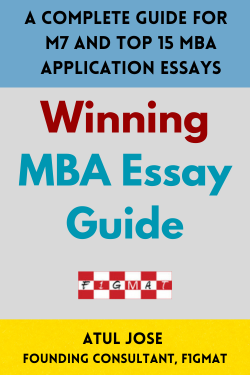
Winning MBA Essay Guide - A Complete Guide for M7 and Top 15 MBA Application Essays
F1GMAT's Winning MBA Essay guide will teach you how to transform your essay into a life journey with trials and tribulations that will move the admission team.
+ Top 15 MBA Programs (Harvard, Stanford, Wharton, Columbia, Booth, MIT, Kellogg, Yale, Haas, Darden, INSEAD, LBS, NYU Stern, Tuck, Duke Fuqua, Ross)
+ The Art of Storytelling + Leadership Narratives + Review Tips + Persuasion Strategies + The Secret to "unleashing" your unique voice + How to prepare and present for the Video Essay + How to write about your Strengths + How to write about your Weaknesses




 GMAT provides two ways to measure your score: Scaled Total and Section wise Scores. However, for Business Schools, these scores have very little value unless they can look through a comparative scale. That is where GMAT Score Percentiles help.