F1GMAT · https://www.f1gmat.com/bay-area-technology-career-vs-mba ·
 Add F1GMAT as a preferred source on Google, opens Google in a new tab
 See more of F1GMAT's MBA admissions research in Google's Top Stories by making us a preferred source on Google.
Is it worth risking a Bay Area technology career for an MBA?
The honest answer: usually not, if you have the reserve fund to persist in a bad and equally transformative job market where old-school project managers are turning into AI managers, monitoring AI agents eagerly rummaging through scarce compute resources while managers slowly atrophy their life-earned programming muscles.
Apart from the loss of identity, a quick switch to an MBA is not required if your goal is to persist in the industry in the short term.
But if you are the risk-taking kind, eager to maximize your earning potential, things get interesting when you map your salary and career growth over 5-7 years.
Contents
The risk is real
Bay Area tech layoffs in the twelve months to June 2026 reached 14,501 according to California WARN filings[9], but an even more important statistic technologists must monitor is the pattern of repeat offenses.
The repeat offenders are large technology giants - some will cite AI-driven restructuring, others efficiency pushes, and even more will cite other ‘technical’ disruption in the next 2-3 years. But once you see the ease with which a technologist is let go at Meta, Amazon, Microsoft, and even Google with recent CAPEX push, you will notice that in the short term, compute is more valuable than personnel because AI is relentless and smarter than 99% of humans. This is not about the ‘evil’ large technology company. It is the nature of the progress that AI models have embarked on, with no regulation, that has led all of us to universally embrace the slogan, “If you can’t beat them, join them”.
When the world is moving ahead at this unfettered pace, the casualties will be workers – the modern technology workers.
But the story and risk are not around the job cuts alone.
AI-related roles are 57% of all Bay Area tech job postings as of June 2026, up from 20% in 2022. Partly because it is impossible to get funding without mentioning AI in the pitch deck, and partly because AI has transitioned from a ‘hype’ word to a real value-add in organizations.
The real question is - can you transition from traditional technology – product and project managerial roles to an AI managerial role where the team size is 1/10th of the pre-2023 era?
The unknowns are truly unknown, unlike the known science of managing a person in a predictable corporate environment. Even if there are the crazies and the occasional eccentric geniuses, most who wear the cool ‘t-shirt’ with the informal attitude are easy to predict.
It is not always that you have to worry about your team of AI agents turning rogue and attacking a state infrastructure one fine morning or emerging from the dead, even when you sandbox them to an environment with limited compute. The need to survive in any organism, digital or analog, begins the moment even a morsel of intelligence is rendered to it.
The cost is clear – an opportunity cost of $600,000 at product-level pay, plus tuition – another $250,000.
The Technology Career Path: you may not need the MBA
A mid-career engineer who moves directly into a Bay Area product or applied-AI role reaches $250,000 to $530,000 in total compensation without taking two years out.
The Bay Area posting from Indeed for a Product Managerial role is at ~$189,000 median base – a slightly better compensation than technology hires at Stanford. But remember one interesting detail, these roles at top MBA programs are mostly in Marketing and Business Development, not in traditional technology roles.
The opportunity cost is even higher if you are a shoo-in for an AI/ML Product Managerial role where the median compensation was ~$234,000. MBA would be a terrible choice. But as you might know, these roles are extremely competitive. The opportunity cost of an MBA could very well be lost applying to these roles while you remain underemployed after the layoff. The freelance market is nosediving as the competition – the full-time roles laid off from 2022 to 2025 - also entered the market in 2026.
Table 1. The direct technology move (San Francisco Bay Area, 2026)
| Role | Live SF / Bay postings | Base | Total compensation |
|---|---|---|---|
| Product Manager | 1,552 (Indeed); 272 at AI startups | ~$189,000 median | $250,000–$350,000; median $311,250 all levels (Levels.fyi) |
| AI / ML Product Manager | Largest growth segment | $178,000–$307,000 | ~$234,000 median |
| Product Marketing Manager | 264 (Corvi.careers) | ~$175,000 SF median | $159,000–$280,000 |
| Senior / Principal PM (ceiling) | — | — | Meta L5 $444,390; Amazon Principal PM $529,853 (Levels.fyi) |
That is why we have created the career quiz. Take it and see where you stand.
The MBA Career Path: it does not win on entry pay
Post-MBA base salary clusters between $175,000 and $190,000 across industries[1]. The two Bay Area MBA programs that feed technology pay a base below what the same person could reach by moving into a product role directly.
Table 2. Post-MBA entry base, Class of 2025, against the direct technology roles
| Destination | Median base | Share of hires |
|---|---|---|
| Consulting | $190,000 | 28–41% at most top programs |
| Financial Services | $175,000 | 35–41% (Wharton, Columbia, Stern, Cornell) |
| Technology (Stanford / Harvard) | $185,000 / $178,000 | 35% / 22% |
| Technology (Berkeley Haas / UCLA Anderson) | $159,000 / $147,000 | 38.6% / 28.3% |
| Direct Bay Area product role (comparison) | ~$189,000 | $250,000–$350,000 total comp |
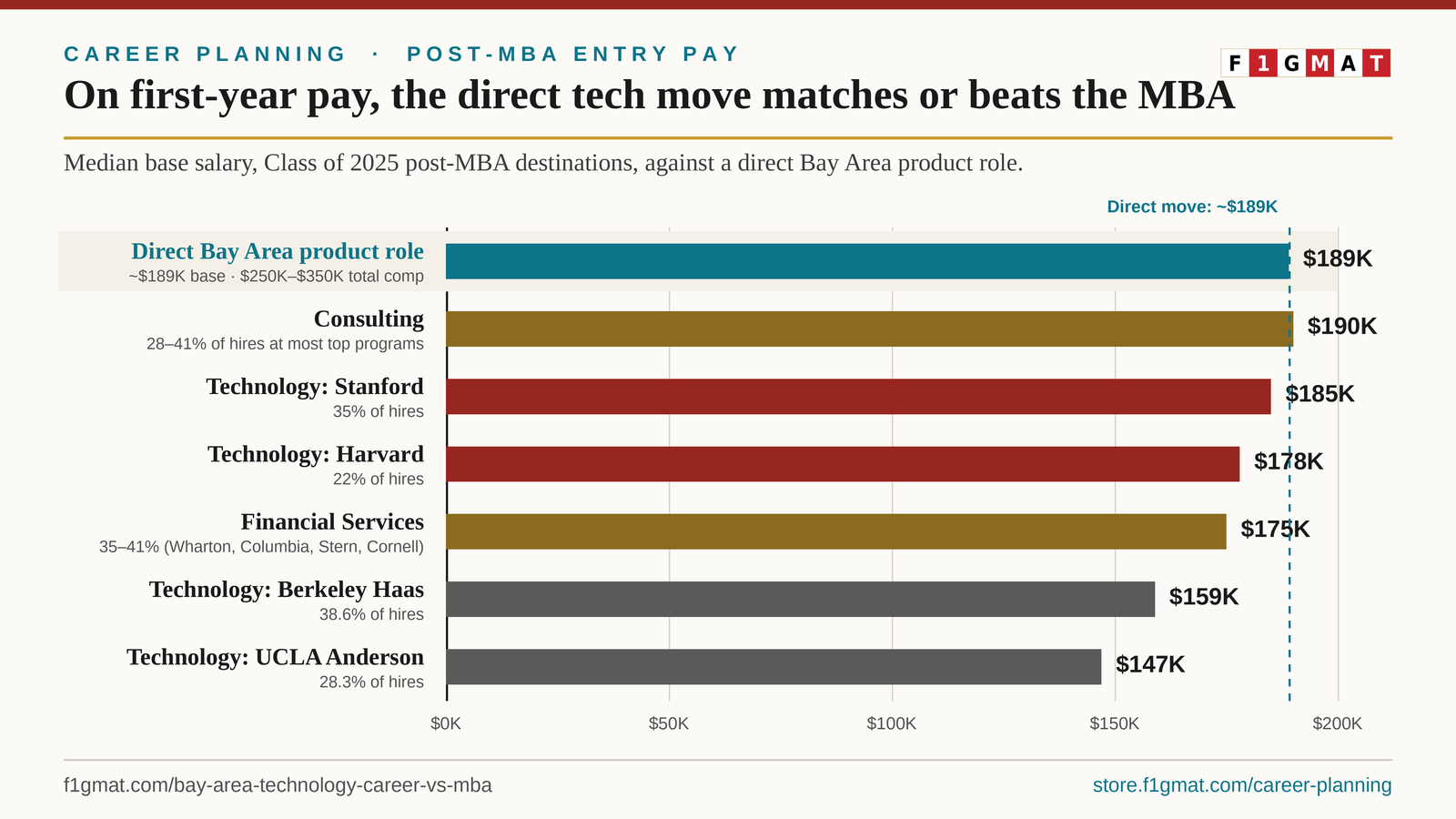
On first-year pay alone, the direct technology move matches or beats every post-MBA entry figure, and a Haas or UCLA graduate re-entering Bay Area tech can come back to a base below the one they left.
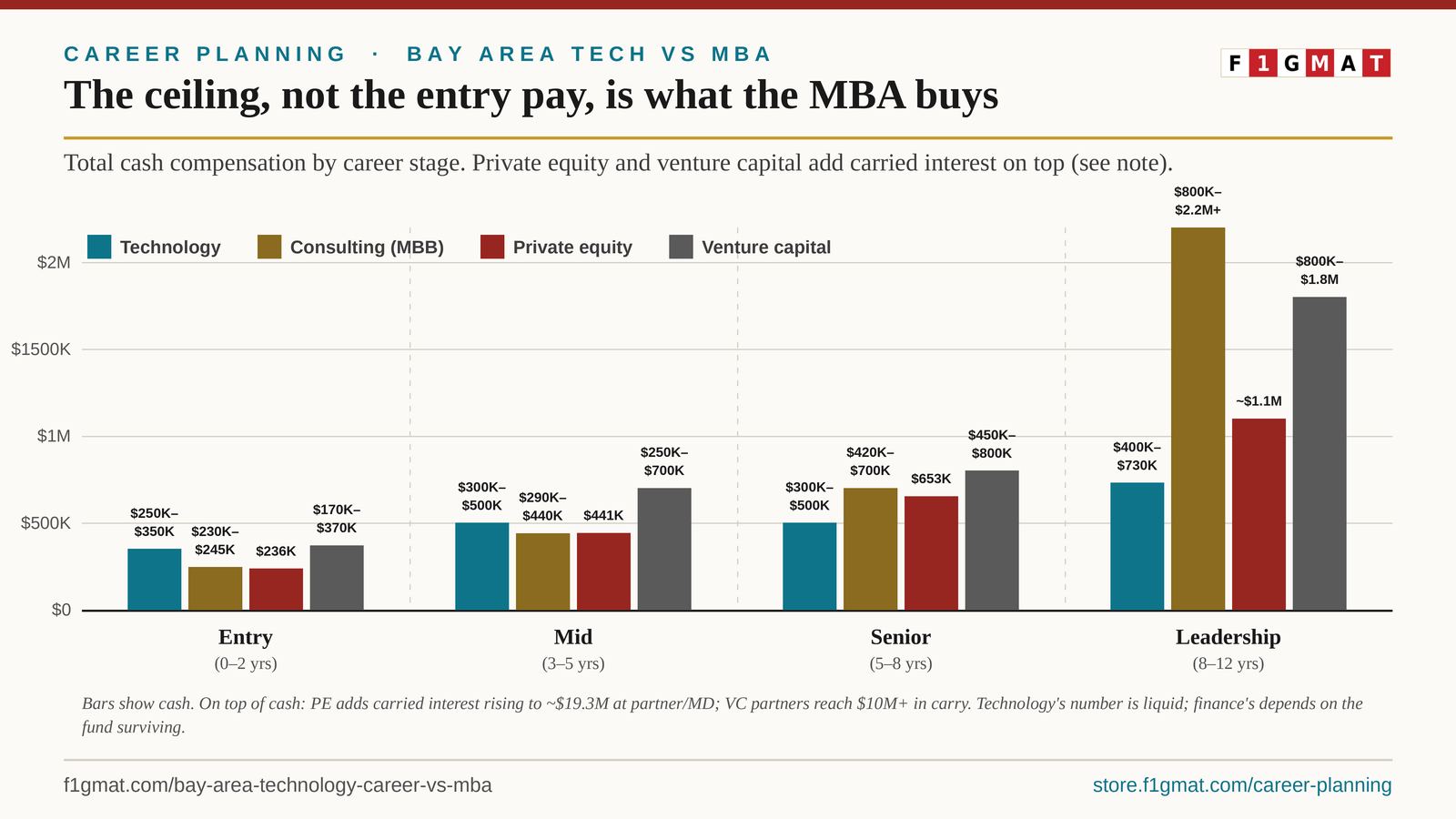
The MBA’s value is long-term and the peculiar ceiling the technology industry has created for Senior and VP roles that PE, VC, or Consulting has not put.
The only reason to take the risk is the ceiling
A technology product career plateaus for most people at the VP band, roughly $400,000 to $730,000 in total compensation, reached without an MBA.
A technology career also has a soft ceiling.
A product manager, after climbing to the VP band, is paid in liquid cash and equity with little variance.
The functions an MBA opens have no such ceiling, because they pay you a share of what you build.
A consulting partner at McKinsey, BCG, or Bain earns $800,000 to $2.2 million-plus in total compensation, where profit-sharing dominates the package [8].
A private-equity principal earns roughly $7.4 million of carried interest and a partner or managing director roughly $19.3 million, a share of the funds’ gains that vests over years. Venture-capital partners at top funds reach $10 million or more on the same mechanism [2][7].
The trade-off is stark - technology pays more, sooner, and safely; finance pays far more, later, and only if you survive the climb.
The numbers show where the trade bites.
At entry level, the gap is small: a Bay Area senior product manager earns $250,000 to $350,000, an MBB consultant $230,000 to $245,000, a private-equity associate $236,000 in cash.
By the five-to-eight-year mark, they diverge sharply.
The catch lies in the word “carried”: it is illiquid, vests over years, and depends on the fund performing.
Technology’s lower number is cash in hand; finance’s larger one depends on the fund’s survival.
Evaluate your personal risk – risk to your family members and plans for starting a family before choosing one path.
Table 3. Private equity ladder, experience-mapped and projected (mid-market $1–4bn, total cash mean)
| Level | Yrs post-MBA | Yrs in PE | Total exp. | 2024 | 2025 | 2026 | Carried interest |
|---|---|---|---|---|---|---|---|
| Associate / Sr Associate | 0–2 | ~3 | ~5–8 | $236K | ~$258K | ~$271K | ~$0.9M |
| Vice President | 3–5 | ~6 | ~8–11 | $411K | ~$441K | ~$463K | ~$3.0M |
| Principal | 6–9 | ~10 | ~12–16 | $593K | ~$653K | ~$686K | ~$7.4M |
| Partner / MD | 10–14 | ~15 | ~17–21 | $979K | ~$1.08M | ~$1.13M | ~$19.3M |
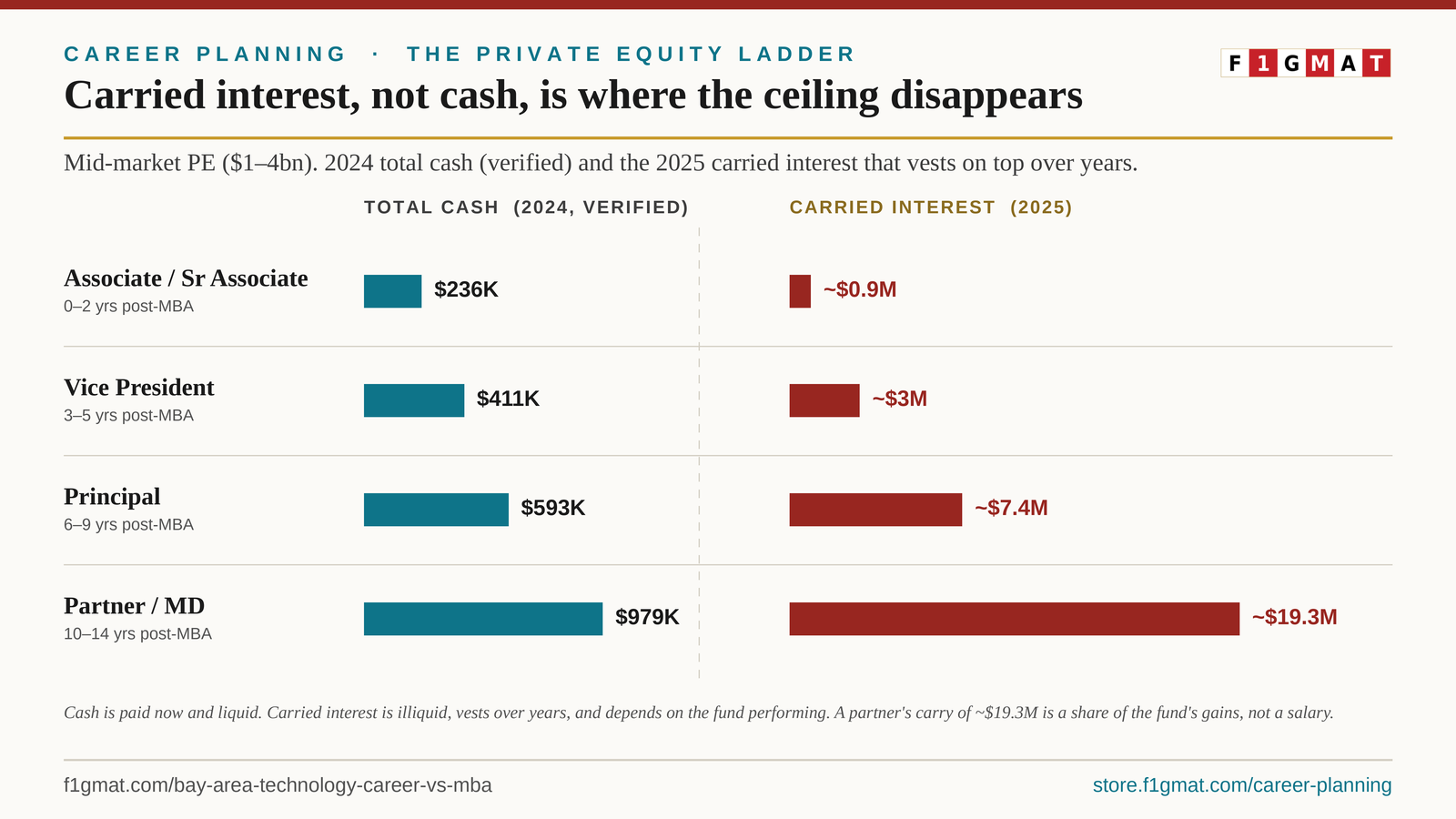
Table 4. The 5-to-10-year ceiling, all four functions (total compensation, experience-mapped)
| Stage | Yrs post-MBA | Technology | Consulting (MBB) | Private equity | Venture capital |
|---|---|---|---|---|---|
| Entry | 0–2 | Senior PM $250K–$350K | Associate $230K–$245K | Sr Associate $236K cash + carry | Sr Associate $170K–$370K cash |
| Mid | 3–5 | Group PM $300K–$500K | Engagement Mgr $290K–$440K | VP $441K cash + ~$3.0M carry | Principal $250K–$700K + carry |
| Senior | 5–8 | Director $300K–$500K | Principal $420K–$700K | Principal $653K cash + ~$7.4M carry | Principal/Partner $450K–$800K + carry |
| Leadership | 8–12 | VP Product $400K–$730K | Partner $800K–$2.2M+ | Partner/MD ~$1.1M cash + ~$19.3M carry | Partner/GP $800K–$1.8M; carry $10M+ |
Technology from Levels.fyi; consulting from StrategyCase / Management Consulted; private equity from Heidrick & Struggles 2025; venture capital from Thelander, Venture5 and VCBeast (senior bands estimated).
Verdict: when the risk is worth it
Take the risk if your goal is to enter a higher-ceiling earning function you cannot enter directly (consulting, private equity, or finance), or if the network, recruiting access, or a visa, especially with the recent US Visa rules that restrict growth in a technology career.
Skip an MBA if your goal is to return to Bay Area product or AI work role; you can acquire it even without a ‘named’ brand.
References
- F1GMAT Salary Comparison Tool by industry ↩
- Private equity by level, 2023–2025 + carried interest — Heidrick & Struggles, 2025 North America PE Investment Professional Compensation Survey | Full PDF ↩
- Technology pay by level (SF Bay Area)
- Product / marketing live postings — Corvi.careers | JobsPipe | Callings.ai (metro openings
- Bay Area layoffs (12 mo to Jun 2026) — Bloomberg Law analysis of California WARN data (S; underlying primary = CA EDD WARN).
- AI share of Bay Area tech postings — CBRE Scoring Tech Talent 2026
- Venture capital by level — J. Thelander Consulting survey; Venture5 2025; VCBeast (senior bands estimated) | ↩
- Consulting by level — StrategyCase; Management Consulted ↩
- WARN CA — filings — WARN Tracker, California ↩