F1GMAT · https://www.f1gmat.com/wharton-mba-application-tips-using-placement-data ·
 Add F1GMAT as a preferred source on Google, opens Google in a new tab
 See more of F1GMAT's MBA admissions research in Google's Top Stories by making us a preferred source on Google.
If you are applying to the Wharton School in the 2026-27 cycle, the Class of 2025 placement data[1] should guide you in the kind of goals, motivations and community contributions you cite for your Wharton MBA application Essays 1 and 2.
TL;DR
- Financial Services was the largest hire by industry at 38.2% with a $175,000 median base salary. A finance applicant has the most comfortable post-MBA opportunities at Wharton, provided the goals they cite and the narrative they use indicate an ownership mindset and a bias towards execution.
- Investment Management paid the highest for a job function with a base salary of $190,917.
- Investment Banking hire was 14.2% of the class with a $180,982 base salary. This is above the $175,000 pay seen in peer schools. Wharton benefited from the HSW branding and the finance school tag, attracting candidates with experience in deal execution and sponsor-driven transactions.
- Private Equity took 13.4% of hires at a $200,000 base salary. A PE post-MBA role should show an operator role.
- Consulting recovered to 28.2% of hires by industry (31.4% by function) and became the largest functional destination. A consulting applicant should write about AI implementation, integration, and operating-model experience, and retire the open-ended strategy story.
- Technology stayed labor-light at 15.3% of hires, and Product Management fell to 5.9%. A technology applicant should target enterprise, business development, and monetization roles instead of classic product management experience. Don’t miss the AI pivot or AI integration story.
- The Northeast absorbed 54.5% of the class at a $185,000 base, while International hiring fell to 6%. A candidate without a US execution story should explain the Northeast fit directly, either by matching the industry or the niche expertise the region has to offer.
The 9 trends should guide your Wharton MBA Application narrative strategy and how you position yourself for the 2026-27 application.
Contents
- Trend #1: Financial Services Anchors 38.2% of Wharton Hires
- Application Tips for Wharton MBA Financial Services Applicants
- Trend #2: Investment Banking Holds 14.2% at a $180,982 Premium
- Application Tips for Wharton MBA Investment Banking Applicants
- Trend #3: Private Equity Takes 13.4% at a $200,000 Base
- Application Tips for Wharton MBA PE Applicants
- Trend #4: Investment Management Pays $190,917, the Highest Investing-Function Base
- Application Tips for Wharton MBA Investment Management Applicants
- Trend #5: Consulting Recovered to 28.2% as the Largest Functional Destination
- Application Tips for Wharton MBA Consulting Applicants
- Trend #6: Technology Held 15.3% but Stayed Labor-Light; Product Management Fell to 5.9%
- Application Tips for Wharton MBA Technology Applicants
- Trend #7: General and Project Management Reached 10.2% as Execution Roles Expanded
- Application Tips for Wharton MBA General Management Applicants
- Trend #8: The Northeast Absorbed 54.5% of the Class at a $185,000 Base, The West Accepted 19.2% as Business Development Rose to 4.2%
- Application Tips for Candidates with Strong Regional Ties
- Trend #9: International Hiring Fell to 6% as US Placement Reached 94%
- Application Tips for International Wharton MBA Applicants
- Key Takeaways for 2026-27 M7 and HSW Applicants
- References
MBA Application Tips Based on 9 Wharton MBA Placement Trends
Trend #1: Financial Services Anchors 38.2% of Wharton Hires
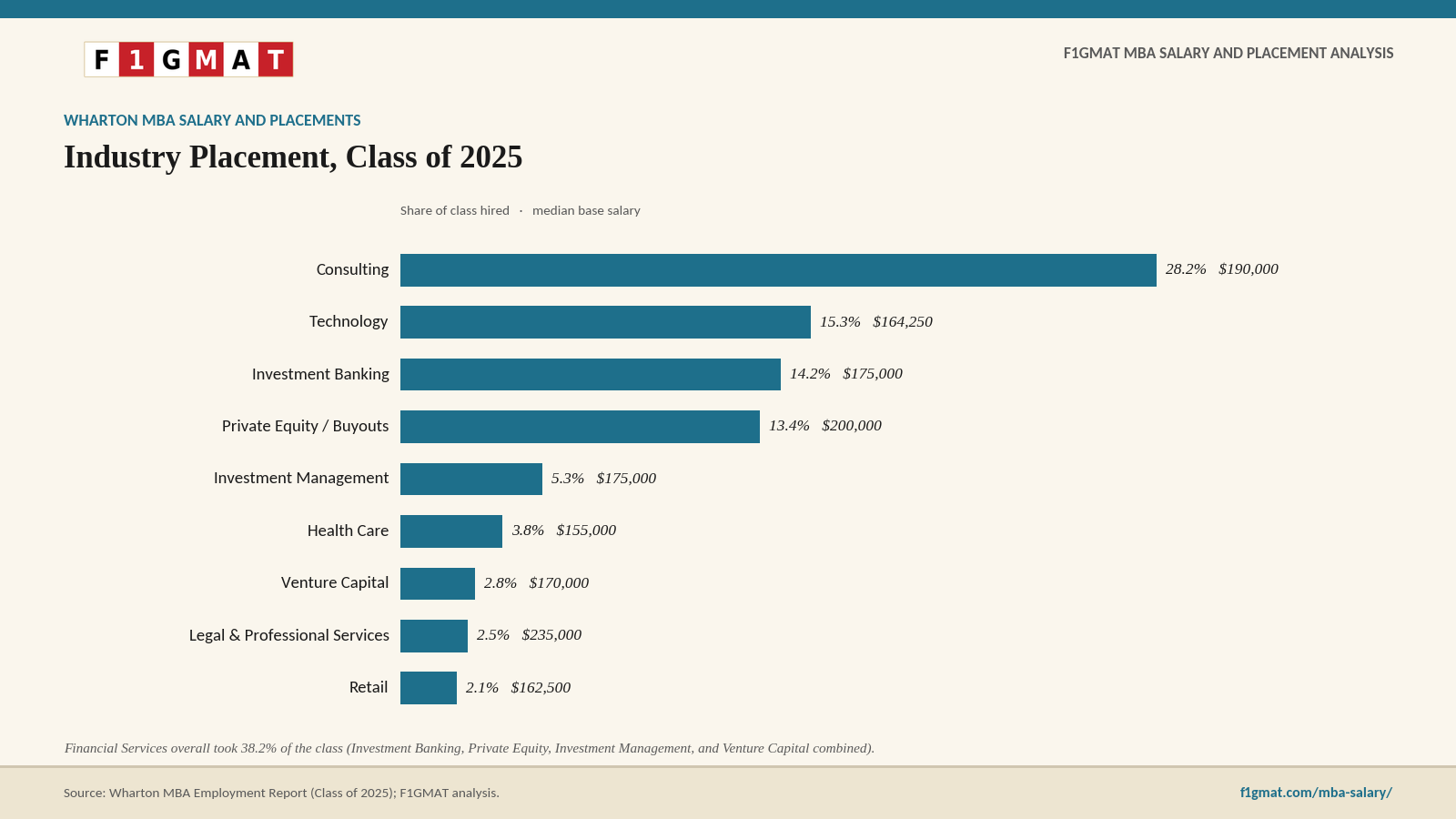
Financial Services accounted for 38.2% of Wharton MBA hires in the Class of 2025 at a $175,000 median base salary, holding its place as the school's dominant post-MBA industry and strengthening its share compared to the Class of 2024[2].
Investment Banking, Private Equity, Investment Management, and Venture Capital each moved in different directions as capital markets reset between Q3 2024 and Q2 2025. Investment Banking remained a stable niche within Finance. Private Equity paid the highest base salary, and Venture Capital contracted to a 2.8% share as more than 70% of new VC capital concentrated in a narrow set of late-stage AI and infrastructure platforms.
Application Tips for Wharton MBA Financial Services Applicants
Because the largest percentage is in Finance, starting with a generic or even a generic title or even the most popular employer should not be your goal.
Target instead a sub-segment in the first sentence of your goals essay.
If you spent two years as an investment banking analyst covering industrials, write that your goal is a private equity associate role at a middle-market industrials fund, and use one recent transaction experience to show why you want to gain a deeper perspective.
You could even go a step deeper, let us say into a carve-out transaction experience by communicating why such a transaction closed because of your role as the facilitator of the deal.
Note: A carve-out is the sale of a division that the parent company never ran as a standalone business
The diligence work that Finance candidates quote is generic. Adcom wants to understand your role in the transaction.
For example, in a carve-out, you might have built a pro-forma profit-and-loss statement that separated the consolidated cost of running the operation from the cost the unit will take to run as a standalone entity.
The cost was the missing piece that buyers could analyze.
Based on your estimation, they could price the asset.
Another value you brought could be the operating model that the unit never had before. This is the critical missing piece that helps a buyer understand the unit as a standalone business from the parent’s gigantic and consolidated numbers. The seller is excited to sell the division to focus on the core business.
By solving other operational roadblocks like software licensing and customer contracts, once a change of control happens, and the one-time cost of establishing a new entity, you are the bridge to that deal. Write about the pivotal moment where the buyer felt relief. Don’t reiterate some metric. Then, use that experience for Essay 2 to show how you look at stakeholder management as a holistic process.
A paragraph about your due diligence skills and stakeholder management before sharing how you will contribute at Wharton is the format an applicant from Finance should follow.
Essay 1: Goal Feasibility (50 and 150 Words)
Use the 50-word immediate goal to name the role a Wharton MBA could offer. A private equity associate role at a named middle-market fund is one such example.
In the 150-word answer, plan a career progression from associate to a role where you lead deals, then to a principal or operating-leadership role. If you are not using the carve-out experience in the Wharton MBA community essay, use the carve-out and value-creation skill as the starting skills you have to achieve your long-term goal in managing the entire deal.
Essay 2: Community Contribution From Your Expertise (350 Words)
Your carve-out and separation experience is something most of your learning team has never seen.
When you write that you will bring the operator's view of a deal to the Wharton Private Equity and Venture Capital Club and its annual conference, and to the cohort case work where finance and non-finance classmates take on the same problem, highlight what you mean by the ‘operator view’.
Share a plan to run a session on reading carve-out financials for the classmates recruiting into sponsor coverage, because teaching the standalone-cost analysis is a contribution that only someone who has done the real work can offer. The experience should not sound like something that an AI agent can automate.
Include the drama of buyers objecting to pricing or certain aspects of the operating model you were proposing.
How you brought them to your vision is the story the admissions team is evaluating.
Bring that ‘human’ element. This is what is lacking in most Wharton MBA narratives.
Trend #2: Investment Banking Holds 14.2% at a $180,982 Premium
Investment Banking employed 14.2% of the class by industry and 13% by function, at a $180,982 function-level median base salary that is above the $175,000 figure standard across M7 and Top 15 programs[2][3].
Employers were willing to pay more for Wharton banking hires even though the placements were below the 15.2% peak reached in 2024.
The recovery from Q4 2024 onward, with US M&A rebounding on fewer but larger transactions, including sponsor-led carve-outs, refinancing mandates, and take-privates such as the Walgreens Boots Alliance deal at roughly $23.7 billion has raised fee pools without requiring a proportional expansion of analyst and associates, as banks have adopted AI-enabled modeling and diligence tools.
When you write essays for the Wharton MBA, be mindful of the high selectivity and scrutiny employers employ before selecting your candidacy.
Application Tips for Wharton MBA Investment Banking Applicants
With fewer deals in the market, deal value is a larger focus this year.
The size of the deal also carries more structuring work per transaction, which needs fewer junior IB candidates.
Your role as an analyst needs a narrative around building the confidential information memorandum if you were working on the sell-side and coordinating the quality-of-earnings review, where you could do a line-by-line test of every single change made by the accountants.
What is the skill gap that you currently have that could be mitigated with a Wharton MBA?
Define the future role in managing the auction, or your potential role on the financial side.
Judgment is the common theme across job functions.
How will you quote the courses and experiences to build the judgment?
Before you sell the long-term vision, share who you are with one event.
Share how you revised your proposal and convinced the client of an equity-against-debt trade-off, and why you gained the buy-in while your peers couldn’t.
What is the judgment quality that is not visible in your peer’s thinking?
Close the essay by mapping the goal to one course that could build your strengths. Advanced Corporate Valuation is a good choice.
Share a career plan to pivot towards an investing role where relationship building is equally important as your quant expertise.
Essay 1: Goal Feasibility (50 and 150 Words)
Use the 50-word immediate goal for an associate role on a financial sponsor’s or leveraged finance desk at a named bank.
Because Investment Banking was stable at 14.2% of hires with a premium base salary, the 150-word answer should be based on one employer’s typical banking career path.
Deal execution skill is what will take you up the ladder.
Build the entire goals essay and Wharton experience around this one target skill acquisition.
Another strategy in a crowded IB profile is to break the stereotype.
When everyone is quoting the old advice to specialize early in just one niche (M&A, leveraged finance, or ECM), you can quote 2026 deals, including the Paramount-WBD financing, where multiple layers of capital — senior bank debt, private credit, structured equity (convertibles), and even large personal guarantees (e.g., Larry Ellison’s $43.3 billion backstop) were used[5].
You can quote the deal value vs. low deal number conundrum to build the case that diverse product exposure is the only way to be ready in a market where Bespoke capital structure is the norm.
Once you build the case, quote the combination of curriculum, and professors with the case they cover to share why the Wharton MBA is an urgent pivot for the rapidly changing IB industry.
Essay 2: Community Contribution From Your Expertise (350 Words)
Because you have strengths in deal execution, mention how you will use that experience for the Wharton Investment Banking Club and the Private Equity and Venture Capital Club in coaching first-years through recruiting. The important contribution is in sharing modeling strategies and capital-structure workshops in the weeks leading up to the interview.
Your communication skills should be established with Essay 1 and a resume, to sell the case that you can break down a complex financial structure to the class, similar to a case study.
A similar experience in college or a tutoring experience will add believability to the contribution narrative.
Trend #3: Private Equity Takes 13.4% at a $200,000 Base
Private Equity captured 13.4% of Wharton hires by industry at a $200,000 median base, the highest base inside Financial Services, and Private Equity and Venture Capital investor roles together rebounded to 13% by function from the 10% dip recorded in 2024[2][3].
Application Tips for Wharton MBA PE Applicants
How to Build a Narrative Around Your Expertise
Limited partners, the pensions and endowments that fund these firms, stopped accepting paper markups and started asking for DPI, the cash a fund has returned against the cash they put in. A fund that cannot sell a company cannot show DPI, so it has to create value inside the company it owns. That means resetting prices and taking costs out of procurement, freeing the cash trapped in working capital, and buying smaller competitors to build scale.
That value creation runs on a plan the firm writes before it owns the asset, the hundred-day plan that names the operational moves and the operating partner who will run them. If you spent a year embedded in a portfolio company resetting its pricing or renegotiating its supplier terms, that experience maps onto the work directly, and it carries more weight than three deals you sourced.
The skills for PE applicants are entirely entrepreneurial. You must show that you have run something.
Leverage and cheaper loans were a reality a few years ago, but with interest rate stagnation, such leverage is limited.
The fundraising in the private market is entirely captured by AI.
For anyone taking a brand private outside AI, their story becomes a contrarian narrative on thriving in a down market.
Establish this background. The AdCom might not be fully aware of this development.
Once you establish the background, build your goals and contribution narrative.
Essay 1: Goal Feasibility (50 and 150 Words)
The 50-word immediate goal should name a private equity associate role with an operating focus, because PE took 13.4% of hires at a $200,000 base salary and the operating angle matches what firms are doing now.
The exits through IPO are few. Secondaries have attained record deal value.
In the 150-word goals answer, mark a path from associate to a deal-leadership role and then to an operating-partner or principal role, and connect each step to the value-creation work you did with the portfolio company, so that the long-term goal reads as the natural extension of an operator mindset.
Essay 2: Community Contribution From Your Expertise (350 Words)
Your time inside a portfolio company is a unique experience.
You might have gained experience in market research, product development, stakeholder management, and driving costs down with product innovation and product management.
Your peers at Wharton might not have gained such diverse expertise on such short notice.
Share how this perspective will help your Wharton classmates.
Share how you will offer the Wharton Private Equity and Venture Capital Club a session on the hundred-day plan.
Share the changes to be expected in the first months of PE ownership.
Bring that operator's lens to your learning team's case work, where the question of whether a plan can be executed can be explained through a Finance and Operator’s lens.
Trend #4: Investment Management Pays $190,917, the Highest Investing-Function Base

Investment Management and Portfolio roles constitute 6% of hires by function at a $190,917 median base - the highest of any Wharton function, while the industry representation was 5.3% at $175,000[2][3].
Traditional equity managers faced pressure for demanding high fees, while capital concentrated in private credit, infrastructure, and AI-themed funds led to outflow of funds from IMs.
Managing this volatility requires specialized analytical judgment and superior client management skills.
Application Tips for Wharton MBA Investment Management Applicants
How to Build a Narrative Around Your Expertise
Lead with the reasoning behind one investment call.
Show how you separated a mispriced asset from a failing one.
A description of your screening process tells the AdCom how you take and spot risks.
Show how you anticipate change in market trends and the risk-reward philosophy.
Show how you bring the contrarian view, the focused narrative that influences the market to re-rate a stock, whether that is from a quarter of stable deposit numbers or a board decision to buy back shares.
Essay 1: Goal Feasibility (50 and 150 Words)
Make the 50-word immediate goal a research or underwriting role at a named fund in a niche like private credit or a sector-specialist strategy role.
The 150-word answer should start from an analyst and end at a portfolio manager role.
Focus only on the niche where you are planning to enter – private credit or sector-specific fund. Quote all courses around the sector. Avoid generic ‘Wharton’s Finance reputation’ narrative.
Essay 2: Community Contribution From Your Expertise (350 Words)
Bring the discipline of defending a thesis to the Wharton Investment Management Club and its stock-pitch competitions, where standing behind a call under questioning is the event itself. No one is as qualified as an IM.
In your learning team, you are the member who asks what the downside is and where the edge comes from, the poking questions that keep everyone on their feet.
Share how such rigor in thinking will improve the class’ learning experience. This is the only role where such universal peer learning is applicable.
Trend #5: Consulting Recovered to 28.2% as the Largest Functional Destination
Consulting hired 28.2% of Wharton MBAs by industry at a $190,000 median base, and Consulting and Strategy roles formed the largest functional destination at 31.4% with a $183,976 base[2][3]. The function recovered after a sharp drop to 25.2% in 2024.
Between Q3 2024 and Q2 2025, consulting demand came from AI-linked execution, post-merger integration, and operating-model redesign.
Global M&A deal value rose roughly 23% year-on-year in Q2 2025, while deal counts declined.
Open-ended strategy roles were deprioritized.
The $183,976 base in 2025, slightly below the $190,000 base in 2024, shows that firms are selective in consulting. The selectivity will continue with tighter ROI accountability as clients allocate their funds to compute and integrate AI in their entire workflow.
Application Tips for Wharton MBA Consulting Applicants
How to Build Narrative Around Your Expertise
Clients stopped paying for an open-ended view of what their strategy should be once their own teams and AI tools could produce the same result. They prioritized ideas that could be implemented and measured.
A common narrative in consulting is around post-merger integration. While earlier iterations of this narrative were around cultural integration, you can bring the implementation angle with examples on finding cost savings through eliminating duplicate roles, merging product features, or even deprioritizing products that could cannibalize the efforts of star developers.
Focus entirely on the cost savings.
Operating-model work and AI deployment follow the same logic.
Operating model redesign could be around the new hierarchy that AI agents introduced. How did you design the layers of management after AI integration?
For AI integration at a functional level, the challenges for a consultant would be validating the quality of the data and the impact of AI on roles and responsibilities.
Which roles get redundant? Which roles get upgraded?
Essay 1: Goal Feasibility (50 and 150 Words)
It is unlikely that the same demand will continue in AI when you graduate in 2029, but for now you, must position yourself as the ‘implementation’ specialist.
Choose post-MBA consulting roles with this niche in mind.
The 150-word answer should show the path from consulting to engagement leadership and then towards a partner or in-house operating role, with each step tied to the delivery work you have done, and plan to do every 2-3 years.
Quote the Management Consulting Practicum and explain why you are uniquely suited for the practicum.
Essay 2: Community Contribution From Your Expertise (350 Words)
Start with a measurable outcome – like how you produced a measurable result in eight weeks under a fixed budget. Show that this mindset to turnaround organizational outcomes will be beneficial for the Wharton Graduate Consulting Club, where several cases are around such tight deadline constraints or resource limitations. For the learning team, you will be the person who can turnaround ideas into a working plan with the owners and a timeline defined for everyone.
Trend #6: Technology Held 15.3% but Stayed Labor-Light; Product Management Fell to 5.9%
Technology accounted for 15.3% of hires at a $164,250 median base, a continued recovery from the post-2022 contraction that is still well below the early-decade highs[2]. Product Management roles fell to 5.9% by function, down from the 19% from the tech-heavy peak in 2021, even as the function held a competitive $179,721 base salary[3].
The cycle of boom and bust produced a clear disconnect - record technology investment alongside restrained MBA hiring.
Location compounded the effect.
Wharton's distance from the West Coast hiring base limited its product management volume against Stanford, MIT, Berkeley Haas, and UCLA Anderson, though the $179,721 base shows the roles that remained were concentrated in enterprise, B2B, and monetization-linked functions.
Application Tips for Wharton MBA Technology Applicants
How to Build Narrative Around Your Expertise
Hyperscalers committed tens of billions of dollars to AI infrastructure, data centers, and semiconductor supply chains.
A decision to choose you is a decision between choosing a human vs. a machine with 5 year shelf life and unlimited training potential.
Only by positioning yourself as an enterprise expert or a product person with a strong grasp of monetization can you stand out in a job market where Wharton MBA product management offers fell to 5.9%.
Earlier, the software cost was license-driven and fixed. With AI models rationed on usage, the cost of intelligence is an extremely important KPI while evaluating the ROI of each employee.
For the product roadmap, the challenge is even more substantial, as the subscription cost must also factor in the cost of AI in building it. These are double entries, and unless owners of each feature rigorously cull the extra spend, the margins will be at risk.
The harder commercial problem is differentiation.
When every company builds on the same handful of foundation models, the product on top is at risk of looking like a thin wrapper.
If you are passionate about products, keep the focus on the foundation of a good product – design, user preference, and utility.
If you are in Enterprise selling, share the buying cycle, and the disruptions each sale faces from the time of the commitment to the time of sale. Sharing that world through the essays will build the conflict-resolution framework ideal for a memorable essay.
Essay 1: Goal Feasibility (50 and 150 Words)
Make the 50-word immediate goal a commercial-strategy or business-development role at a named enterprise technology firm.
The 150-word answer must address how a candidate priced a new model tier against the cost of serving it, and what that did to gross margin. The commercial command should be evident when you portray the enterprise market in the next 3-5 years and where you fit into that world.
If your goal is the West Coast, give a clear reason for choosing Wharton over a program closer to that hiring base.
What particular coursework and orientation will help you acquire a skill that Bay Area schools can’t offer?
Talk about the changing paradigm in enterprise sales where expertise in pricing and cost management is equally important as a strong grasp of the product.
Essay 2: Community Contribution From Your Expertise (350 Words)
Bring the commercial view of AI to the Wharton Technology Club and the Wharton FinTech community, where students have to evaluate the market potential and the longevity of the Hyperscalers in a post-AI world.
Share a plan to offer a session on the unit economics of an AI product. Most classmates have worked with sophisticated AI, but they do not fully understand the triggers that convert an interest in AI to an enterprise-level 20,000-seat sale.
These insights are deeply meaningful for a Wharton MBA peer.
Trend #7: General and Project Management Reached 10.2% as Execution Roles Expanded
General and Project Management roles accounted for 10.2% of hires by function at a $152,169 median base salary. The demand arose[3] as firms across consulting, technology, and healthcare slowed headcount growth and placed more weight on cross-functional coordination and cost control.
The Business Analytics major helps candidates integrate analytics and AI into operating decisions. For candidates working with Supply Chain partners, the Operations, Information, and Decisions major offers direct value in manufacturing and supply-chain engagements where operational efficiency matters the most.
Application Tips for Wharton MBA General Management Applicants
How to Build Narrative Around Your Expertise
A general manager owns the outcome but depends on many variables, from talent utilization, cost of equipment, and leverage over the supply chain, while negotiating with finance for acceptable margins.
If you ran a regional unit and held its margin through a supply disruption, write the trade-off you had to negotiate.
What did you prioritize to keep the largest customer happy?
How did you protect your margin?
Essay 1: Goal Feasibility (50 and 150 Words)
The 50-word immediate goal should name a profit-and-loss or operating role in a rotational leadership program or a business unit.
Because General Management offers at Wharton were 10.2% of hires, the 150-word answer must name the major that matches your work.
Operations, Information, and Decisions major is the popular choice for a supply-chain goal.
Share how you entered the function and why you feel General Management will deepen as job functions automate at scale.
Essay 2: Community Contribution From Your Expertise (350 Words)
Your value to the Wharton community is from the perspective of a multi-functional talent who can take any dynamic team and derive an outcome from them, fully knowing that there will be several pivots on the way.
If the learning team or a club is tackling a new initiative, they desperately need such leaders, who shine under deadline pressure.
Offer to lead a new initiative at Wharton, and bring the operator's judgment to the leadership clubs and the Leadership Ventures.
Trend #8: The Northeast Absorbed 54.5% of the Class at a $185,000 Base, The West Accepted 19.2% as Business Development Rose to 4.2%
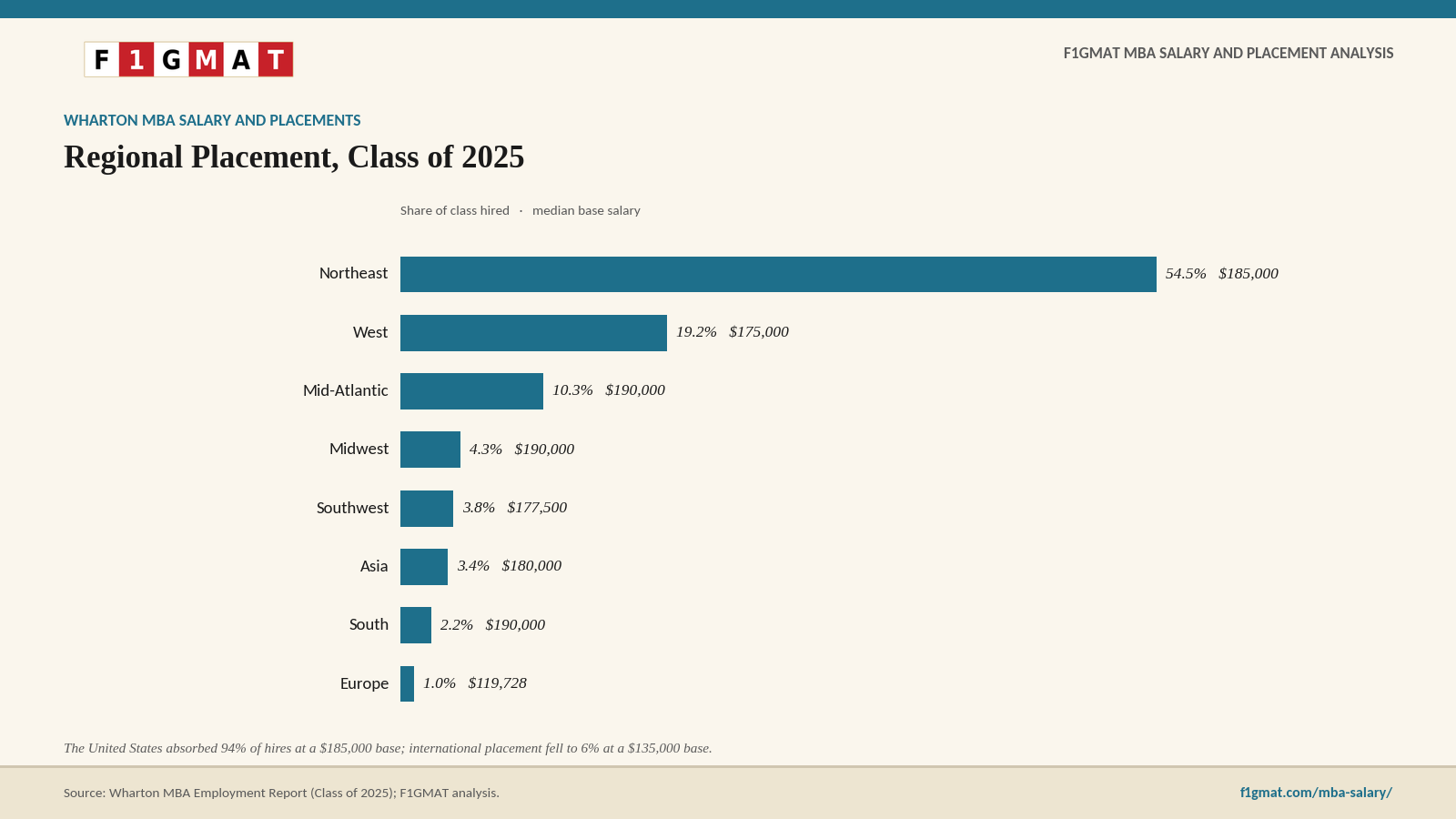
Within the United States, the Northeast alone accounted for 54.5% of total hires at a $185,000 median base, by far the largest regional cluster and a clear increase over the prior year[4].
Wharton’s role as a finance school is confirmed.
New York and the broader Northeast corridor remained the primary execution hub for investment banking, private equity advisory, restructuring, and sponsor-related transactions. Even deals with global footprints were staffed and managed from Northeast offices. Consulting firms routed a large share of integration and transformation work through Northeast teams working in financial institutions, healthcare systems, and infrastructure assets.
The West accounted for 19.2% of hires at a $175,000 median base, the second-largest US region by volume[4]. The base salary was above schools with stronger engineering identities, such as Berkeley Haas and MIT Sloan, even as the West's overall MBA role count stayed below pre-2022 levels.
Application Tips for Candidates with Strong Regional Ties
How to Build Narrative Around Your Connections
Treat the Northeast as the target share about the unique restructuring, sponsor advisory, and capital-markets execution opportunities in the region.
But don’t paint a broad picture only around the corridor.
New York holds the banking and private equity opportunities, along with the hedge fund roles; Boston is the home of the asset managers, of healthcare and biotech investing, with a deep consulting bench.
Choose the city accordingly.
The Mid-Atlantic is a different market with a $190,000 base salary and a 10.3% share, where the roles were clustered around the federal government.
Map your role to region to city, and share where you fit in.
If you have a connection to the region – founding a venture or family, share why a region is a higher priority.
For candidates moving to the West, the region experienced heavy capital investment into AI infrastructure, cloud platforms, semiconductors, and data centers, but that investment produced fewer MBA-level roles than earlier technology cycles. The roles that were available were concentrated in product operations, internal strategy, and business development.
For Business development candidates (4.2% of hires) at a $171,989 base salary, focus on how your talent will be extremely useful when the market is flooded with AI-native Apps or Saas-modified AI Apps.
Essay 1: Goal Feasibility (50 and 150 Words)
Make the 50-word immediate goal name both the role and the city.
The 150-word answer should keep the geography consistent when narrating plans to establish yourself in the region.
Essay 2: Community Contribution From Your Expertise (350 Words)
Offer to organize a Wharton club trek to the New York or Boston firms in your specialization. For your learning team, you could be the person who can connect a case to the real institutions where staff work.
Since Wharton has no dedicated leadership track around AI, a Business development person could share how the specialization is the foundation for strategic M&A and partnership, and in positioning a growing product range in models, and agents[3].
Wharton AdCom has a favorable impression of a candidate with strong regional ties or functional identity. Lean into it.
They know that as an Alum you could open new opportunities in the firm and in the region with your network in the next 3-5 years.
Trend #9: International Hiring Fell to 6% as US Placement Reached 94%
International hiring fell to 6% of the class at a $135,000 median base salary, while the United States placed 94% of Wharton MBA hires at a $185,000 base salary, a structural re-concentration of hiring into the US market[4].
Asia stood apart. It represented 3.4% of hires at a $180,000 base salary, ahead of the US figure in some functions and mostly concentrated in finance and strategy roles tied to cross-border deals.
Application Tips for International Wharton MBA Applicants
How to Build Narrative Around Your Expertise
For international applicants planning to return to Asia, use goals where your role will be closely tied to cross-border deals like advising on a US company's acquisition of an Asian business, or an Asian acquirer's move into the US, where the value is in bridging the regulatory and cultural distance between the two sides of a transaction.
Essay 1: Goal Feasibility (50 and 150 Words)
Even for American candidates interested in the Asian market, make the 50-word immediate goal a US-based role with a keen interest in learning about a cross-border US-Asia advisory role in Singapore or Hong Kong.
The 150-word answer should keep the work tied to the US or to US-Asia deal flows.
Essay 2: Community Contribution From Your Expertise (350 Words)
If you have experience in cross-border transactions or cross-border consulting, keep that experience as the central contribution narrative, even if the percentage of international students has fallen sharply at Wharton. Your value is in offering peers in the country a perspective on doing business in Asia and the processes involved in closing a deal.
Key Takeaways for 2026-27 M7 and HSW Applicants
Applicants targeting Wharton, Harvard, and Stanford in the 2026-27 cycle should internalize five takeaways from the Class of 2025 placement data.
1. Wharton is a finance school anchored in the Northeast
Financial Services took 38.2% of the class and the Northeast absorbed 54.5% of all hires.
Position your "why Wharton" around this regional trend
2. Finance now rewards ownership and execution
Private Equity paid the highest finance base salary at $200,000, Investment Management paid $190,917, and even Investment Banking held a $180,982 premium for deal-execution skills.
Position your owner mindset and emphasize skills in capital allocation, underwriting, and operating expertise. Limit any generalist or general leadership narratives.
3. Consulting recovered, but only the execution version
Consulting rebounded to 28.2% of hires by industry and 31.4% by function, entirely driven by AI implementation, integration, and operating-model work.
An essay showing awareness of the changing skill demand in consulting is a meta way to show the AdCom how you will thrive, with changing times.
4. Technology means enterprise and commercial, not classic product management
Technology held 15.3% of hires while Product Management fell to 5.9%.
The openings were in enterprise, business development, and monetization.
A technology goal should target these functions and keep the engineering narrative to near zero.
Talk about market dynamics, competition, and monetization challenges in a copycat market where the barrier to entry has been disrupted with AI.
5. The US market is where execution capability gets rewarded
The US absorbed 94% of hires while international placement fell to 6%.
Employers prioritized immediate execution skills. A candidate should show deep awareness of the US and Asia markets where the US funds typically move around.
References
- Wharton MBA Employment Report, Class of 2025 (Career Management) · The Wharton School ↩
- Wharton MBA Salary: By Industry (2025) · F1GMAT ↩ ↩ ↩ ↩ ↩ ↩
- Wharton MBA Salary: By Job Function (2025) · F1GMAT ↩ ↩ ↩ ↩ ↩ ↩ ↩
- Wharton MBA by Job Location (2025) · F1GMAT ↩ ↩ ↩
- Q1 2026 Investment Banking Trends ↩