AI commercialization moved from experiment to mass adoption. The placements for the Class of 2025 at Harvard Business School shows the shift.
For the 2026-27 Harvard MBA applicants, targeting Stanford and Wharton too, the year-over-year shifts against the Class of 2024 shows a clear trend towards increased AI integration opportunities.
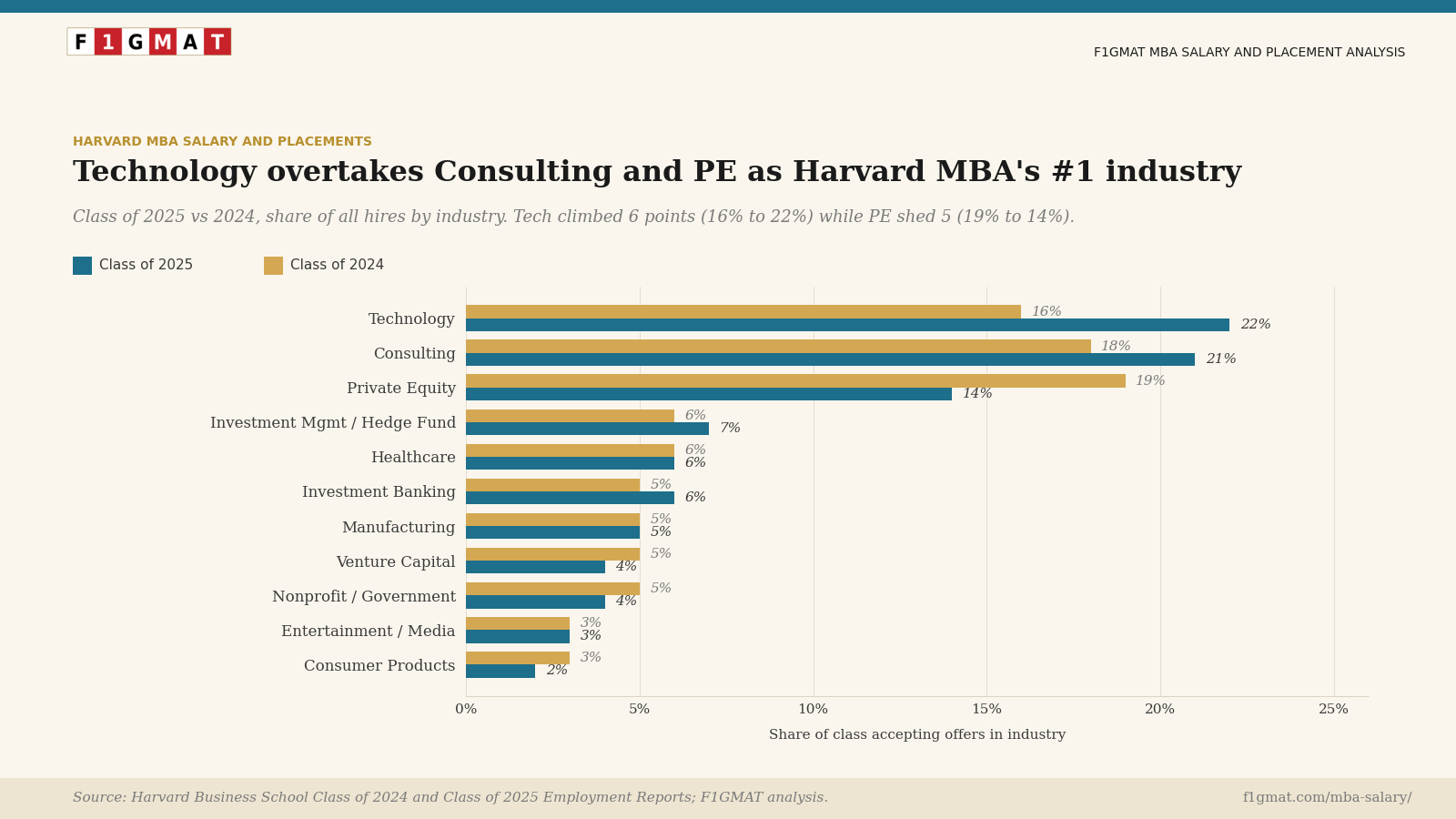
Technology overtook Consulting and Private Equity, the West Coast added seven points of class share, and 155 graduates founded companies, with 62 of those launching social-impact ventures.
TL;DR
- Technology became the #1 industry at 22% of hires, up from 16% in 2024 while Median base salary climbed from $165,000 to $178,000.
- Private Equity dropped from 19% to 14% of the class (the steepest year-over-year decline), even as median total comp rose from $211,363 to $217,500.
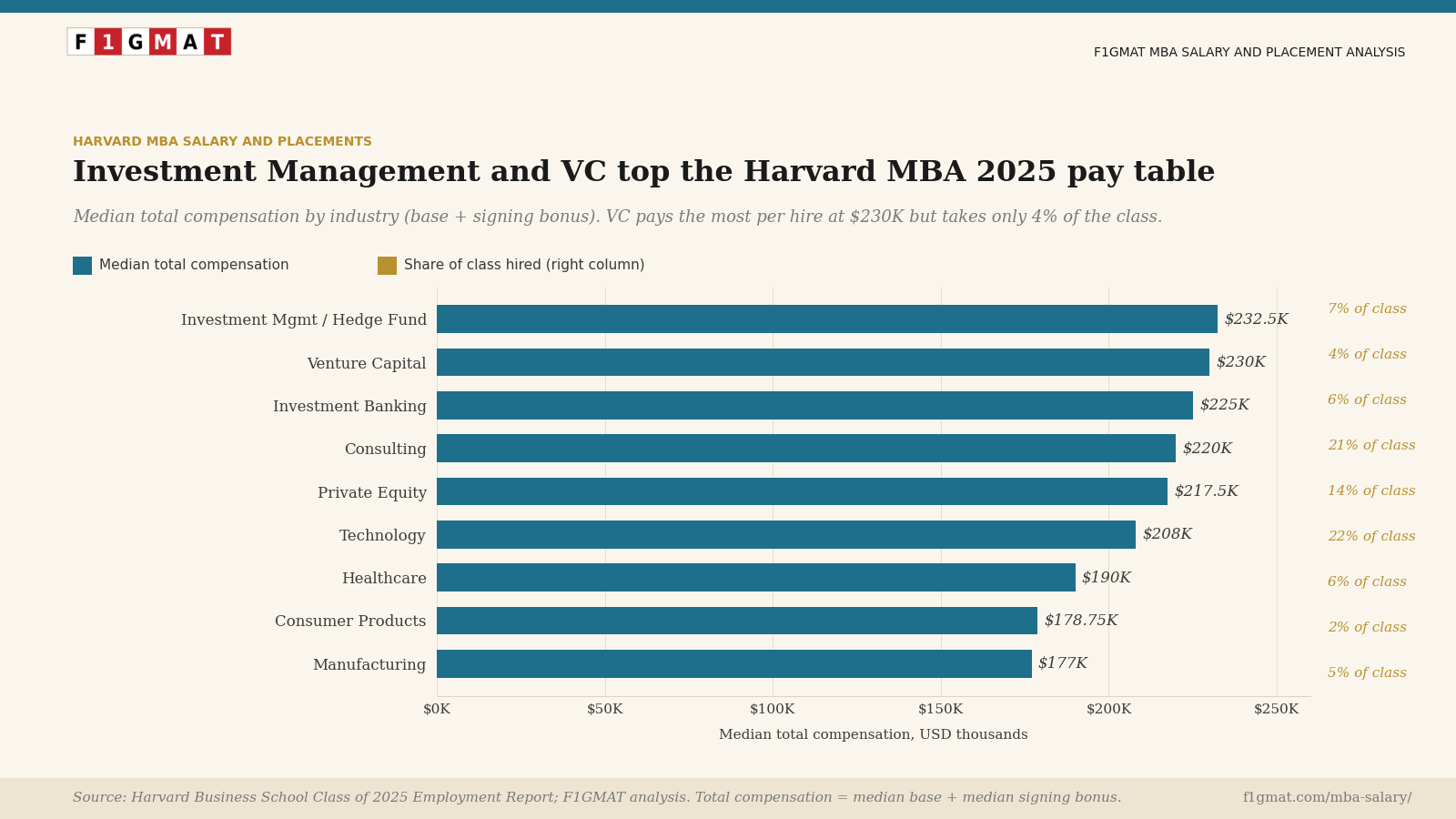
- Investment Management and Hedge Funds lead the pay table at $232,500 median total compensation, ahead of VC ($230,000), Investment Banking ($225,000), and Consulting ($220,000).
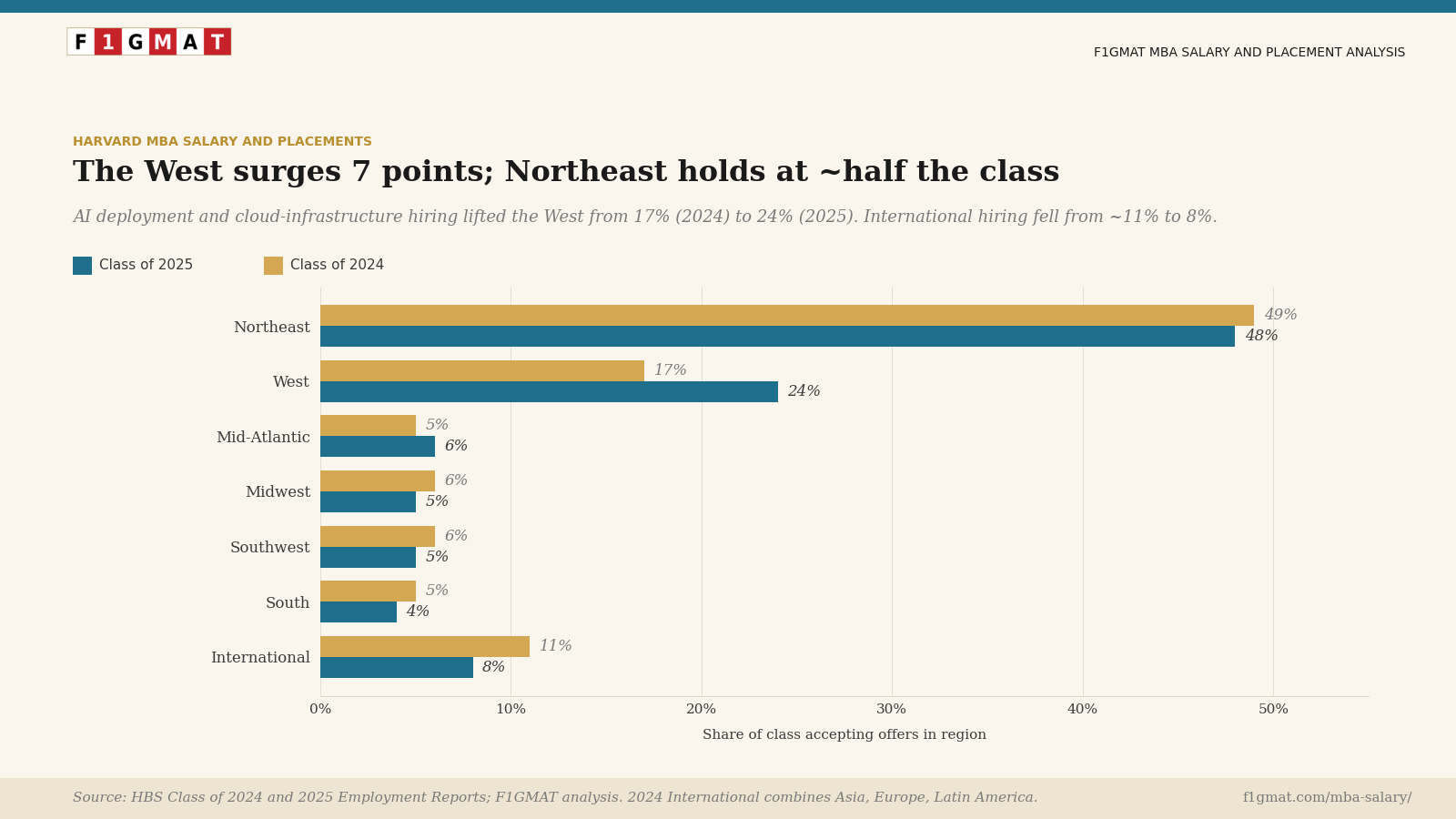
- The West Coast share jumped from 17% to 24%, driven by AI commercialization in the Bay Area and Seattle. The Northeast held at 48% (down 1 point).
- 17% of the class joined startups (private companies under 10 years old) at $175,000 median base. The class produced 155 founders and 62 social-impact ventures.
- Finance fell as a function from 38% to 33% of all hires, with bonuses compressing from $50,000 to $40,000.
Contents
- Trend #1: Technology Takes the Crown
- Trend #2: Private Equity Drops 5 Points in Hiring, Pay Climbs
- Trend #3: Consulting Rebounds in Volume, Holds the Line on Pay
- Trend #4: Venture Capital - Fewer Hires, Highest Base Salary
- Trend #5: Investment Management and Hedge Funds Crack $232K
- Trend #6: Finance Function Loses 5 Points but Stays #1
- Trend #7: Business Development Function Picks up
- Trend #8: The West Surges to 24%
- Trend #9: The South Is Now Harvard's Highest-Paying Region
- Trend #10: Startups and Founders Are Back
10 Trends in Harvard MBA Class for 2026-27 MBA Applicants
Trend #1: Technology Takes the Crown
Technology overtook Consulting and Private Equity to become the #1 destination for Harvard MBAs[2]. The climb from 16% of hires in 2024 to 22% in 2025 also added a $13k jump in median base salary from $165,000 to $178,000. The total compensation moved from $190,000 to $208,000.
Inside Technology, the role mix shifted away from Product Management toward commercial leadership as seen in the 36% entering Marketing, 20% into Business Development, and 16% in General Management functions, mirroring the industry-wide supply-demand mismatch. The bulk of the technology candidates and product management talent are now replaced by AI and AI agents.
The shortage is in selling and marketing these sophisticated products.
Harvard MBA Application Tips for Technology Applicants
Because the surge in interest has been mostly in Business Development and Marketing roles, a pure engineering play in the essay is unlikely to help you stand out. But if you are a Product Person, share examples where you saved costs for the company.
Case Study: Systems Thinking and Cost Cutting
One applicant went with the assumption that every 2 months, the intelligence of the model will improve, and one must abandon the model and pivot to a smarter model. One artifact that didn’t change throughout the entire cycle was the internal intelligent dashboard the company used.
The systems thinking to keep adding intelligence to the local dashboard was the strategy that helped the person pivot from a pure product role to a strategy role, which he wants to pursuit full-time with a Harvard MBA.
By the 3rd iteration of an AI model, the local dashboard was as smart as the cutting-edge AI models in the market for the niche industry.
The company could now reliably unsubscribe from frontier models and depend on the locally trained models for the company’s specific workflow.
The cost saved was in millions.
Trend #2: Private Equity Drops 5 Points in Hiring, Pay Climbs
Although PE made a record breaking comeback from Q1 2026, for the 2025 graduating class, the markets were entirely different.
PE hiring fell from 19% (2024) to 14% (2025), the steepest single-year drop among major industries at Harvard.
The contraction came from slower fundraising and exit activity.
The comp trend tells the opposite story: median base climbed from $180,000 to $187,500 and total compensation from $211,363 to $217,500, with 49% of the (much smaller) PE cohort placed in the Northeast.
Harvard MBA Application Tips for PE Applicants
The trends have reversed, starting from Q4 2025 to Q1 2026, but still, the concentration of funds in a few funds means that unless you are from that fund, the examples you cite will always be quoted against the PE professionals with hands-on experience in deals that dominated the new cycle.
Case Study: Carve Out and Add-On Examples in the Middle Market
The 14% entering PE, a drop of 6%, is likely to reverse in 2026. Instead of going by the 2025 narrative, imagine a recovered market. Address the weaknesses if you are working in a middle-market PE firm.
Instead of positioning yourself against the big players, talk about the volume and evaluation metrics you devised to vet AI, energy, or data center businesses.
Because the upside potential is high, share a few new innovative strategies you adopted to bring the best value out of portfolio companies.
Although the mega deals have come down in this niche, add-ons and carve-outs have increased in a distressed economy. The 2021-23 investments in SaaS have not played out as imagined.
Share one such example where you found an opportunity for a carve-out that later became a big bet for the industry.
Note: The Operating role experience in a PE firm or an Investment Banking role, alone with name brands, will not convince the AdCom.
Bring a unique ‘experience’ narrative to the Harvard MBA essay.
Trend #3: Consulting Rebounds in Volume, Holds the Line on Pay
Consulting, considered to be a recession proof industry has its year of reckoning in 2024, but 2025 was a relatively good year. The industry placement at Harvard recovered from its 2024 slump, rising from 18% to 21% of the class.
The compensation structure has remained stagnant. Even the pull of the Harvard MBA brand couldn't turn around the reality of Consulting compensation with equity actively considered at McKinsey as an alternative to the bonus cash option.
The Median base salary stayed at $190,000 and total compensation at $220,000, the same numbers as last year.
The hiring mix changed underneath.
Firms with a rise in implementation demand pulled back on generalist hiring[3]. The shift again is driven by AI and the massive private credit fueling the boom.
Most of the consulting opportunities are in AI deployment, transformation, and operational restructuring practices. These consulting are increasingly in Finance, Pharma & Healthcare and industries as seen with 44% of Consulting hires placed in the Northeast[4].
Harvard MBA Application Tips for Consulting Applicants
A quick adjustment you must make this year is to highlight the practice where you want to get in after an MBA.
Although Artificial Intelligence / Generative AI & Digital Transformation was the theme for the past 2 years, the momentum is shifting towards responsible AI as models have attained intelligence that could be a direct threat to stakeholders and even communities around the world.
An essay acknowledging the threat while also addressing the potential to maximize human potential should be narrated with a stoic balance.
Even though the Oil disruption from the Iran war has set in motion a pivot to fossil fuels to address the supply shock, the pivot is only a short-term effort. Decarbonization and green energy efforts are accelerating.
Climate Strategy, Decarbonization, and Net-zero related consulting engagement has high recall in an HBS MBA application.
Prioritize these three themes.
For applicants with experience in Pharma, value-based care has been the theme ever since Q4 2025, primarily to address the federal funding gap and the high cost of healthcare in the US.
A preventive medicine push requires greater emphasis on value-based care.
PE firms have been most active in AI and Pharma/healthcare consolidation.
Any experience in these two niches or integrating AI to streamline operations or reduce costs in healthcare delivery will be valuable for the essay.
Trend #4: Venture Capital - Fewer Hires, Highest Base Salary
After the inflated valuation that drove most of the demand for VC candidates in 2021-23, 2023 with the entry of AI was a year of reckoning for the VC function.
The portfolio companies where the funds flew were not into any cutting-edge AI technology. They were Web 3.0 iterations in a post-pandemic era where investors assumed a digtial only lifestyle.
The downfall of VC representation across M7 and HSW continued.
VC's share of the class slipped from 5% to 4%.
Unlike the 2021-23 period, there is a high barrier of entry for VC candidates.
Harvard embodies that selectivity as the median base salary jumped from $177,500 to $200,000, a $22,500 increase with an equally impressive doubling of median signing bonus from $15,000 to $30,000.
The total compensation accelerated from $192,500 to $230,000, putting VC ahead of Consulting and PE on total compensation.
Harvard MBA Application Tips for VC Applicants
PE dominance in the past three years set in motion VC’s shrinking power in startup ecosystems where even seed funds required were in the billions for scaling AI compute.
The overindulgence in investing through the 21-23 on a digital first-world a.k.a a future Meta bet on and lost means, targeting Harvard MBA with a thin thesis on finding opportunities in an overvalued market is not sufficient.
Applicants must strategically place investing experience and include interactions with a founder network, or at least operating experience in a niche that qualifies you to frame post-MBA goals in a VC role.
Strongest candidates will have some public ideating platform like a personal website or a substack and even a newsletter with a considerable audience where your investing thesis have been produced, challenged and tested by the entrepreneurial audience or VC peers.
Trend #5: Investment Management and Hedge Funds Crack $232K
PE's loss was Investment Management and Hedge funds gain at Harvard.
The cohort grew from 6% to 7% of the class and now carries the highest median total compensation of any industry cluster at $232,500 (up from $227,500).
The Median base rose from $177,500 to $182,500, with the $50,000 signing bonus remaining unchanged.
53% of these hires landed in the Northeast and 25% in the West, showing the concentrated hiring at firms building AI-augmented quantitative platforms.
Trend #6: Finance Function Loses 5 Points but Stays #1
Finance as a function dropped from 38% of placements in 2024 to 33% in 2025, but they represent the largest functional category at HBS.
Despite PE as a function falling at Harvard, 49% of hires went to PE and VC, the highest representation.
20% to Investment Management, and 17% to Investment Banking complete the Finance breakdown.
The worrying part if the lack of growth in base salary that improved marginally from $175,000 to $177,500, while the signing bonus fell from $50,000 to $40,000.
The upward-downward trend of the base salary vs. bonus pushed the total compensation down to $217,500 from $225,000.
Harvard MBA Application Tips for VC Applicants
PE dominance in the past three years set in motion VC’s shrinking power in startup ecosystems where even seed funds required were in the billions for scaling AI compute.
The overindulgence in investing through the 21-23 on a digital first-world a.k.a a future Meta bet on and lost means, targeting Harvard MBA with a thin thesis on finding opportunities in an overvalued market is not sufficient.
Applicants must strategically place investing experience and include interactions with a founder network, or at least operating experience in a niche that qualifies you to frame post-MBA goals in a VC role.
Strongest candidates will have some public ideating platform like a personal website or a substack and even a newsletter with a considerable audience where your investing thesis have been produced, challenged and tested by the entrepreneurial audience or VC peers.
Trend #7: Business Development Function Picks up
Business Development rose from 8% to 10% of the class, a 25% year-over-year increase in share.
Median base climbed from $165,000 to $175,000 and total compensation from $192,500 to $200,000.
Most demand in the business development function was in Technology (43%).
Pharma and Healthcare with increased AI integration also needed the support of marketers and salespeople where 22% of Harvard MBA graduates entered. Manufacturing with 16% in BD function arose from a surge in demand for eco-friendly, and low-carbon products. BD professionals help companies win green contracts, achieve certifications, and tap into sustainable supply chains.
Harvard MBA Application Tips for Applicants Entering Business Development Role
In a market where AI’s sameness is slightly disrupted by performance benchmarks and context windows, Business Development plays a direct role in driving revenue and market expansion.
Equally important in such an ecosystem, where the roles of chip manufacturer, model developers, or AI orchestrators are blurring, are BD professionals capable of building win-win channel partnerships.
For a Harvard MBA Application in 2026-27, BD post-MBA goals are one of the strongest paths.
Find a credible thesis on why a vertical is the right choice for you.
Prioritize Technology, Pharma, or Manufacturing experience for the essay.
Trend #8: The West Surges to 24%
As expected, The West's share of placements jumped from 17% (2024) to 24% (2025)[4], a 7-point gain that correlates with the strong AI deployment and cloud-infrastructure hiring in the Bay Area and Seattle.
The Median base salary in the West rose from $180,000 to $190,000 and total compensation from $210,000 to $220,000.
Meanwhile, the Northeast slipped from 49% to 48%, with its own pay rising: base from $175,000 to $180,000, and total compensation from $205,000 to $210,000.
Harvard MBA Application Tips for Applicants Targeting the West Coast
The Boston and the network in East Coast is slowly dwindling in favor of the Bay Area, Seattle or LA as Harvard sends a quarter of the class to the West.
For applicants remotely connected with AI or Technology, build real network with west coast companies, HBS MBA alumni clubs, trek organizers and recruiters, before bringing that experience into the essay.
Real research work carry more weight than MBA tours or reading online about job placements in the West Coast.
Trend #9: The South Is Now Harvard's Highest-Paying Region
The South cut its hiring share from 5% to 4%, but median base salary rose from $175,000 to $191,000 and total compensation from $205,000 to $221,000[4], giving Harvard MBA graduates entering the region with the highest salary, according to the 2025 HBS MBA Employment report.
Consulting drove this demand. 41% of Southern placements were in Consulting, supported by data-center buildouts in regions with strong renewable and potential to build nuclear energy plants.
Logistics expansion and nearshoring activity in Georgia, North Carolina, and Tennessee to counter The Big Beautiful Bill fall out in Tariff rate is another factor driving the demand.
The Mid-Atlantic also saw a $10,000 jump in total compensation (from $202,000 to $210,000), led by tech-enabled government modernization in the D.C. corridor.
Harvard MBA Application Tips for Applicants Targeting the South
For applicants targeting the south, the career move is unconventional. Obviously, you can’t use the pay narrative. Bring a personal story that connects your story to Atlanta, Austin, Nashville or Charlotte. Add to the personal story a professional experience in advanced manufacturing, energy, or data centre build out experience for the 2026-28 application cycle.
Trend #10: Startups and Founders Are Back
17% of the Class of 2025 joined startups (private companies ten years old or younger) at a $175,000 median base salary[5], up from the 14% who 'ventured into entrepreneurship' in the 2024 report[6].
70% of these startup hires went into Technology, 11% into Healthcare, and 11% into Manufacturing.
The class also produced 155 founders and 62 social-impact ventures, with 37% of new companies in Technology and 35% in Financial Services.
A larger percentage of entrerpeenrus are entering fintech and infrastructure software compared with earlier cohorts.
Harvard MBA Application Tips for Applicants Targeting Startups
Don’t start with the scaling goals or hedging stories.
Start with why you are building something.
In a down market, the trend is to enter the entrepreneurial world and build products/services as a hedge against a down market, where your 6-month investment in a job search might give you very little in return.
As a Harvard grad, you will get an offer, but they might not fit what you had anticipated.
HBS knows this technique.
A better alternative is to build an MVP that could scale. Share where you are in the product lifecycle, and how the HBS MBA will drive the growth of the venture.
You don’t need a sacrifice narrative.
Even with seed funds, a portion is dedicated to covering an entrepreneur's expenses and providing a competitive wage.
Focus instead on why the diversion from a typical entrepreneurial path, pitching to investors, MVP, iterate, iterate, and find scale, and into the HBS ecosystem.
You must know the entrepreneurial ecosystem in Harvard like the back of your hand.
Key Takeaways for 2026-27 M7 and HSW Applicants
Applicants targeting Harvard, Stanford GSB, and Wharton in the 2026-27 cycle, remember these 5 takeaways:
Technology at 22% of hires is a primary career path at Harvard overtaking Consulting and PE
Essays and recommendations that demonstrate product judgment, AI commercialization experience, or systems thinking are timely without needing to bring in any engineering-heavy jargon into the application.
Private Equity even though fell in share of the class entering the industry, still attracts top talent, especially after the Q1 2026 resurgence.
Pre-MBA banking or buy-side experience matters more than it did in the Class of 2024 cycle. Applicants without that background should think carefully about whether to position PE as a primary post-MBA goal or as a secondary path behind Consulting or Investment Management.
The West Coast rise in hires is from the AI boom
Harvard now sends 24% of the class to the West, narrowing one of the historical gaps between Harvard and Stanford GSB.
Applicants without a West Coast network, particularly international candidates, should plan for that geography during the recruiting season.
Even though selective (7%) with the highest compensation ($232,000), Investment Management and Hedge Funds reward quantitative competence.
Candidates with strong analytical mind even outside traditional Finance backgrounds should target this function.
As seen in any down economy, entrepreneurship is rising.
17% of the class chose startups at full MBA base salaries, with 155 founders and 62 social-impact ventures.
The difference from the 2008-09 entrepreneurial boom is that now, we have a much more evolved ecosystem where entrepreneurs are compensated well.
You don't have to focus too much on the 'sacrifice' part of the entrepreneurial narrative.
Focus on the beneficiary and the systems you plan to disrupt.
References
- Harvard Business School, Class of 2025 Employment Report
- Harvard MBA Salary: By Industry (2025) (F1GMAT) ↩
- Harvard MBA Salary: By Job Function (2025) (F1GMAT) ↩
- Harvard MBA Salary: By Job Location (2025) (F1GMAT) ↩ ↩ ↩
- Entrepreneurship at Harvard MBA: 2025 (F1GMAT) ↩
- Analysis: Harvard MBA Salary and Placements (2024) (F1GMAT) ↩