The ratio of US to International students selected every year will give you a perspective on the class composition over the years.
Here are the percentage of International students over the past five years:
2012: 37%
2011: 33%
2010: 34%
2009: 34%
2008: 37%
A 33-37% International students over the past five years is a healthy class composition. You will get a better understanding of your chance to get into stanford full-time MBA program if you look at the regional breakup for the class of 2012.
Africa: 2 %
Asia: 11 %
Europe: 6 %
North America: 64 %
Latin America and the Caribbean: 5 %
Oceania: 1 %
Dual citizenship: 11 %
Another factor that influence the admission is the gender of the applicant. We haven’t come across many top Business Schools that have consistently maintained a strong female representation for their Full-time MBA program. Here are the % of female students in Stanford Full-time MBA Program.
2012: 39%
2011: 34%
2010: 36%
2009: 38%
2008: 32%
Another positive aspect of Stanford MBA program is the representation of US Minority in the Full-time MBA program.
2012: 23%
2011: 21%
2010: 24%
2009: 23%
2008: 17%
So if you are a female US Minority student with strong academics and leadership qualities, then you are most likely to get into Stanford than your counterparts from other backgrounds.
Experience
Pre-MBA Experience influences your admission chance. The top 5 industries that make up the Stanford Full-time MBA class are from:
1) Consumer Products (Manufacturing & Services)
2) Investment Management (Includes investment banking, hedge funds, private equity, venture capital)
3) Consulting
4) Non-Profit/Government
5) High Tech (Manufacturing & Services)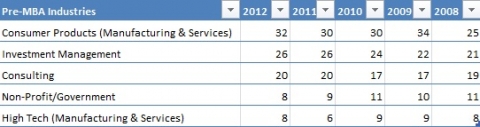
The past five-year trend shows that applicants in the Investment Management and Consumer products have the maximum possibility of getting into Stanford. Surprisingly, applicants from high tech has the least possible chance of getting into stanford. Stanford receives a high number of applications from the tech industry. Consulting is right at the middle of the probability list.
Does the number of years of experience matter?
It would take 3-4 years of experience to get considerable growth and leadership opportunities in any career. That might be the reason why Stanford Pre-MBA Median experience is in the 3.9 to 4 year range.
Undergraduate Degree
Stanford MBA is known to have a bias towards students with Humanity background. Look at the stats below: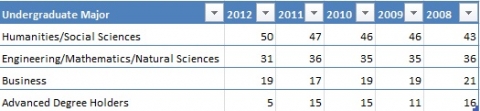
The representation of Humanities and Social Sciences undergraduates have increased over the past 5 years. Advanced degree holders have been the most affected in the past 5 years with their representation decreasing from 16% for the class of 2008 to 5% for the class of 2012.
Analyzing historical data on various admission criteria – Academic, Nationality, Gender,
Undergraduate and Years of Experience will allow you to present your application(essays, resume and recommendation letter) accordingly.
Resources
1) Stanford MBA Essay Guide – Stacy Blackman
2) Stanford MBA Interview Guide – Stacy Blackman

Essay A: What matters most to you, and why? (650 Words)
Essay B: Why Stanford? (350 Words)
Optional Question: Think about times you’ve created a positive impact, whether in professional, extracurricular, academic, or other settings. What was your impact? What made it significant to you or to others? (600 Words) (200 words – each example)
Download F1GMAT's Stanford MBA Essay Guide
(24+ Sample Essays & 300+ Pages of Essay Writing Wisdom)
 About the Author
I am Atul Jose, Founding Consultant of F1GMAT, an MBA admissions consultancy that has worked with applicants since 2009.
For the past 15 years I have edited the application files of admits to the M7 programs: Harvard Business School, Stanford Graduate School of Business, the Wharton School, MIT Sloan, Chicago Booth, Kellogg School of Management, and Columbia Business School, together with admits to Berkeley Haas, Yale School of Management, NYU Stern, Michigan Ross, Duke Fuqua, Darden, Tuck, IMD, London Business School, INSEAD, SDA Bocconi, IESE Business School, HEC Paris, McCombs, and Tepper, plus other programs inside the global top 30.
My work covers the full MBA application deliverable: career planning and profile evaluation, application essay editing, recommendation letter editing, mock interviews and interview preparation, scholarship and fellowship essay editing, and cover letter editing for funding applications. Full bio with credentials and admit history is here.
I am the author of the Winning MBA Essay Guide, the best-selling essay guide covering M7 MBA programs. I have written and updated the guide annually since 2013, which makes the 2026 edition the thirteenth.
The reason I still write and edit essays every cycle: a good MBA essay carries a real applicant's voice. Writing essays for F1GMAT's Books and Editing essays weekly is how I stay calibrated to what current admissions committees respond to.
Contact me for school selection, career planning, essay strategy, narrative development, essay editing, interview preparation, scholarship essay editing, or guidance documents for recommendation letters.