An investment banking analyst applies to M7 and Top MBA Programs with skill sets that an AI now possesses.
Once the due diligence is automated, what a bank pays is for a candidate’s judgment.
What banks ask of the Investment Banker
Global M&A hit a record $1.6 trillion in Q1 2026 while the deal count fell 30 percent.
Mid-market bankers face redundancy risk, and advisory fees flow to boutiques and large banks.
Sector specialization in a consolidating vertical, AI infrastructure, biopharma, or energy, is the real career leverage for the 2026-27 admissions cycle.
Use them strategically for the MBA goals essay.
Strategic M&A – Gains Momentum
The revenue recovery is concentrated in Advisory (M&A) and ECM.
Leveraged finance has not caught up with strategic M&A and now is at par with private equity – where the deals are heavily skewed towards AI and selective healthcare deals.
Post-MBA Goals - Opportunities
Advisory, restructuring, and capital-structure groups at Tier-1 firms have the strongest deal flow and the clearest career growth since 2021.
AI Infrastructure and New Skill Demand – Capture them in your MBA Essays
AI infrastructure shifted the skill set from evaluating models and token economics to the economics of physical infrastructure units, including dollar-per-kilowatt returns, megawatt interconnection queues, fuel pass-through clauses, and multi-decade power-purchase agreements.
Before you strategize for your M7 MBA Applications, shortlist examples that show one of these 6 skills:
- Stamina for Long Due Diligence Period: ECM became a backlog book where a few large and structurally complex deals managed over one to two years is the norm instead of a steady flow of small deals.
- Expertise in Convertibles: Convertibles made up half of equity-linked issuance. Investment bankers need fluency in convertible-bond structuring, defense-sector coverage, and dual-track management that runs an IPO and a sale in parallel.
- Judgment to Choose Private vs. IPO: Strong IB candidates must have the judgment to decide when to push for a jumbo IPO to market versus when to keep the company private.
- Deploy Bespoke Capital: They should also possess the skills to structure a deal with a mix of senior bank debt, private credit, structured equity in the form of convertibles, and family-office or sovereign-fund equity at the top.
- Strong International Insight: Even more important is the skills to read trends across Asian, European and American markets.
- Regulatory Mastery: With the Basel III re-proposal, candidates must also possess strong deregulatory pivoting skills and judgment to reprice acquisition financing under the new rules, determine where to reweight leveraged finance, and choose the right lending verticals for the best ROI.
The essay should cite one of the six skills.
The Investment Banking Analyst Sample
*****
Note: The Sample Essay is shared to illustrate the craft of storytelling for Investment Banking applicants.
Schools have tools to detect the exact page from which you copied a line.
Don’t copy the Sample Essay for any MBA Application.
If you like the Essay, subscribe to F1GMAT’s Essay Editing Service, where we work with your authentic voice and turn it into a winnable essay.
*****
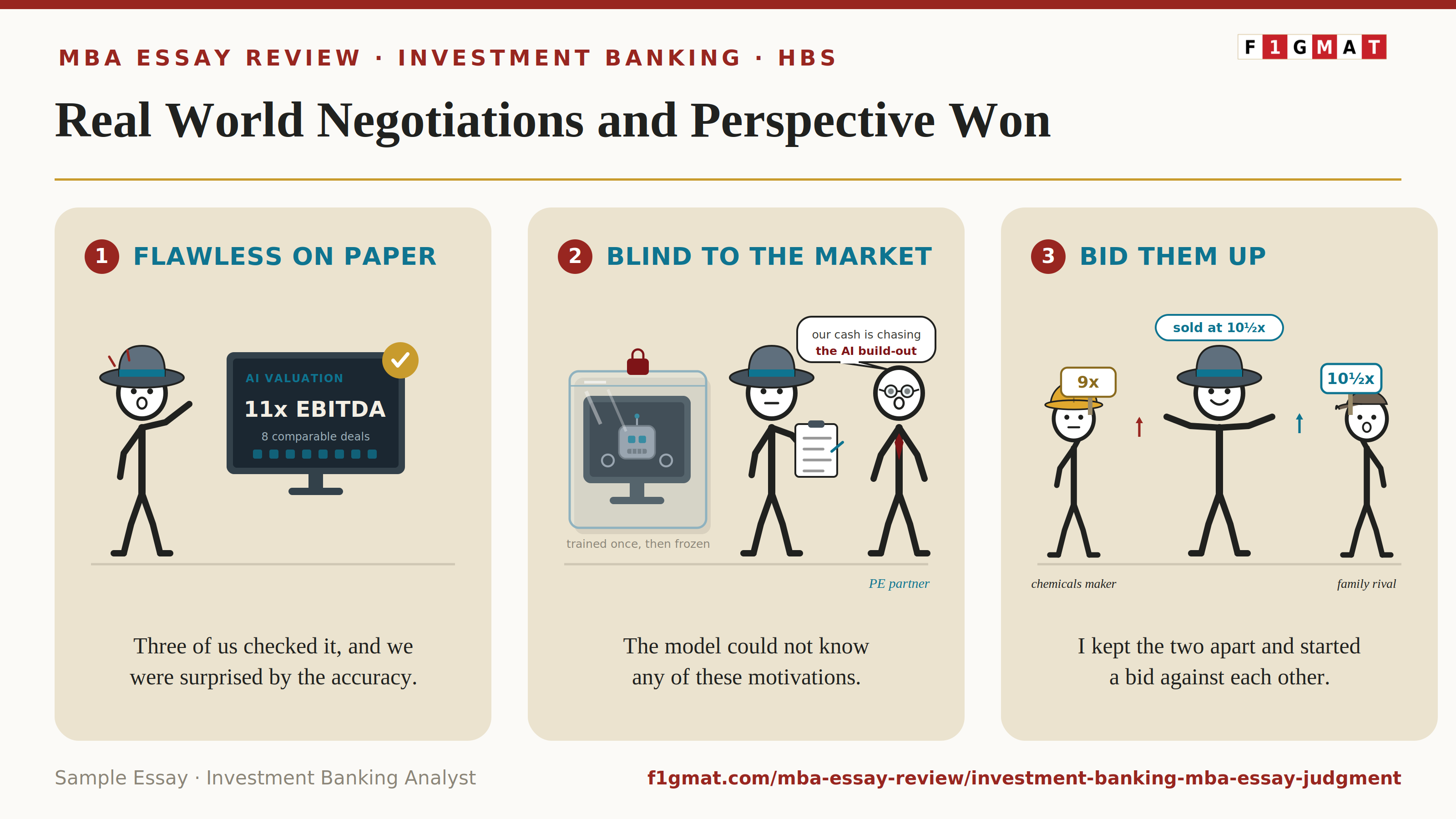
On a sell-side deal for a $600 million specialty-chemicals business, the desk had started running its first-pass valuations through an AI tool the bank had licensed. The model was trained on three decades of comparable instruments and transactions that produced strategies in minutes that took us at least two days if we had pursued the due diligence.
For the transaction, the model finalized an eleven times EBITDA earnings (earnings before interest, taxes, depreciation, and amortization, a standard proxy for cash earnings).
The number was good. Three of us checked it, and we were surprised by the accuracy.
I queried to find the deals it had prioritized, and without any hesitation, it listed eight past sales of similar companies as the proxy for the valuation.
I couldn’t believe the valuation, as my personal attempts to find similar prices had failed in a tight fundraising market.
AI was getting all the attention.
Specialty chemicals, which happens to be closer to a Pharma niche, was still way behind in the fundraising priorities of large funds.
I ran another analysis to find where the past eight deals closed.
AI confirmed my fear.
Our competitor gulped 7 out of 8 deals. They had legitimately won the race by finding buyers who believed that the acquisition could be turned into their own operations.
They paid even more than what we had proposed.
I had sat in four management meetings, and I knew the two competitors most likely to buy were out.
One had misread a deal dynamic of a big acquisition the year before and told its board no more deals until we fixed our operating levers. The other had a new finance chief who was paying down debt, not taking on more debt with the acquisition.
On the AI model’s list, they still counted as buyers.
What was left were PE firms, whose lenders are steering their cash into the AI build-out instead.
The data centers and power projects were absorbing hundreds of billions of dollars this year.
A higher cost of borrowing comes straight out of the price a private equity buyer can offer.
Even before the AI boom, PE buyers were the lowest bidders as they considered acquisitions strategic, with many acquiring to change the market dynamics.
The model could not know any of these motivations. They look at data as the truth.
It didn’t interview PE partners as I did or watch AI build-out draining the debt market at a pace we had never seen before.
The big technology firms planned to spend around $700 billion in a single quarter.
A pricing model is trained once, on a fixed library of past deals, then frozen until someone retrains it.
I flagged the perception gap to the managing director.
It was not a comfortable call.
When I insisted that we tell the client that nine times the EBITDA earnings is the realistic goal, my manager shared the history of all the deals that we missed when we tried to negotiate lower on the potential asking price.
I understood that lowering the price was not an option.
For six weeks, I was the analyst who had talked down his own bank’s valuation.
After being stuck with the truth of the valuation and knowing fully well that a PE buyout will crash the valuation further, I looked at our firm’s past 7 failures.
All of them were in open auctions – the kind that invite every potential buyer. Inevitably, the lower valuation news reaches one party, and it brings down the entire value proposition.
I argued for the opposite.
What if we could shortlist buyers who saw the acquisition as life and death?
I found two such buyers after breaking the AI’s due diligence pattern.
One was a larger specialty-chemicals maker with a plant about forty miles from our client’s, close enough to run both sites under one management team.
The other was a family-owned rival a state away that had spent two years trying to build the same product our client has and failed.
I kept the two apart and started a bid against each other. Only the serious gave counteroffers.
They pushed each other up from the nine we had set toward the eleven the model had started at.
The company sold at ten and a half times to the revenue numbers, above what an open auction would have produced.
The AI model was not wrong about value. It was blind to the demands of the market and the subtle cues that defined deal dynamics.
This is the business judgment and negotiation that I want to build with HBS – a work AI cannot replace, which is why I am applying now for the Harvard Full-time MBA program.