When I reach out to clients to check on the progress of their MBA essays, they often complain about the biggest obstacle – how should I reflect and capture the pivotal events in my life?
Before you trivialize or dramatize any event from your life, follow these 5 reflection tips:
3) Remember The Conflict Conversation
5) Capture Coping Mechanism and Support Network
1) Memory Trap
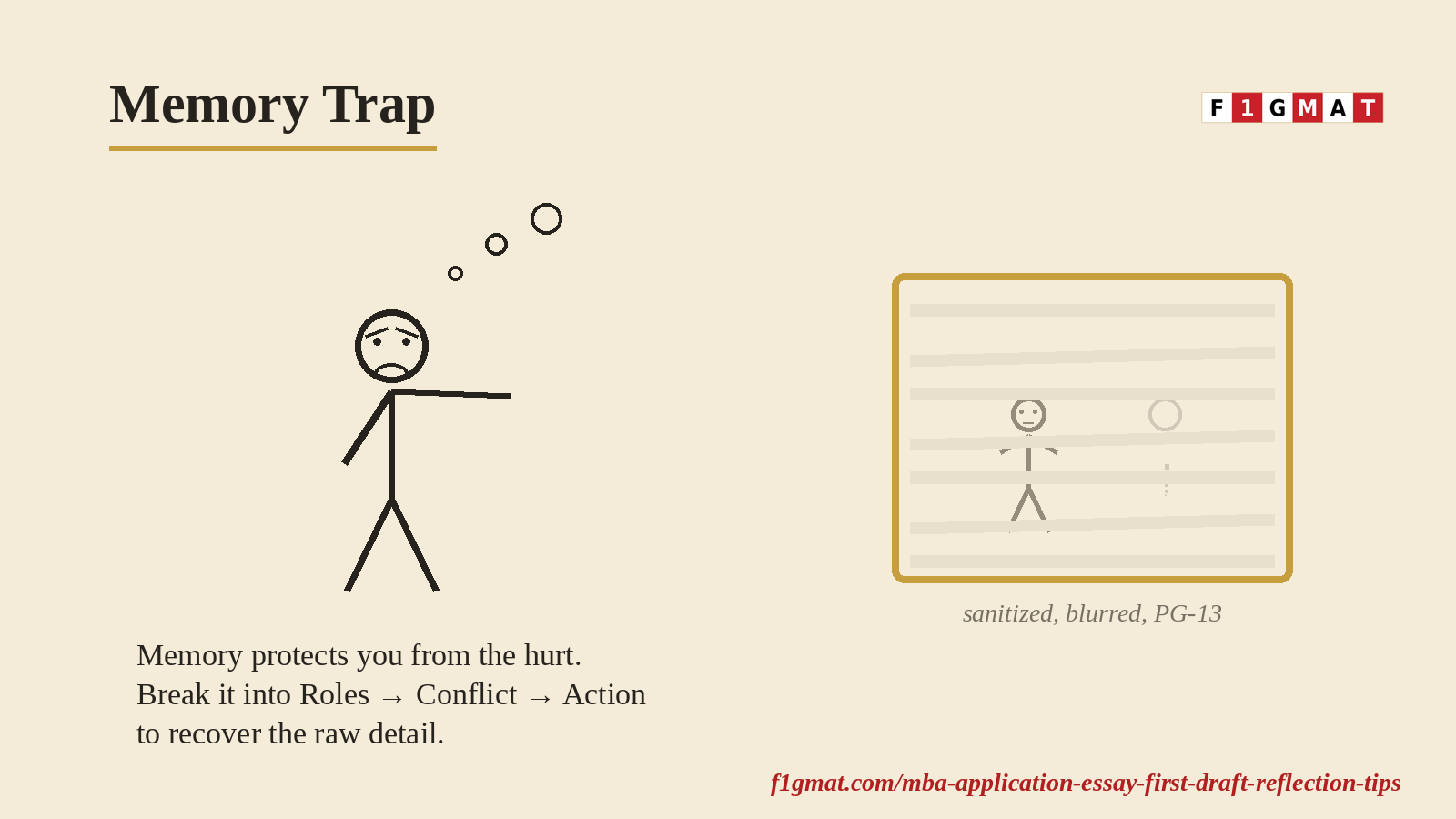
We all have experienced this where the details are blurred, the quotes of who said what are uneven, and even the traumatizing event is made into PG-13 for our mental health. Reflecting on the event to capture the core of where it all began can lead to narratives that are sanitized and ineffective for a personal MBA essay.
A quick framework to capture the details is by dividing the memory into its parts.
Roles -> Conflict -> Action
The first part is the roles – protagonist, antagonist, and supporting roles
The second part is the ‘point of conflict’ – the core of the narrative.
The third part is the ‘action’ that traumatized you or changed your values.
For an applicant, the ‘point of conflict’ was the conversation around his sexuality with his parents. Instead of empathizing, parents began searching for remedies to cure the person of his orientation. The conflict reaches a fever pitch when the applicant, with tears after one of the ‘curing’ events, pleads to accept him for who he is and not to change him.
The third part – family abandoning him is a memory that still haunts me as an essay reviewer.
The memory trap is a trap to protect you from past hurtful moments. Use it carefully and capture the raw emotions. If it is too painful, there is another way.
2) Detached Attention
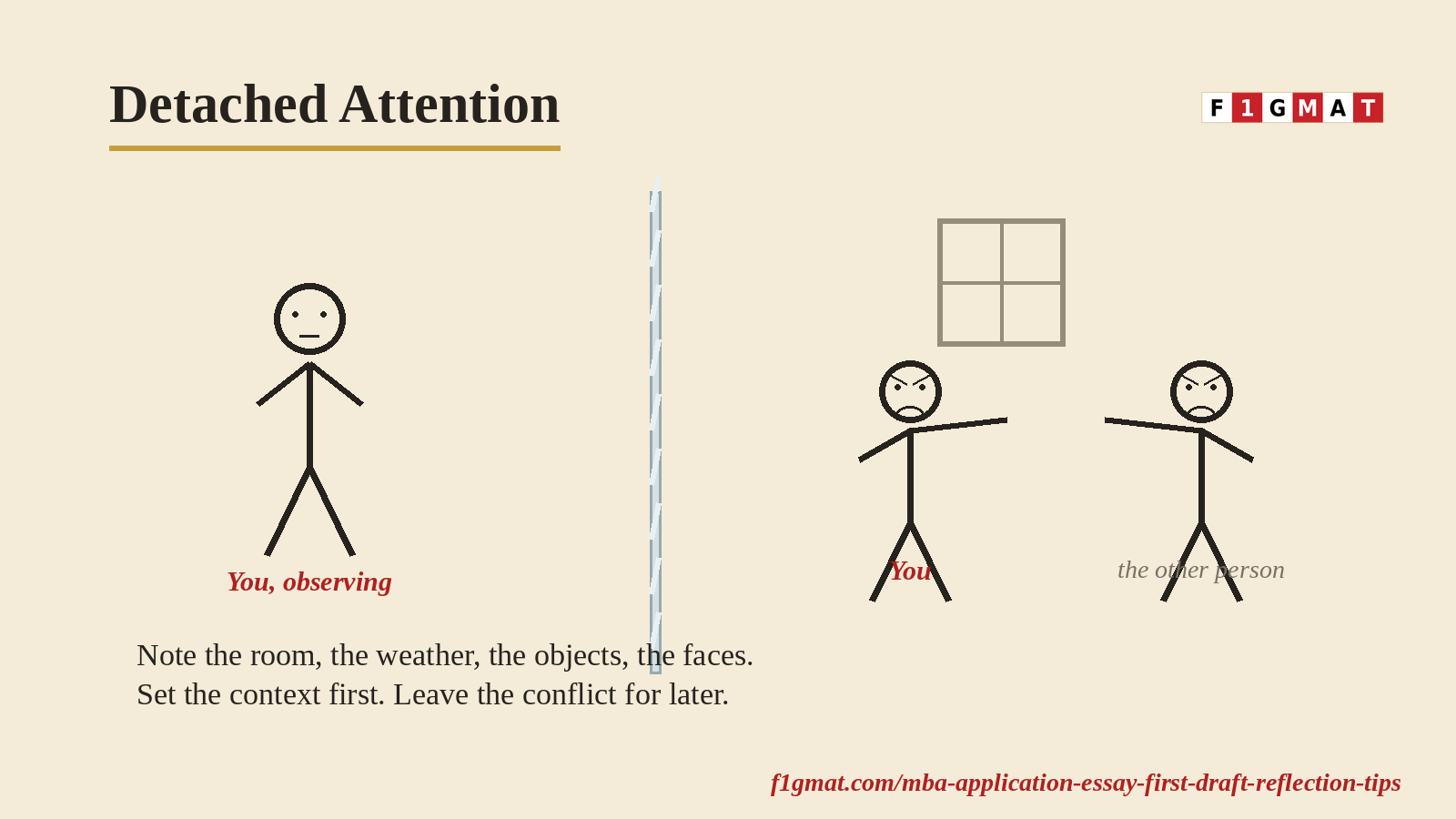
Feeling all the traumatized events to write essays might not work for everyone. An alternative is to imagine that you are observing your life as a third person.
This time, the third part – ‘action’ and the second part – “conflict,” is not the focus.
Even the irrelevant details like Where the conversation happened, the details of the room, whether it was a hot or a cold day, the objects in the room, the facial expressions, and other events/activities going on in your life are the only focus.
By noting down all the details from the memory except the ‘conflict’ and the subsequent action, you set in the context for the conversation.
3) The Conflict Conversation
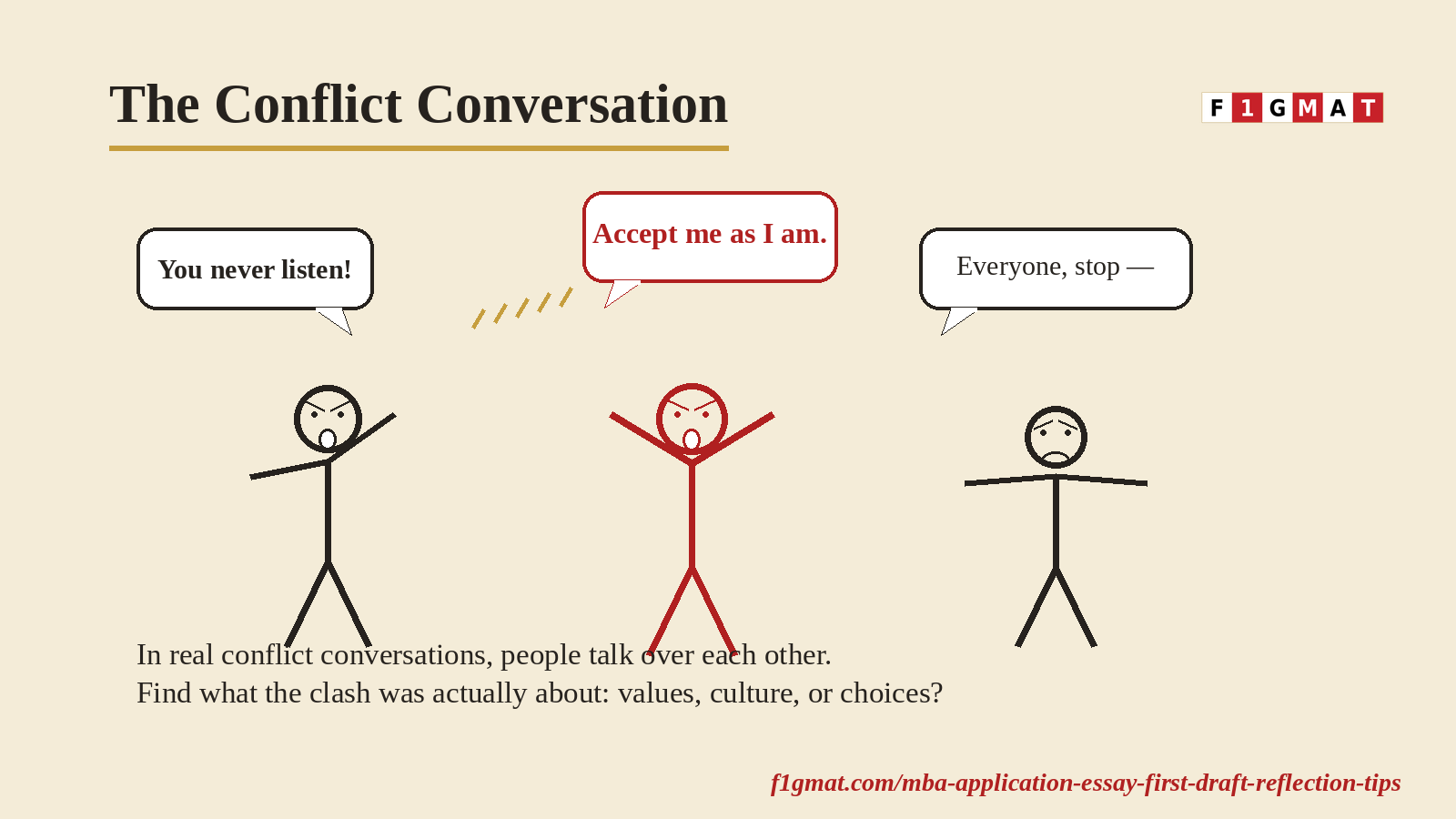
Conversations rarely happen in a sequential pattern.
One person’s emotion overshadows rational conversation. It is not like any sitcom or TV series where no one talks over each other. In real life, we all talk over each other. With high-charge emotion like in a Conflict, the talking over is excessive.
A person shouts. Other shouts even louder. A third person intervenes. There are moments of silence. One storm out.
In all the escalations, there is a ‘core’ of the conversation – a conflict in values.
A conflict of culture.
A conflict of choice.
Many conflict conversations are around a generation not understanding the current culture or not showing empathy for the person’s choice.
Many times, the conflicts are around the decision of a career, the decision of choosing a parent (divorce), the decision of sending the parent to rehab, the decision of migrating to a new country, and the decision of abandoning a dream.
When two points of view have two different paths – conflict arises.
Conflicts are the best examples in a personal MBA essay. Reflect and find the core of the conflict.
4) Escalation
Do we have to capture all the lows of the escalation?
In the first 3 to 4 drafts – yes. Without capturing the IMPACT of the escalation, the comeback or change in value won’t invite support from the reader. But as we close in on the final edits, the details of the escalation will be trimmed to add the 2nd half of the essay.
A personal essay has two parts.
The Pre-Conflict and the Post-Conflict part.
The post-conflict part showing how you changed or how you started a non-profit or supported others in similar distress is equally important.
5) Coping Mechanism and Support Network
Many applicants share struggles of coping after a dramatic life event.
The cliched but often repeated path is the dependence on addictive substances.
Even in the most challenging life circumstances, there are support networks that help you orient to a safe path. Often, this support network consists of recommenders and mentors who will endorse your growth as a person and a professional.
If you need mentorship in writing your MBA Essays, Subscribe to F1GMAT’s Essay Editing Service