Lately, I have been paying attention to the Amazon Prime Movie Description as a fun thought experiment to see how the description adds up to the actual plot of the movie. One consistent flaw I saw is the pain with which the copywriters tried to summarize complex storylines into 3-line snippets, often missing the theme or the emotional core of the movie.
This is how I feel when I hear the first version of the client’s answer to the Walk me through your resume question in F1GMAT’s Mock Interview Service. It simplifies a complex career journey and milestones with the fear that even the slightest narrative will stretch the answer to more than a minute.
This is not the case.
If you are wondering why it is important to add ‘some’ not ‘extensive’ storytelling into the Walk Me through your resume, here are 3 reasons:
Contents
Just Information is the #1 Enemy
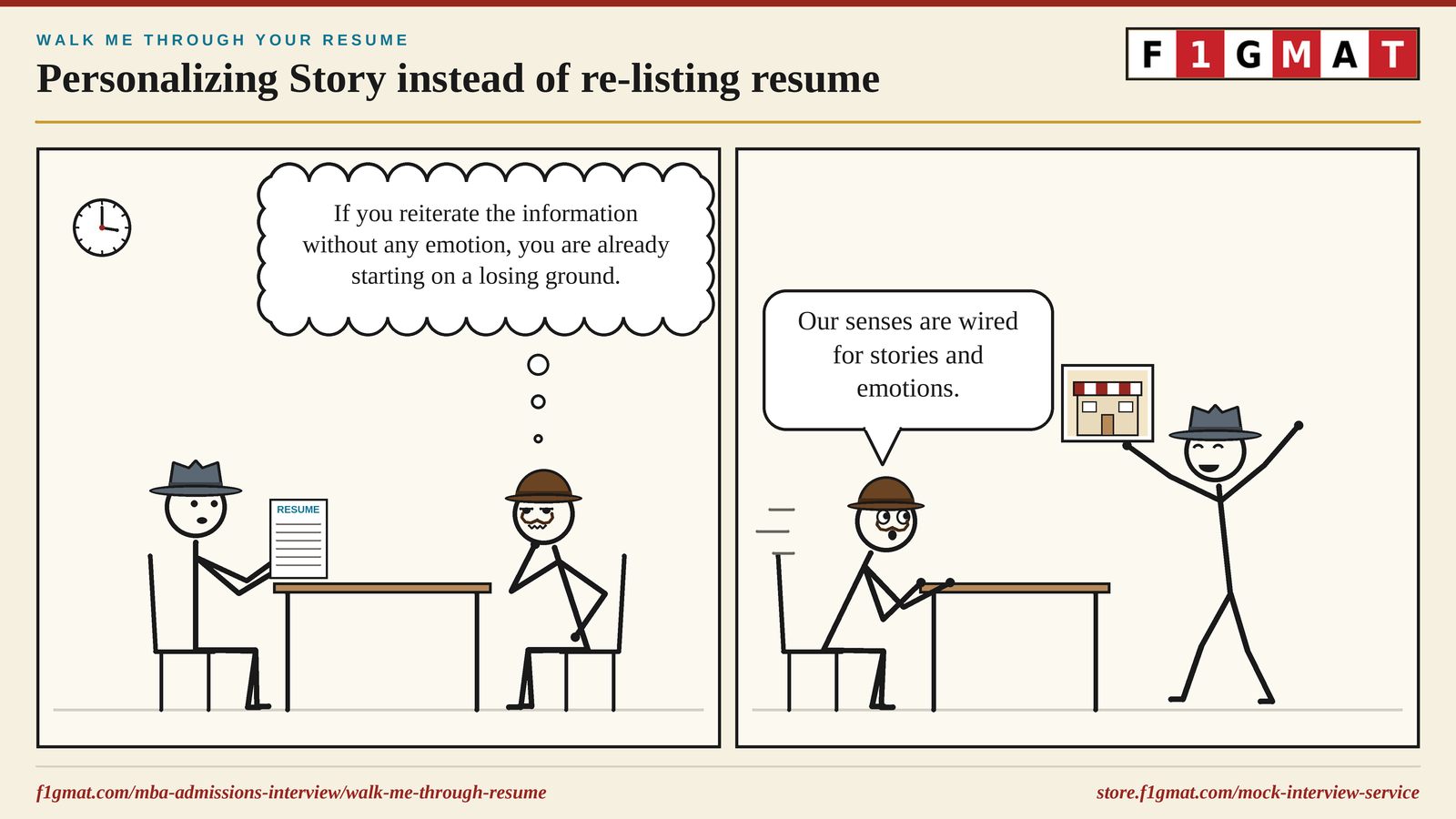
The interviewer has a resume in front, and the person is trying to understand the person behind the milestones. Our senses are wired for stories and emotions. If you reiterate the information without any emotion, you are already starting on a losing ground. Find subtle emotional cues – words/phrases that force the interviewer to lean into your story. And that requires starting with a routine chronological answer and finding small gaps to plug in emotions.
When I conducted a mock interview with a client, in the first version of the answer, I asked him to improvise with strong ‘emotional’ phrases to highlight his passion for finance. The candidate planned to continue in PE. So, we had to establish early on the origins of the interest in the career.
Personalizing Answers with Childhood Stories
A routine his father taught to measure loss-making menu items in the family restaurant became an interesting exercise of finding patterns in cash flow that became valuable even as recent as a month back to find a lost opportunity in a portfolio company. Such connecting of the story needs careful planning and creative thinking within the constraints of the 1-minute answer.
Just a phrase in the opening line added the necessary story to differentiate just enough without turning the answer into an essay.
F1GMAT's Mock Interview Service - Interview Prep with Atul Jose (Admissions Consultant, F1GMAT)
With F1GMAT's Mock Interview Service, you'll gain three key advantages:
- The ability to deliver confident, concise answers in 1 to 1.5 minutes.
2. The skill to infuse your responses with genuine emotion and authenticity.
3. Expert guidance to craft scripted answers that feel fresh, original, and free of clichés.
For any questions about F1GMAT's Mock Interview service, email me, Atul Jose, at [email protected]
Covered in the 3-hour MBA Admissions Mock Interview session:
1) Planning and practicing the answers for the standard interview questions
• How to answer the “Tell us about yourself” introductory question?
• How to answer Walk me through your resume?
• What is the greatest accomplishment in your professional career?
• What is your leadership style?
• How would you contribute to the School Community?
• What is the most difficult obstacle you overcame?
• Are you a Creative Person?
• How do you define Success?
• How to answer about Innovative Solutions?
• Answering Frequent Job Switch
• How did you Handle Conflict?
• How did you manage Change?
• Give an Example of an Ethical Dilemma you faced. How did you handle it?
• Answering Greatest Accomplishment
• How did you Handle a Difficult Boss?
• Tell me a time when you made a Mistake. What did you learn from it?
• How to summarize your Career?
• How to explain low grades?
• How to answer Scenario Questions?
• How to answer the Backup Plan Question
• How to discuss about Industry Experience & your Role?
• What Questions should you ask the AdCom after an MBA Admissions Interview?
• Tell me about yourself that is not covered in the application
• What are your post-MBA goals?
• What is your plan B if you can’t achieve your short-term goals?
• Why consulting/finance/marketing/general management (if you are a career switcher)
2) Follow-up Questions based on your resume
3) Follow-up Questions based on your essays
If you need help, subscribe to our $349 (3 hours) mock interview session, where I will offer immediate feedback after each question on improving:
1) The tone
2) The transitions
3) The style and
4) The narrative of your overall story, covering the broader achievements in your career and the choices in your life
I will ensure that your answers sound authentic.
Next Step
1. Purchase the service from F1GMAT's Store
2. Send an email to Atul Jose (Admissions Consultant)([email protected]) with your latest resume and the essays used for the application.
High Context vs Low Context Communication
If you have read the books - Culture Map and Cultures and Organizations, you might be aware of this concept.
If the interviewer has most of their education in a Western society, they are fine-tuned for high-context communication. This means breaking down your career journey into its smallest parts and even filling the gap of sudden career changes, gaps, and trends in the country, industry, or even region.
Asian vs. Western Interviewee
For Asian applicants, such high-context communication might seem like an insult to their intelligence, but there are genuine gaps that emerge from industry-level knowledge, jargon, and cultural challenges that are tough to translate if the person is not from the region.
Typically, schools match the applicant with a person from the region – a current student or an alum. But they need not to be native.
I have often seen Asian American interviewers with most of their education in the US interviewing native candidates.
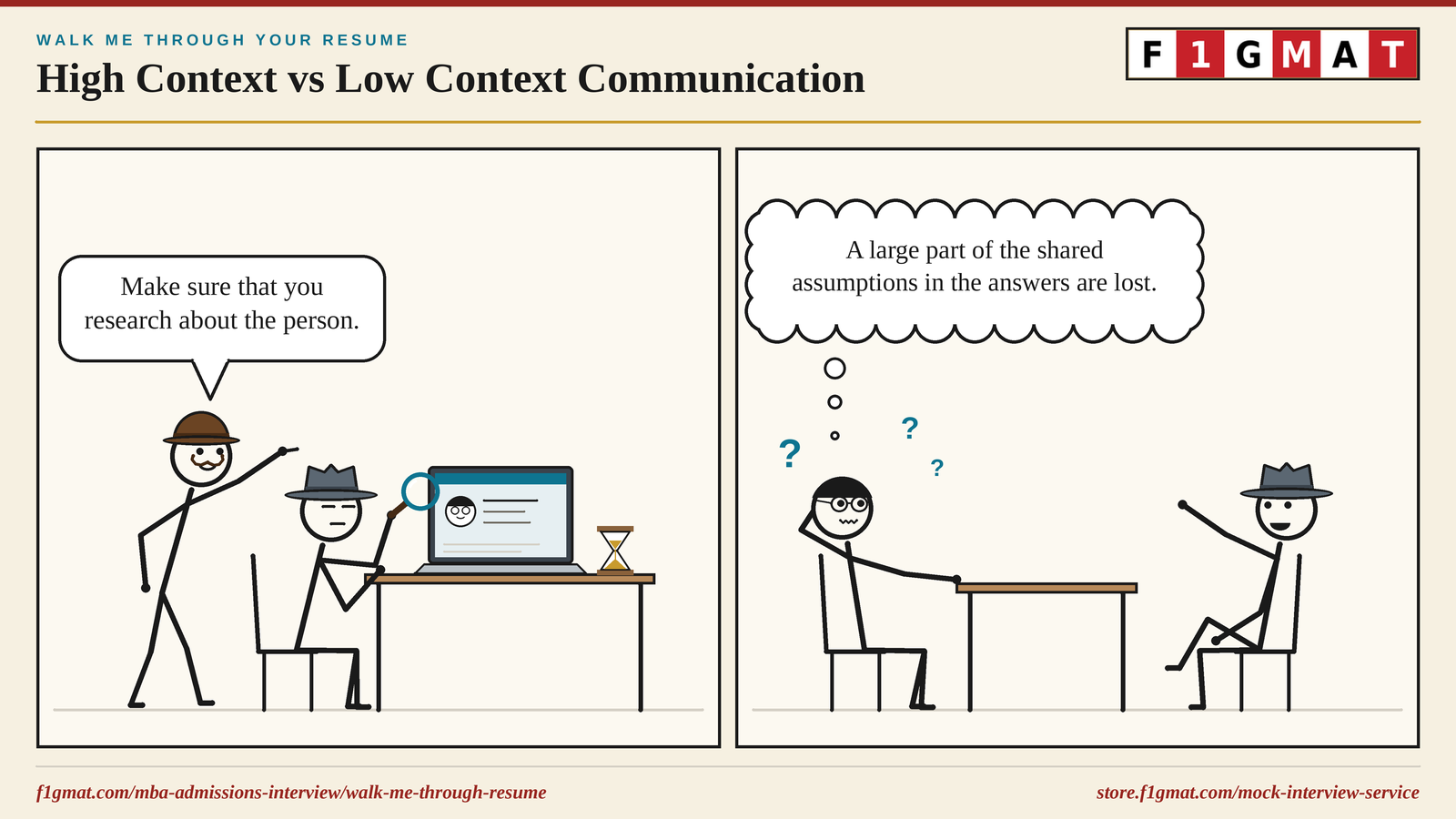
A large part of the shared assumptions in the answers are lost.
From 2 hours to 1 day, the information about the interviewer will always be available to you.
Make sure that you research about the person.
Once you know the person’s cultural upbringing, add more context – if the person is oriented towards a Western culture and aim for the middle, if the person is raised in an Eastern culture.
Don’t Reinvent Your Brand
In an effort to make the Walk me through your resume answer interesting, I have seen the extreme, too, where the candidate is trying to reinvent their personal brand. The interview invite came because the school connected with your essay about goals, values, and your journey.
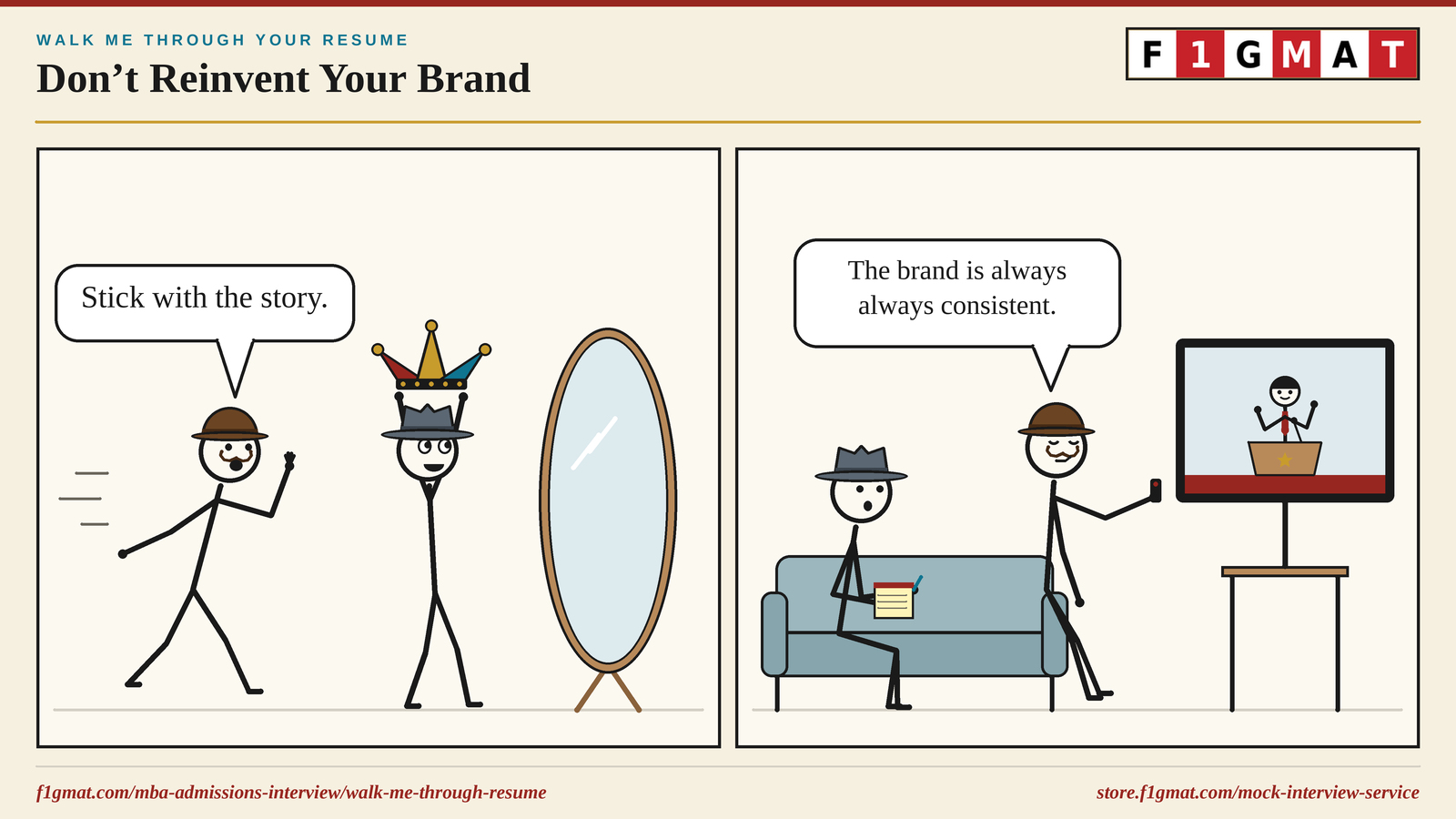
Stick with the story.
Lesson from politicians on Brand Messaging
If you want to see how consistency works, observe the politicians.
The smart ones always maintain the same brand regardless of the chaos around the campaign.
If the person is articulate, there won’t be any unprepared appearances.
If the person is known for off-the-cuff remarks, you can bet to see more entertaining answers.
If the person is a nerd with visionary policies, the answers will sound like how an accountant talks.
If the person is bordering on anarchism, expect to hear about tearing down existing systems.
All of them know that none of their vision will be made into a reality without some fight. But they all stick to their personal brand. There is no deviating from it.
The tough person is unlikely to show signs of weakness.
The kind person is unlikely to make rude remarks.
The brand is always always consistent.
One false move – the weird “Wohooo” or cute remarks often end a politician’s career.
Even if you don’t appreciate the breed of people, you can learn from their branding strategy.
For help with preparing for your MBA Admissions interview, Subscribe to F1GMAT’s Mock Interview Service where I will personally help you up to speed with the answers – 3 hours (2 sessions). 1st is a feedback session. The 2nd is a delivery session.