Before starting communication for Recommendation letter in M7 MBA admissions, start with an honest evaluation of where you fit in the applicant pool. Super achievers, the top 1%, make up only 20 to 30% of the M7 pool; the rest are top achievers, the top 10%, whose pitch is built from the combined narrative from work, college, and volunteering.
Your communication strategy with a supervisor should follow with that awareness.
In this advisory series, I cover:
Contents
MBA application deadlines 2026-27 (2027 entry)
July 2026
August 2026
September 2026
October 2026
November 2026
January 2027
March 2027
April 2027
May 2027
Planning the Communication
Even in the M7 application pool, the super achievers would comprise 20-30% of the entire application pool. The rest are great achievers with skill sets, college experiences, non-profit contributions, and life experiences that work in tandem to build a case for admissions.
Once you do an honest evaluation of whether you are a super-achiever (Top 1%) or a top achiever (Top 10%), your communication strategy should vary.
Super Achiever vs. Top Achiever
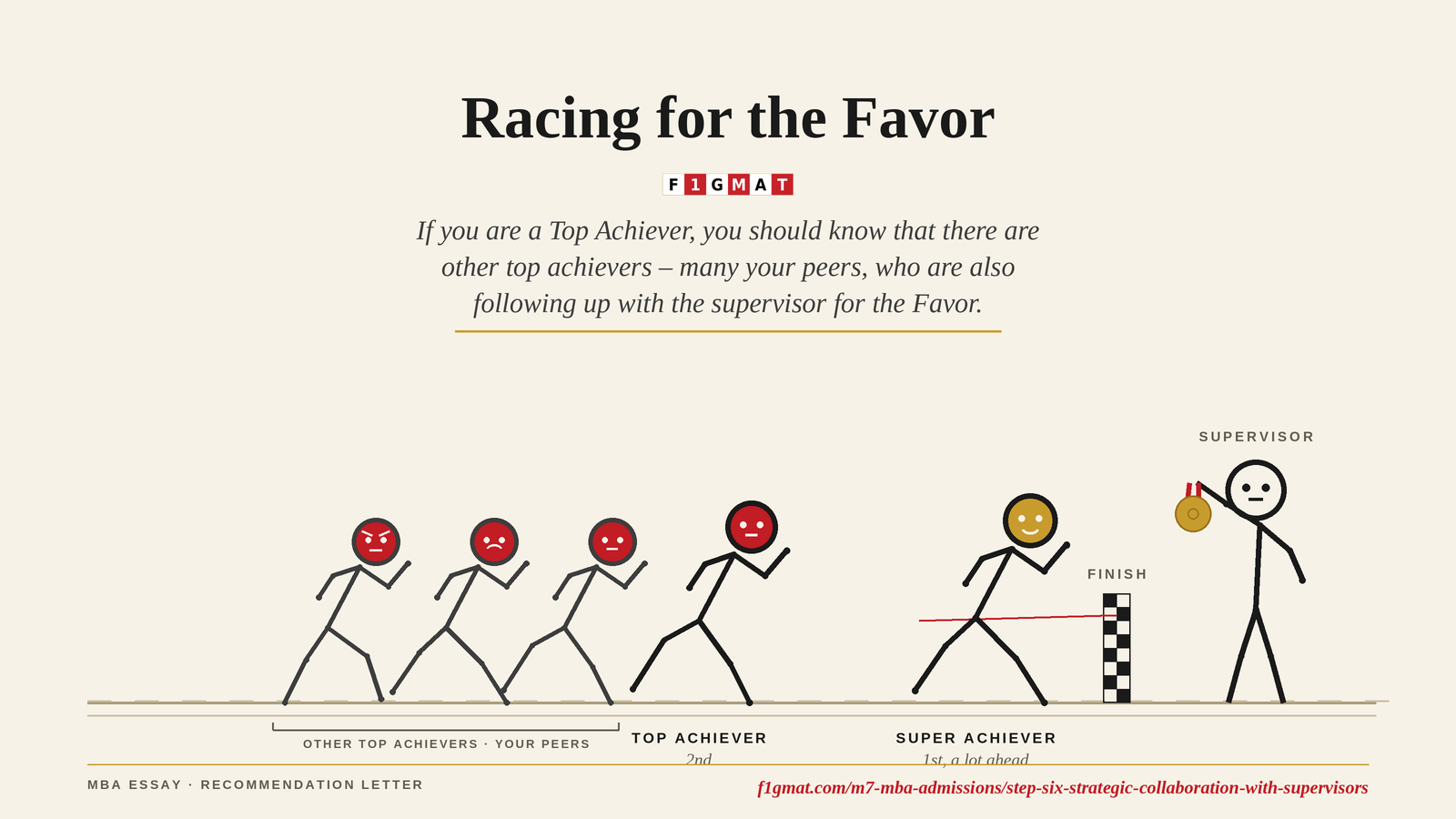
If you are a Super achiever and the supervisor has mentioned it multiple times, you must wait for the right ‘moment’- preferably a month or month and half before the deadline, before starting the communication.
If you are a Top Achiever, you should know that there are other top achievers – many your peers, who are also following up with the supervisor for the Favor.
Why Should the Supervisor Care?
For Super achievers, the supervisor will be willing to put in the time as your contributions have enhanced a supervisor’s reputation and career growth.
For Top achievers, going the extra mile with deliverables and helping the supervisor look good is essential before initiating communication.
At the core of all the communication strategies with your supervisor, understand one universal truth
“Supervisors are doing you a favor.”
You have been fairly compensated for your contributions by the company.
There is no mandatory requirement for supervisors and managers to write a recommendation letter for you.
‘Humbleness’ and patiently following up are essential to facilitate great recommendation letters.
Admission Consultant’s Note
I have intervened in several interactions through F1GMAT’s Recommendation Letter Editing Service where the applicant didn’t ask the right supervisor for the letter, aggressively followed up instead of following-up with anticipated roadblocks and didn’t do all the socializing required for managing a supervisor.
A 10-Step checklist will help you manage supervisors.
Great vs. Good Work vs. Routine Work – Position for Availability Bias
Understanding your great work vs. good work vs. routine work will help you create a list of examples that nudge the supervisor to write in a favorable tone.
All schools have a LOR question that specifically asks why you are different from your peers.
The good work is enough for T15 to T30 schools, but for M7 to T15, your supervisor must highlight contributions that were exceptional.
These contributions should be relevant to your post-MBA goals and potential contributions to the school’s student initiatives.
IMPACT Table
Nudging your supervisor requires shortlisting relevant examples that had high impact and shortlisting one example where you failed, or your weakness was evident.
Creating an IMPACT table – a deliverable in all our consulting (career planning) and editing services (one essay, essays, and all in one) is a best practice I would recommend to all M7 MBA applicants.
Admission Consultant’s Note
Once you have your best work – share only your top 5 for the recommendation letter narrative.
Don’t overwhelm them with other examples or unnecessary details that might be important for implementing a solution but are not relevant while writing a recommendation letter for M7 schools.
Leadership, Sense of Community, Creative Thinking, Maturity and Self Efficacy – five qualities need special mention in recommendation letters.
Inclusion and International Teams
2022 set in motion a new set of essays exclusively about applicant’s Inclusion initiatives.
The challenge for many who are part of organizations that have frozen or slowed down on funding DEI initiatives is to find relevant examples for M7 application.
Volunteering becomes a critical narrative to validate this claim.
One Employer and Traditional Roles
For one employer applicants and those applicants in a traditional career (investment banking/accounting), a strategic two supervisor – one from the current company and the second from a non-profit is a better way to offer additional perspective about your fit for school cultures where inclusion is of paramount importance.
Ethnicity
The emphasis on Inclusion might not be a big priority if you are from China, India or other emerging economies where peers are from one ethnicity or limited number of ethnicities (less than 5). The only exception is if you are part of a global organization with international teams, and your work requires traveling to international hubs (consulting, technology, oil and gas).
Supervisors can offer examples on how you adapted to a different culture, understood inclusion efforts in other regions/countries and prioritized team building effort with an inclusive mindset.
Cosmopolitan Cities
The diversity of the culture could be industry-driven, but if you are from - Toronto, New York, London, Sao Palo, or Sydney, strategically including the ‘city’ in the backdrop for your narrative can affirm the admissions team’s stereotypes about an international mindset that you possess.
Admission Consultant’s Note
Inclusivity is a broad concept. Understand how different M7 schools prioritizes Inclusivity before suggesting an example from your Top 5 IMPACTFUL contributions.
For Finance applicants, unless you are part of deals, a perspective that you understand the injustice and challenges of other ethnicity depends entirely on your volunteering experience. That is one reason why good finance applicants with mediocre community engagement and volunteering experience are among the most widely rejected demographic.
Assess Team Dynamics - 4 Scenarios
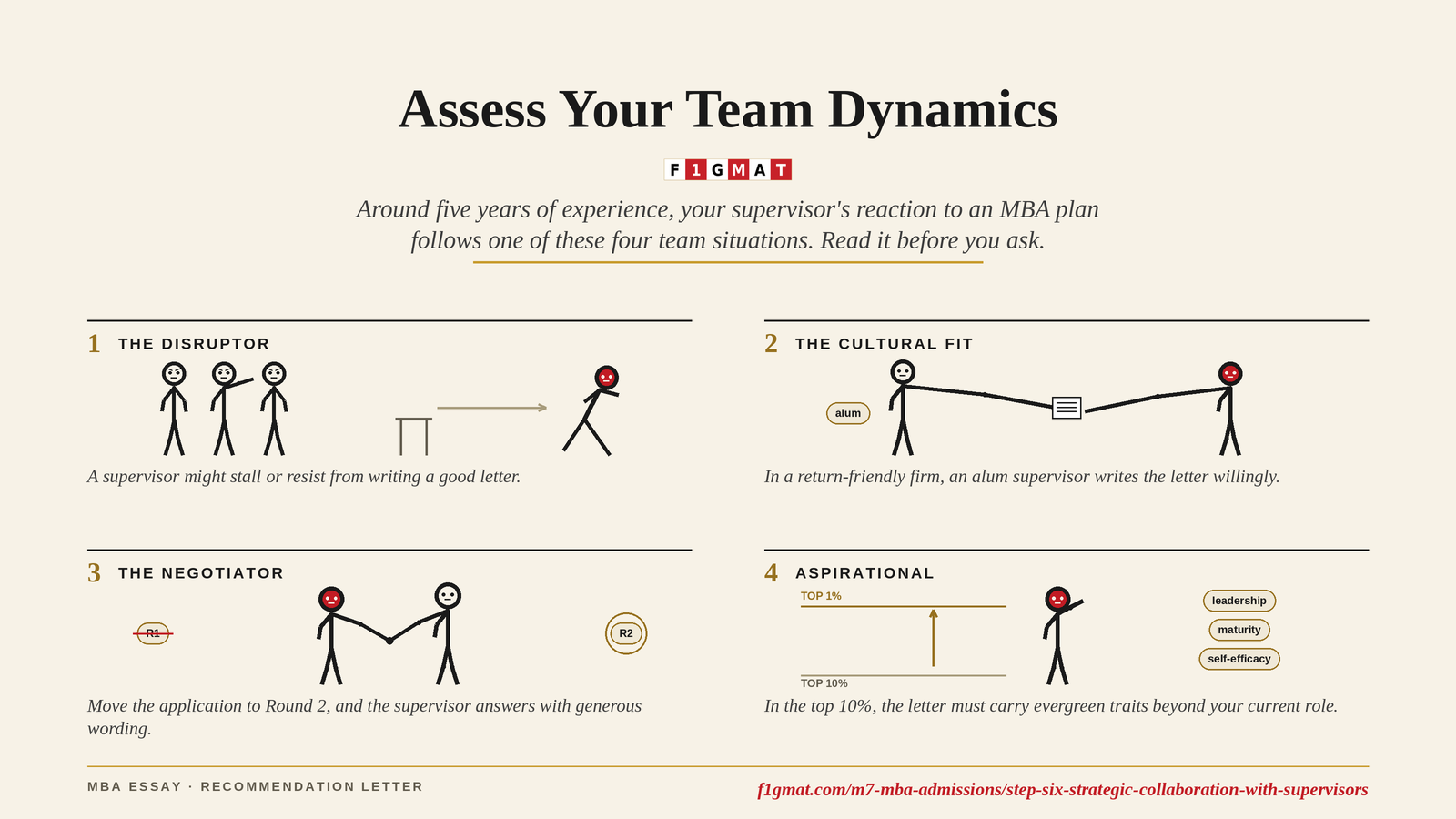
Team Dynamics in your current organization can be disrupted by your plans for an M7 MBA.
M7 MBA Application within one year of job: If the switch to a career with an MBA happens within one year of joining the organization, expect friction from the supervisor or anyone you plan to ask for a recommendation letter from the organization.
Schools understand this scenario and offer additional space in the optional essay section to explain why you are not seeking recommendation letters from the current supervisor.
M7 MBA Application within three years of the job
The ideal time frame is to complete three years with an organization. By then, you would have at least two supervisors and a few favorable client relationships for endorsement, and if your performance were in the top 1%, management would also notice your contributions.
M7 MBA application with 3-7 years on the job
By the 5th year, you might have a team working for you, and the supervisors might have seen your multiple styles of leadership and crisis management. The letters for experienced (5 years and above) applicants are often the most convincing in M7 application.
For the majority who fall within the five-year experience range, strategically maneuver for these 4 team dynamics scenarios:
1. The Disruptor
If you were among the few candidates to pursue an MBA in your company or in your industry, expect a lot of conflicts as you have revealed a plan to get out of the ‘group.’
Worse – if you are an industry switcher, the team might assume that your interest in pursuing team goals is diminishing since you plan to exit within 6-12 months.
Some recommenders might not take it too kindly, especially if they do not have a management degree or their career progression has been stagnant for the past 2-3 years.
They will see your ambition as a challenge to the group and will consciously or subconsciously create hurdles in delivering recommendation letters or submitting them by the suggested deadlines.
2. The Cultural Fit
In most big consulting, PE, and IB firms, the culture encourages pursuing an MBA and returning to the employer (close to 40%).
If you are in such a firm, you should take advantage of supervisors with a history of good conversion (high number of recommendation letters with M7 admits).
There are no rules on whether the person is an Alum or not, but typically, a supervisor with an MBA understands the challenges of iteratively writing a recommendation letter and delivering value with clear, concise, and relevant narratives on your achievements.
3. The Negotiator
Then, there is a group of applicants who know how to negotiate and find the best of both worlds.
If the company requires their talent for the next 2-3 months, they often push the application to Round 2 to accommodate higher commitments expected.
In return, supervisors tend to be generous with the wording and capturing impactful lines.
4. Aspirational
The toughest group dynamics is in team where you are not a top performer but falls within the 10% group.
You are also planning to switch functions, industries, or both with an MBA.
In such cases, the letter requires not just capturing traits in your current role, but also needs the evergreen traits – leadership, maturity and self-efficacy, to demonstrate fit for an M7 MBA program.
I hope you got value from my tips. Subscribe to F1GMAT’s Recommendation Letter Editing Service (1 supervisor, 1 School) for help.
Other Related Service where I help you capture your IMPACT - F1GMAT’s Essay Editing Service
Related Download
• Winning MBA Essay Guide (M7 and T15 Schools) (For Sample Essays, Curriculum Analysis and Tips on creating persuasive essays)
Reference