F1GMAT · https://www.f1gmat.com/mba-most-rigorous-least-rigorous-grade-non-disclosure ·
 Add F1GMAT as a preferred source on Google, opens Google in a new tab
 See more of F1GMAT's MBA admissions research in Google's Top Stories by making us a preferred source on Google.
What does academic rigor mean?
The academic rigor of the MBA program should be viewed through five lenses: teaching methodology, internship pressure in the first semester, peers & learning teams, GND and its impact on electives, and your post-MBA goal.
Key Takeaways
- Schools with GND and flexible cores (Wharton) give students more room to choose depth and are less academically rigorous.
- Booth, despite the unofficial GND, also relies on the grading curve to enforce mastery of core courses
- Schools with heavy fixed cores and participation grading (HBS, Darden) enforce academic rigor by design.
- Stanford GSB relies on the participants to self-direct their academic experience to achieve post-MBA goals
- Every other top MBA falls in between the two extremes on academic rigor.
Most Rigorous vs Least Rigorous MBA Programs 2026
Table of Contents
- Grade Non-Disclosure Policies at Top MBA Programs & Impact on Rigor
- The cold call and its Influence on Student's Learning Time
- Case Method vs Lecture: Which MBA Teaching Style Is Most Rigorous?
- Quant shock in the first quarter
- Recruitment and Grades: How much academic rigor is possible
1. Grade Non-Disclosure Policies at Top MBA Programs & Impact on Rigor
Seven of the top ten U.S. MBA programs: Stanford GSB, Chicago Booth, Columbia Business School, Berkeley Haas, Yale SOM, Carnegie Mellon Tepper, and Cornell Johnson, with Kellogg and Wharton, have some form of Grade Non-Disclosure, or GND.
Harvard Business School reversed its GND policy in 2008 after the then-MBA program chair said students were reporting "little motivation to excel."
Harvard Business School (HBS) implemented a grade non-disclosure (GND) policy in 1998, under which students were prohibited from disclosing their grades to recruiters or employers even though recruiters used the internal honors like Baker Scholars to compare performance. The school reversed the decision in December 2005[1], shifting to optional disclosure for future classes
UVA Darden and NYU Stern never adopted it.
NYU Stern went a step further and double down on its Stern curve. Based on the curve, only a maximum of 35% of students can receive an A or A- in core courses. In the Finance department, the suggested split up is 15% for A and 20% for A- with B grades split evenly, with the median score of the class falling in straight B [2].
Second-year electives at most top programs have a looser or no forced curve, which is why you see happier 2nd year students embracing their role as mentors for first year students or preparing for global experiential learning programs without worrying about grades.
The Wharton Graduate Association has publicly disclosed that grades are not revealed to recruiters to encourage students to take the tougher electives and expand their expertise and exposure. The non-disclosure also builds team skills as they don't have to do scorekeeping during their learning experiences. The enforcement mechanism is dependent on students' approval every year, with at least 50% votes and 67% approval to continue the GND mandate[3].
Booth's GND policy is stricter in practice, even though there is no official policy. After full-time students adopted GND in 2001, Booth explicitly requested employers not to probe the grades or even academic honors until a full-time offers is accepted by the student [4].
Stanford has no official administrative policy on grade non-disclosure, but a student can choose to use a pass-fail grading system instead. If they decide to go with a traditional grading system, there are clear differences in academic performance from H (Honors)(top 10%), HP (High Pass) (next 30%), P (Pass) (50%), LP (Low Pass) (bottom 10%), and U (Unsatisfactory) (failed).[5]
Kellogg follows the Family Educational Rights and Privacy Act, and doesn't release grades to recruiters even though students are free to share their grades with the recruiter [6]. Because of the school's collaborative culture, students rarely share their grades with their recruiters.
What does GND actually do to student behavior?
A paper on GND policies across top MBA programs found that in-course academic effort drops about 4.9% under GND compared to matched students without the policy[7].
The same paper found that GND students substitute that effort into harder elective courses and more extracurricular activities as the risk tolerance improves.
How Grade Non-Disclosure (GND) Affects Effort & Rigor
Students with GND are incentivized to cooperate and contribute meaningfully to group discussions instead of worrying incessantly about preparing for a test. The worry is around the effort put into these group discussions and case analysis. Is it the same effort as an individualized evaluation of a candidate?
2. The cold call and its Influence on Student's Learning Time
Cold calling is the opening move at HBS and Darden, and shows up in some form at Stanford GSB, Columbia, and Darden.
Booth, Wharton, Kellogg, and MIT Sloan rely heavily on cases for their electives.
HBS's Christensen Center for Teaching & Learning describes the cold call as
"After framing the class session, the instructor typically cold calls a student to open the discussion. Some instructors use additional cold calls during the class.[8]"
Follow-up questions are common to measure a student's comprehension and strategic thinking.
Applicants often confuse a cold call with a simple 1-minute opinion on a topic.
It is not.
A cold call can last up to ten minutes.
Without preparing the case, a student is unlikely to endure the 10 minutes of recapping the issue and offering a clear recommendation from the protagonist's perspective.
HBS alumni shared that the cold calls are not random.
Professors memorize each student's bio each semester and choose participants with intent.
They might pick a non-expert on a technical case to let the class understand the finer points of the case that an expert might miss, an experienced person to show the class how they should think, an introvert to give them the space to express confidently, and the eager participant, who might have read the case a hundred times.
The professor also circles back to participants who had been cold-called initially to keep all the participants on their toes.
Prep Ritual: Case Study
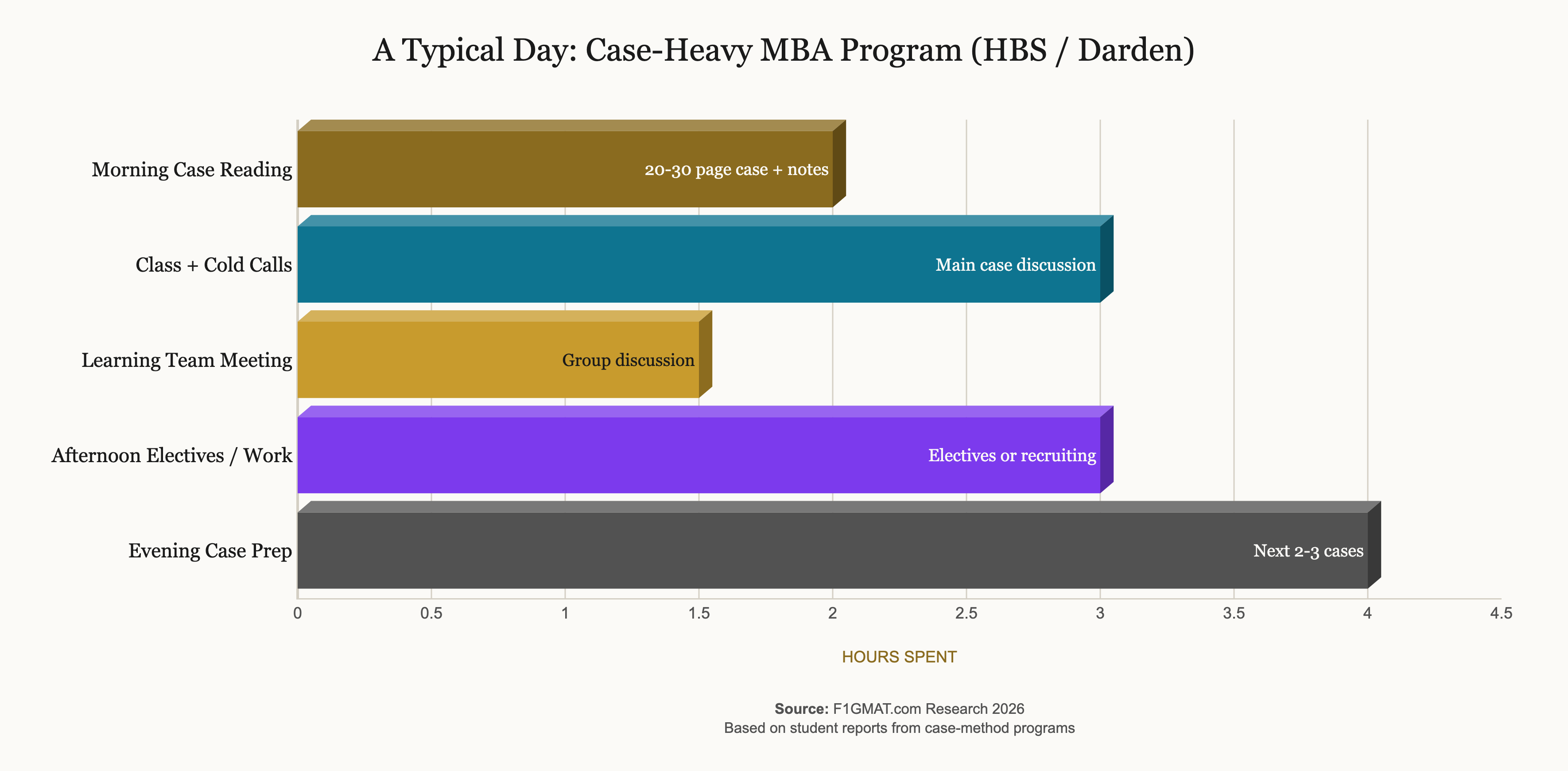
The prep ritual is the same: read the case, work through the financials and technical part of the case, write a solutions summary with numbers to back it up, and finally cross-check the solutions with the group of five to six in each learning team to find counterpoints and objections.
Wharton, UVA Darden, Booth, and Columbia all have formal learning teams that function this way.
Darden runs on three cases per day, which cannot be delivered without teamwork.
Workload & Time Commitment Comparison: Top MBA Programs
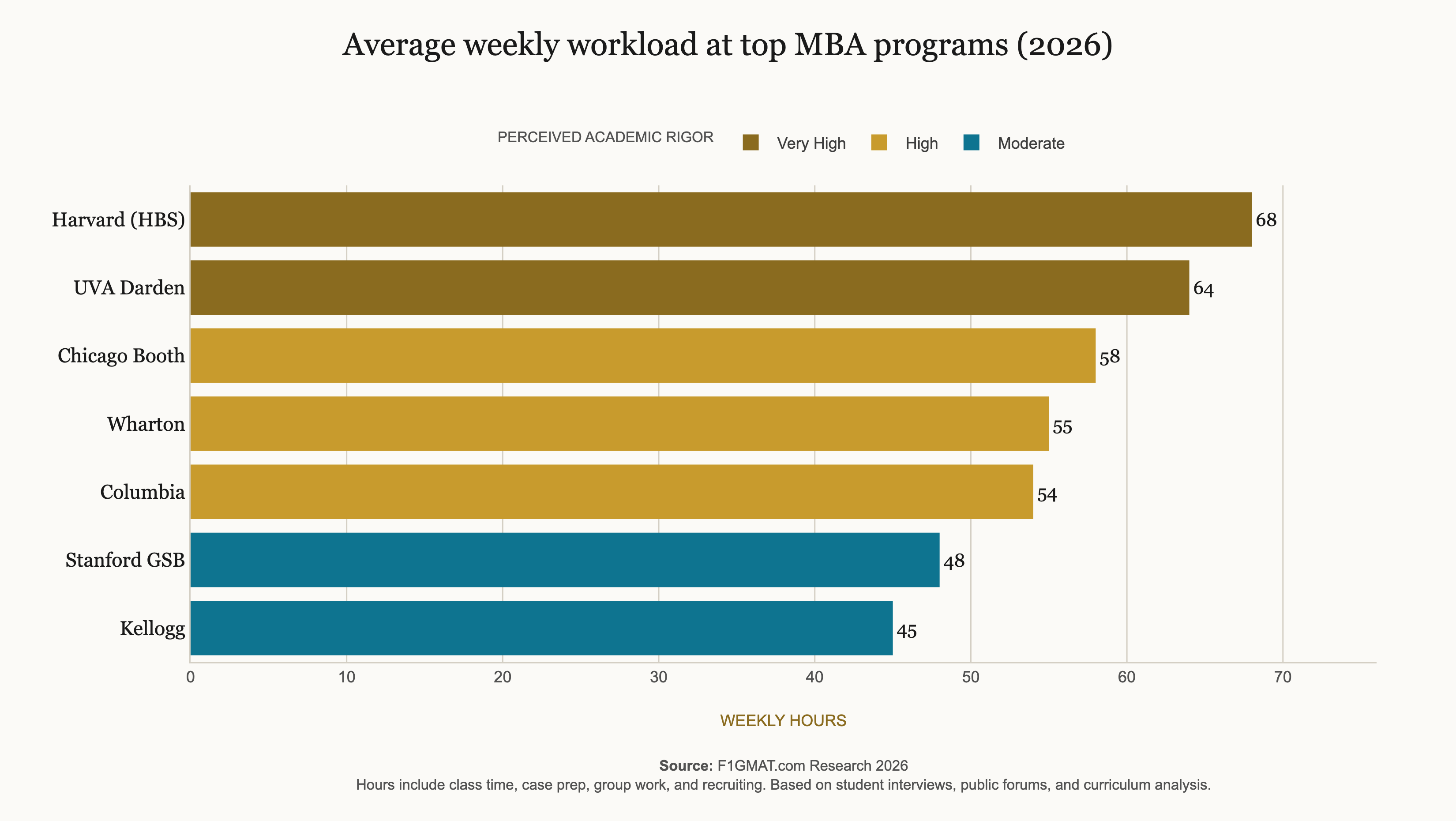
Approximately 15-20% of grading at Stanford GSB and 50% at HBS is dependent on classroom participation [9].
Darden, which also adopted the case study method at scale, adds a similar weightage as HBS for class participation.
Kellogg, Wharton, and Booth lean more toward traditional exams and team projects.
Even though HBS[10] and Columbia allow students to negotiate the norms on who should speak and how often, there are baseline expectations on their extroversion skills.
Non-native English speakers and introverts should build a strong positioning strategy and be mindful of the expectations for admissions to case-heavy MBA programs.
3. Case Method vs Lecture: Which MBA Teaching Style Is Most Rigorous?
HBS is almost entirely case-based.
Darden is entirely case-based.
Stanford GSB runs about half cases and half lecture-discussion, and they are not as intensive as the cold calling seen at HBS.
Stanford MBA Curriculum Analysis
Professors are comparatively informal, and students live up to their high EQ expectations.
HBS classrooms are high-tensed discussion rooms mimicking the tense atmosphere seen in boardrooms.
Wharton, Booth, and Columbia use a mix of heavy lectures in quant core courses, case-based discussions in strategy, marketing, leadership, and organizational behavior, and experiential elements interleaved into all courses.
MIT Sloan runs action learning labs (G-Lab, E-Lab, L-Lab) that place students on real company engagements for a semester.
Yale SOM's integrated core co-teaches classes with faculty from multiple disciplines, offering perspectives around all stakeholders while keeping the scope of the discussion to one organizational perspective at a time.
Kellogg leans heaviest on lectures, team-based learning, and simulations.
Which is more demanding?
The Case method demands daily preparation. Typically, one must prepare one to three cases a night.
Lecture-based quant courses demand a different kind of concentration, where conceptual comprehension is valued over scenario-based learning.
Experiential learning demands flexibility, cultural intelligence, client communication, and leadership skills to manage the many moving parts in a multinational client project.
Booth students, expected to shine as Finance grads, shared that Quant electives were the surprising low-grade scoring course. They particularly quoted Investments, Financial Econometrics, and Cases in Financial Risk Management as the ones that produced C grades. Wharton's Advanced Corporate Finance and MIT Sloan's Analytics Edge were also considered to be failing courses.
4. Quant shock in the first quarter
For applicants from non-traditonal background (military, HR, sports, creative and Marketing), the first quarter or semester around statistics and accounting was the toughest to keep pace with, while manageable Managerial Economics, Operations courses were all squeezed into a ten to fourteen-week schedule.
The Pre-MBA Orientation to financial statements, probabilities, and basic statistics arose from the mismatch in learning comprehension between non-traditional and traditional applicants.
Academic preparedness as an admissions criterion is a genuine requirement.
The admissions team doesn't want to risk the reputation of the MBA program with more Cs and fewer A grades.
Academic preparedness in case-heavy MBA programs also requires extroversion and debating skills in small peer groups.
When you write MBA application essays, understand the difference in the definition of academic readiness in case-heavy vs. lecture-heavy courses and choose your story accordingly.
Pre-MBA Foundational Core Courses: Preparation for the Academic Rigor
The pre-MBA prep ecosystem is dominated by HBS Online's CORe (Credentials of Readiness), which offers a three-course program in Business Analytics, Economics for Managers, and Financial Accounting priced at $1,600 per course or $2,250 for the bundle.
MBA Math is a better option for high-agency professionals from technology and consulting. The self-paced nature of the course is a better option than showing no signal in your application that you are proactive in dealing with lower grades.
Berkeley Extension and UCLA Extension offer graded university courses with transcripts to support an alternative transcript if you had weak quant grades during your undergraduate degree.
Rice's Pre-MBA Quantitative Skills Certificate on Coursera is a highly reputed course and covers accounting, finance, and data analysis fundamentals.
Berkeley Haas offers its own Quantitative Readiness Course (QRC) free to incoming students.
None of the additional quant courses compensates for a strong Quant GMAT score.
Use the quant courses only as an additional branding strategy if you are from a competitive demographic, instead of using them as an alternative to your GMAT Quant score.
5. Recruitment and Grades: How much academic rigor is possible
This is the single biggest force shaping how much actual academic work gets done at a top MBA.
Structured recruiting for consulting, investment banking, and big tech starts and peaks in the fall.
Consulting application deadlines at firms like McKinsey, BCG, and Bain for summer internships fall between mid-July August and September for MBAs.
First-round interviews run through October and November.
Offers arrive in November through January.
For a first-year MBA at HBS, Wharton, Booth, Kellogg, or Columbia targeting MBB consulting or a bulge-bracket banking internship, the first 14 weeks of the program look like this: accounting, finance, statistics, and microeconomics core classes; two to four company information sessions per week; case interview prep (40 to 80 hours); networking coffee chats; club leadership; and a cold call at 8:40 AM on Monday.
Students are working incredibly hard.
Spring of Year 1 is different.
After internship offers are converted in January and February, the pressure releases.
Second-semester electives are chosen purely out of interest.
The hours drop from 100 hours per week to 40-60 hours.
Students feel like taking risks.
They try marketing courses, entrepreneurship seminars, cross-registrations at the Kennedy School, Law School, or Engineering, and writing-intensive classes they avoided in the fall.
Year 2 fall brings full-time recruiting for students without return offers.
Year 2 spring is the genuinely relaxed semester.
Final Take: Most and Least Rigorous MBA Programs
The school choice, therefore, matters in achieving your post-MBA goal while balancing the academic rigor of the MBA program.
How much class engagement and grades do you want to target when your primary goal with an MBA was to master case interview prep and pivot to MBB?
Booth and Wharton enforce it through the forced curve in the quant core courses.
HBS and Darden go through the intense 3-case schedule every day.
Yale SOM forces it through the integrated core's multi-perspective teaching.
Stanford forces it less, trusting the caliber of the admits to self-direct their goals.
Kellogg follows a traditional exam-based academic rigor.
The least and most academic rigor depends on your learning capacity and how much you are willing to sacrifice your personal goals, personal commitments, and risk recruitment chances with GND.
| School | Teaching Method | GND Policy | Core Structure | Perceived Rigor | Best For |
|---|---|---|---|---|---|
| Harvard Business School (HBS) | Almost entirely Case Method + Cold Calling | No GND (reversed in 2005) | Fixed heavy core with high participation grading (~50%) | Very High | Leadership development, consulting/banking pivot, students who thrive under pressure |
| UVA Darden | 100% Case Method + Cold Calling | No GND | Fixed core: 3 cases per day | Very High | Intense case discussion lovers, general management careers |
| Chicago Booth | Mix: Heavy lectures (quant) + Cases | Unofficial/Strict GND in practice | Flexible core + strong grading curve in quant | High (especially quant) | Finance, quant-heavy roles, flexible curriculum seekers |
| Wharton | Mix: Lectures (quant) + Cases + Experiential | Official GND (student-voted) | Flexible core | High (quant curve) to Moderate overall | Finance, entrepreneurship, students wanting work-life balance after recruiting |
| Stanford GSB | ~50% Cases + Lecture-Discussion (less intense) | De-facto GND + Pass/Fail option | Flexible & self-directed | Moderate | Self-motivated students, high EQ, entrepreneurship, impact-focused careers |
| Kellogg | Lectures + Team projects + Simulations | GND (collaborative culture) | Flexible core | Moderate | Marketing, general management, team-oriented & collaborative students |
| Columbia / MIT Sloan | Mix: Lectures + Cases + Experiential (labs at Sloan) | GND (Columbia) / Flexible (Sloan) | Relatively fixed core (Columbia) / Flexible (Sloan) | High to Moderate | NYC finance/tech (Columbia), action-learning & innovation (Sloan) |
Notes on the Summary: Comparison of Academic Rigor at Top MBA Programs (2026). Perceived rigor is based on teaching method, grading pressure, and student feedback.
References
- [1] In Reversal, HBS To Allow Grade Disclosure
- [2] Grading Standards
- [3] Wharton Academics
- [4] MBA Recruiting Policies
- [5] Graduate School of Business Grading System
- [6] Kellogg recruiting policies and guidelines
- [7] Making the Grade (But Not Disclosing It): How Withholding Grades Affects Student Behavior and Employment
- [8] Teaching by the Case Method Cold Calling
- [9] 2.5 Grading
- [10] Making the Most of HBS
