F1GMAT · https://www.f1gmat.com/how-haas-interview-diversity-question ·
Follow F1GMAT
- LinkedIn, opens in a new tab
- YouTube, opens in a new tab
- X, opens in a new tab
- Instagram, opens in a new tab
Email me articles like this
MBA essay guides and deadline reminders. Unsubscribe in one click.
Email me articles like this, opens Mailchimp in a new tab Add F1GMAT as a preferred source on Google, opens Google in a new tab
 See more of F1GMAT's MBA admissions research in Google's Top Stories by making us a preferred source on Google.
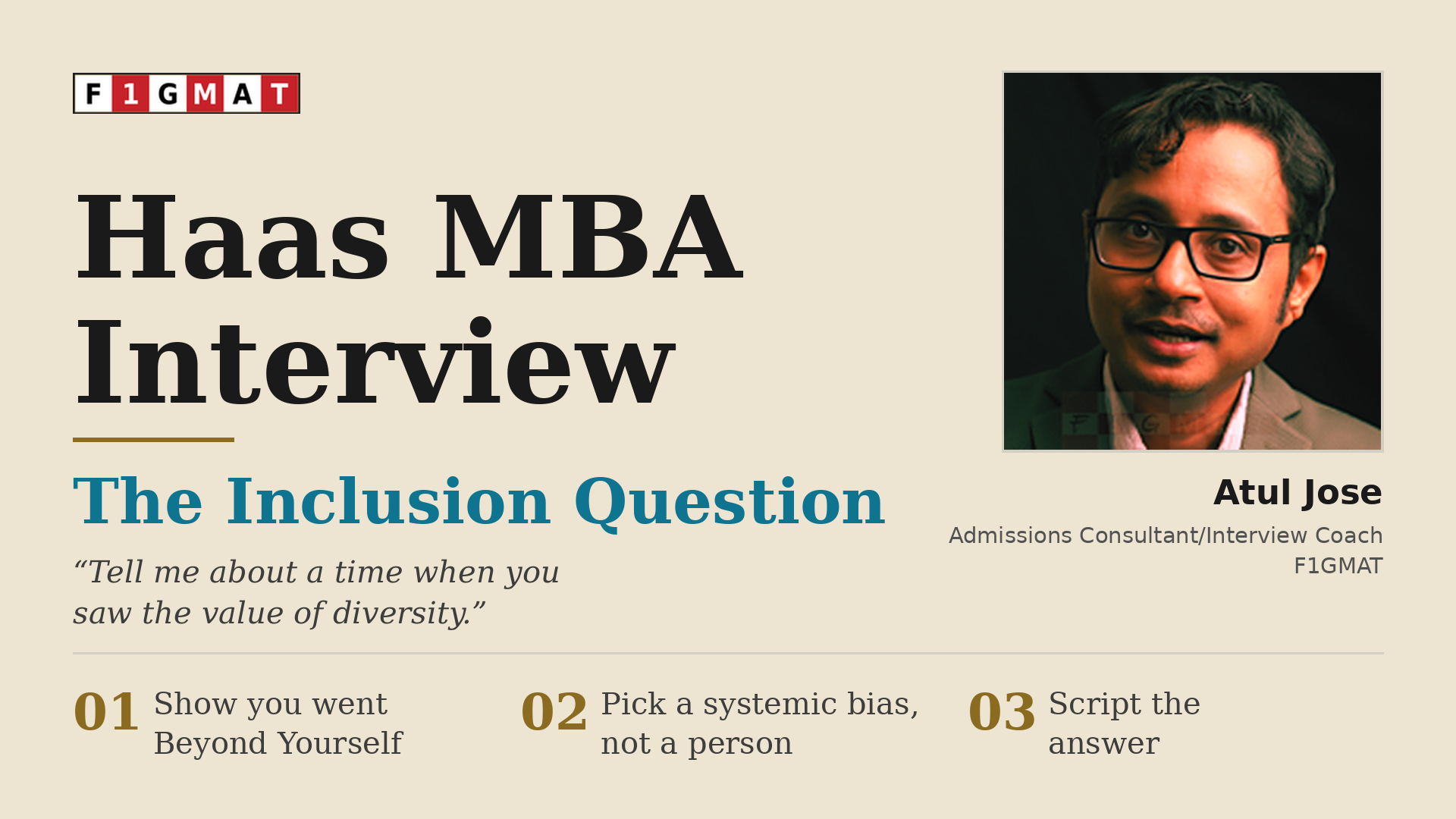
Diversity and Inclusion have multiple contexts, but the admissions team is looking for an example where you went ‘Beyond Yourself’ to achieve a milestone.
How should I answer the Berkeley Haas MBA Interview Inclusion Question
Feedback
Value of Inclusion and Diversity
f1gmat.com
Four Defining Principles
f1gmat.com
Diversity and inclusion have multiple contexts
f1gmat.com
Extreme Judgment
f1gmat.com
Case Study: Stereotype about Asian applicants
f1gmat.com
Case Study: Age and Silicon Valley
f1gmat.com

But coming from a philosophy background struggled to get interesting projects.
f1gmat.com
Initially, the applicant thought that it was the background, the philosophy major, that is discouraging the team from hiring this particular talent.
f1gmat.com
Inclusion and Second Chances
f1gmat.com
Transcript
Haas has a specific question about diversity and inclusion in MBA admissions interview.
Haas has a specific question about diversity and inclusion in MBA admissions interview.
Value of Inclusion and Diversity
For context, tell me about a time when you saw the value of diversity.
Four Defining Principles
Haas is among the very few schools that have mentioned its four defining principles, Questioning the status quo, Confidence without attitude, Student Always and Beyond Yourself.
Diversity and inclusion have multiple contexts
Diversity and inclusion have multiple contexts, but the admissions team is looking for an example where you went beyond yourself to achieve a milestone. If you're planning to mention an example where you felt that some injustice is being met to a team member based on the person's color, age, nationality, gender, sexual orientation or ethnicity, you really have to script the answer.
Extreme Judgment
Any extreme judgment other than systemic biases and assumptions would lead to some awkward conversations or speculations about your employer. It has to be something that our society is still struggling to articulate. For an applicant whose team member was Asian, the typecast was based on his culture, having excellent work ethics and mediocre communication skills.
Case Study: Stereotype about Asian applicants
Is the cliched stereotype about Asian applicants. The task allocation from the project manager was confirming the typecasting. As a team lead, the applicant vouched for the person and shared multiple instances where his communication skills solved complex technology and operational hurdles. The case for Asian candidate and the applicant was right. The project could cross several setbacks because of the candidate's superior communication skills.
Case Study: Age and Silicon Valley
Another example that you can cite for Haas' inclusion interview question is related to age. In Silicon Valley, the perception that older candidates can't pick up technology is rampant. Older in the sense, anyone above the age of 35. The effort required to learn and the commitment to persist through setback is considered low for older candidates. This is because of an interesting development socially. For example, older candidates tend to be married, who have family commitments, who have children, and that would discourage them to put in the extra hours. This unspoken rule leads to several scenarios where project managers are discouraged to hire anyone over the age of 35.
F1GMAT's Mock Interview Service
When one mock interview I conducted with F1GMAT's Mock Interview Service, a client shared about a career switcher who was passionate about technology.
But coming from a philosophy background struggled to get interesting projects.
But coming from a philosophy background struggled to get interesting projects.
Initially, the applicant thought that it was the background, the philosophy major, that is discouraging the team from hiring this particular talent.
Initially, the applicant thought that it was the background, the philosophy major, that is discouraging the team from hiring this particular talent. But later, she realized that the bias was against age. She took it upon herself to mentor and assign one of the toughest projects to this person. He could have an extremely complex project under his belt. Through mentorship, the older candidate picked up the skills in record time. So, inclusion can have so many contexts.
Inclusion and Second Chances
Inclusion could also be around second chances when a candidate fails in achieving a particular milestone or doesn't meet the expectations of a client. What is the logical step? The logical step is to remove the person from the project and assign them to a less consequential one. Once a reputation is against you, very few project managers and team leads would take the risk. If you had an opportunity to bring a candidate who has failed before on an important project, it would also be an interesting example. For this question on how you brought inclusivity and diversity into the team, you have to script the answers.
F1GMAT's Mock Interview Service
If you need help in scripting your Haas MBA interview answers, subscribe to F1GMAT's Mock Interview Service store.f1gmat.com/mock-interview-service