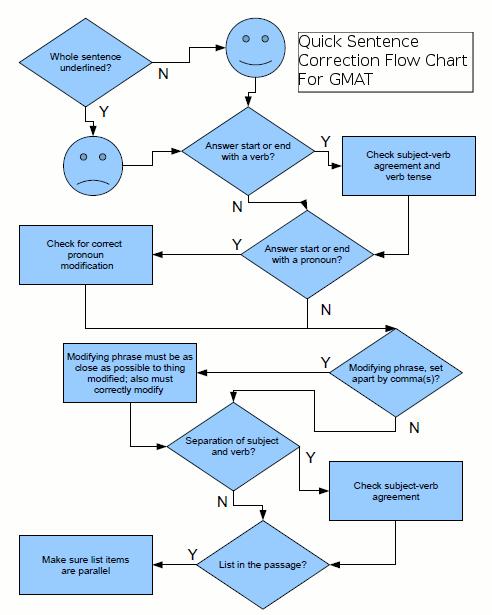
The above is no substitute for reading each sentence carefully, predicting what the correct answer might look like, and finding it in the answer choices of course. A little more on each of the decision points:
• Whole sentence underlined: There isn't much to say about this. With no part of the sentence left static, there's more to keep in mind; the other decisions still help.
• Answer start or end with a verb: Beware nouns close to the verb that may distract you from the real subject
• Answer start or end with a pronoun: Read carefully for the pronoun's antecedent (the word it's replacing in the sentence)
• Modifying phrase, set apart by comma(s): These phrases are easier to spot and work with when they start the sentence, since you need only look at the first thing after the first comma, but these modifying phrases can appear anywhere.
• Separation of subject and verb: The further apart they are, the more words there will be to confuse you. Try paraphrasing the core of the sentence to simplify it.
• List in the passage: The GMAT loves parallelism so much, they should get married, and lists are a great way to test parallelism.