F1GMAT · https://www.f1gmat.com/class-profile/harvard-vs-stanford-vs-wharton-mba/latest ·
 Add F1GMAT as a preferred source on Google, opens Google in a new tab
 See more of F1GMAT's MBA admissions research in Google's Top Stories by making us a preferred source on Google.
Harvard, Stanford, and Wharton are often evaluated in the same breath, even though the schools are clearly diverging. For help choosing the right program, we at F1GMAT analyzed the 2025 Entering Class or the Class of 2027 (2027 graduating class).
We are evaluating the three programs on
• Application Volume and Selectivity
• Undergraduate Degree
• Pre-MBA Industry
Application Volume and Selectivity
Harvard received 9,409 applications and enrolled 943 students, giving it both the largest applicant pool and the largest class size among the three schools.
Wharton followed with 7,613 applications and 888 enrolled, while Stanford had 7,259 applications but enrolled only 434, reflecting its intentionally small cohort model. The enrollment differences are closely connected to each school’s positioning.
Stanford’s Small Class Size and High Selectivity - Motivation
Because Stanford keeps its class size deliberately small, it naturally becomes more selective, which helps explain why it attracts and enrolls candidates with the highest average work experience (5.3 years) and the highest median GMAT (738).
Smaller cohorts tend to appeal to applicants with more established early-career experience who prefer close-knit, mentorship-heavy environments.

Harvard is still the Universally Recognized Brand
Harvard’s larger class size and broad global applicant pool contribute to its slightly lower median GMAT of 730, not due to weaker competitiveness but because more diverse academic and professional backgrounds are represented. Its average work experience of 4.9 years aligns with this broader pool. Because the brand appeals to a diverse and global audience, Harvard tends to draw a mix of early-career professionals, entrepreneurial candidates, and technical talent entering business leadership earlier than Stanford’s applicant base.
Wharton – Target School for Career Switchers
Wharton sits between the two on nearly every metric. Its 888-student class, 735 median GMAT, and 5.0 years of experience reflect a model that balances size with selectivity. This structure also mirrors Wharton’s strong professional focus: many candidates with commercial or consulting backgrounds enter Wharton at the point where they have enough experience to pursue strategic roles but are not as deep into their careers as typical Stanford GSB applicants.
Wharton MBA Class of 2027 Analysis
Stanford and Harvard – Higher International Percentage
International representation also interlinks with class size and yield dynamics. Stanford (38%) and Harvard (37%) maintain higher international shares than Wharton (26%). Because Wharton has the largest proportion of domestic finance and consulting applicants, its international yield is more sensitive to changes in visa processing and global mobility. In 2024–25, U.S. institutions saw slower international enrollment due to increased documentation requirements and processing delays; schools with larger domestic pipelines, like Wharton, felt this shift.
Harvard and Stanford – Strong Brand Recall Among International Students
Harvard and Stanford’s higher international percentages suggest that their global brands and smaller-to-mid-sized cohorts helped stabilize international yield even in a tighter visa environment.
Women Representation – At Par at three Schools
The gender distribution remains remarkably consistent across the three schools: 44% women at Harvard, 45% at Stanford, and 44% at Wharton.
Class Profile | Harvard MBA Class of 2027 | Stanford MBA Class of 2027 | Wharton MBA Class of 2027 |
| Application Volume | 9409 | 7259 | 7613 |
| Enrolled | 943 | 434 | 888 |
| Work Experience (Average) | 4.9 years | 5.3 years | 5 years |
| GMAT Score (Median) | 730 | 738 | 735 |
| GPA (Average) | 3.76 | 3.76 | 3.7 |
| % Women | 44% | 45% | 44% |
| % International Students | 37% | 38% | 26% |
Related Download
- F1GMAT's Harvard MBA Essay Guide (20 Essay Examples)
- F1GMAT's Stanford MBA Essay Guide (24 Essay Examples)
- F1GMAT's Wharton MBA Essay Guide (15 Essay Examples)
Stanford vs Harvard vs Wharton Class of 2027: Undergraduate Degree
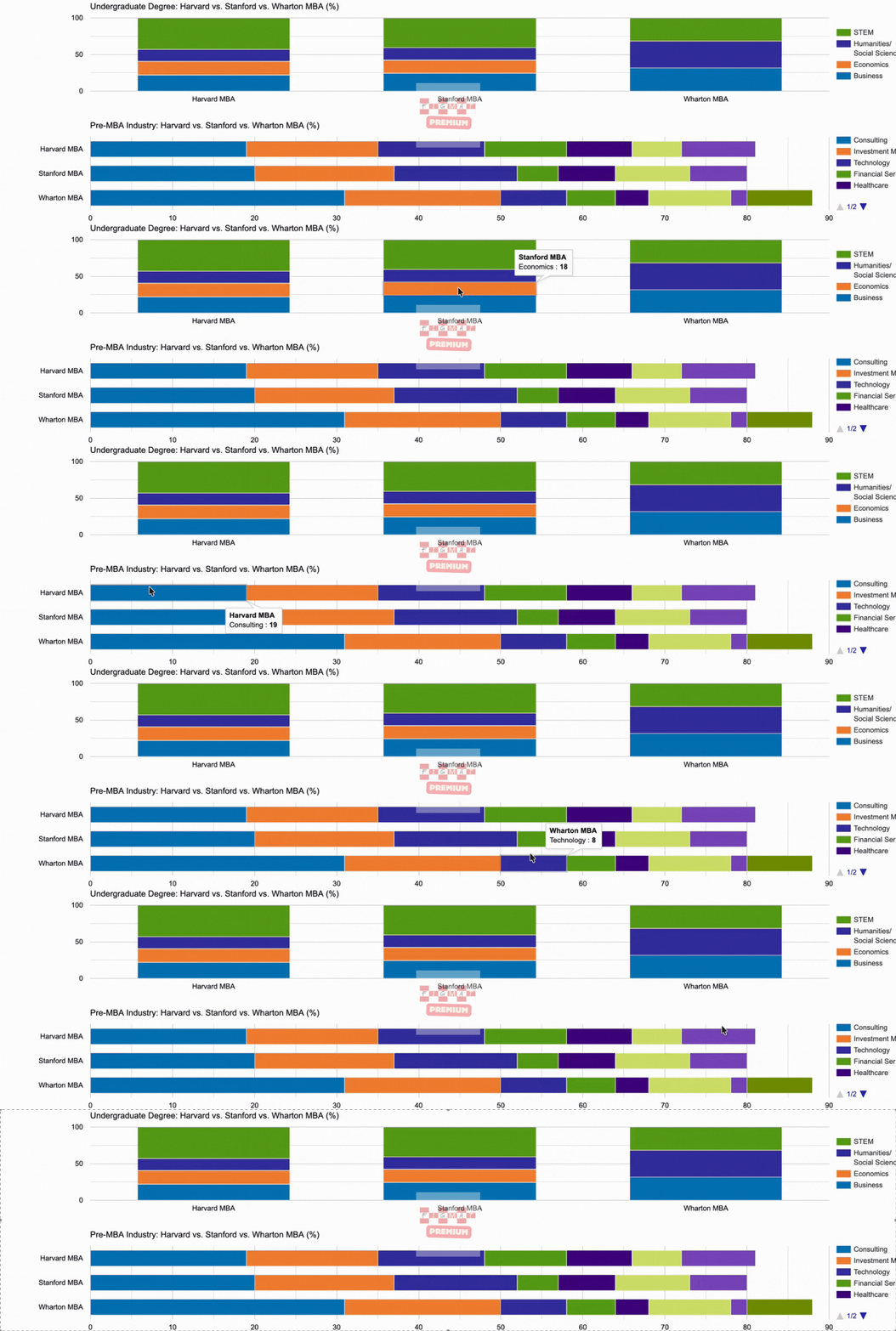
Across the three schools, the most noticeable difference appears in the mix of STEM, business, and humanities backgrounds.
STEM Concentration – Highest at Harvard and Stanford
Harvard and Stanford have the highest STEM concentrations at 43% and 41%, while Wharton stands lower at 32%.
Entrepreneurship – A bigger Factor for the high STEM Concentration
Applicants with technical degrees often select Harvard and Stanford because both schools offer strong pathways into product, tech strategy, analytics, and early-stage entrepreneurship, areas where quantitative skills provide immediate advantages. Their STEM-heavy cohorts also signal peer groups with similar technical foundations, which can appeal to engineers and data-driven candidates.
Wharton – Still a Business Major-Heavy Class
Wharton, on the other hand, enrolls the largest share of business majors (32% compared with Harvard’s 22% and Stanford’s 24%). This reflects Wharton’s identity as the most finance- and analytics-centric of the three.
Business graduates who want to deepen their quantitative training or pursue roles in consulting, banking, or corporate finance often prefer Wharton because the curriculum directly builds on business fundamentals.
Humanities – Still a Big Draw at Wharton
The biggest contrast appears in the humanities and social sciences. Wharton has 36%, far higher than Harvard (16%) and Stanford (17%). This suggests that candidates from non-quant backgrounds find Wharton’s structured analytics core and broad recruiting options especially valuable for career pivots into consulting, marketing, or finance roles. Harvard and Stanford’s lower humanities shares reflect more diversified applicant pools, still broad, but skewing more toward STEM, economics, and professional backgrounds.
Economics Major – A big Draw at Harvard and Stanford
Economics representation is nearly identical at Harvard (19%) and Stanford (18%), while Wharton does not report it separately because many economics majors fall under its business/economics grouping.
Undergraduate Degree | Harvard MBA Class of 2027 | Stanford MBA Class of 2027 | Wharton MBA Class of 2027 |
| Business | 22% | 24% | 32% |
| Economics | 19% | 18% | NA |
| Humanities/Social Science | 16% | 17% | 36% |
| STEM | 43% | 41% | 32% |
Stanford vs Harvard vs Wharton Class of 2027: Pre-MBA Industry
Consulting – The Strongest Feeder Industry at Wharton
Consulting is the strongest feeder industry at Wharton, with 31%, much higher than Harvard (19%) and Stanford (20%). For applicants, this means a Wharton cohort with a high concentration of ex-consultants and a recruiting ecosystem heavily oriented toward consulting and strategy roles. The increase aligns with broader consulting market stabilization in 2024–2025, which expanded the number of consultants pursuing MBAs.
Wharton – PE/VC Heavy and 8% from IB
Finance remains steady across all three schools, but with different patterns. Harvard reports 10% in financial services, Stanford 5%, and Wharton 6%, but Wharton also adds 8% from investment banking and 19% from PE/VC, making it the most finance-weighted class overall. This concentration reflects Wharton’s long-standing strength in finance and its location near New York’s financial sector. Applicants seeking roles in private equity, banking, or investment management will find a larger peer network at Wharton.
Technology – Strongest at Stanford and Harvard
Technology representation is highest at Stanford (15%), followed by Harvard (13%) and Wharton (8%). This mirrors Stanford’s ties to the tech ecosystem and the fact that many tech professionals choose GSB for career acceleration or transitions into product management and venture roles. Harvard attracts a similarly broad tech pipeline due to its strong entrepreneurial ecosystem, while Wharton’s lower figure reflects the narrower flow of applicants coming directly from technical roles during a period of uneven tech hiring.
Healthcare – Another Strong Representation at Stanford and Harvard
Healthcare backgrounds appear strongest at Harvard (8%) and Stanford (7%), with Wharton lower at 4%, consistent with the fact that both Harvard and Stanford have stronger ties to biotech, healthcare innovation, and health policy communities.
Government and Non-Profit – Strongest at Wharton and Stanford
Government and nonprofit representation is highest at Wharton (10%) and Stanford (9%) compared with Harvard (6%), suggesting broader intake from mission-driven roles at Wharton and Stanford.
CPG/Retail – Strong at Harvard and Stanford
CPG/retail is highest at Harvard (9%) and Stanford (7%) but minimal at Wharton (2%), reflecting the stronger general-management and consumer-brand pathways at HBS and GSB.
Pre-MBA Industry | Harvard Class of 2027 | Stanford Class of 2027 | Wharton Class of 2027 |
| Consulting | 19% | 20% | 31% |
| Investment Management/PE/VC | 16% | 17% | 19% |
| Technology | 13% | 15% | 8% |
| Financial Services | 10% | 5% | 6% |
| Healthcare | 8% | 7% | 4% |
| Government/Non-Profit | 6% | 9% | 10% |
| CPG/Retail/E-commerce | 9% | 7% | 2% |
| Investment Banking | NA | NA | 8% |
Final Take
Insights from the Class Profile Comparison (Harvard MBA vs. Stanford MBA vs. Wharton MBA)
1) Consulting background: Strongest at Wharton
2) PE/VC/IB Role: Strong Peer Group at Wharton
3) Technologists: Stanford and Harvard lead
4) Entrepreneurship: Stanford first and Harvard second
5) Healthcare: Stanford and Harvard have close to equal representation
6) CPG/Retail: Harvard MBA has a stronger representation than Stanford MBA
7) STEM: Highest at Harvard, followed by Stanford
8) Business Major: Wharton is a preferred school
9) Humanities: The strongest draw at Wharton
10) Economics Major: A big Draw at Harvard and Stanford
11) International Students: Harvard and Stanford lead
12) Women Representation: At Par at three Schools