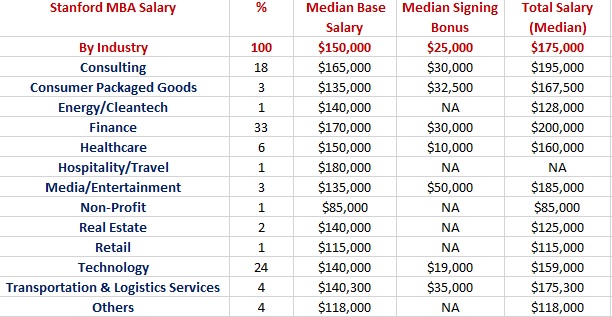
When the highest total median salary is close to half a million - $4,50,000 to be precise, Stanford MBA has rightly earned a reputation of attracting some of the most accomplished and driven candidates. Comparison with Harvard, although legitimate, the 2019 class has stood its ground with a median base salary of $150,000 and a signing bonus of $25,000, taking the total median salary to $175,000.
Finance and Technology are the two favorite industries for the latest graduating class attracting 57% of the class. Consulting as an industry seems to lag as a destination (18%), although this year, the class saw a 2% increase. On job function, Strategy/Planning was neck and neck with Management consulting - 15% vs. 17%, whereas Marketing/Sales continues to be the most popular job function. The trends are reversing as this year saw a 9% drop in offers to this function. Product Manager role has taken the share of the offers with 10% of all offers despite a $142,500 base salary that is well below the class median.
Private Equity (PE) and Venture Capital (VC) as an industry continues to be the most compensated, both crossing $200,000. On the function side, PE was behind VC by over $60,000.
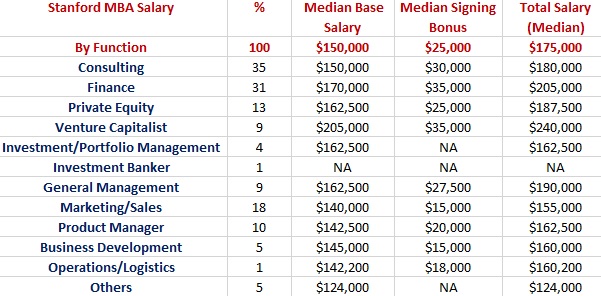
Consistent with what we have seen in other M7 schools, Strategy/Planning role is a function where the candidate is willing to take a pay cut. The latest Stanford MBA class demonstrated the trend with a mere $10,000 signing bonus, the lowest across all job functions, despite 15% of the class accepting the offer. A pre-destined path to a CXO role, often seen with a strategy/planning career, could be a reason for the short-term sacrifice, or it could be from the increased number of career switchers entering the function. No such sacrifices were required for other functions as the signing bonus ranged from $15,000 to $35,000.
2017 vs. 2019 – Stanford MBA Salary Growth
Stanford MBA - Salary By Industry (Comparison)
Base Salary: It is not just the $150,000 base salary that impressed us. In just 2 years, the school attracted median base salary offers that were $14,000 higher. The signing bonus has remained stagnant at $25,000. The biggest jump in median base salary has been in Healthcare and Consumer Packaged goods ($25,000), followed by Consulting and Finance ($20,000). All the other industries have maintained a $4,000 to $14,000 increase.
Bonus: The bonus payment has gone up across industries ($4,000 to $22,500). Consumer Packaged goods saw a record $22,550 increase. Healthcare ($10,000 decrease) was the only exception.
For more salary-based analysis, subscribe to our career planning and profile evaluation service.
Stanford MBA - Salary By Function (Comparison)
Base Salary: The incredible growth of Amazon and the e-commerce ecosystem were reflected in the increase in median base salary for operations/logistics that saw a $17,250 increase in base salary. However, the industry cleverly cut the signing bonus by $12,000 compared to the graduating 2 years ago, canceling out the gain.
No such trickery was used by the Venture Capital function that saw an incredible $37,500 increase in base salary and $15,000 in signing bonus, contributing the most towards positioning Finance as a rising function. General Management is another function with a similar $37,500 increment.
Private Equity roles, contributed by the anticipation that a recession is a year or two away, and the pressure to book profits, has led to pressure on the fixed cost – employee and partner compensation. In just two years, PE offers at Stanford MBA saw a $37,500 decline in median base salary. The exact PE vs. Venture Capital salary increase/decrease seems a coincidence.
Bonus: When other school offers consisted of a declining bonus payment, Stanford managed to maintain a $5,000 to $15,500 increase.
Reference: Stanford MBA Employment Report