To give you a complete picture of what MIT Sloan MBA is offering, I cover:
MIT Sloan MBA - Required Core Courses
MIT Sloan's MBA curriculum starts with the six required core courses in the first semester: Communication for Leaders, Financial Accounting, Economic Analysis for Business Decisions, Leadership Challenges for an Inclusive World, and Data Models and Decisions.
The required core themes are balanced – leadership, finance, and decision-making with data models.
The elective core courses cover broader functional roles in marketing, operations management, and marketing, with one course covering a broader – managerial finance.
MIT Sloan, known for its academic rigor, requires that the students score over 4.0 (on a five-point scale) or above a "B" average to graduate.
After the first semester, candidates can customize their courses according to their post-MBA goals and develop strong analytic, problem-solving, and leadership skills.
MIT Sloan MBA - Electives
Students can choose from 144 units of electives categorized around 9 themes, in addition to three approved non-MIT Sloan subjects, which are graduate-level MIT or Harvard courses. In the electives, industry themed courses are in Healthcare, Technology, and Finance. Courses in Global Economics & Management provide a well-rounded view of how businesses operate in a globalized economy.
MIT Sloan MBA - Tracks
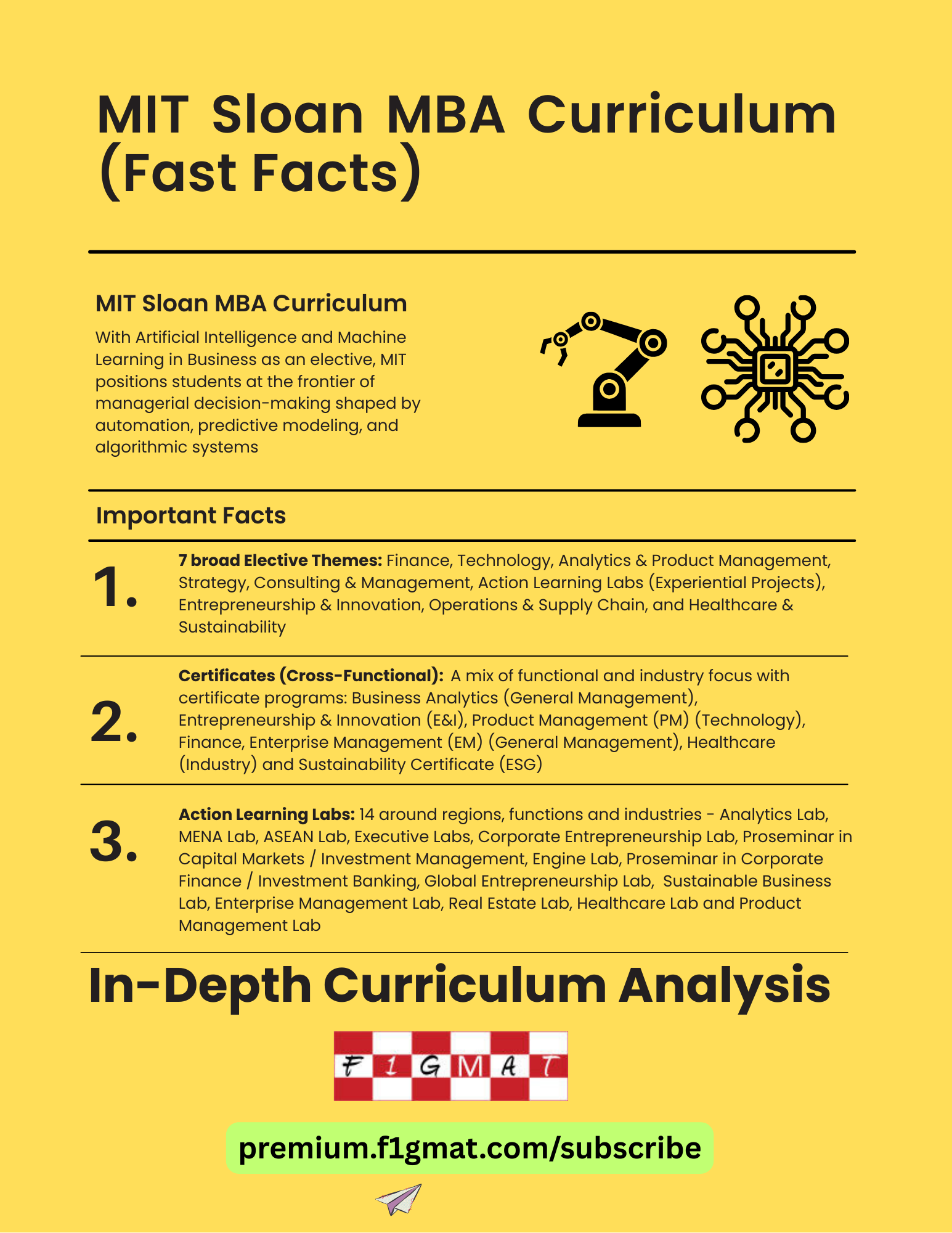
MIT Sloan offers three optional tracks - Finance, Entrepreneurship & Innovation, and Enterprise Management. MIT MBA candidates can also specialize through Healthcare and Sustainability certificate program, but they must complete 144 units of electives, with one subject contributing 3 to 12 units for graduation. MIT is clearly defining the boundary by limiting the tracks to three.
Finance Track: is for MBA students who want to pursue a career in the Finance industry post-MBA. The track has required courses, elective and extra-curricular activities that help MBA students develop their skills in Financial Management. At the end of the track, the students will receive a Certificate in Finance, along with the MBA degree.
Entrepreneurship & Innovation Track (E&I): is for MBA students who have already committed to following an entrepreneurial journey. The classes focus on developing new ventures, especially technology start-ups (which MIT is known to support). The E&I students are mentored by successful entrepreneurs and thought leaders. Students receive a certificate in Entrepreneurship and Innovation, along with an MBA degree.
Enterprise Management Track: is ideal for roles that require offering consulting solutions and leadership or in positions that require expertise in Marketing, Operations, Product development, and Supply Chain Management. Students can also choose cross-functional electives in Business Analytics, Industries & Sectors, Management Practices, Product Development and Innovation, and Global Management.
MIT Sloan cover letter strategies
MIT Sloan MBA - Certificates
Analytics Certificate: With the success of the Master of Business Analytics program and the evolution of Data Science from a niche skill to a must-have competency for decision-making, MIT Sloan has embraced the demand and launched the Analytics Certificate program for students in all graduate degree programs. The program can be completed in 2 to 4 semesters with the goal of building skills to breakdown large structured and unstructured data into actionable insights. The use cases for this skillset cover a cross-section of functions and industries: marketing, operations, finance, and healthcare.
Product Management Certificate: With a cross-functional exposure, Product Management certificate builds skills in research, strategy, marketing, finance, data analysis and sustainability. The certificate program also opens up access to the largest cohort at MIT – the Product Management club; a network that will provide participants a realistic perspective on the challenges and opportunities that lie ahead for the technology industry.
Enterprise Management Certificate: Primarily the EM certificate applies marketing, operations, and strategy skills for preparing business leaders to develop a holistic perspective when they approach a business problem. A real-world project is assigned from day one, rapidly building skills with EM Lab in the first semester and Management Practice Hack-a-Thon in the second semester. The certificate is a rare opportunity for community engagement and networking with leaders and like-minded peers interested in roles that are often the precursor to CXO roles.
Sustainability Certificate: The Certificate in Sustainability allows MBA Students to view sustainability as a function of interconnected models of economic, environmental, and societal systems. Students will learn how overall success depends on success across all areas and not just on the economic results. The courses in the Certificate Program will leverage Sloan's strengths: Process Improvement, Technology and Innovation, Entrepreneurship, and Dynamics of Organizational Change.
Healthcare Certificate: With Healthcare turning into one of the most disrupted industries, Sloan is offering all graduate students the opportunity to decode the fieldwork and research the students and faculty at MIT are capturing. The certificate program will give students the necessary knowledge and hands-on experience required to enter Healthcare, Biomedical, or the Pharma industry as a consultant, management professional, or an innovator.
Entrepreneurship & Innovation Certificate: MIT Sloan is known for its strong Technology cohort. But the E&I certificate is open to entrepreneurs with interest in non-technology companies as well. By working with entrepreneurs, faculty and cohort of like-minded peers, students will gain a practitioner’s perspective of building and scaling a venture.
Experiential Learning
Note: Mentioning experiential learning is essential for your MIT Sloan MBA Cover Letter. Match them strategically with your post-MBA goals.
Analytics Lab: For large Businesses, lasting changes cannot be implemented with intuition. Big data and analytics offer the data points required for strategic changes.
The Analytics Lab (A-Lab) is offering a combination of tools - machine learning, analytics, and big data, designed to make sense of business bottlenecks and find opportunities the executives have missed. Apart from full-time MBAs, the A-Lab attracts some of the best minds from EMBA, Sloan Fellows, and MFin.
ASEAN Lab: Perhaps the most useful lab for candidates interested in consulting or doing business in Southeast Asia is the ASEAN lab, where students will dive deep into the dynamics of the ASEAN (countries (Brunei, Cambodia, Indonesia, Laos, Malaysia, Myanmar, the Philippines, Singapore, Thailand, and Vietnam) countries with China, particularly under modern-day cold-war between the US and China. Another interesting aspect of the lab is the complex socio-economic status, diverse populations, and GDP growth rates of each ASEAN country and its correlation with global trade and supply chain.
Corporate Entrepreneurship Lab: For applicants interested in introducing innovative initiatives in a traditional corporate environment, the Corporate Entrepreneurship lab offers the framework to introduce startup behaviors and thinking into hierarchal organizational structures. Speaker series and networking with industry veterans who have introduced similar innovations will build the hands-on experience required for the transformation.
Enterprise Management Lab: For students interested in the Enterprise Management Track, the EM-Lab helps them focus on three aspects of the Business - Strategy, Marketing, and Operations, although they can bring their expertise in other functional areas into the solution. Students present their findings to clients and deliver recommendations for a specific problem faced by non-profit or for-profit companies.
Entrepreneurship Lab: Students with a short-term or long-term goal of pursuing Entrepreneurial dreams can test their ability with the E-Lab. Candidates work with Entrepreneurs and help them find new markets, fine-tune their technology framework for mass adoption, use industry and competitor knowledge to recommend a new product or pricing strategy and develop a viable path to large-scale commercialization or profitability.
Finance Lab: Students opting for the Finance track at MIT Sloan MBA can join members of the Master of Finance program for the Finance Research Practicum and Finance Proseminars - two modules that are part of the Finance lab. Recent projects have enabled a wide range of skill development, including investment research, risk measurement, research for venture capital, identifying PE targets, strategies for investment firms to enter the market, and making investment decisions based on news analytics.
Global Entrepreneurship Lab: With 55 Countries and 500+ startups served since 2000, the Global Entrepreneurship lab began offering students tools and frameworks to dissect political, cultural and non-economic factors that determine a country's policies and growth potential. Such context helps students understand the constraints under which they are serving the market. Once they build a holistic understanding of the business culture, students work with senior leadership and develop a strong sense of the dynamics under which decisions are made.
Generative AI Lab: While the world's focus has been on the value of prompt engineering, which the lab extensively covers, the Generative AI lab is broadly designed to encapsulate the IMPACT of generative AI across roles, from brainstorming to implementing a solution. The lab is not a technical lab but offers enough exposure for a person to lead a team of developers and build fluency in the application of AI in strategy and media while also giving candidates entering VC/PE to make an informed investment decision in AI start-ups.
MENA Lab: For candidates interested in doing business in the Middle East and North Africa, the lab explores the geopolitical and cultural factors influencing the thinking of entrepreneurs and investor communities. Students get the opportunity to directly interact with government officials, universities, and multinationals and explore managerial issues facing technology niches – AI, advanced life science, analytics, cybersecurity, fintech, quantum computing, robotics, and Web 3.0. MIT students will also get to work with startup entrepreneurs in the region to understand the dynamics between the creators and the investors.
Organizations Lab: Leading with IMPACT: The social-impact experience at MIT is fulfilled through the organizations lab where students work with cohorts from MIT School of Engineering, Harvard Graduate School of Education, Harvard Kennedy School, Harvard School of Public Health and Wellesley College on issues affecting beneficiaries in the Greater Boston region.
Operations Lab: Ops-Lab is open for all MIT Sloan students with learning experience exclusively designed for Operations. Students work as consultants for manufacturing companies, and hospitals of small and mid-sizes in the Greater Boston Area.
USA Lab: With the change in the economic condition of rural Americans and the increased paranoia against immigration, MIT Sloan is diving deep into American heartland with the USA Lab. Instead of painting a broad brush on information from mainstream media, students will work with organizations across the US, learning the day-to-day challenges of competing in a globalized market and the changing job trends in small towns.
Sustainable Business Lab: Leveraging MIT’s cross-functional cohorts from MBA, Fellows to graduate students, the sustainable business lab explores outlining problems with a proprietary MIT framework to include holistic development: economic, social, personal, political, and environmental levels to create a solution that offers a stable and long-term impact. Through a community-driven learning experience with cases, speaker series, experiential learning, and reading, students internalize the values for building sustainable businesses.
Reference