In this F1GMAT's Stanford MBA Essay review series, I show how story archetypes used by applicants from the Oil and Gas industry and industries with a high carbon footprint continue to work.
Learning Objective: Story Archetype
What matters most to you, and why? (up to 650 words)
Applicant Background: Reservoir Engineer, ExxonMobil (28-year-old Domestic Applicant, 5 years of experience in Houston)
Stretch Schools: HBS, Stanford
Match Schools: Rice Jones, McCombs, Booth, MIT
Post-MBA Goal: Energy Finance
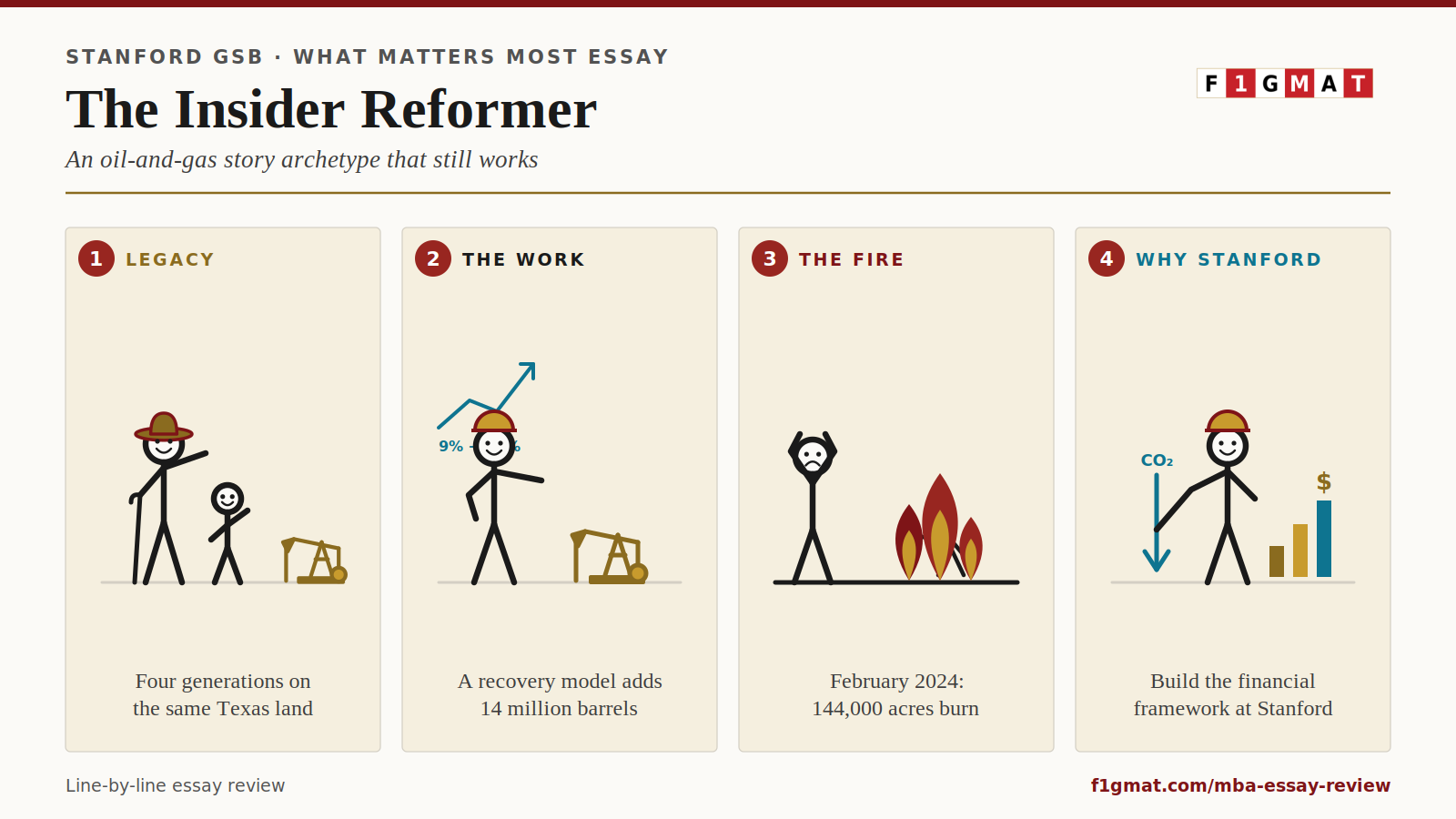
Sample Stanford MBA What matters most to you, and why? – Story Archetype That Works (Oil and Gas) (Engineering to Finance)
*****
Note: This is a first draft essay to illustrate the story archetype used by Oil and Gas applicants. Don't use it in your Stanford MBA application. They are shared for educational purposes only.
*****
MBA Resume Entry: "Built a waterflood optimization model for a mature Permian (Wolfcamp) field at 10,400 feet that raised the recovery factor from 9% to 12%, adding 14 million barrels of recoverable reserves, roughly $140M in NPV, and extending the field's economic life by nine years."
What matters most to me is to bring sustainable and affordable energy to future generations.
Over the years, I have become good at creating models that spot oil reserves two miles below the rocks.
I didn't have much of a choice
From the moment my grandfather kept his first drill bit on the mantel, I would shadow around his drill work and name the parts of the pumpjack before I could name half the state capitals. I was only 5, but the barrel of oil meant so much to my grandfather. His father – a rancher who had given up on the cotton sale woke up one day collecting a check that erased all his debt and kept some more for my grandpa. He bought the adjacent ranch with that single lucky exploration. The royalty was one-eighth in those days. Grandpa took me to these dry oil wells on our land with gleaming eyes.
I proudly continued the legacy of changing lives and communities in Texas. Energy independence meant the farmers and ranchers don't have to worry about the input costs . My work on a recovery model extended the exploration of the Permian Basin field by nine years . That same afternoon, my sister sent me a photograph.
A gutted pumpjack – the one grandpa treasured
I was devastated. The hours of my childhood memories were no longer recoverable. Worst - 144,000 acres across the panhandle in February 2024 were charred to the ground.
Windy Deuce Fire, which started at an oil field in Moore County on the same afternoon as Smokehouse Creek began at the ignition point of a pumpjack, which was powered through faulty wires.
When the wind moved the limbs against the energized lines, the contact ignited a spark.
When unregulated greed is passed along as opportunities in communities, devastation follows.
The pumpjack's power lines were wired by oil and gas operators, outside the state's purview.
After the oil boom, the communities were looking for any sources of income to sustain the legacy of these once oil-rich towns. It didn't matter if they were illegal
I had to think beyond my individual accomplishments.
What was I doing for my community?
I had become good at integrating systems and processes that limit carbon emission in our exploration and kept a 100% safety record in our oil rigs, but for communities spread outside the federal purview, safety is secondary
Attending the emissions-reduction working group, I learned that the same reservoir modeling used to find oil could locate the best rock for storing carbon dioxide underground with a technique called sequestration.
I proposed a small change to how we scheduled well completions to cut flaring and store carbon underground. It was approved for two fields and refused for a third on cost.
The same cost excuse let the unregulated oil explorers cut corners and burn down my grandpa's legacy
I am the fourth generation of my family to make a living from this land.
Cost, a variable I have no influence over, is everything in the energy business.
I need skills I do not have yet to allocate capital in energy storage and create risk frameworks that protect communities.
What matters most to me is to protect the land and the sea that have given us so much.
The time has come to create the financial framework to bring sustainable energy to future generations.
What is the Story Archetype in the above Stanford MBA What Matters Essay?
The story archetype is that of an applicant who is good at his job, but is aware of the perils of chasing profitability and unsustainable exploration practices.
He doesn't dislike his job, nor does he pivot away from the job because of a moral dilemma.
The story archetype is all about reconciling with bringing sustainable practices into Oil Exploration while also accepting that a strong Finance foundation where cost is controlled or risked is the only way to transform the community.
It is an acceptance of the changing economics seen in the oil and gas industry.
What is the trigger event?
In memorable essays, applicants strategically connect public news and events to the story.
The burning of the 144,000 acres across the panhandle in February 2024 is the trigger for taking a stand in favor of sustainability for the entire community.
Think about Forrest Gump and the Vietnam War. Imagine if that entire sub-plot were not there. There is no moral grandstanding, but the backdrop of the war is ingrained in the psyche of anti-war thinkers and the public, even those who were born decades later. The story didn't have to take any public position against or for the war. The consequences and the storylines speak for themselves.
A good essay uses such a backdrop to show the negative impact of policies.
In this essay, the stubbornness to believe that the Oil and Gas industry will continue to thrive, and a town taking any means to earn a living through the desolated oil wells are two parallel plots.
Who is the secondary character used in the What Matters to You the Most and Why Stanford MBA Essay?
The applicant's grandfather is used as the secondary character.
Look at the entire paragraph. 6 sentences, where only 2 sentences are where the applicant is not mentioned. This should be the best practice whenever you bring your influences, caretakers, and mentors into the story. Connect it back to you – your interaction with the person, the impact they had on you, and your change in values.
It is all about you – how you felt about the person, what you learned from that person, and what you will carry forward. Here, don't be humble or allow the other person to shine, even if it was your loving grandfather.
What is the object that binds the entire Stanford MBA Essay together?
Pumpjack – the mechanical device used for extracting crude oil from an underground well. This is a classic storytelling tool to keep the audience hooked on an object. It was rosebud in the movie Citizen Kane.
Spoiler alert – the word rosebud is revealed at the end of the movie, and the object doesn't hold on to the intrigue the audience was anticipating. It is not like a Sherlock Holmes novel where the clue is everything.
Spoiler below!!
Rosebud is a metaphor for the protagonist's lost childhood. Similarly, the pumpjack is a metaphor for the dying Oil and Gas industry in the community and the applicant's motivation to join the Oil and Gas industry.
It is the applicant's way of justifying why he cares about the industry.