By the time an M7 admissions officer reaches your essay, she has read a stack of Product Manager introductions that sound like yours.
These cliched openers lean into cross-functional influence, data-driven decision making, prioritizing features that customers love, or how to navigate ambiguity.
Here are 10 cliched Product Manager opening line patterns seen in M7 MBA essays:
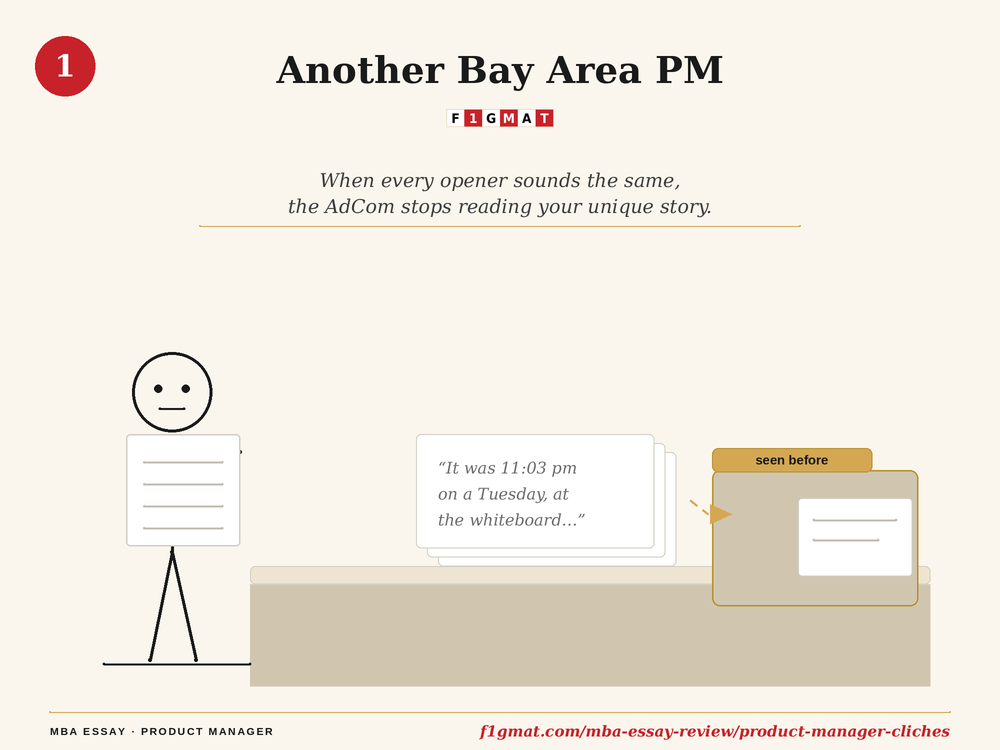
1) Late Night Founder Mode
"It was 11:03 pm on a Tuesday, and I'm at the whiteboard, sticking notes to find that one bug that was derailing our plan. When my lead engineer reminded me that the release is slipping, I .."
A commitment to outcome with the 11:03 pm reveal and 'coolness' under pressure with "my lead engineer reminded me that the release is slipping"
There is nothing wrong with starting with this line, but the number of applicants who use this kind of strategy should discourage you from using such lines.
Better Alternative
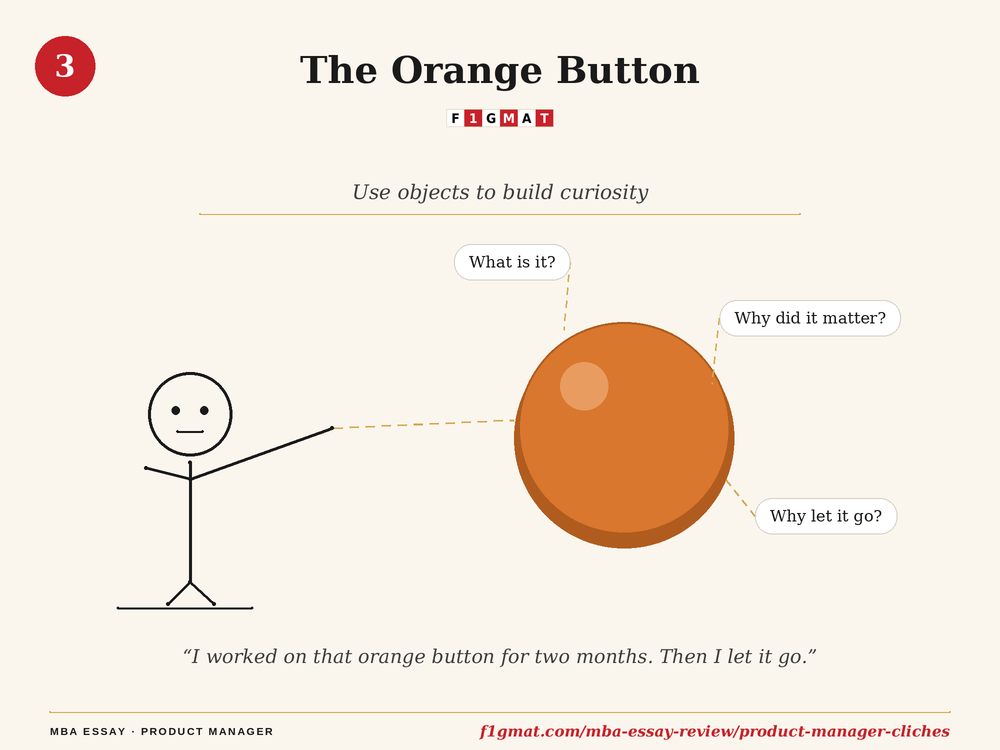
A better demonstration of skills is by showing second-order thinking, detachment from a feature you championed for the greater good, owning the outcome of a colleague who failed, and managing cross-functional conflicts.
"I had worked on that orange button for over 2 months. But the time has come to let go of my baby"
This is a line that will build curiosity.
What is the orange button?
Why was the orange button important?
Why let go of the feature?
2) Metric Drop
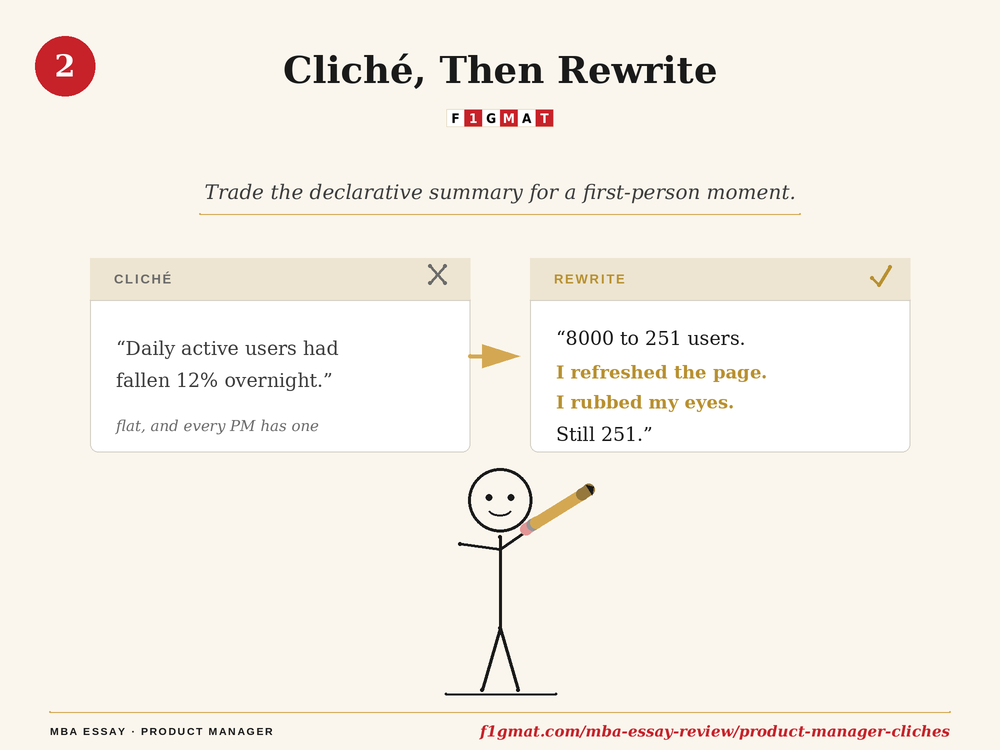
"Daily active users had fallen 12% overnight, and no one knew why."
Again, nothing wrong in opening the line with a crisis statement, but if the next lines don't build on the 'outcome' with some why and some gap and then back to the why, the interpretation will drift into the 'cliched' another Bay Area PM trying their luck folder.
Better Alternative
"8000 to 251 users. I refreshed the page 5 times, rubbed my eyes 3 times, and still the customers online were just 251"
The fall is dramatic. Not the 12% active user that could be from seasonal changes. Not worthy of dramatizing.
There is no declarative statement in this version. I am trying to bring the AdCom to the applicant's story.
I refreshed the page.
I rubbed my eyes.
We love first-person narratives.
Don't overdo it, but start with it.
3) User Empathy without Any Empathy
"I sat behind the one-way glass and watched a user abandon our onboarding at step three"
Again, nothing about the user.
Who is the user?
Is it some anonymous person with no physical characteristics?
How can we humanize this version?
"I saw an elderly gentleman, frantically pressing a button that wasn't a button but just a cool shadow we added last night. He checked his phone and then tried again and again to find the button, before finally giving up and moving to the next screen"
Instead of a declarative statement, we are capturing the age of the customer, a moment of distraction (checked his phone), and then the giving up moment.
Here, empathy for a customer is captured by sharing the person's emotional state and behavior during the interaction.
The age is important because in the next few lines, the applicant reveals the big gap between what they were designing and the end customer's needs.
4) Role Definition
"A product manager is not an engineer and not a designer. A PM is the person who owns the why."
There is no better alternative to a general role description.
A startup PM had a better version.
"My CEO shared that by next Wednesday, we will go bankrupt if the product isn't released. My lead engineer gave up and submitted his resignation. I looked at the designer, and he was smiling ear to ear with excitement."
This is a technique where you don't become the hero or the redeemer in the opening line.
You force the attention to a secondary character, who will take the narrative forward with themes of leadership and working with a team of B-players who truly believed in your vision.
5) No more Intersection as Opener
"I live at the intersection of business, technology, and design."
I have been seeing this line for a decade now, and applicants won't give up on it.
There is a certain efficiency in this line, but don't use it as an opener.
This is a good enough line for a transition where you want to show your multi-functional expertise.
As you write more, you will soon realize that some cliched lines work depending on where you are using them.
6) Don't Define Leadership
"Leadership for me is about empowering people"
Any defining leadership through the opening line will soon turn into a thesis about leadership instead of your story.
Your story should have all the elements of leadership but don't make it all about leadership.
Add vulnerability.
Add suspense.
Add emotion.
Bring back the focus to your quant skills.
Show your people skills.
Share your vision.
7) Don't Quote the Founder or a Thinker
"A brand for a company is like a reputation for a person. You earn reputation by trying to do hard things well."
There is nothing wrong with interesting quotes if it came from the applicant. The quote above is from Jeff Bezos.
The trouble with such lines is that you have to shift focus away from you to Bezos.
Then another transition to bring back the story to 'you'.
The quotes from famous people work if the theme of your story is closely related to that line.
That is the only exception.
8) Don't start with a retrospective line
"Looking back, I knew I always wanted to be a Product Owner"
Any retrospective opening line kills the entire narrative.
This is a subtle tell, but don't show strategy from applicants who are desperate to show their passion for the PM Role.
9) Name Drop FAANG
"On my second week at Google, a VP asked me a question I could not answer."
With the PM role among the most saturated applicant pools for M7 MBA, applicants use this strategy to name-drop the company they work for.
This is a last attempt at differentiating from other technology applicants from startups and mid-size companies.
This rarely works unless the question asked by the VP is revealed in an interesting way in the next few lines.
10) Zoom Out Technique
"In a world where every app competes for our eyeballs…"
This is another cliché where the applicant is setting up a line to show that the product he managed was special.
Don't use these cliches as a Product Manager.
Draft a memorable opening line for your M7 and Top MBA essays. Contact me for support throughout your MBA Application.