F1GMAT · https://www.f1gmat.com/insead-mba-candid-description-essay-product-manager ·
 Add F1GMAT as a preferred source on Google, opens Google in a new tab
 See more of F1GMAT's MBA admissions research in Google's Top Stories by making us a preferred source on Google.
INSEAD, Motivation Essay 1 (500 words). "Give a candid description of yourself as a person and a leader, emphasising the strengths and weaknesses you recognise in yourself. Explain how you are actively working on your development, sharing key experiences that have shaped you, providing specific examples where relevant."
Learning Objective: Essay Concept – Paper Floor
Applicant Background: Product Manager
Stretch Schools: HBS, Stanford GSB
Match Schools: INSEAD, LBS
Post-MBA Goal: General Management
MBA Resume Entry: C Shipped a full-month price calendar for a 30-airline travel marketplace, replacing single-date search with day-by-day fares in one view; built a 9-KPI ownership register and a resignation-checklist handoff rule that reassigned or retired 6 orphaned metrics across 4 departures in 4 months.
Sample INSEAD MBA Essay 1 – Strengths and Weaknesses
*****
Note: The Sample Essay is shared to illustrate the craft of storytelling for Product Managerial applicants. They have not been edited to fit the 500-word limit.
Schools have tools to detect the exact page from which you copied a line.
Don’t copy the Sample Essay for any MBA Application.
If you like the Essay, subscribe to F1GMAT’s Essay Editing Service, where we work with your authentic voice and turn it into a winnable essay.
*****
The strangest part of my job is that nobody on the team reports to me.
I share eight engineers, one designer, and one analyst with other managers.
I cannot order any of these people to prioritize a single feature, yet the product's outcome rests on me.
The page load lagged by 0.300 ms; I was called by the QA testing team. When the marketing campaign's Call to Action was a different color than planned in the brand design meeting, I was called by the Marketing team.
When the revenues team integrated a new tax collection process for travelers from one small country the size of New Jersey, I was called to take the feature live before the 1st May compliance deadline.
I worked in a strange hub-and-spoke model where the problems kept racing to the hub while the hub was supposed to control what the spoke paid attention to.
As the product manager at a travel booking site in Amsterdam, one has only so much room to build six things in sixty ways in three months. In that argument on prioritizing features, numbers win.
I led with numbers and pointed out the sales uplift with the new button.
For four years, the part I looked after was the payment page - the three screens that come after you press Book.
I could not touch the airline's price but the three screens defined our commission, our partner's commission, and our future.
Before I was entrusted with the payment page, I gained fame by building the price calendar. A traveler picked one date and saw one price, and if that traveler wanted to know whether Tuesday was cheaper than Monday, they had to run the whole search again, and then again, until most of them gave up on the third try.
The calendar took four months to build and optimize. A woman once wrote to us to say she had moved her wedding to a Wednesday because of that calendar.
Unlike a universal feature like the price calendar, for any new feature, you cannot simply change the page and hope for the best.
Instead, you show the new version of the page to half of your visitors, you keep the old version for the other half, and you watch both groups for three weeks to see which version does better.
The trouble with an A/B test is that the number everyone looks at first is sales.
A change to a page can lift sales and, at the very same time, frustrate another customer.
To prevent this swing in happy and angry customers, someone wise long ago defined a safety limit for the 'quality' metrics.
If a change pushes past the safety limit, that change is not allowed to go live, no matter how much money the change makes.
In September 2022, one of our airlines changed the way it billed us. Their taxes now was shown a screen later than before, and our price gap grew wider than the guardrail.
I could easily have raised the guardrail and moved on with my week.
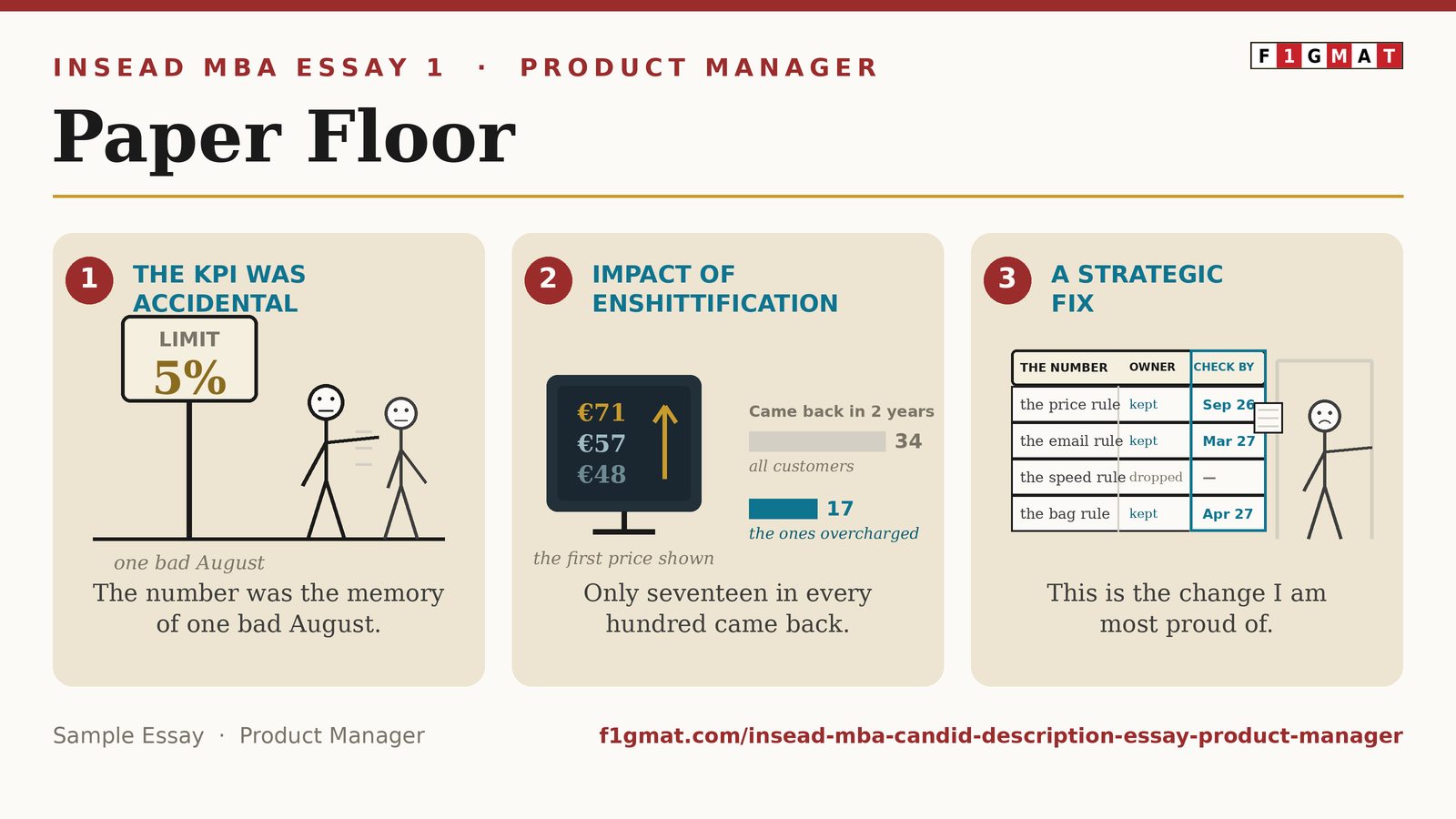
Instead, I spent three weeks trying to find out where the five percent in the guardrail had come from in the first place.
There was no document that explained it.
I read every support ticket in the archive from that year, and in the end I found Pieter.
Pieter had held my exact job back in 2021, and he now works in Rotterdam.
He told me that in the summer of 2021, when travel started again after the pandemic, the airlines were changing their fees almost every week.
The price gaps went wide all through July and August, and refund requests tripled.
He needed some kind of limit in place by that Friday.
So he took the worst week of that whole summer, rounded the number off, and wrote down five percent.
He told me he had always meant to go back and make the limit change with the seasons.
He simply never got the free time to do it.
The number that had been governing my work for years was not a carefully chosen rule at all.
The number was the memory of one bad August.
In January 2023, I built the seasonal guardrail that Pieter had never been given the time to build.
I pulled three years when the prices had the widest gap from the start to the end of the screen.
The gap was widest in January, February, and March, which is when Europeans book their summer holidays and their long trips with several flights.
The gap was narrowest in the months of October and November.
Instead of one flat limit, I proposed two.
I set a tight limit of three percent during the busy booking months, when a wide price gap does the most harm to the most people.
I set a liberal limit of nine percent from September to December, when trips are short.
My director approved the new guardrail.
In November 2024, I got the promotion I had wanted for two years, and I moved across to run the loyalty program.
My job on the loyalty program is to get travelers to book with us a second time.
On my fourth day in the new job, I was given access to the customer database.
The very first thing I did was to find every booking from 2023 that had finished more than nine percent above the first price shown.
Did these travelers ever come back?
That is the hardest sentence in this essay for me to write.
I use evidence to win my arguments far more often than I use evidence to change my own mind.
Across all of our 2023 customers, thirty-four in every hundred came back and booked with us again within two years. But among the travelers who had been hit with that wide price gap, only seventeen in every hundred came back.
Half as many.
We saw the four percent jump in revenue in real-time.
The loss was confirmed eighteen months later, inside a database my old team would never know existed.
Then I did one more thing.
I opened our own site, and I booked a real flight to Lisbon, as an ordinary customer, which I had not done in about a year.
I typed in my dates, and I saw a price.
I typed in the passenger names and the price changed.
I chose a bag and the price changed again.
The first price I had been shown was a price I was never going to actually pay.
I had built the price calendar so that a traveler could see the true price of every day of the month in a single glance. And then I had spent the next three years slowly moving the true price to a place where the traveler could no longer see it.
The site I now worked on was worse for travelers than the site I had first joined.
It sold more trips but lost its soul.
In December, sitting with those eleven pages, I finally saw that the real problem was never the display at all.
Pieter had set the five percent on a single Friday in 2021. Then, Pieter left the company. For four years that number decided what my team was allowed to ship.
I had done the exact same thing myself.
I had moved to a new team in November, and I had never handed the knowledge transfer document to anyone as I left.
Pieter did nothing wrong. I did nothing wrong on the day I left either.
So I built a table.
On the table, I put every important number that my new loyalty program depends on.
The table has five columns.
The first column is what the number actually is.
The second column is who owns the number today.
The third column is who first set the number, and when.
The fourth column is why they set it, written in a single sentence.
And the fifth column is the date when the number must be looked at again.
That fifth column is the one that matters most.
Now, when someone resigns from our company, before we take back their laptop and their door pass, we ask them to fill out the table.
A simple Table is the change I am most proud of, and it took the longest for me to understand.