Your MBA career goals essay describes a future self. An admissions person spends a few minutes deciding whether that self has anything attached to your current identity. The authenticity of your narrative begins before you even reach your long-term goal.
Hazel Markus and Paula Nurius called these constructions possible selves, the versions of yourself you want and expect, along with the version you work to avoid.
A seven-year-old who wants to drive a fire truck has built one.
The difference between that child and an admitted M7 MBA applicant comes down to two questions.
Does a strategy define the ambition?
Did the applicant choose the goal or was it mimicked?
In this MBA Essay Tips series, I cover:
Contents
- How Agency Influence MBA Career Goals Essay
- Tough Goals – Recent Past
- Possible Selves and MBA Goals
- Evaluation of Goals – Internal and External Motivation
- Internal Motivation
- External Motivation - MBA Goals
- Internal Motivation and Pursuit of Goals
- Possible Selves and the MBA Goals Question
- What the 2026-27 MBA Essay prompts are actually measuring
- The Possible Self - MBA Goals Checklist
- References
How Agency Influence MBA Career Goals Essay
Agency is brilliantly explained through the MAPS (Metacognition, Agency, Behavior and Possible Selves) model[1] that postulates that to develop a sense of agency, one must have strong self-regulation of actions and behaviors.
I would argue that the current generation applying to M7 schools are far more capable of self-regulation if they have crossed all the academic entry criteria than an applicant who achieved similar grades a decade or two ago.
The sense of agency is not just validated by your academic achievements or any achievement that requires persistent application of skills (music, arts, sports). It also determines your ability to achieve your short-term and long-term goals.
Schools use the narrative you have used in your goals essay to validate your ambitions. That is one reason consultants like me emphasize the need to add narratives on how you achieved a tough goal in the recent past in your goals essay - not to reiterate the resume but to demonstrate your agency.
Tough Goals – Recent Past
There are universally agreed on tough achievements and milestones outside one’s academic achievements that will force the admissions team to pause.
Two years back, I read the resume of an applicant who ticked all the check boxes to be a Harvard or a Stanford MBA admit. He just needed validation from an admissions consultant that these 1% milestones are truly 1%. I just replied, “Keep doing what you are doing” and you are likely to get into Stanford or Harvard. And he got admitted to Stanford.
These are representative of only 10-15% of the application pool.
The rest are mere mortals with misses and missteps that were corrected with their superior sense of agency.
The feedback loop – “evaluation of results” is a critical aspect of course correction.
A shift in careers, majors, or switch in functions/employers – all work if the narrative has clear evidence of agency.
Possible Selves and MBA Goals
Another critical element of the MAPS model is the concept of ‘selves.’
We as human beings are wired to create possible selves right from the age of 4.
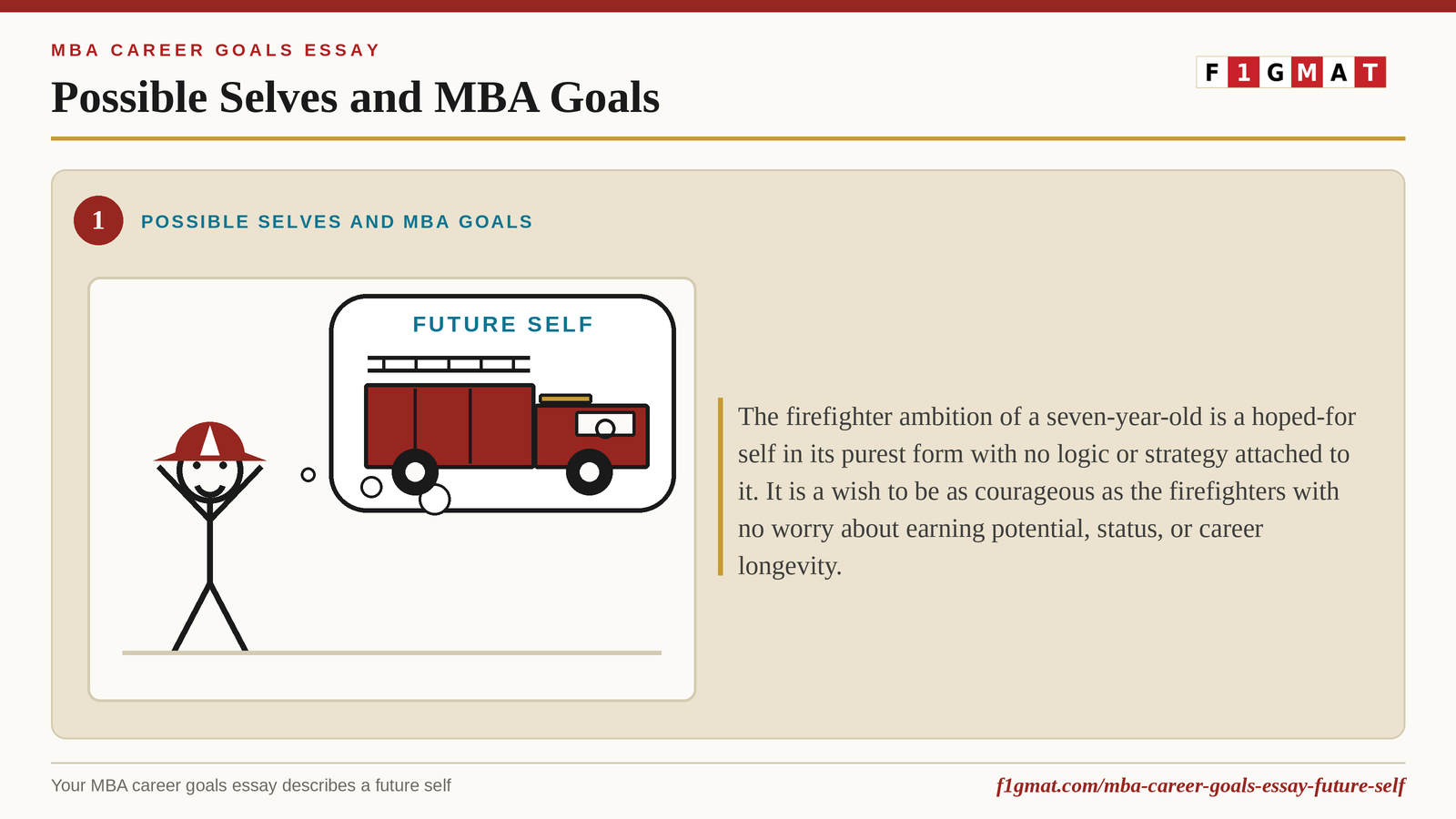
The ambition to be a firefighter or a truck driver – no matter how unrealistic it was, are our young minds creating future selves.
The ‘Evaluation’ of the goals – from an interest, skills, and external factors (status, peer pressure, family), drives the sense of agency.
Evaluation of Goals – Internal and External Motivation
The ‘evaluation’ of results and goals that we are pursuing are driven by internal and external motivation.
Internal Motivation
The reason why we feel good about our childhood – apart from no pressure to earn a living or grow in a career, is the pursuit of activities that are driven by internal motivation.
Children explore activities that are motivated purely by exploration and novelty.
Through each exploration, they learn and master a skill or a concept. That is pure joy.
So when career coaches and self-proclaimed gurus preach to ‘follow’ your passion, they are indirectly asking you to find your internal motivation.
I would love to be just writing short stories everyday. But there aren’t enough movie producers, readers and publishers to help me persist with my internal motivation.
My sense of agency will be shattered if I am not rewarded for my exploration of activities that are purely based on novelty and feeling a sense of ‘joy.’
External Motivation - MBA Goals
The orientation to the grown-up world happens sometime in high school where pursuing learning goals becomes increasingly aligned with career goals.
Even if you are planning to take over your family business or you have a clear career path to follow, your learning will be optimized to thrive as the ‘future self’ and not to pursue the exploration of current activities that gives you joy.
Internal Motivation and Pursuit of Goals
Internal motivations also play into your pursuit of tough goals – even if the goals are aligned with a career.
Here autonomy or sense of agency in completing a task or mastering a job function is influencing your internal motivation[2].
Even the thought of pursuing an MBA and switch careers happens when you strongly feel that you have exhausted the reserve of internal motivation to continue in the current role or career path.
Studies on external rewards (bonuses or other perks) diminishing the feeling of autonomy validate the behavior of late 20s and early 30s career switchers.
I had several career planning discussions where the client once they shed the corporate persona revealed their true motivation.
And the career paths are incredibly risky.
If the person asks the same question to a corporate career planner, they will limit the search to the 3 big job markets – Finance, Consulting and Technology.
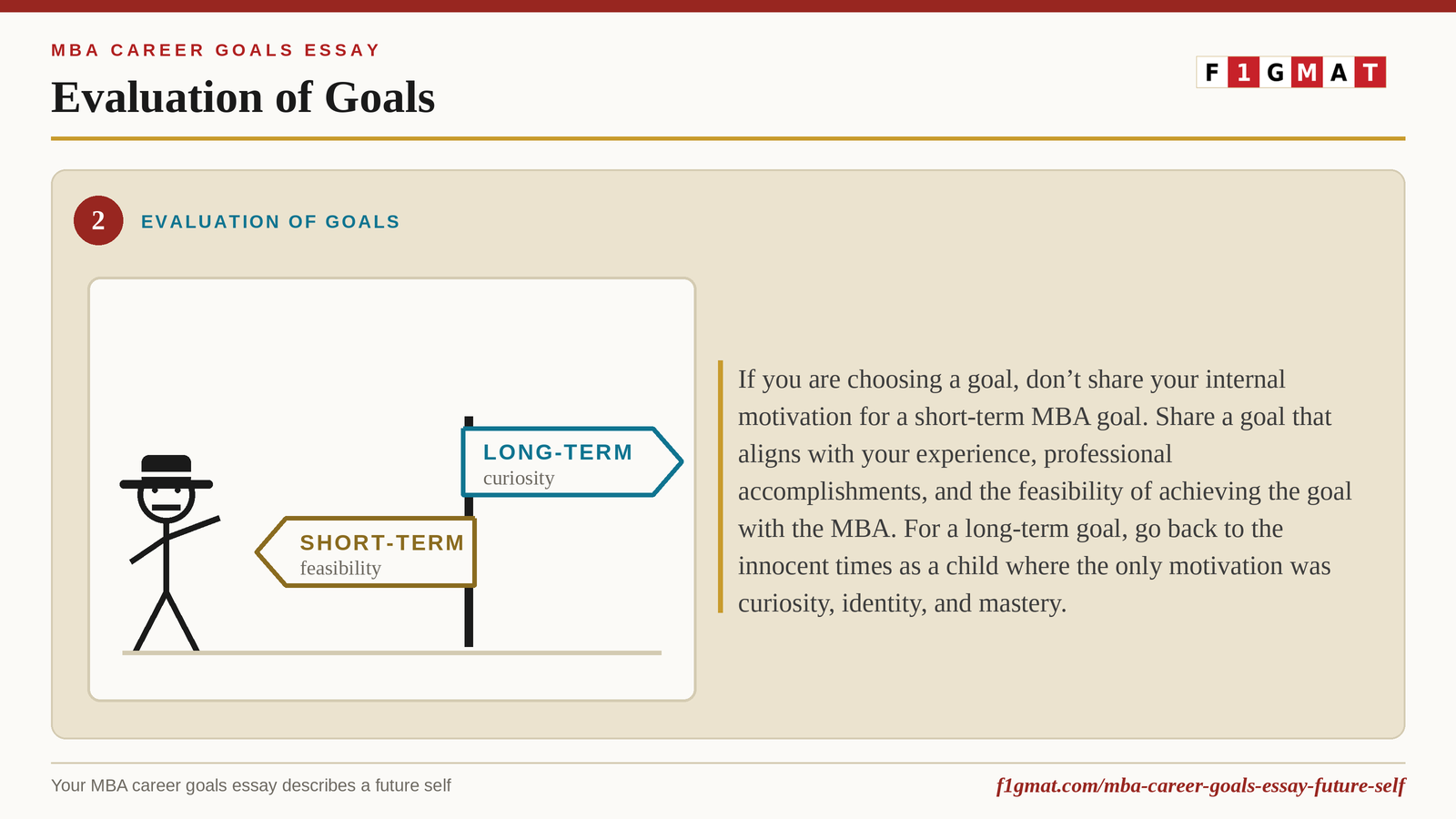
If you are choosing a goal, don’t share your internal motivation for a short-term MBA goal.
Share a goal that aligns with your experience, professional accomplishments, and the feasibility of achieving the goal with the MBA.
For a long-term goal, go back to the innocent times as a child where the only motivation was curiosity, identity, and mastery with reward rarely a factor in persisting with a goal.
Possible Selves and the MBA Goals Question
Hazel Markus and Paula Nurius published "Possible Selves" in the American Psychologist in 1986[3].
A possible self is a mental representation of what a person could become.
Unlike the best version of the possible self that an MBA Goals question brings out, the theory cites three possible selves - the hoped-for self (the version you are aiming with an MBA), the expected self (the version you will reach if you continue in the current path) and the feared self (the version you are avoiding).
The firefighter ambition of a seven-year-old is a hoped-for self in its purest form with no logic or strategy attached to it. It is a wish to be as courageous as the firefighters with no worry about earning potential, status, or career longevity.
Markus and Nurius argued that possible selves function as the bridge between the concept of self and motivation in its purest form.
A goal emerging from the bridge offers both direction and incentives.
A direction in the MBA Application context would cover taking the GMAT/GRE, preparing for your essays, preparing for the interview, coordinating with supervisors, and then targeting M7 schools - an ambition matching the hoped-for self; T15 schools to match the expected self at a faster pace.
Daphna Oyserman and her collaborators explain why most childhood ambitions evaporate[4]
In her work on academic possible selves, a future identity changes behavior only when strategies are attached to it.
A hoped-for self with no plan produces wishes.
Her later work on identity-based motivation adds a second mechanism - the interpretation of difficulty.
When pursuing an identity feels hard, a person may interpret that difficulty as evidence that the identity doesn't fit or doesn't matter.
Oyserman also found that hoped-for selves work better when contrasted with a matching feared self.
A student who imagines graduating and also imagines dropping out regulates their behavior more consistently than a student who only imagines graduating.
An MBA Applicant who imagines applying to 5-7 M7 schools and getting admitted to 1, and also contrasts it with not receiving an interview call from any, will put in the effort to correct all their weaknesses and deliverables.
The contrast creates a direction, a boundary, and a fear-based incentive.
E. Tory Higgins published self-discrepancy theory in Psychological Review in 1987[5], separating the ideal self, the attributes you want to possess, from the ought self, the attributes you believe you are obligated to possess.
The gap between your actual self and your ideal self produces sadness.
The gap between your actual self and your ought self produces anxiety.
An MBA Essay written from the ought self will be interpreted as anxious even when the sentences are neutral or calm, because the writer is describing an obligation and calling it an aspirational goal.
Herminia Ibarra published Provisional Selves in Administrative Science Quarterly in 1999[6], based on investment bankers and consultants moving into senior roles.
Professionals in transition observe role models, assemble provisional identities out of borrowed pieces, test those identities in low-stakes settings, and then evaluate the results against internal standards and external feedback. They don't pick on all the attributes of the possible-self in one go.
This is the mechanism behind the MBA itself.
The two years are a licensed period for running provisional selves in front of recruiters, classmates, and clients.
What the 2026-27 MBA Essay prompts are actually measuring
Goals is the most common theme in the latest M7 and Top MBA Essays.
The expected self and MBA Goals Essay
Cornell Johnson's Goals Statement requires the applicant to complete two sentences, naming the role, company, and industry, once for the immediate post-MBA position and once for five to ten years out.
Wharton asks for the immediate goal in 50 words and the medium and long-term goals in 150.
Darden asks for the short-term goal in terms of industry, function, geography, and company size, then asks how it aligns with the long-term vision.
All the prompts want the expected self, the version the applicant believes is reachable, stated with enough specificity that a career-services office could verify it against placement data.
The Feared Self and MBA Goals Essay
Duke Fuqua asks for a first-choice career plan and an alternate plan in 100 words.
Indiana Kelley asks what alternate paths you would consider if the short-term goal does not materialize, and offers "I'm most afraid of..." as one of its short-essay options.
Rochester Simon asks for a back-up plan given the fluctuation of hiring trends.
Berkeley Haas added a clause asking how you plan to remain adaptable as your career evolves.
These prompts are asking for the balanced possible self that Oyserman's research identifies.
An applicant who names only the hoped-for outcome fails the goals essay.
Goals with Limited Word Count
Columbia caps the immediate goal at 50 characters.
Chicago Booth replaced its 250-word goals essay with two 300-character short answers, one for the immediate plan and one for the long-term plan. Fifty characters is roughly seven words.
There is no room for a second future self, and no room for the qualifying language applicants use when they have not decided.
The word count scarcity is a commitment test.
The Authenticity test - MBA Goals in Video
Carnegie Mellon Tepper moved the career-goals statement into a two-minute video.
Texas McCombs added a four-question video assessment completed within seven days of submission.
Berkeley Haas turned its signature prompt into a one-to-two-minute video that opens with a self-introduction.
UC Irvine Merage moved the goals statement to video.
A possible self expressed in video cannot be faked or edited multiple times. The truth will be visible in your delivery.
The exception to the one-future-self rule
Two schools explicitly ask for more than one path.
Vanderbilt Owen asks the applicant to walk through the career journey and share two post-MBA career paths they aim to explore during the program.
Duke Fuqua asks for a first-choice plan and an alternate.
Columbia asks for goals over the next three to five years and separately for the long-term dream job.
The unfocused narrative looks different.
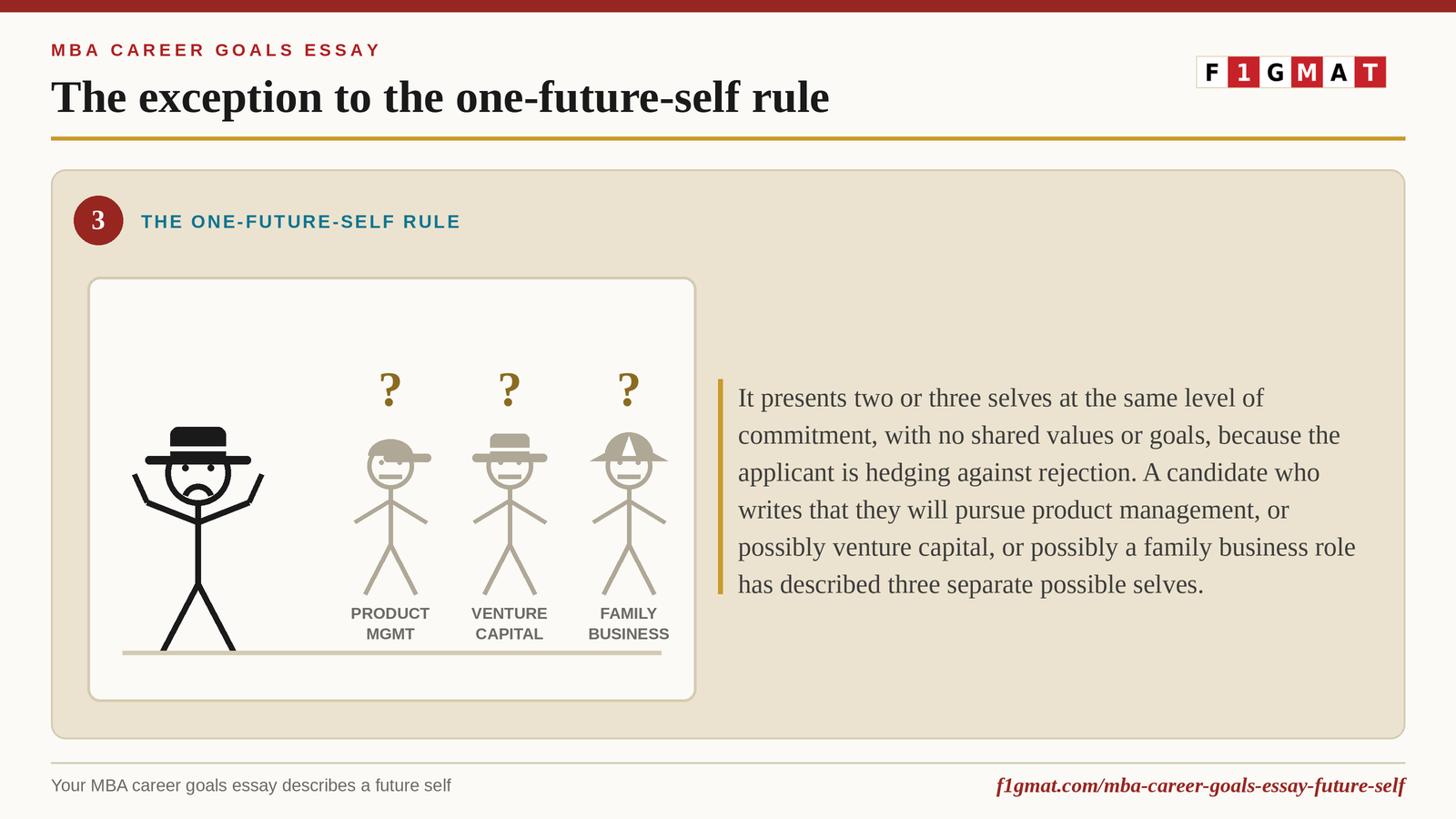
It presents two or three selves at the same level of commitment, with no shared values or goals, because the applicant is hedging against rejection.
A candidate who writes that they will pursue product management, or possibly venture capital, or possibly a family business role has described three separate possible selves.
The Possible Self - MBA Goals Checklist
An MBA applicant can test a goals essay against three questions.
1) Can the future self be realized with a strategy?
Name the course, the club, the recruiting channel, or the person who moves you from where you are to where you say you are going.
Oyserman's finding is that the identity without the strategy does not produce lasting behavior.
2) Does the Essay draft name a feared self?
If the essay contains no version of a bad outcome, the writer has not run the pair that produces self-regulation.
3) Count the future selves and check whether the reader can identify the expected self within the first 100 words of the goals essay.
The MBA program just accelerates reaching the expected self. It is a time-based ROI with long-term earning potential.
Related Download
References
- The MAPS model of self-regulation: Integrating metacognition, agency, and possible selves - Leslie D. Frazier, Bennett L. Schwartz & Janet Metcalfe ↩
- Self-Determination Theory and the Facilitation of Intrinsic Motivation, Social Development, and Well-Being - Richard M. Ryan and Edward L. Deci, University of Rochester ↩
- Possible selves ↩
- Identity and Self ↩
- Self-discrepancy: A theory relating self and affect ↩
- Provisional Selves: Experimenting with Innage and Identity in Professional Adaptation ↩