F1GMAT · https://www.f1gmat.com/how-improve-mba-application-writing-skills-diary ·
 Add F1GMAT as a preferred source on Google, opens Google in a new tab
 See more of F1GMAT's MBA admissions research in Google's Top Stories by making us a preferred source on Google.
Even as someone who has been writing and helping MBA applicants for over 13 years, the process of allowing the most innermost fears, hope and dreams, to guide the writing process would have never materialized if there wasn’t an easy process. The diary and categorization of thoughts into subjects are pushing me to write more.
This process will change the quality of your writing.
P.S: The idea is inspired from Derek Sivers (https://sivers.org/dj)
Why Diary is Important for MBA Application
One of the toughest parts of improving an MBA Applicant’s writing is at letting go of their pre-conceived notion of what an essay should be. Some despite several nudging stick to a bland and formal narrative - a facade driven by the fear that the admission team would see their weakness. Some don’t know what to share and what to leave out. Some don’t have the skills. We are not suggesting that you share the most private information, but without any intimate details of what you felt when a project failed or when planning didn’t achieve the goals you desired, the essay would sound like another ‘pitch’.
How to structure the Diary Topic List
The biggest secret is not to structure your writing.
Whatever is bothering or inspiring you should flow into a notepad (in a computer or hard copy). This could be about a project, your partner, outlook towards a controversial topic, a perspective about an interest area or any random thought that needs development.
Name it as dd-mm-year or mm-dd-year whichever fits your style.
Let us say on 10th March 2019, you felt like writing about a memory as a child that you cherish the most – perhaps a time with your childhood friend, an inspiring teacher, your grandparents, or a visit with your parents to a foreign destination.
Rule #1: There are no rules on writing diary entries
Capture whatever thoughts are flowing into your mind. Imagine that you want to document all the thoughts that flow when you think about a subject. Keep writing.
Rule #2: Don’t hold back
This is a big part of stretching your writing skills. When MBA Applicants write, there are moments when they self-censor and rightly so in many occasions as the ‘raw’ emotion about your boss would look out of place. But for this exercise, there are no such rules. Write freely.
Rule #3: Narrate
Imagine that you are narrating a scene to an audience. The biggest learning curve for MBA Applicants from Technology and Finance or anyone with limited writing experience is the process of narrating an event. Think beyond documenting. Bring elements of storytelling to the writing process – describe the person, the surrounding and what you felt during each point of the interaction.
Don’t overdo describing the scenery. It is all about your inner thoughts – fears, desires, and hope.
 Rule #4: After you can’t write any more, structure it
Once you feel that writing an extra sentence would sound like a filler, stop writing. Now it is time to structure it.
Read the diary and see if you can change the paragraph sequence. Perhaps, the second paragraph should be the opener. That builds the mystery, and by moving the first paragraph to second, the audience would be eager to learn what is happening.
Don’t edit it any further.
Your original diary entry should have the <date_format>.txt
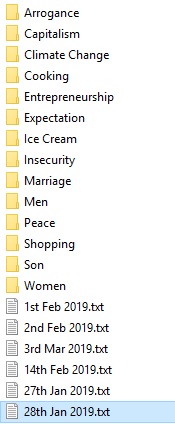
In my case, as an Entrepreneur in my 30s, who is married with two kids, the topics touch marriage, Entrepreneurship, shopping and Son. This is unlikely to be your topic list.
Note: I didn’t create the folder first.
Based on the theme of the diary entry – let us say 14th Feb 2019.txt when I fought with my wife, I created folders about Marriage, Women and Expectation.
I copied the 14th Feb 2019.txt to the folders.
Similarly, after writing, list the themes of the entry and create folders.
What this does is that there are no restrictions on what you want to write. The themes are selected after you write.
P.S: I kissed and made up with my wife. Hence the folder – Peace
For writing tips that will drastically improve your narrative style, read my book – Winning MBA Essay Guide.
You can always reach out to me for guidance using the contact form or call me at USA/International (Ph): +1 415-800-3806 or India (Ph): +91 9497189032 or +91 9048469555