A leading board member of AutoSnip Co., makers of an automated home haircutting system, recently stated that the company was in terrible shape and headed for a disastrous year. His concern was that, since the introduction of the AutoSnip III last year, calls to the customer service line have nearly doubled, indicating that people are very unhappy with the new product. Although it's true that it is the job of responsible board members to raise issues of concern, in this case the board member's analysis of the situation is mistaken. The customer service line handles not only complaints but also sales, and the majority of the new calls have been to place new orders.
What role do the two boldfaced selections play in the above argument?
A.The first provides evidence supporting the main conclusion of the argument; the second provides evidence supporting a conclusion that the argument opposes.
B. The first provides evidence, an interpretation of which supports the main conclusion of the argument; the second provides evidence supporting the main conclusion of the argument.
C. The first provides incontrovertible evidence opposing the main conclusion of the argument; the second provides evidence supporting the main conclusion of the argument.
D. The first provides evidence supporting the main conclusion of the argument; the second states that main conclusion.
E. The first provides evidence, an interpretation of which opposes the main conclusion of the argument; the second provides that interpretation.
Explanation:
This is an argument structure question, of the role played variety. To answer these questions, strip away the particular content of the argument to identify the underlying structure. In this argument, the first sentence contains a prediction that functions as a conclusion that the rest of the argument comes to oppose (that the company is in trouble). The next sentence provides evidence (calls doubling), and an interpretation of that evidence that would support the initial conclusion (people are calling to complain). The third sentence provides an alternate conclusion (that the board member is wrong). The final sentence provides new evidence (the nature of the calls) to support an alternate interpretation of the earlier evidence, which can now be shown to support the alternate conclusion.
Explanation for Each Answer Choice
a.The second provides evidence to support the main conclusion of the argument, namely that the board member is wrong and the company is in fact in good shape, since the phone lines are busy with customers placing new orders.
b.This is the credited response. In context, the first boldfaced selection provides evidence that is interpreted in a way that goes against the conclusion of the argument, but by the end of the argument we understand that this same selection could also be interpreted in a way that supports the main conclusion. The second selection is unequivocally understood as support.
c. The first selection does not provide incontrovertible, i.e. unquestionable, evidence; rather it provides evidence that can be interpreted in either direction, as we see in the argument itself.
d. The second provides evidence; it does not state a conclusion.
e. The second does not provide an interpretation; it introduces evidence. That evidence is then used in support of an interpretation of the first selection, but we still need to distinguish between the evidence itself and the use to which it is put. Grockit, an online test prep game, is the smartest way to study for your test. It's adaptive, fun and finds the right teacher for you. Grockit’s analytic capabilities and adaptive technology identifies students' strengths and weaknesses, focusing the student's study time. Students can practice in adaptive solo games, play social learning games with peers, and work with experts that match their specific needs.
Mastering GMAT Critical Reasoning (2023 Edition)

1) Introduction
2) 6 Step Strategy to solve GMAT Critical Reasoning Questions
3) How to overcome flawed thinking in GMAT Critical Reasoning?
4) 4 GMAT Critical Reasoning Fallacies
5) Generalization in GMAT Critical Reasoning
6) Inconsistencies in Arguments
7) Eliminate Out of Scope answer choices using Necessary and Sufficient Conditions
8) Ad Hominem in GMAT Critical Reasoning
9) Slippery Slope in GMAT Critical Reasoning
10) Affirming the Consequent – GMAT Critical Reasoning
11) How to Paraphrase GMAT Critical Reasoning Question
12) How to Answer Assumption Question Type
13) How to Answer Conclusion Question Type
14) How to Answer Inference Question Type
15) How to Answer Strengthen Question Type
16) How to Answer Weaken Question Type
17) How to Answer bold-faced and Summary Question Types
18) How to Answer Parallel Reasoning Questions
19) How to Answer the Fill in the Blanks Question
Question Bank
Question 1: 5G Technology (Inference)
Question 2: Water Purifier vs. Minerals (Fill in the Blanks)
Question 3: Opioid Abuse (Strengthens)
Question 4: Abe and Japan’s Economy (Inference)
Question 5: Indians and Pulse Import (Weakens)
Question 6: Retail Chains in Latin America (Assumption)
Question 7: American Tax Rates – Republican vs. Democrats (Inference)
Question 8: AI – China vs the US (Weakens)
Question 9: Phone Snooping (Strengthens)
Question 10: Traditional Lawns (Assumption)
Question 11: Appraisal-Tendency Framework (Inference)
Question 12: Meta-Analysis of Diet Trials (Weakens)
Question 13: Biases in AI (Strengthens)
Question 14: Stock Price and Effectiveness of Leadership (Inference)
Question 15: US Border Wall (Weakens)
Question 16: Driverless Car and Pollution (Assumption)
Question 17: Climate Change (Inference)
Question 18: Rent a Furniture (Weakens)
Question 19: Marathon Performance and Customized Shoes (Weakens)
Question 20: Guaranteed Basic Income (Assumption)
Question 21: Brexit (Infer)
Question 22: AB vs Traditional Hotels (Assumption)
Question 23: Tax Incentive and Job Creation (Weakens)
Question 24: Obesity and Sleeve Gastrectomy (Inference)
Question 25: Recruiting Executives (Weaken)
Answers with Detailed Explanation
Essential GMAT Reading Comprehension Guide (2023 Edition)

Collecting and Interpreting Facts: GMAT Reading Comprehension
Effective Note-taking for GMAT Reading Comprehension
5 Questions to Speed up Summary Creation
Mastering GMAT Reading Comprehension: 3 Best Practices
How to Remember Information
How to improve comprehension by Questioning the Author
How to Read Faster
How to Answer GMAT Reading Comprehension Title question
How to Answer GMAT Reading Comprehension Main Idea Question
How to Answer GMAT Reading comprehension inference question
How to Answer GMAT Reading Comprehension Purpose Question
How to Answer GMAT Reading Comprehension Detail Question
How to Answer the GMAT organization of passage Question
How to Improve GMAT Reading Comprehension Score?
Passage #1: Protein-Rich Diet Passage #2: Pregnant Women and Stress Management
Passage #3: F Losing Momentum
Passage #4: Conservatives and Automation
Passage #5: Collaboration, Team size and Performance
Passage #6: Effective Altruism
Passage #7: Loneliness Epidemic
Passage #8: Space Exploration
Passage #9: Lab-Grown Meat
Passage #10: Minimum Wage in the US
Passage #11: AI and Creativity
Passage #12: Bias Against Healthcare in Developing Economies
Passage #13: Legacy Admissions
Passage #14: Plastic Ban and alternatives
Passage #15: Underestimating Homo Sapiens
Passage #16: Conspiracy Theories
Passage #17: Relative Poverty
Passage #18: Why Paintings are expensive
Passage #19: US Obesity Epidemics
Passage #20: The Future of Advertising
Passage #21: Breaking Large Companies
Passage #22: Helicopter Parenting
Passage #23: Future of Democracy
Passage #24: Technology and Global Citizenship
Passage #25: Morality and Investment
Answers: 157 to 294
Pages: 295
Questions: 100+
Download F1GMAT's Essential GMAT Reading Comprehension Guide (2023 Edition)
Do you want to work with the expert consultant who has consistently guided applicants to M7 and T20 MBA programs? Sign up now!
F1GMAT's Services
- MBA Application Review (Essay Editing + Resume Editing + Recommendation Letters + All Application Questions)
- Essay Editing (Essays and All Application Questions)
- One Essay Editing (One Essay/One Cover Letter)
- Career Planning and Detailed Profile Evaluation (Find career goals and courses/schools to match your aspirations)
- One School Recommendation Letter Editing Service
- One Supervisor Recommendation Letter Editing Service
Read the Essay Guides and see how we write & edit MBA essays
Winning MBA Essay Guide - A Complete Guide for M7 and Top 15 MBA Application Essays
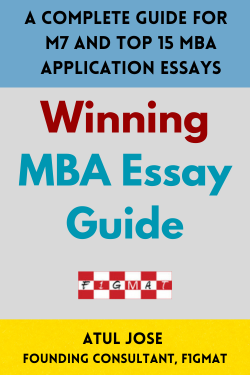
F1GMAT's Winning MBA Essay guide will teach you how to transform your essay into a life journey with trials and tribulations that will move the admission team.
+ Over 245 Sample Essays (Read Previews of F1GMAT's Winning MBA Essay Guide Sample Essays here)
+ Top 15 MBA Programs (Harvard, Stanford, Wharton, Columbia, Booth, MIT, Kellogg, Yale, Haas, Darden, INSEAD, LBS, NYU Stern, Tuck, Duke Fuqua, Ross)
+ The Art of Storytelling
+ Leadership Narratives
+ Review Tips
+ Persuasion Strategies
+ The Secret to "unleashing" your unique voice
+ How to prepare and present for the Video Essay
+ How to write about your Strengths
+ How to write about your Weaknesses
+ Leadership Narratives
+ Review Tips
+ Persuasion Strategies
+ The Secret to "unleashing" your unique voice
+ How to prepare and present for the Video Essay
+ How to write about your Strengths
+ How to write about your Weaknesses
Want to try the individual school Essay Guides before upgrading to the Winning MBA Essay Guide? Try below.
F1GMAT's Essay Guides
- Harvard MBA Essay Guide (20 Sample Essays)
- Stanford MBA Essay Guide (24 Sample Essays)
- Columbia MBA Essay Guide (21 Sample Essays)
- Wharton MBA Essay Guide (15 Sample Essays)
- INSEAD MBA Essay Guide (19 Sample Essays)
- Darden MBA Essay Guide (21 Sample Essays)
- Yale SOM MBA Essay Guide (15 Sample Essays)
- Tuck MBA Essay Guide (15 Sample Essays)
- Haas MBA Essay Guide (18 Sample Essays)
- NYU Stern MBA Essay Guide (15 Sample Essays + 6 Examples - Visual Essay)
- LBS MBA Essay Guide (6 Sample Essays)
- MIT Sloan MBA Essay Guide (6 Sample Cover Letters + 3 Sample Video Statement Scripts + 3 Sample Optional Essays)
- Kellogg MBA Essay Guide (11 Sample Essays)
- Chicago Booth MBA Essay Guide (12 Sample Essays)
- Ross MBA Essay Guide (31 Sample Essays)
- Duke Fuqua MBA Essay Guide (10 Sample Essays + Two 25 Random Things Samples)
- Cambridge MBA Essay Guide (12 Sample Essays)
Want to read the Essay Examples before purchasing the Essay Guides?
Get Exclusive Events, Advice and Trends in your Inbox
Not sure if an MBA Program is right for you? See our Premium Research.
F1GMAT Premium