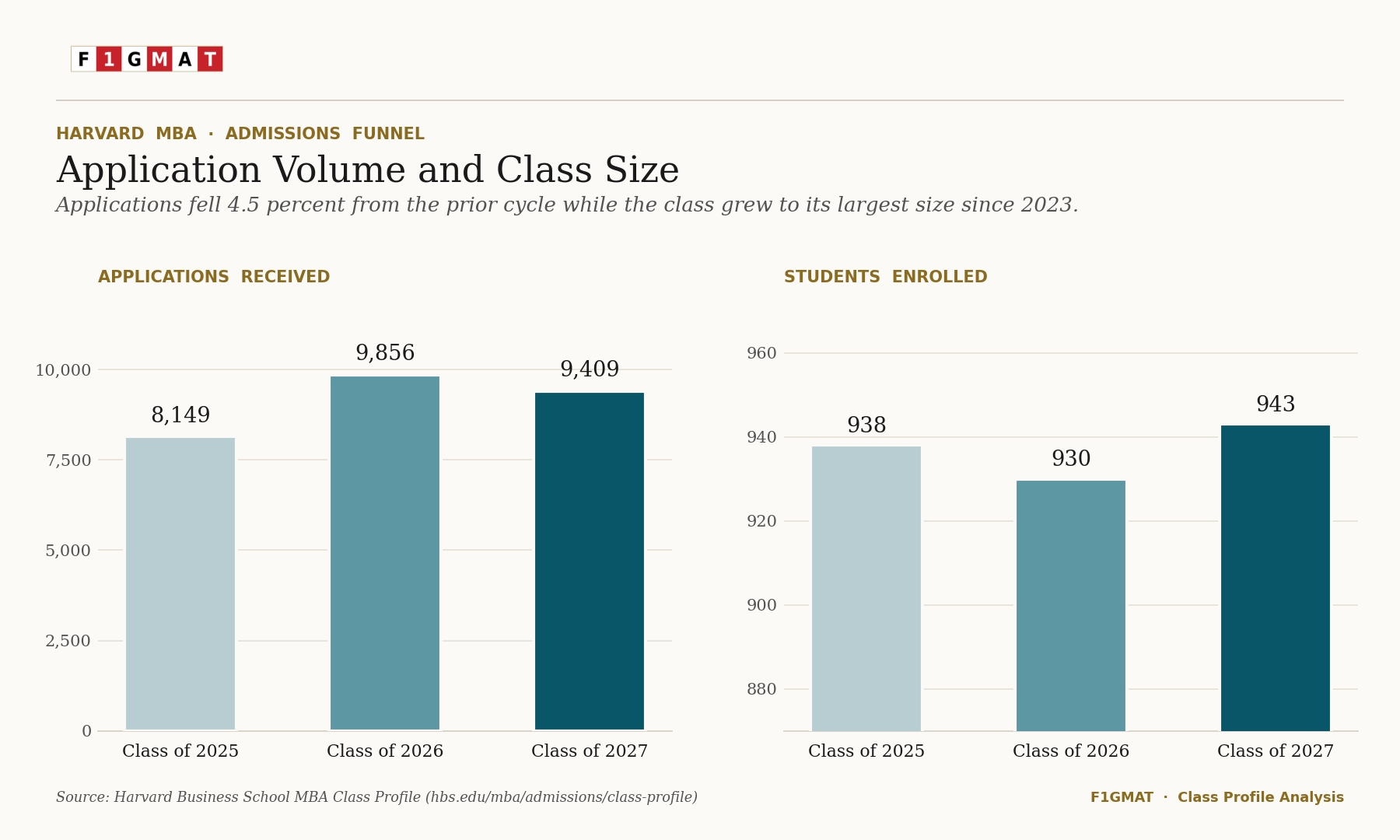
The Harvard MBA Class of 2027, drawn from the 2024-25 admissions cycle, enrolled 943 students from 9,409 applications, the largest HBS class since the Class of 2023, even as application volume fell 4.5% from the prior year's 9,856 [1]. The average GPA rose to 3.76, the highest in three cycles. The median GMAT 10th Edition score settled at 730, and admits submitting the new GMAT Focus Edition posted a median of 685 [1]. International enrollment moved up to 37%, a 2-point gain against the national tide of visa-driven declines at U.S. graduate programs. Women's representation eased to 44% from 45%, staying inside the 44-to-45% band HBS has held for a decade [1]. Consulting share rose to 19% of pre-MBA industries, and Venture Capital and Private Equity held at 16%.
TL;DR
- Harvard MBA Class of 2027 enrolled 943 students from 9,409 applications, up 13 students from the Class of 2026 and the largest HBS class since 2023, even as applications fell from 9,856 [1]
- Acceptance rate is approximately 11% (HBS does not publish an official figure; the rate is inferred from the 943 enrolled at the typical HBS yield)
- Median GMAT 10th Edition score is 730 (middle 80% range 690-770), median GMAT Focus score is 685 (range 645-735), and median GRE is 164 Verbal and 164 Quantitative [1]
- Average GPA rose to 3.76, up from 3.69 in the Class of 2026, the highest in three cycles [1]
- Women represent 44%, down 1 point from the Class of 2026, and international students reached 37%, up 2 points [1]
- Class represents 62 countries and 283 universities, with 57 languages spoken [1]
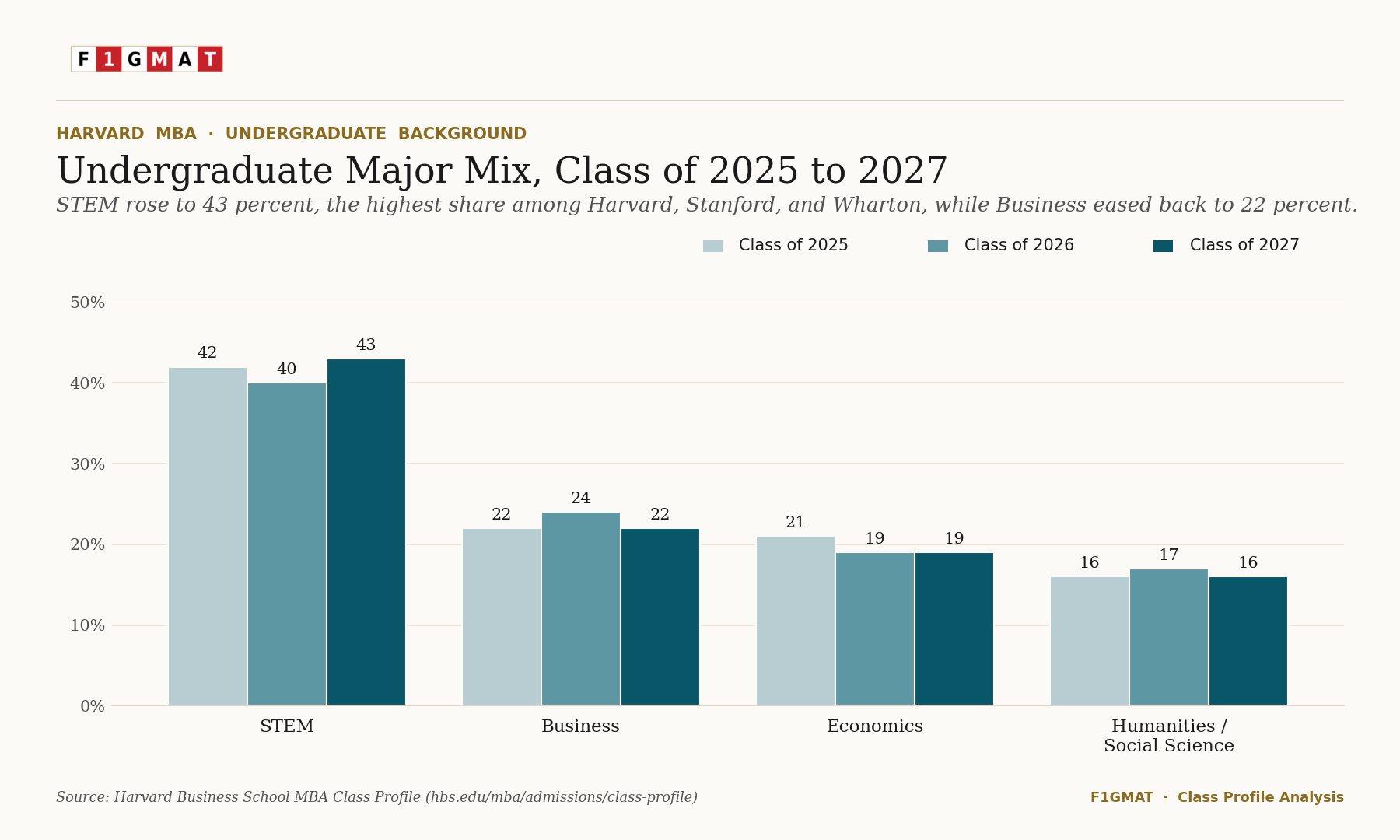
- STEM undergraduate majors reached 43% (Engineering 24% plus Math/Physical Sciences 19%), the highest STEM share among Harvard, Stanford, and Wharton [4]
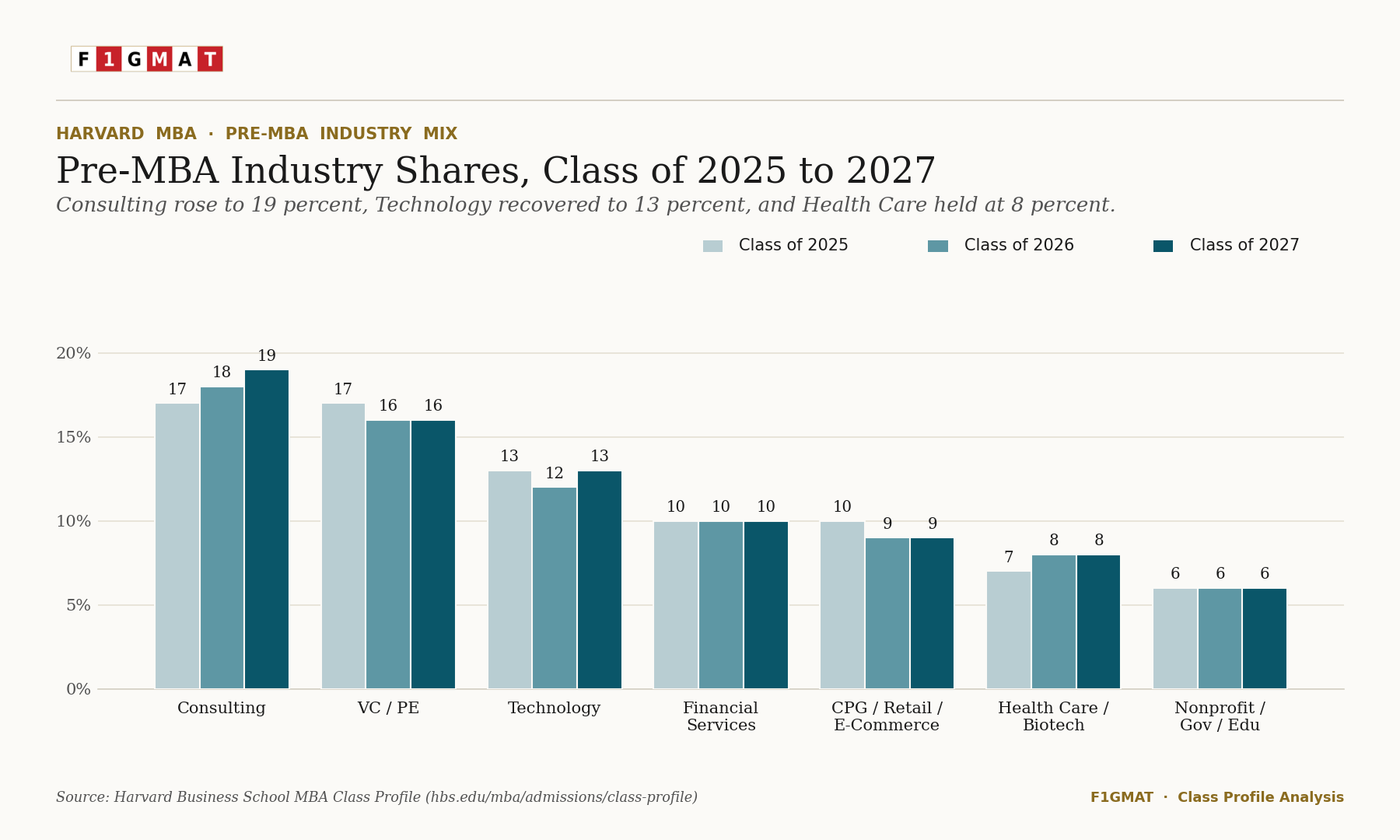
- Consulting pre-MBA share rose to 19%, Venture Capital/Private Equity held at 16%, Technology recovered to 13%, and Financial Services held at 10% [1]
- 10% are first-generation college students, and approximately 50% of students receive a need-based scholarship averaging $100,000 over two years [3]
Contents
Class Size and Admissions Funnel
From 9,409 applications, the Harvard MBA Class of 2027 enrolled 943 students. For an M7 MBA, this is the largest pool and the largest class.
Academic Profile
The median GMAT for the 2027 Class is 730, the average GPA is 3.76, and the work experience averages 4.9 years.
Harvard's median GMAT is below Stanford's 738 and Wharton's 735, and the gap is a result of Harvard's international applicant pool that includes more entrepreneurial profiles, whose standardized scores, although not weak, are not in the upper quartile[4].
The 4.9-year work experience is closer to Wharton's 5.0 than to Stanford's 5.3, which fits a school taking a mix of mid-career talent and earlier-stage technical applicants moving toward business leadership earlier than the GSB-typical applicant.
| Harvard MBA Class Profile | Class of 2025 | Class of 2026 | Class of 2027 |
|---|---|---|---|
| Application Volume | 8,149 | 9,856 | 9,409 |
| Enrolled | 938 | 930 | 943 |
| Work Experience (Average) | 5 years | 5 years | 4.9 years |
| GMAT Score (Median) | 740 | 740 | 730 |
| GPA (Average) | 3.73 | 3.69 | 3.76 |
| % Women | 45% | 45% | 44% |
| % International Students | 39% | 35% | 37% |
Demographics
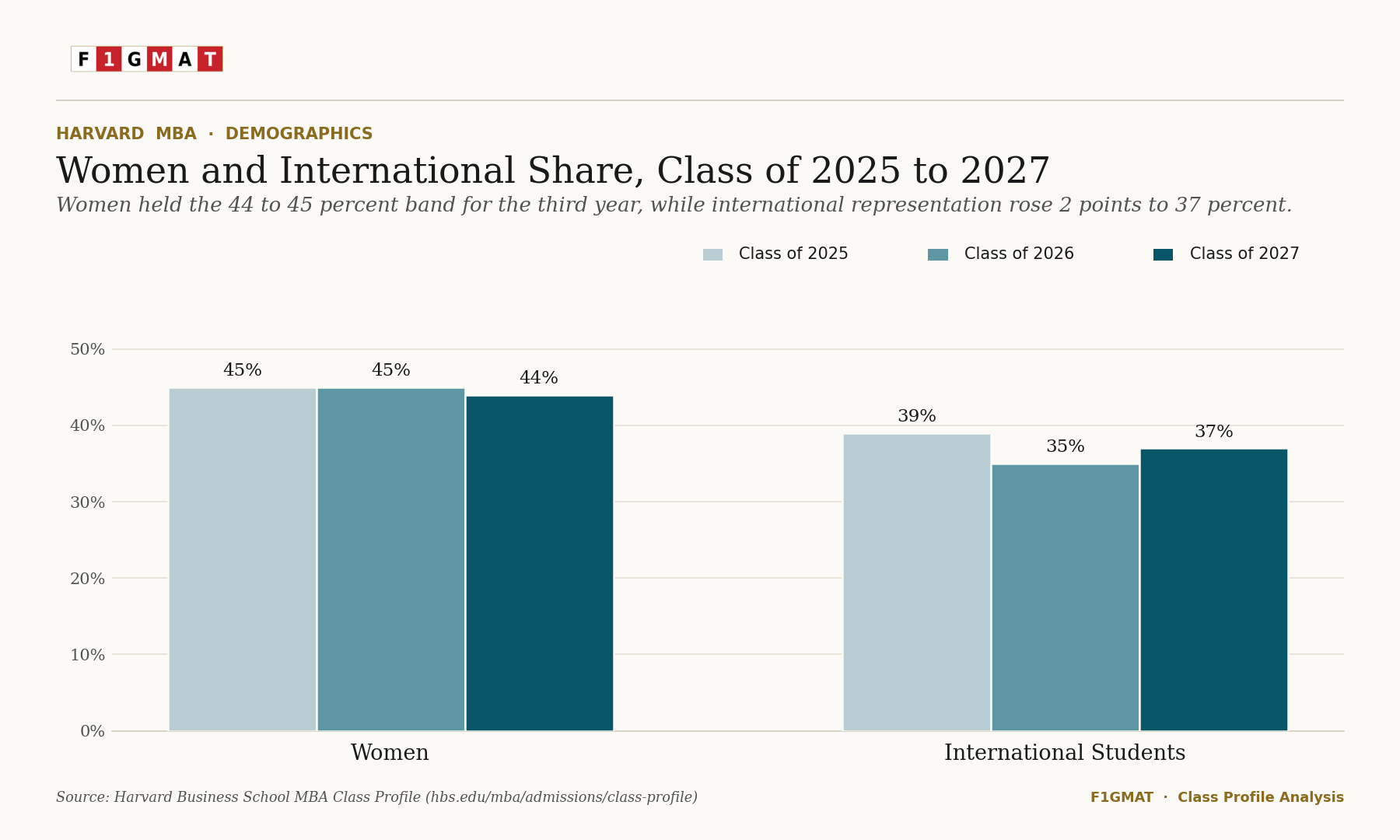
Women in the Harvard MBA Class of 2027 was 44% of the class, which is a 1-point decline from the 45% the Class of 2026 posted, but falls between the 44 to 45% range Harvard Business School has held since the Class of 2014, when women's representation first crossed the 40% women threshold[6]. Although HBS is operating as a Forté partner school and the Forté Fellowship is integrated into the regular MBA admissions process across Round 1 and Round 2, the school has not yet crossed the 50% threshold or even come close to achieving gender parity. Partly, the problem is the high demand for Finance and Business candidates, where women are traditionally underrepresented.
The STEM designation Harvard Business School secured for the full MBA degree, effective for the Class of 2025 and onward, makes the Class of 2027 the third HBS cohort entering with STEM eligibility and the first cohort to apply with full awareness of the 24-month STEM OPT extension[2].
The CIP code change is tied to the new Data Science & AI for Leaders course in the Required Curriculum, and the expanded management-science content in the Elective Curriculum[7].
Harvard's 37% international share rose 2 points from 35% in the Class of 2026 and went the opposite way from Stanford and Wharton, both of which lost ground on international share in the same 2024-25 cycle[5].
The resilience was impressive despite the 2024-25 visa-processing delays that hit every U.S. graduate program.
When you look deep inside, the story is a yield adjustment where the international cohort grew from 326 students to 349. More international students were admitted to HBS at a higher yield rate.
When application volume fell 4.5% to 9,409, HBS Round 1 and Round 2 admits started visa processing in January through April 2025. The processing concluded before the State Department's three-week interview pause from May to June 2025.
Another factor that encouraged international application volume is HBS's need-based aid pool, which covers international students on the same terms as domestic students, with the average award reaching $100,000 over two years. Harvard has a clear yield advantage against competing programs that require international admits to self-finance the cost of attendance.
Pre-MBA Industry
You said: undergraduate degree - year on year?
| Pre-MBA Industry | Harvard MBA Class of 2025 | Harvard MBA Class of 2026 | Harvard MBA Class of 2027 |
|---|---|---|---|
| Consulting | 17% | 18% | 19% |
| Investment Management/PE/VC | 17% | 16% | 16% |
| Technology | 13% | 12% | 13% |
| Financial Services | 10% | 10% | 10% |
| Healthcare | 7% | 8% | 8% |
| Government/Non-Profit | 6% | 6% | 6% |
| CPG/Retail/E-commerce | 10% | 9% | 9% |
| Investment Banking | NA |
The 17% to 19% gain in Consulting representation at Harvard MBA Class of 2027 corresponds with consulting firms resuming more consistent hiring after a slow 2023–24 period.
The 2-point gain at HBS reflects McKinsey, BCG, and Bain reopening their analyst-to-MBA sponsorship channels in 2024 after pausing two-year sponsored offers during the 2023 hiring freeze, which routed a backlog of consulting analysts into the 2024-25 application cycle who had deferred plans the prior year.
The steadiness of Investment Management/PE/VC at 16% is evidence that Harvard is a strong pipeline for VC candidates. Even if the representation fell by 1% this year, the applicant flow is driven by boutique PE firms, where deal-fee revenue dropped sharpest in 2024 when large PE firms dominated the AI funding ecosystem. The second group of candidates entering Harvard is from Blackstone, KKR, Apollo, and Carlyle, where the slow-exit environment attracted portfolio operations and value-creation teams. Many MBA applicants soon realized that they lacked the management skills to operate a portfolio company. Hence, a Harvard MBA.
Layoffs cooled down, and firms began prioritizing Marketing and Business Development hires. The pivot was visible at Harvard, where technology representation rose to 13% - matching 2025 levels and reversing a dip last seen in 2026. Applicants were willing to take risks in a new AI market where the crowded products need Business Development and Marketing talent to stand out.
The change in demand encouraged Technology candidates from Marketing and Business development to prioritize Harvard.
The reversal specifically reflects the 2022-23 layoff wave at Meta, Google, Amazon, and Microsoft working through to the MBA application funnel two years downstream, and the HBS DSAIL addition functioning as the curriculum signal that AI-deployment leadership is the post-MBA repositioning track these applicants were targeting at the school-choice moment.
Financial Services held steady at 10%, a consistent trend across all three years, reflecting stable early-career hiring in banking, risk, and asset-management roles.
Financial Services remained steady at 10% - a three-year streak. The early career pivoters continued to find representation in the Harvard MBA Class of 2027. A bigger factor was Goldman Sachs, JPMorgan, Morgan Stanley, and Bank of America, where their two-year associate programs are structured to feed MBA matriculation as part of the standard sell-side career ladder, regardless of the macro deal environment in any given year.
Healthcare increased to 8%. The surge in healthcare-services PE rollups in 2024-25 deal-making opened portfolio-operations roles at Bain Capital, Apollo, KKR, and Welsh Carson healthcare arms. Healthcare MBA applicants targeted through the MBA as the credential for crossing from clinical or product work into the operating-partner career track.
Government and Nonprofit remained unchanged at 6%, which is typical for HBS and reflects Harvard's consistent intake of public-sector leaders. The consistency can also be attributed to the Goldsmith Fellowship channel and the joint MBA/MPP and MBA/MPA-ID profile with Harvard Kennedy School, creating a dedicated funding architecture that public-sector and nonprofit-bound applicants weigh into the school-choice decision. The broader federal-hiring slowdown that began in late 2024 and accelerated with the doge-cut also triggered competition for the 6% class representation.
Even though retail and e-commerce hiring slowed down, the middle management hire didn't. The Harvard MBA Class profile with 9% from the industry was down from 2025 but steady compared the 2026 class.
The e-commerce bucket, post the 2022 DTC consolidation and Amazon's embracement of AI and its disruption of their middle-management also slowed down the aggresive hiring Amazon is known for. Brand Management roles continued at P&G, Unilever, Estée Lauder, and L'Oréal
The Harvard MBA Class of 2027 reflects the economic reality of 2024–25. Consulting and Technology regained stability in hiring. Finance maintained consistency, and mission-driven sectors continued to contribute a fixed but important share of the cohort.
Undergraduate Degree
| Undergraduate Degree | Harvard MBA Class of 2025 | Harvard MBA Class of 2026 | Harvard MBA Class of 2027 |
|---|---|---|---|
| Business | 22% | 24% | 22% |
| Economics | 21% | 19% | 19% |
| Humanities/Social Science | 16% | 17% | 16% |
| STEM | 42% | 40% | 43% |
STEM majors are 43% of the Class of 2027, the highest share among Harvard, Stanford, and Wharton, edging Stanford's 41% and clearing Wharton's 32% by 11 points.
Business majors are the second largest group at 22%, while Economics were not far behind at 19%. Like Wharton, which has a high Humanities background, Humanities and Social Sciences at Harvard were at an impressive 16%.
Overall, in the HSW bucket, Harvard has the most balanced class.
The high STEM concentration should be attributed to the entrepreneurship track in the MBA Class that sends 150 to launch new ventures. The technology placement track took another 22% of the same class. The remaining technology candidates chose marketing and business development roles.
Final Takeaway - Harvard MBA Class of 2027
For the Harvard MBA Class of 2027, Consulting rebounded after the 2023-24 contraction. Technology recovered to its 2025 level, Financial Services held steady, and Venture Capital and Private Equity remained the second-largest feeder at 16%.
The international cohort grew to 37% despite the visa-processing slowdown that hit peer programs. The 24-month STEM OPT extension became available to international admits beginning with the Class of 2025 [2][5].
The undergraduate profile is the most STEM-heavy among the M7, with 43% of admits arriving from Engineering or Math/Physical Sciences backgrounds.
The average GPA climbed to 3.76, the highest in three cycles, and the median GMAT 10th Edition stayed at 730 even as the cohort split its test submissions across the GMAT Focus (34%), GRE (44%), and legacy GMAT (28%) [1].
References
- Harvard Business School MBA Class Profile, Class of 2027 ↩ ↩ ↩ ↩ ↩ ↩ ↩ ↩ ↩ ↩
- Harvard Business School MBA Is Now STEM Designated ↩ ↩
- Harvard Business School Financial Aid Fast Facts ↩
- Top 70 MBA Programs - GMAT and GPA Scores ↩ ↩
- Top 50 MBA Programs - International Percentage ↩ ↩
- Top MBA Programs - Women Percentage ↩
- Harvard MBA Curriculum Analysis ↩
